How to Get Rid of Bed Bugs in a Mattress
29 August 2026
Quick answer: Check the mattress seams, piping, tags and the corners of the bed frame for small dark faecal spots, translucent shed skins, tiny pale eggs, or the bugs themselves. If you find evidence, strip the bed immediately and wash all bedding at 60°C or above. Vacuum the mattress and bed frame thoroughly and dispose of the vacuum bag in a sealed bag outdoors. Do not move to another room — this spreads the infestation. DIY steps reduce numbers and buy time but rarely eliminate an established infestation. Professional pest control is usually required for complete eradication.
Bed bugs are among the most stressful pest problems a UK household can face, not because they carry disease, but because they are highly effective at hiding, resilient to most home remedies, and easily spread through a property if the wrong response is made in the first hours after discovery. Instant Dry Carpet Cleaning is not a pest control company and does not treat bed bug infestations, but we clean mattresses after professional pest treatment and see regularly what thorough initial identification looks like. Getting that identification right shapes everything that follows.
How to identify bed bugs in your mattress
Bed bugs are flat, oval-shaped insects roughly 4 to 5 millimetres as adults, reddish-brown in colour and roughly the size of an apple seed. Their scientific name is Cimex lectularius. They feed exclusively on blood, typically at night, and spend most of their time in hiding rather than on their host.
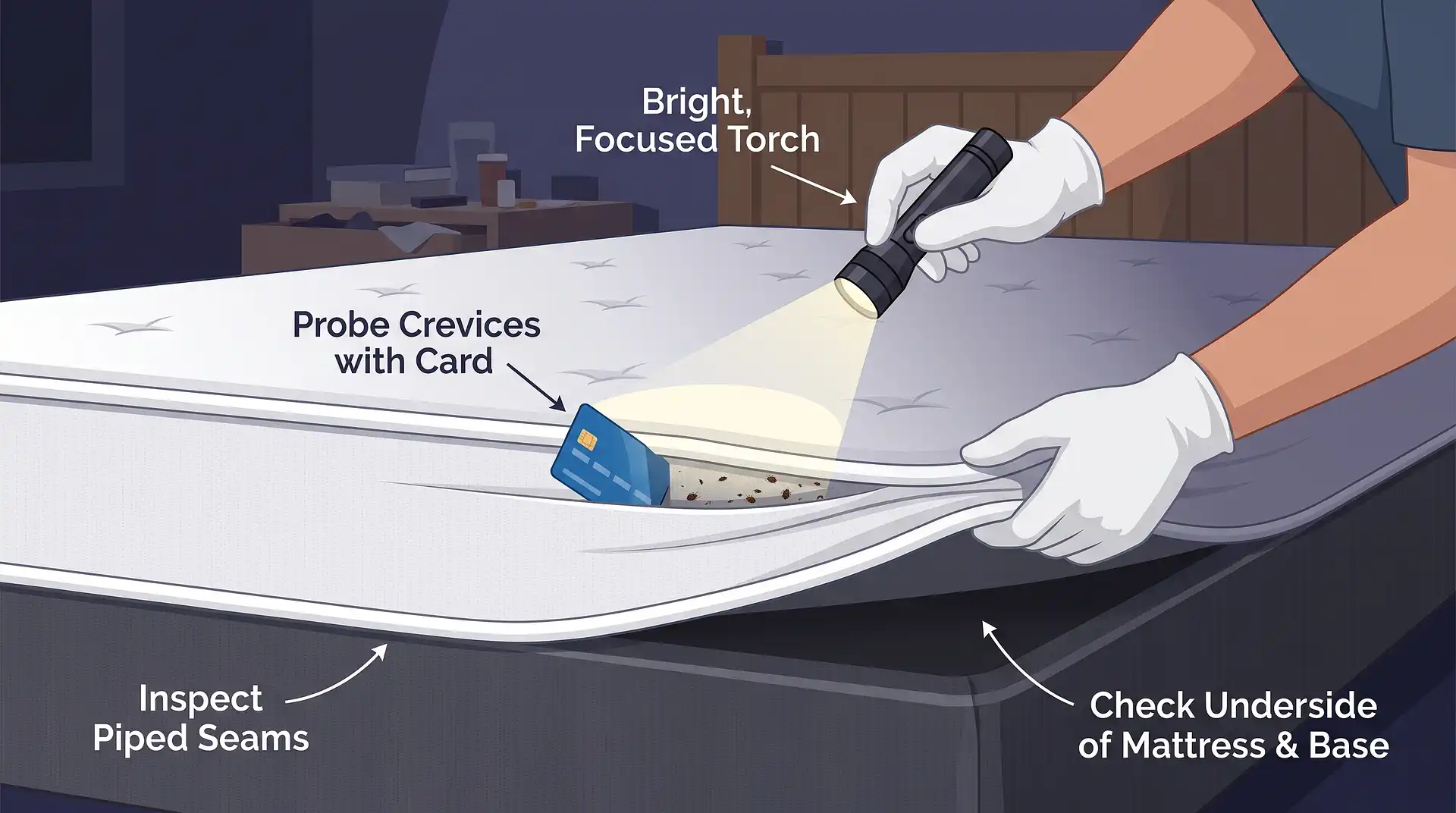
The mattress is one of their primary harborage locations, particularly at seams, piping, tags and labels, and the fold where the mattress meets the base. Use a torch and a white card or old credit card to examine these areas closely.
What to look for:
Faecal spots. Small dark brown to black marks, one to two millimetres across, that tend to bleed into fabric like ink from a felt-tip pen. Found along mattress seams, piping and labels, and on the headboard and bed frame. This is often the first and most reliable sign of an active infestation.
Cast skins. Translucent, shell-like casings that retain the shape of the bug. Bed bugs moult five times as nymphs before reaching adulthood, each time leaving a cast skin behind in their hiding places. These accumulate and are easier to spot than the bugs themselves.
Eggs and nymphs. Eggs are white, about one millimetre long, and are usually found in clusters in protected crevices. Nymphs are smaller, paler versions of the adult and are visible to the naked eye though easy to miss.
Blood stains on bedding. Small rust-coloured marks where bugs have been crushed after feeding, or where blood has transferred during the night.
Live bugs. Adults and nymphs are visible but quick to retreat into hiding. A slow, methodical inspection with a bright torch is more likely to find them than a quick visual sweep.
Bites, with an important caveat. Bed bug bites typically appear as small itchy red welts, often in clusters or a rough line on exposed skin. However, research suggests that up to 30% of people show no visible skin reaction at all. The absence of bites does not rule out an infestation. If other signs are present, treat it as a confirmed infestation regardless of whether anyone in the household has been bitten.
The one thing you must not do when you find them
Do not move to another bedroom.
This is the most common and most damaging response people make when they discover bed bugs. The impulse to sleep away from the infestation is entirely understandable but counterproductive: bed bugs track their host by carbon dioxide and body heat, and moving to a new room encourages them to spread through the property in search of you. What starts as one room becomes two or three in the weeks following.
Stay in the affected room. The infestation is contained there. Moving creates two problems where you had one.
Similarly, do not immediately dispose of the mattress and move it through the house. Bag it completely in a sealed mattress bag before moving if disposal is necessary, and take it straight outside without passing through other rooms.
What DIY steps genuinely help
These steps are valuable for reducing the infestation load and slowing spread while professional treatment is being arranged. They are not, on their own, a reliable route to eradication of an established bed bug population.
Step 1: Strip the bed and wash all bedding. Everything goes into the washing machine at 60°C or above. Bed bugs and their eggs die at temperatures above 45 to 50°C sustained throughout the item, and a hot wash at 60°C reaches this threshold reliably. Tumble dry on a high setting for at least 30 minutes.
Step 2: Bag clothing and soft items. Bag anything from the affected room that cannot be washed immediately into sealed black bin bags. This contains rather than eliminates.
Step 3: Vacuum the mattress thoroughly. Use a HEPA filter vacuum if available. Work slowly and methodically over the mattress surface, focusing on seams, folds, piping and labels. Then vacuum the bed frame, headboard, skirting boards and the floor around the bed. Bed bugs and eggs on surfaces can be physically removed this way.
Immediately after vacuuming: remove the vacuum bag or empty the canister into a sealed bag and dispose of it outdoors. A bag of live bed bugs inside the house is not an improvement.
Step 4: Reduce clutter in the room. Bed bugs exploit clutter for hiding places. Reducing it limits harbourage, makes inspection easier and makes subsequent treatment more effective.
Step 5: Do not use DIY insecticide sprays broadly. Most consumer insecticide sprays are ineffective against bed bug eggs and cause bugs to disperse further into the property rather than staying in a treatable area. Targeted use of diatomaceous earth along bed frame joints and skirting boards is a lower-risk DIY physical treatment that works by damaging the bugs' waxy outer coating, though it doesn't address the full population quickly.
Heat treatment: what temperature kills bed bugs
Bed bugs die when their body temperature exceeds 45°C sustained for a period. Pest control professionals use whole-room heat treatment that raises the ambient temperature to 56°C or above and holds it for several hours, which penetrates furniture, mattresses and wall cavities to kill bugs at every life stage.
A domestic steam cleaner reaches surface temperatures well above this threshold and kills bugs and eggs on direct contact. It is genuinely useful as a supplementary DIY treatment on the mattress surface and bed frame. Move the steam nozzle slowly and closely along seams and folds. Bed bugs retreat from steam so work methodically and don't allow them to escape into areas not being treated. The steam does not penetrate into the mattress interior, so it addresses surface populations only.
Washing at 60°C and tumble drying on a high setting achieves lethal temperatures for bedding and clothing. Freezing items at minus 18°C or below for at least four days is an alternative for items that cannot be washed.
Why professional pest control is usually necessary
This is the honest position and it's worth stating clearly rather than burying.
Bed bugs are one of the pest species most resistant to DIY eradication. Several factors explain why.
Eggs are hidden in protected locations that most DIY treatments don't reliably reach. An insecticide that kills adult bugs and nymphs may leave eggs intact to hatch within a week or two, which is why infestations that seemed cleared reappear within weeks of self-treatment.
Bed bugs have developed resistance to many of the active ingredients available in consumer products. Professional pest control companies use products and formulations not available over the counter, and apply them in a planned sequence that accounts for the lifecycle.
Multiple visits are usually required. A single professional treatment rarely eliminates all eggs. Two to three visits spaced to break the lifecycle — typically two to three weeks apart — are standard for complete eradication.
The infestation is rarely limited to the mattress. Bed bugs inhabit bed frames, headboards, skirting boards, soft furnishings, and in heavier infestations wall cavities and electrical outlets. Treating the mattress alone, by any method, doesn't address the wider infestation.
The British Pest Control Association (BPCA) provides a directory of accredited pest controllers in the UK. A contractor registered with the BPCA holds the appropriate qualifications and insurance.
After treatment: mattress cleaning and encasement
Once professional pest control treatment is complete, two further steps significantly improve the outcome.
Professional mattress cleaning. A treated mattress still contains residual debris: shed skins, faecal staining, dead bugs, and egg casings in the seams and folds. Professional mattress cleaning using hot water extraction removes this residue from the mattress surface and upper layers, improving hygiene and helping confirm that no active infestation remains visible in the pile and seams.
Instant Dry Carpet Cleaning provides professional mattress cleaning across England and Wales. This is a complementary service after professional pest control, not an alternative to it. A mattress clean after treatment makes a meaningful difference to both hygiene and peace of mind. Mattress cleaning is covered in more detail in the how to clean a mattress guide and the mattress stain removal guide on this site.
Mattress encasement. A properly fitted, bite-proof mattress encasement seals any bugs remaining in the mattress interior permanently inside. They cannot feed, cannot reproduce, and will die over time. The encasement also makes future inspection dramatically easier: signs of re-infestation appear on the smooth outer surface of the encasement rather than in the difficult-to-inspect seams of the mattress itself. Choose an encasement specifically rated as bed bug proof rather than a general waterproof protector.
Prevention
Inspect second-hand furniture before it enters your home. Second-hand mattresses and upholstered furniture are one of the primary routes of introduction. Inspect every seam, joint and fold with a torch before accepting any item. The how to clean a rug at home guide covers checking the underside of rugs and floor coverings, which can also harbour bed bugs brought in with second-hand purchases.
Inspect luggage and clothing after travel. Hotels are another primary route, particularly in cities with high tourist traffic. Inspect the mattress seams and headboard of any hotel room on arrival. On return, launder travel clothing before introducing it to bedroom wardrobes.
Keep bed frames away from walls where possible. This reduces the pathways bugs can use to access the mattress from the wall.
Use mattress encasements as a preventative measure. They don't prevent introduction, but they make any infestation dramatically easier to detect early.
Reduce clutter in bedrooms generally. Clutter provides more harborage and makes early detection harder.
FAQ Section
How do you know if you have bed bugs in your mattress? Check the mattress seams, piping, tags and labels with a bright torch. Look for small dark faecal spots that bleed into fabric like ink, translucent shed skins along the seams, and the bugs themselves. Blood stains on bedding are also a sign. Note that up to 30% of people show no visible bite reaction, so the absence of bites does not rule out an infestation.
What kills bed bugs in a mattress? Sustained heat above 45°C kills bed bugs and their eggs. Washing bedding at 60°C and tumble drying on a high setting achieves this for textiles. A steam cleaner used slowly along mattress seams kills bugs on contact but doesn't penetrate into the mattress interior. Professional whole-room heat treatment is the most thorough method.
Can you get rid of bed bugs yourself? DIY steps reduce numbers and buy time but rarely eliminate an established infestation. Eggs are hidden in locations that most home treatments don't reliably reach, and bed bugs have developed resistance to many consumer insecticides. Professional pest control is usually necessary for complete eradication, typically over two to three visits.
Should I throw away my mattress if I have bed bugs? Usually not immediately and not without careful preparation. Moving an infested mattress through the property spreads the infestation. If the mattress needs to be disposed of, seal it completely in a mattress bag before moving it, and take it directly outside. Consult a pest controller before discarding, since in many cases the mattress can be treated and encased rather than replaced.
What should I do first when I find bed bugs? Strip the bed and wash all bedding at 60°C. Do not move to another bedroom — this spreads the infestation to a new room. Vacuum the mattress and bed frame thoroughly, dispose of the vacuum bag in a sealed bag outdoors, and arrange a professional pest inspection as soon as possible.
How long does it take to get rid of bed bugs? A professional treatment plan typically requires two to three visits over four to six weeks to break the bed bug lifecycle. DIY methods alone can take considerably longer with uncertain outcomes. The longer an infestation is left untreated, the more it spreads and the harder it becomes to eradicate.
Do mattress covers stop bed bugs? A properly fitted, bed-bug-proof mattress encasement seals any bugs inside permanently and makes future inspection easier by moving any signs of re-infestation from the difficult-to-inspect seams of the mattress onto a smooth, visible surface. They don't prevent an infestation from being introduced but are effective containment and monitoring tools after treatment.
Does vinegar kill bed bugs? No. Vinegar does not reliably kill bed bugs on contact and has no effect on eggs. It is widely suggested in DIY guides but gives bed bugs time to spread and lets the infestation grow while a false sense of action is taken.
Service Section
After professional pest control: mattress cleaning helps
A bed bug treatment eliminates the infestation. What it leaves behind is the residue: shed skins in seams, faecal staining, dead bugs and egg casings in folds and piping. Professional mattress cleaning after treatment removes this residue using hot water extraction, improving both hygiene and peace of mind.
This is a complementary step after pest control, not an alternative to it. Instant Dry Carpet Cleaning provides professional mattress cleaning across England and Wales, with a free survey and a fixed price before any work begins. Confirm with your pest controller that the treatment is complete and the product's re-entry period has passed before booking a clean.
Get your fixed quote in 60 seconds
Or call 07555 856988