How to Clean a Memory Foam Mattress
9 September 2026
Quick answer
Vacuum the surface first, then spot clean stains with a small amount of mild detergent in cold water, blotting rather than rubbing. Sprinkle bicarbonate of soda over the whole surface for odour, leave it for several hours, then vacuum it off. Never soak memory foam and never use a hairdryer or radiator to speed up drying. Let it air dry fully, ideally standing up with airflow on both sides, before putting bedding back on.
Memory foam behaves differently to a normal spring mattress, which is why a lot of general "how to clean a mattress" advice does not quite fit it. If you want the full method with reasons, keep reading.
Why memory foam is different to clean
Memory foam is an open cell material. It is designed to absorb pressure, and unfortunately that means it also absorbs liquid very easily. Once moisture gets past the surface layer it does not sit there the way it would on a firmer spring mattress, it spreads sideways and downwards through the cell structure. This is why over wetting a memory foam mattress is one of the easiest ways to damage it permanently.
The team at Instant Dry Carpet Cleaning sees this most often with mattresses that were "cleaned" with far too much water and never dried out properly afterwards. The stain often lifts fine. The problem shows up two or three weeks later as a musty smell that will not go away, which usually means moisture is still trapped deep in the foam.
The other thing that makes memory foam different is heat sensitivity. The material can soften and lose its shape if it gets too warm, so anything involving a hairdryer, heater or tumble dryer sheet trick is a bad idea, even though those tricks are sometimes fine on other fabrics.
What you will need
A vacuum cleaner with an upholstery attachment
A spray bottle
Mild liquid detergent (washing up liquid works)
Cold water
Clean white cloths or towels
Bicarbonate of soda
An enzyme cleaner, only needed for urine, blood or vomit
Distilled white vinegar, for odour only, used sparingly
Do a colour fastness check first if the mattress cover has any colour or pattern. Dampen a white cloth, press it onto a hidden edge of the mattress for thirty seconds, and check that no dye transfers before treating a visible stain.
Step by step: general cleaning and deodorising
1. Strip the bed completely Remove sheets, mattress protector and any topper. Wash these separately following their own care label.
2. Vacuum the whole mattress Use the upholstery attachment and work in slow, overlapping passes. Do the top, the sides, and if you can lift it, the underside too. This lifts dust, skin cells and hair before you introduce any moisture, which matters because wet dust just turns into a paste that is harder to remove.
3. Spot check any visible marks Note where the actual stains are so you can treat them individually rather than soaking the whole mattress.
4. Mix a light detergent solution A few drops of mild detergent in a cup of cold water is enough. Put it in a spray bottle rather than pouring it directly onto the mattress.
5. Lightly mist, do not soak Spray a light mist onto the stained area only. You want the surface damp, not wet through.
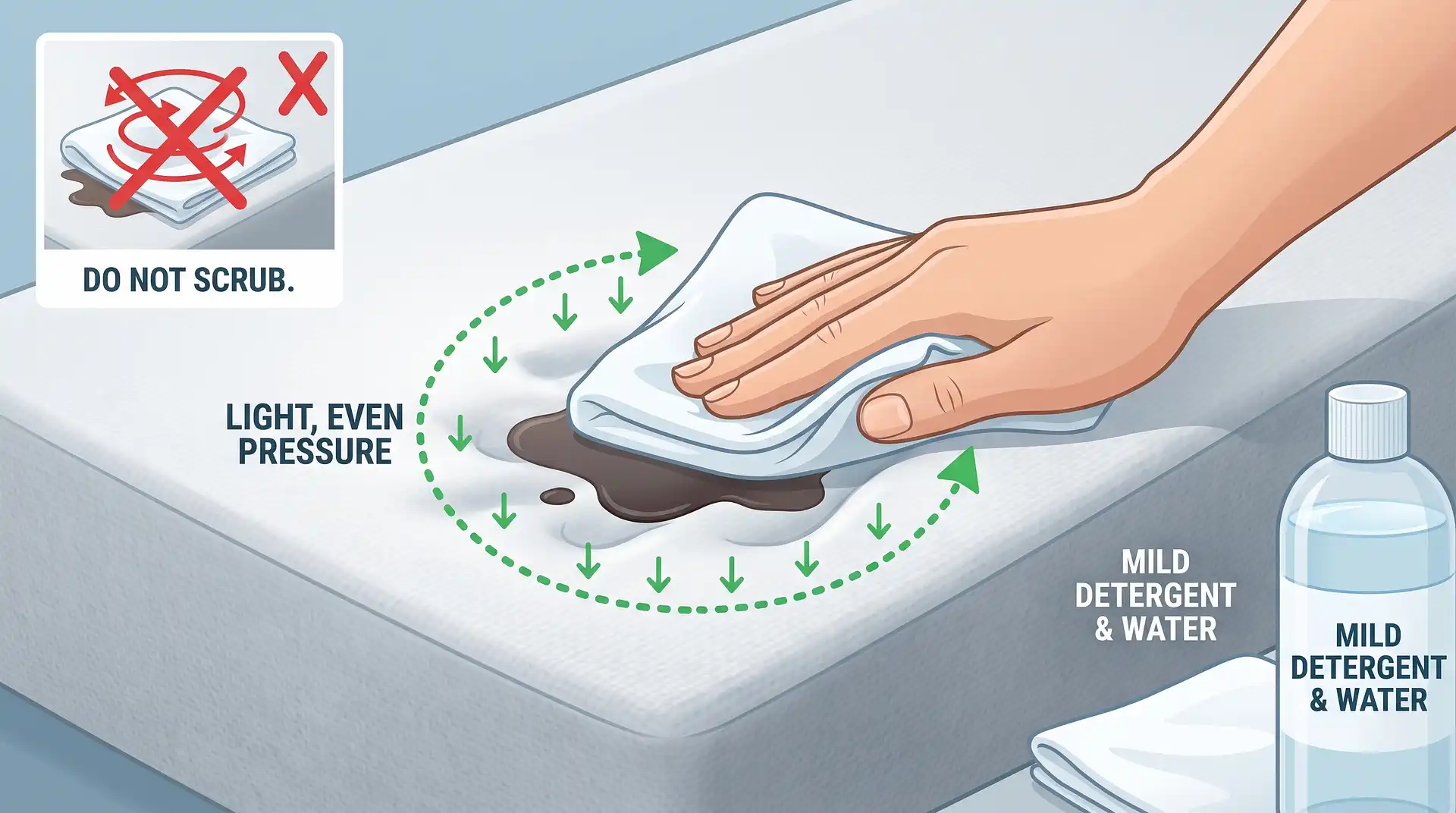
6. Blot, never rub Press a clean white cloth onto the area and hold it there for a few seconds before lifting. Move to a dry section of the cloth and repeat. Rubbing spreads the stain sideways and pushes it further into the foam, which is the opposite of what you want.
7. Rinse with a clean, barely damp cloth Blot again with a cloth dampened in plain cold water to lift any leftover detergent, then blot with a dry towel to draw out as much moisture as possible.
8. Deodorise with bicarbonate of soda Once the treated area is no longer wet to the touch, sprinkle bicarbonate of soda evenly across the whole mattress surface, not just the stain. Leave it for at least four hours, overnight if you can. It absorbs both moisture and odour without adding any liquid.
9. Vacuum off thoroughly Go over the entire surface again with the upholstery attachment until all the powder is gone.
Halfway through a job like this, most people are tempted to rush the drying stage to get the bed back together. That is where things usually go wrong, so the drying section below is worth reading properly rather than skipping.
Removing specific stains
Different stains need different first moves. Treating everything the same way is the most common reason a stain sets in rather than lifting out.
Protein stains (blood, urine, sweat, vomit, milk) Always use cold water, never warm or hot. Heat cooks the protein and binds it into the fibres permanently, which is why a stain that looked like it was lifting can suddenly become impossible to shift if hot water gets used at any point. For urine and blood specifically, an enzyme cleaner works better than detergent because it breaks the protein down rather than just diluting it. Apply according to the product's instructions, let it dwell for the time stated, then blot dry.
Oil and grease based marks A small amount of washing up liquid mixed with cold water is usually enough, since washing up liquid is designed to break down grease. Blot rather than rub, and expect to repeat the process two or three times for an older mark.
General dirt, sweat rings and light discolouration The detergent and water method above is usually sufficient. These respond well to the bicarbonate of soda step too, since a lot of general discolouration is actually trapped moisture and body oils rather than a true stain.
Older, set in stains may lighten rather than disappear completely with DIY methods. If a mark has been there for months, it has likely worked its way deeper into the foam than surface cleaning can reach.
Drying memory foam safely (the part most guides skip)
This is the step that decides whether the whole job was worth it. Memory foam cannot dry from the inside out. If the surface looks and feels dry but the centre of the foam is still damp, you can seal moisture inside the mattress the moment you put a fitted sheet back on, and that is exactly the condition mould needs to start growing where you cannot see it.
To dry it properly:
Stand the mattress on its side if you can, so air reaches both faces
Open a window or run a fan pointed at the treated area
Avoid direct sun for long periods, since UV and heat both degrade foam over time
Press a dry towel firmly against the area every hour or so in the first few hours to pull out extra moisture
Do not put bedding back on until the area feels completely dry, not just on the surface but a few centimetres in if you press firmly
As a rough guide, a lightly spot cleaned area usually needs four to six hours of good airflow. A more heavily treated area can take twenty four hours or more. If you are ever unsure, wait longer rather than less. A dehumidifier in the room speeds this up considerably if the weather is damp or humid.
If the mattress still smells musty two or three days after it felt dry to the touch, that is usually a sign moisture is still trapped inside, and it is worth getting it properly assessed rather than covering the smell with another round of bicarbonate of soda.
What not to do
Do not pour water directly onto the mattress
Do not use a washing machine, steam cleaner set to high heat, or a tumble dryer on any part of it
Do not use a hairdryer or place it against a radiator to speed up drying, the heat can soften and distort the foam
Do not use bleach or hydrogen peroxide, both carry a real risk of discolouring the cover and can weaken the foam structure underneath
Do not scrub a stain, however tempting it is, since it pushes the mark deeper rather than lifting it out
Do not skip the colour fastness test on a mattress with any coloured or patterned cover
When to call a professional
DIY cleaning handles most day to day marks and general freshening up well. It is worth calling in a professional mattress clean when:
The stain covers a large area rather than a small spot
The mattress has been wet through, whether from a spill, a leak, or a child or pet accident that soaked in before you found it
There is a musty smell that persists after the mattress has fully dried
You can see or suspect mould, which sometimes shows as small dark spots rather than an obvious patch
Professional equipment uses far less moisture and extracts far more of it than a spray bottle and a cloth, which matters enormously on a material that struggles to dry from the inside. The Instant Dry Carpet Cleaning team uses low moisture methods designed specifically for foam and upholstery, so the mattress is safe to sleep on again the same day rather than sitting propped against a wall for two days waiting to dry out.
If you are dealing with a stubborn stain elsewhere in the bedroom while you are at it, the approach for cleaning a fabric sofa uses very similar blotting and low moisture principles, since fabric upholstery has the same drying constraints as foam. And if the mattress issue turned out to be blood rather than general staining, our dedicated guide on getting blood out of a mattress goes into the enzyme cleaning method in more detail. For rugs in the same room that need a deeper refresh, our guide on cleaning a rug with a steam cleaner covers a method that is safe for most rug types but should never be used on memory foam itself.
Once your mattress is clean, a mattress protector is the simplest way to stop this happening again, since it catches spills before they reach the foam at all.
For anything beyond a light spot clean, or if you are simply not confident treating it yourself, Instant Dry Carpet Cleaning can assess and treat the mattress professionally, with low moisture methods built for foam.
Frequently Asked Questions
Can you get memory foam mattresses wet? A little dampness from spot cleaning is fine as long as it dries out fully. Soaking it through is not, since memory foam holds onto moisture far longer than it looks like it should, which raises the risk of mould developing inside the foam where you cannot see it.
Can you steam clean a memory foam mattress? Home steam cleaners are generally too hot and put too much moisture into the foam, so they are best avoided. Professional low moisture cleaning is a safer option if the mattress needs more than a light spot clean.
How long does memory foam take to dry after cleaning? A light spot clean usually needs four to six hours with good airflow. A larger or wetter area can take twenty four hours or more. Press firmly with a dry towel to check, since the surface can feel dry while the foam underneath is still damp.
Why does my memory foam mattress smell even after cleaning? This is usually trapped moisture rather than a stain that was missed. If the smell persists after a few days of drying, it is worth having the mattress checked for damp or early mould inside the foam.
Can I use vinegar on a memory foam mattress? In small amounts for odour, yes, but it is not a disinfectant and it will not lift a protein based stain like urine or blood on its own. An enzyme cleaner is a better choice for those.
Is it safe to use bicarbonate of soda on every mattress clean? Yes, it is one of the safest steps in this whole process. It only adds a dry powder, not moisture, so there is very little risk involved. Just make sure it is fully vacuumed off afterwards.
How often should I clean a memory foam mattress? A light vacuum and deodorise every one to two months keeps most mattresses in good condition. Stains should always be treated as soon as they happen rather than left.
Can I flip a memory foam mattress to help it dry? Only if the manufacturer's care label allows flipping that particular mattress, since many memory foam mattresses are one sided by design. Standing it on its side is usually a safer way to get airflow to both faces without flipping.
Service Section
If your memory foam mattress needs more than a spot clean, whether that is a large stain, a full soak through, or a smell that will not shift, Instant Dry Carpet Cleaning offers professional low moisture mattress cleaning across England and Wales.
Get a free quote: instantdrycarpetcleaning.co.uk/ Call or WhatsApp: 07555 856988