How to Dispose of a Mattress
15 August 2026
Quick answer: A mattress cannot go in your household bin, and leaving one at the kerb without a booked collection is fly-tipping. Your legal routes are council bulky waste collection (commonly £15 to £60 depending on the authority), a household waste recycling centre if you can transport it, charity or reuse if the mattress is nearly new with its fire label intact, retailer take-back when buying a replacement, or a licensed waste carrier. If you pay someone to take it, check they're on the Environment Agency's public waste carrier register and keep the waste transfer note, since the legal responsibility stays with you if it's later fly-tipped.
Before any of that, one question worth asking.
First, does it actually need replacing?
Every other guide to this topic is written by a company that makes money when you dispose of your mattress. Worth knowing before you read any of them, including the cost comparisons further down this page.
A mattress that's genuinely finished, sagging in the middle, springs you can feel through the surface, visible structural damage, or simply past the age where it's supporting you properly, needs replacing and no amount of cleaning changes that.
A mattress that's stained, smells stale, or looks unpleasant is a different situation. Those are surface and hygiene problems, and they're often fixable at a fraction of replacement cost. Old sweat marks, a one-off spill, a pet accident, general accumulated soiling, none of these mean the mattress has failed structurally.
The rough test: press down firmly across the surface in several places. If the support feels even and it springs back, the mattress is structurally sound and you're dealing with a cleaning problem. If it sags, feels uneven, or you can feel the springs, it's a replacement problem.
If it's a cleaning problem, our guide to cleaning a mattress covers what you can do at home, and professional cleaning handles most of what home methods can't.
If it's genuinely finished, here's how to get rid of it properly.
The legal position, and why it matters
A mattress is classed as bulky waste by every UK local authority. It cannot go in a standard household bin, and it cannot be left at the kerbside, beside your bins, or in any public place without a booked collection. Doing so is fly-tipping.
Penalties are real. Fly-tipping can result in a fixed penalty notice, and prosecution in more serious cases can carry substantially higher fines. Fly-tipping is a significant and well-documented problem across England, and enforcement has been increasing rather than easing.
Your duty of care doesn't end when someone takes it away. If you pay a person or company to remove your mattress, you are legally required to make sure they're a licensed waste carrier. Check them against the Environment Agency's public waste carrier register in England, SEPA in Scotland, or Natural Resources Wales in Wales. Keep the waste transfer note afterwards as proof.
This matters practically, not just technically. If an unlicensed carrier takes your mattress and dumps it in a lane, and it's traced back to you, the liability can land on you rather than on them. A cheap cash quote from someone with a van and no paperwork is not a saving.
The six disposal routes compared
Route | Typical cost | Timeframe | Best for |
|---|---|---|---|
Council bulky waste collection | Commonly £15 to £60, varies by authority, some offer free collections to certain residents | Often one to three weeks | Most people, no transport needed |
Household waste recycling centre | Often free, though some sites charge for certain items | Same day, subject to booking | Anyone with a suitable vehicle |
Charity or reuse | Free | Varies | Nearly-new mattresses only, in practice rarely accepted |
Selling or giving away | Free, or small return | Varies | Genuinely good condition mattresses |
Retailer take-back | Often included or a small fee with a new mattress purchase | On delivery | Anyone buying a replacement |
Licensed waste carrier | Varies, commonly from around £50 upward | Often same or next day | Urgent removal, no transport, or upstairs collection |
Council bulky waste collection
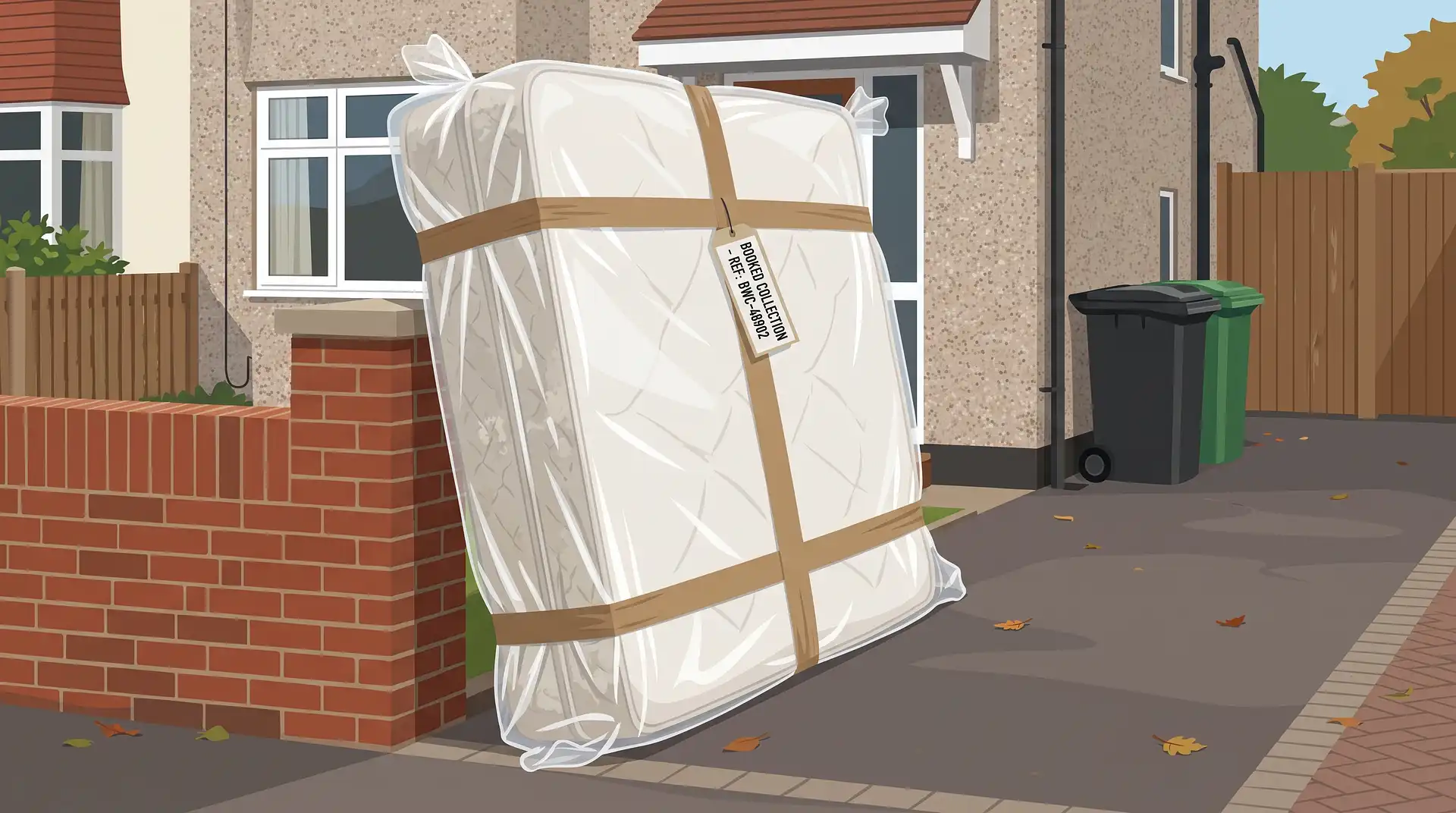
The most common route. Book through your local council's website, choose an available date, and put the mattress out as instructed on the morning of collection.
Points that catch people out: you usually have to get the mattress to the kerbside yourself, since collection teams generally won't enter your property. Waiting times of one to three weeks are common. Fees vary considerably between authorities, and some councils offer free bulky collections to certain residents, so check yours specifically rather than assuming.
Keep it dry. Many councils require mattresses to be clean and dry for hygiene reasons, and a mattress left out overnight in the rain can be refused, or become unrecyclable even if it is collected.
Household waste recycling centre
Usually free and usually same-day, if you have a vehicle that can take a mattress and a site that accepts them.
Most sites now require advance booking, and many operate vehicle restrictions, particularly on vans and trailers, which sometimes need a separate permit. Check your council's site before setting off. Wrapping the mattress in plastic for transport is worth doing and is required by some sites.
Charity donation and reuse
Worth trying, but manage your expectations, because most guides oversell this option considerably.
In practice, relatively few charities now accept mattresses at all, largely for hygiene and fire safety compliance reasons. Where they do, they generally require the mattress to be in near-new condition, free of stains, and crucially, to still have its permanent fire safety label attached.
That label matters more than people realise. UK upholstered furniture and mattresses carry a permanent fire safety label, and without it a mattress generally cannot legally be resold or passed on by a charity. If you've cut yours off because it was scratchy or visible, the donation and resale routes are closed to you.
Reuse organisations and furniture reuse networks are sometimes more flexible than high street charity shops. Worth a call before assuming.
Retailer take-back
If you're buying a replacement, ask about take-back at the point of purchase. Many UK mattress retailers will remove the old mattress on delivery, either included in the price or for a modest fee. It's usually the least effort route available and it's easy to forget to ask about.
Professional removal by a licensed waste carrier
The convenience option. A licensed carrier collects from inside your property, does the lifting, and disposes of it correctly. Costs more than the council route but is generally faster and involves no heavy lifting down stairs.
Check the licence, get the waste transfer note, and be wary of unusually cheap quotes from carriers who can't produce registration details.
What happens to a recycled mattress
Worth knowing, because it affects how you prepare it.
A mattress is a composite object: steel springs, polyurethane foam, cotton and polyester textiles, and sometimes latex or memory foam. At a specialist facility these are separated and processed through different routes, with steel recovered for reuse and foam shredded and repurposed. A substantial proportion of a mattress can be recycled when it reaches the right facility.
What stops that happening: water damage, heavy contamination, and infestation all limit or prevent recycling. This is the practical reason for keeping a mattress dry before collection. One night out in the rain can move a recyclable mattress into the landfill stream.
7. FAQ Section
Can you put a mattress in your household bin? No. Mattresses are classed as bulky waste by every UK local authority and won't fit standard collections. They must go through a council bulky waste service, a household waste recycling centre, or a licensed waste carrier.
Is it illegal to leave a mattress outside your house? Leaving a mattress at the kerb or in a public place without a booked collection is fly-tipping under UK law, and can result in a fixed penalty notice or, in more serious cases, prosecution.
How much does it cost to dispose of a mattress in the UK? Council bulky waste collection commonly falls between £15 and £60 depending on the local authority, and some councils offer free collections to certain residents. Household waste recycling centres are often free. Licensed waste carriers typically start from around £50. Check your own council's fees rather than relying on a national figure.
How do I dispose of a mattress for free? A household waste recycling centre is usually free if you can transport it. Some councils offer free bulky waste collections, particularly to residents receiving certain benefits. Retailer take-back is sometimes included when buying a replacement.
Do charities take old mattresses? Rarely, in practice. Most charities won't accept mattresses at all for hygiene and fire safety reasons, and those that do generally require near-new condition with the permanent fire safety label still attached. Furniture reuse organisations are sometimes more flexible than high street charity shops.
Can you put a mattress in a skip? Many skip hire companies exclude mattresses or charge extra for them, since they need separate processing. Check with the provider before assuming, and never add one to a skip you haven't hired yourself.
How do I know if a waste carrier is licensed? Check them against the Environment Agency's public waste carrier register in England, SEPA in Scotland, or Natural Resources Wales in Wales. Ask for the registration number and keep the waste transfer note after collection, since your legal responsibility for the waste continues if it's later dumped.
Can a mattress be recycled? Most can. Steel springs, foam and textiles are separated and processed through different routes at specialist facilities. Water damage, heavy contamination and infestation all reduce or prevent recyclability, which is why keeping it dry before collection matters.
Should I clean my mattress or replace it? Press firmly across the surface in several places. If support feels even and it springs back, the mattress is structurally sound and stains or smells are a cleaning problem rather than a replacement one. If it sags, feels uneven, or you can feel springs through the surface, it's finished and needs replacing.