How to Clean a Mattress
13 August 2026
Quick answer: Strip the bed and wash all bedding at 60°C or above. Vacuum the mattress thoroughly with an upholstery attachment, including seams and sides. For general freshening and odour, sprinkle bicarbonate of soda across the surface, leave it at least half an hour, then vacuum off completely. For stains, spot clean only, using a barely damp cloth and a mild detergent solution, never pouring liquid onto the mattress. Use cold water on protein stains such as blood, sweat and urine, since heat sets them permanently. Then dry it thoroughly with good ventilation before remaking the bed, because moisture trapped inside a mattress core is the one mistake you cannot easily undo.
You spend roughly a third of your life on your mattress, and unlike almost anything else in the house, it collects contamination continuously rather than occasionally. Perspiration, shed skin cells and natural body oils pass through bedding into the mattress every night. That's the ongoing problem, and it's a different problem from the occasional spill or stain most cleaning guides focus on.
It's also the single most difficult item in a home to clean safely, for one specific reason that's worth understanding before you start.
Why a mattress is the hardest thing in your house to clean safely
Everything else you clean either has a surface that dries into open air, like a carpet, or an interior that can at least be propped up and ventilated, like a sofa cushion.
A mattress has neither. It's a thick, enclosed structure of foam, springs or fibre fill inside a sewn cover, lying flat on a base with restricted airflow underneath. Water that soaks through the cover reaches material that cannot dry from the inside out, and there's no practical way to get air to it. A mattress core that stays damp can develop mould or mildew inside where you won't see it, and you'll typically only find out weeks later when it starts to smell, at which point the mattress often can't be recovered.
This is the same principle that applies to sofa cushions, covered in our guide to cleaning a fabric sofa, but a mattress is the extreme version of it. Thicker, heavier, harder to move, harder to ventilate, and used for eight hours a night.
Everything that follows is built around that constraint. Minimal moisture, spot cleaning rather than surface-wide wet cleaning, and thorough drying every time.
Check the care label first
Mattress manufacturers vary considerably in what they permit, and some are notably stricter than general cleaning advice suggests.
Several UK manufacturers advise against vigorous cleaning methods, harsh chemicals or heavy moisture on their own products, and some memory foam mattresses come with covers that look removable but carry instructions advising against removing and washing them. General cleaning guidance and your specific manufacturer's guidance can genuinely conflict, and where they do, the manufacturer's instructions take precedence, both because they know their own construction and because ignoring them can affect your warranty.
Check the label, and check the manufacturer's care guide online if the label is unclear.
The dry method, which covers most of what a mattress needs
For routine maintenance, and for anything short of an actual stain, this is the whole job. No moisture, no risk.
Step 1: Strip the bed and wash everything
Sheets, pillowcases, duvet cover and mattress protector all go in the wash. Washing at 60°C or above is the standard recommendation for reducing dust mites and allergens, since lower temperatures don't reliably deal with them. Check individual labels first, since not everything tolerates a 60°C wash.
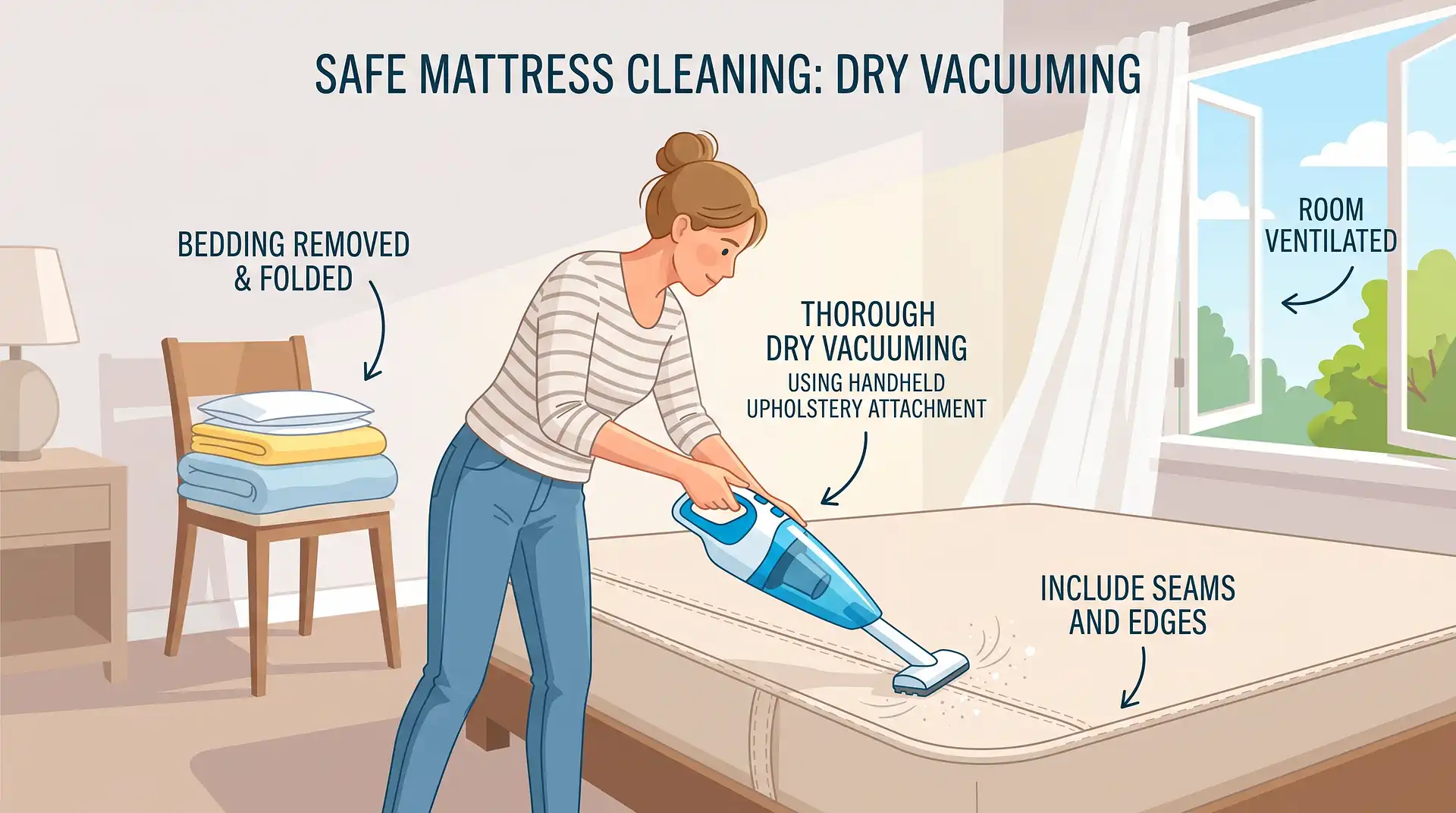
Step 2: Vacuum thoroughly
Use the upholstery attachment, and make sure it's clean before it touches the mattress. Work systematically across the whole surface, then go back over the seams, piping and sides with a crevice tool, since that's where skin cells and dust collect most heavily.
Vacuum the underside too if the mattress is double sided or you're flipping it anyway, and vacuum the base and the floor under the bed while you're there. It makes a noticeable difference if anyone in the house has allergies.
Step 3: Bicarbonate of soda for odour
Sprinkle a light, even layer across the whole surface. Leave it at least thirty minutes, and several hours is better for a persistent smell. It absorbs residual moisture and neutralises odour rather than masking it.
Step 4: Vacuum it off completely
Go over the whole surface more than once. Bicarb left behind feels gritty and will end up in your bedding.
Step 5: Rotate or flip
Rotate head to toe if the mattress is single sided, or flip it if it's designed to be flipped. This evens out wear and is worth doing every few months regardless of cleaning.
For most mattresses, done every few months, that's genuinely enough.
Wet spot cleaning, step by step
Only for actual stains, and only on the stained area, never across the whole mattress.
Step 1: Test on a hidden area first
The side panel near the base, or an area that will sit under the bed frame, works. Apply your solution, let it dry fully, and check for any colour change or watermarking before going near a visible area.
Step 2: Mix a mild solution
A small amount of clear, uncoloured washing up liquid in cold or lukewarm water is enough. Don't make it stronger, since detergent residue left in a mattress cover stays tacky and attracts dirt.
On the hydrogen peroxide recipes you'll find online: a mix of hydrogen peroxide, bicarbonate of soda and washing up liquid appears in a lot of mattress cleaning advice. Peroxide does work on protein stains, but it's an oxidising agent with a genuine bleaching risk, and mattress covers vary in colour-fastness. If you use it at all, test on a hidden area first, dilute it heavily, use it only on a small stained area rather than broadly, and wear gloves with the window open. On a stain that's already faded to the point of being cosmetic, it isn't worth the risk to the cover.
More generally, don't mix cleaning products beyond a single simple solution, and never combine anything with bleach.
Step 3: Apply to the cloth, not the mattress
This is the technique point that matters most. Dampen a white cloth, wring it out well, and work with that. Never spray or pour liquid directly onto a mattress, since you have no control over how far it soaks in.
Use white cloths only, to avoid dye transfer.
Step 4: Blot, don't scrub
Work from the outer edge of the stain inwards. Blot, don't rub, since rubbing drives the stain deeper into the layers and damages the cover fabric.
Step 5: Rinse and lift
Go over the area with a second cloth dampened with plain cold water only, to lift detergent residue. Then press a dry towel firmly onto the area to draw out as much moisture as possible.
Step 6: Dry thoroughly before anything else
Covered in its own section below, because this is the step that decides whether the whole exercise was worth doing.
Stain by stain on a mattress
Blood. Cold water only, never warm or hot. Blood contains a protein that behaves like egg white under heat, so hot water cooks it and binds it permanently to the fibre. Blot with a cold, damp cloth, repeat patiently, and expect several passes. Our full guide to removing blood covers the method in more detail, including hygiene precautions, which apply just as much to a mattress as to a carpet.
Urine. An enzyme-based cleaner is the right tool, since it breaks down the compounds causing the odour rather than covering them. Detergent alone lifts the visible mark and leaves the smell behind, which is why urine stains so often seem to come back. Blot up as much as possible first, apply the enzyme cleaner following its stated dwell time, then blot and dry thoroughly.
Sweat and general yellowing. This is protein and body oil built up over time rather than a discrete stain, so it responds better to patient repeated treatment than to one aggressive attempt. A mild detergent solution and cold water, applied sparingly and blotted, lightens it. Complete removal of long-established yellowing often isn't achievable, and it's worth knowing that before you escalate to something harsher and damage the cover.
Vomit. Remove solids first, then treat as a protein stain with cold water and an enzyme cleaner. Ventilate well throughout.
Drink spills. Blot immediately and treat with cold water and mild detergent. For tea and coffee specifically, the tannin behaves the same way it does on carpet, covered in our coffee stain guide, and cool water is again correct rather than warm.
Dust mites, allergens and what actually helps
Worth being accurate about this, because a lot of mattress cleaning content overstates what cleaning alone achieves.
Dust mites live in bedding and mattresses, feed on shed skin cells, and it's their waste particles rather than the mites themselves that trigger allergic reactions in people sensitive to them. They're a normal part of almost every home and eliminating them entirely isn't a realistic goal.
What genuinely helps:
Washing bedding at 60°C or above, regularly. This is the single most effective routine measure.
A mattress protector, which puts a washable barrier between you and the mattress.
Regular vacuuming of the mattress, base and floor beneath.
Lowering bedroom humidity. This is the one most guides miss entirely. Dust mites need moisture from the air to survive, and they struggle in drier conditions. In UK homes, particularly with windows kept shut through autumn and winter, bedroom humidity often sits comfortably in the range mites thrive in. Airing the room daily, using extractor fans, and drying laundry outside the bedroom all help more than most people expect.
What helps less than claimed: bicarbonate of soda is good for odour and moisture absorption but isn't a mite treatment. Sunlight airing helps with moisture but isn't a reliable elimination method.
If someone in the house has diagnosed asthma or a dust mite allergy, it's worth speaking to a GP or an allergy specialist about what's appropriate for their specific situation, since allergen management is genuinely medical territory rather than a cleaning question alone.
Drying properly, the step that matters most
If you've used any moisture at all, this is where the job is won or lost.
Ventilate hard. Open windows. Use a fan directed at the mattress. If the weather allows and you can manage it physically, standing the mattress on its side against a wall in a well ventilated room dramatically improves airflow to both faces, and is far more effective than leaving it flat.
Avoid direct heat. No hairdryers, no positioning it against a radiator. Direct heat dries the cover quickly while leaving the interior damp, which is the exact failure mode you're trying to avoid, and it can damage foam.
Give it much longer than you think. Several hours minimum, and longer for anything more than a small spot treatment. Clean in the morning so it has the full day.
Don't remake the bed until it's completely dry, and not just dry to the touch. Press a dry hand firmly into the treated area, and if there's any coolness or dampness at all, leave it longer.
Prevention, and why a protector changes everything
A good mattress protector is worth more than any cleaning routine, because it moves the problem from something you can't wash to something you can. Perspiration, skin oils and most spills stop at the protector, which goes in the washing machine at 60°C alongside your bedding.
Alongside that: air the bed each morning by folding the duvet back for a while before making it, rather than sealing overnight moisture in immediately. Rotate or flip every few months. Keep the bedroom ventilated. Those habits together mean the mattress itself rarely needs more than a vacuum and a bicarb refresh.
When to call a professional
DIY handles routine mattress care well. Consider professional mattress cleaning when:
There's a significant urine, blood or biological stain, particularly one that's soaked deep rather than sitting on the surface
A smell persists after proper cleaning and thorough drying, which can mean contamination or moisture in the core
Someone in the household has significant allergies and you want a deeper clean than surface vacuuming achieves
The mattress hasn't been cleaned in years and general soiling has built up throughout
A previous cleaning attempt has left the mattress damp and you're now concerned about what's happening inside it
Professional mattress cleaning uses controlled extraction that removes far more moisture and soil than blotting by hand, which matters more here than anywhere else in the house given how badly a mattress handles residual moisture.
8. FAQ Section
How do you clean a mattress at home? Strip and wash all bedding at 60°C, vacuum the mattress thoroughly with an upholstery attachment including seams and sides, then sprinkle bicarbonate of soda across the surface, leave it at least half an hour and vacuum off completely. Spot clean stains only, using a barely damp cloth rather than pouring liquid on, and dry thoroughly before remaking the bed.
How often should you clean a mattress? Vacuum and refresh every few months as routine, alongside washing bedding weekly and the mattress protector regularly. Spot clean stains as they happen rather than letting them set.
Can you use hydrogen peroxide on a mattress? It works on protein stains but carries a real bleaching risk, and mattress covers vary in colour-fastness. If you use it, test on a hidden area first, dilute heavily, apply only to the stained spot rather than broadly, and ventilate the room. For faded, purely cosmetic marks it generally isn't worth the risk.
How do you get urine out of a mattress? Blot up as much as possible, then use an enzyme-based cleaner, which breaks down the compounds causing the odour rather than masking them. Follow the product's stated dwell time, blot again, and dry the area thoroughly. Detergent alone removes the mark but leaves the smell.
How do you get blood out of a mattress? Cold water only, never warm or hot, since heat sets the protein permanently. Blot with a cold damp cloth working from the outside of the stain inwards, and repeat patiently over several passes rather than scrubbing.
How do you get sweat stains out of a mattress? Patient repeated treatment with cold water and a mild detergent solution, applied sparingly and blotted rather than scrubbed. Long-established yellowing often can't be removed completely, and escalating to harsher products risks damaging the cover for limited cosmetic gain.
How do you get rid of dust mites in a mattress? Eliminating them entirely isn't realistic, but you can reduce them substantially. Wash bedding at 60°C or above, use a washable mattress protector, vacuum the mattress regularly, and lower bedroom humidity by airing the room daily, since dust mites depend on moisture in the air to survive.
How long does a mattress take to dry after cleaning? Several hours at minimum, and longer for anything beyond a small spot treatment. Ventilate well, stand the mattress on its side if you can, and never use direct heat. Don't remake the bed until it's completely dry all the way through, not just dry to the touch.
Can you clean a memory foam mattress the same way? Check the manufacturer's guidance first, since memory foam generally tolerates less moisture than sprung mattresses and some manufacturers advise against removing or washing the cover even when it appears removable. The dry method, vacuuming and bicarbonate of soda, is safe on memory foam and covers most routine needs.
Is it worth getting a mattress professionally cleaned? Worth considering for a significant biological stain, a smell that hasn't cleared after proper drying, allergy concerns needing more than surface cleaning, or a mattress that hasn't been cleaned in years. Professional extraction removes far more moisture than hand blotting, which matters more on a mattress than anywhere else given how poorly it handles residual damp.
Get your fixed quote in 60 seconds
Or call 07555 856988.