How to Steam Clean a Mattress Safely
7 October 2026
Would rather leave it to a professional? See our mattress cleaning in Manchester.
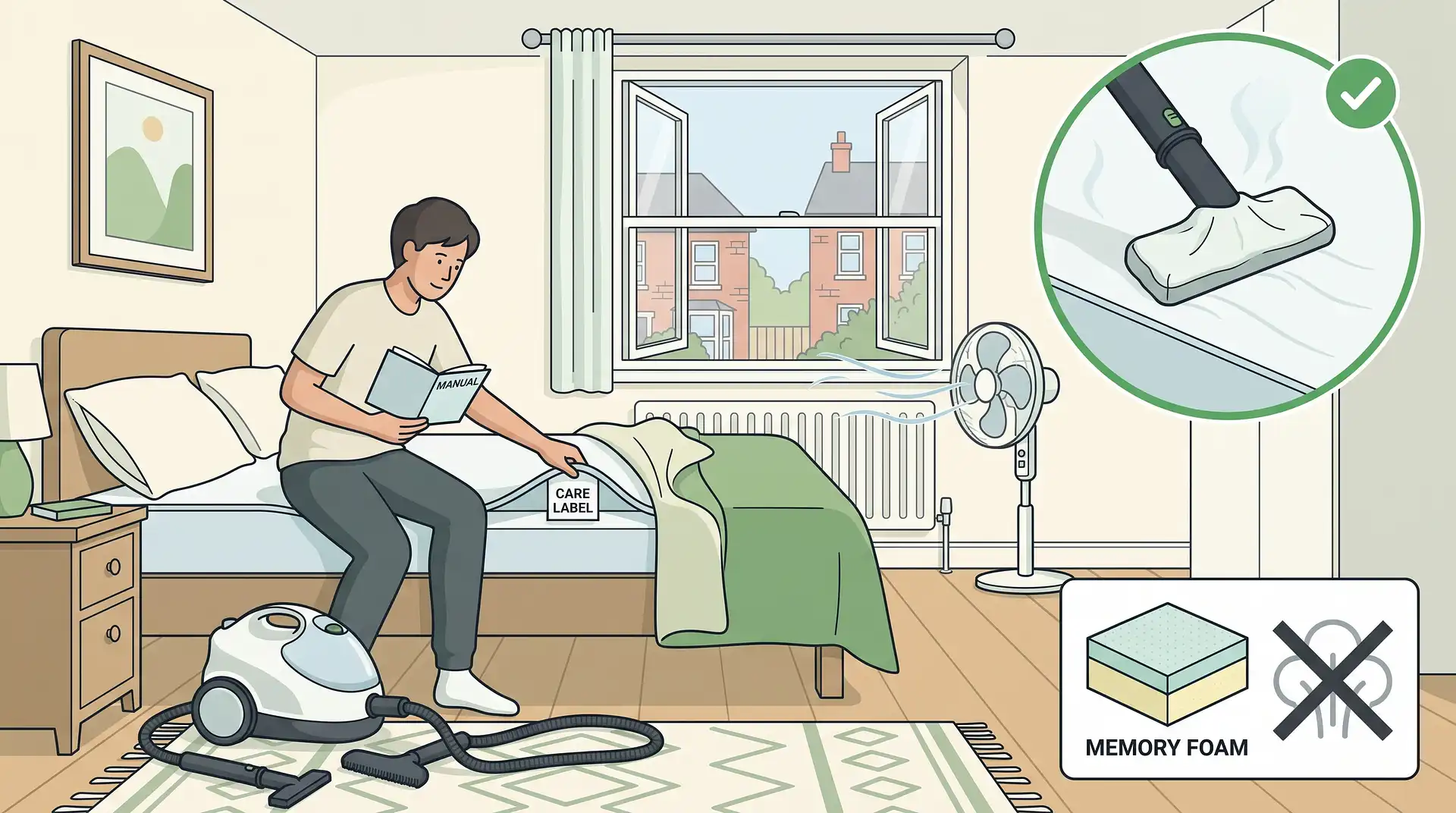
Quick answer: Steam clean a mattress only when the mattress manufacturer and your steam cleaner’s instructions allow it. Strip the bed, remove loose dirt using the approved method, test a hidden area and use the recommended textile attachment and settings. Keep treatment at the surface, avoid soaking the filling and let the mattress dry fully before replacing bedding. If the care instructions rule out steam or are unclear, use the permitted cleaning method instead.
A steam cleaner can help loosen surface dirt on suitable materials. However, a mattress has thick layers that can hold moisture, and heat can damage some covers and fillings. The safest starting point is the care guide for your exact model, even if a general cleaning article recommends steam.
Can you steam clean your mattress?
Check the mattress label, purchase details and manufacturer’s care instructions. Look for specific guidance on steam, heat, moisture and cleaning the cover. Permission to spot clean with a damp cloth does not automatically mean steam is allowed.
Also check the steam cleaner’s manual. A machine approved for sealed floors may be unsuitable for mattresses. A clothing steamer is not automatically a mattress cleaner, and a narrow jet nozzle can concentrate heat and moisture in one small area.
Mattress or condition | What to check before cleaning |
|---|---|
Memory foam or heat-sensitive layers | Do not steam unless the exact model’s instructions expressly permit it. TEMPUR specifically prohibits steam cleaning its TEMPUR Material. |
Hybrid or pocket-sprung mattress | Springs do not make the cover, foam or natural fillings heat-safe. Check the complete construction and care guide. |
Removable cover | Remove and wash it only if the maker permits this. A zip alone does not confirm that removal or washing is safe. |
Mould, a musty smell or deep wet contamination | Stop and arrange an assessment. Adding steam cannot establish that the inner mattress is clean or dry. |
If the instructions conflict, ask the mattress manufacturer before proceeding. A successful patch test can reveal visible damage, but it cannot override a restriction on steam or prove that the inner layers will tolerate it.
Steam cleaning and hot-water extraction explained
A true steam cleaner heats water and releases steam through a nozzle. Steam loosens dirt, which must then be collected with the approved cloth or attachment. Many household steam cleaners have no suction, so they do not remove liquid or dissolved soil from inside a mattress.
A hot-water extractor applies a cleaning solution and uses suction to recover liquid and loosened dirt. This method is sometimes called steam cleaning in adverts, although it works differently. Both methods need permission from the mattress maker and careful moisture control.
Check which machine you own before starting. A carpet shampooer, steam mop and upholstery extractor are not interchangeable. Choosing a suitable machine and attachment matters more than choosing a product described as a deep cleaner.
What you need before starting
The mattress care instructions and the steam cleaner’s manual
A steam cleaner explicitly suitable for the task, with its recommended textile attachment
Clean attachment cloths, where required by the manual
White absorbent towels
A vacuum with a clean upholstery tool, only if the mattress maker permits vacuuming
Ventilation and a safely positioned fan for drying
Another sleeping place if the mattress remains damp at bedtime
Start early enough to leave plenty of drying time. A damp room or thick comfort layers can make drying slower. If you cannot provide good airflow and leave the bed unused until it is dry, postpone wet cleaning.
Prefer a professional mattress clean?
How to steam clean a mattress step by step
Follow these steps only after both sets of instructions confirm that steam is suitable. Use any model-specific instructions in place of the general steps below.
1. Strip the bed and inspect the surface
Remove sheets, pillows, the duvet, protector and any separate topper. Wash and dry washable bedding according to its care label. A topper needs its own suitability check, even when the mattress below allows steam.
Inspect seams, the cover and accessible sides. If you find mould, damaged fabric or a wet area reaching into the filling, stop. Steam is not a reliable repair for deep contamination or structural damage.
2. Remove loose dust and debris
If vacuuming is allowed, use the attachment and suction level recommended by the mattress maker. Gently clean the surface, seams and sides without catching the fabric or using an aggressive rotating brush.
Some mattress covers need gentle brushing rather than vacuuming. Follow their instructions. Removing loose dirt before steam treatment helps prevent it from becoming damp residue on the cover.
3. Deal with stains separately
Steam is not a universal stain remover. Heat can make certain biological stains, especially blood, harder to remove. Fresh urine, vomit and other spills need suitable stain treatment and moisture removal before you consider general surface cleaning.
Use only a treatment approved for the mattress, and let it dry as directed. Do not steam over unknown cleaning residue. For everyday care and gentle spot treatment, see our guide on how to clean a mattress.
4. Prepare the machine and test a hidden area
Fill the reservoir with the type of water specified in the manual. Keep detergent, vinegar, fragrance and disinfectant out of a water-only steam tank. Fit the recommended attachment and clean cloth, then let the machine reach its ready state.
Test a small area on an inconspicuous section of the cover using the stated setting and distance. Let it dry fully, then check for colour transfer, water marks, shrinkage, roughness or a change in shape. Stop if any damage appears.
Unsure which cleaning method suits your mattress?
5. Work across the permitted surface
Treat small sections in a planned order so you can see which areas you have covered. Follow the manual’s directions for movement, steam output and nozzle distance. There is no single safe speed or temperature for every machine and mattress.
Keep treatment shallow and avoid repeated passes over the same patch. Do not push the head into the cover or hold a concentrated jet in one place. Change attachment cloths as directed when they become dirty or wet, switching off and allowing hot parts to cool before handling them.
Stop if liquid beads on the surface, the cover becomes soaked or the fabric changes. Do not continue steaming a stubborn mark to force it out. Treat sides or the underside only when the care instructions allow it, and never flip a one-sided mattress just to repeat the treatment.
6. Leave the mattress uncovered until fully dry
Switch off the cleaner and follow its cooling and storage instructions. Keep the mattress uncovered and allow air to move across the treated surface. Open windows when conditions allow, or use a dehumidifier and suitable airflow if the room is humid.
Keep fans, plugs and leads away from damp areas. Reposition the mattress for airflow only if the maker permits it and you can do so safely with help. Do not use a hairdryer, radiator or repeated steam to speed up drying.
Check the treated areas, seams and accessible underside before remaking the bed. A dry cover does not prove that the filling is dry. If it was heavily wetted, stays damp or develops a musty smell, arrange an assessment and use another bed in the meantime.
How long does a mattress take to dry after steaming?
Drying time depends on steam output, treatment area, mattress construction, room humidity and airflow. A light permitted surface treatment and an over-wet mattress have very different drying needs. A fixed promise such as “ready in two hours” is not reliable for every bed.
Leave extra time rather than replacing bedding as soon as the surface feels dry. A protector or fitted sheet can restrict evaporation and trap remaining moisture. If you cannot confirm that the mattress is dry, leave it uncovered and sleep elsewhere.
What steam cleaning can and cannot achieve
On an approved surface, steam can loosen some dirt for removal. It cannot repair sagging, broken springs or damaged foam. It may also leave old discolouration behind even when removable surface soil has been lifted.
Do not assume a cleaner’s germ-killing claim applies to a whole mattress. Some claims are tested on smooth, hard surfaces under specific conditions. A brief pass over a thick mattress does not establish that every layer has been disinfected.
Bed bugs require a separate treatment plan covering their hiding places around the room. Steam may be one part of professional pest treatment, but routine mattress cleaning alone does not confirm that an infestation has been removed.
Safety guide for using a steam cleaner
Inspect the plug, cable, hose and attachments. Stop using equipment that leaks or shows damage.
Keep children and pets away from the work area. Hot steam, water and attachments can cause scalds.
Keep hands clear of the outlet, and never direct steam towards people, animals, sockets or electrical controls.
Disconnect heated bedding and adjustable-bed electrics, and keep steam away from their electrical parts.
Follow the refill procedure. Never force open a pressurised boiler cap or assume that unplugging instantly removes pressure.
Keep plugs and connections dry, and arrange cables so they do not create a trip hazard.
Use help when moving a heavy mattress. Do not balance it where it could fall or block your route.
The Health and Safety Executive’s electrical safety guidance explains that damp conditions increase the risk of injury from electric shock. Follow the appliance manual throughout cleaning, cooling and refilling.
Frequently asked questions
Can you steam clean a memory foam mattress?
Do not assume it is safe. Check the exact model’s care instructions. TEMPUR prohibits steam cleaning its TEMPUR Material, and other foam mattresses may also have restrictions on heat and moisture.
Can I use a steam mop or clothing steamer?
Only if both the appliance instructions and mattress maker allow that use. A floor setting or clothing setting does not establish suitability for a thick mattress.
Should I add detergent or vinegar to the steam cleaner?
Keep them out of a water-only tank. Follow the machine’s instructions for reservoir contents, and use only permitted cleaning products in the equipment designed for them.
Will steam remove urine smell from a mattress?
Steam alone is not a reliable treatment for urine residue, especially when it has reached the filling. Use a suitable stain and odour treatment approved for the mattress, or arrange an assessment for deep contamination.
Can I sleep on the mattress after steam cleaning?
Only once it is fully dry. Use another sleeping place if moisture remains or if heavy wetting makes the condition of the inner layers uncertain.
Is it safe to steam clean a mattress?
Most spring and hybrid mattresses with a fabric cover can take a light steam on the surface. Avoid steaming memory foam and latex, as trapped heat and moisture can damage the foam. Keep the steamer moving and do not soak it.
Does steam cleaning kill dust mites and bed bugs?
Steam at the surface can kill dust mites and bed bugs on contact, but it does not reach deep inside. Use it alongside vacuuming and, for bed bugs, professional pest control.
When to ask for professional help
Ask for an assessment if the care label is unclear, the mattress has a large stain, odour remains after permitted cleaning, or a previous attempt has left it damp. Give the cleaner the brand, model, construction, care instructions and details of any products already used.
InstantDry can assess the mattress and advise whether its cleaning service is suitable. The method should match the material and condition, with realistic expectations for staining and drying.
Ready to discuss a suitable clean for your mattress?
Request a Mattress Cleaning Quote
Related guides: how to get rid of bed bugs in a mattress, how to clean a memory foam mattress. For a professional finish, see our mattress cleaning service or carpet cleaning in Manchester.
Related guides
Need it cleaned properly?
Book our mattress cleaning service — from £35 (UK average £55), free in-home survey and pay on completion.