How to Clean a Rug at Home
24 August 2026
Quick answer: Check the care label and identify the fibre before applying anything wet. Test colour fastness on a hidden corner with a damp white cloth — if colour transfers, stop and call a professional. For most synthetic and wool rugs, the method is the same as a fabric sofa: mild detergent solution on a cloth, gentle agitation in the pile direction, rinse thoroughly, and dry with air circulating on both sides, not lying flat on a hard floor. Viscose, bamboo silk and antique rugs should not be wet cleaned at home. Natural fibre rugs like jute absorb water and stiffen — dry cleaning only.
A rug is not a fitted carpet. It has two faces, a back as well as a front, a backing material that behaves differently from the pile, and in many cases a fibre that's more expensive, more delicate, and less forgiving of wrong treatment. The method that works on a synthetic hall runner can permanently damage a hand-knotted wool rug, and the method that's fine on wool will ruin viscose.
Get your fixed quote in 60 seconds
Or call 07555 856988.
Starting with the rug type is not optional on this topic.
Identify the rug before you clean it
Rug type | Common in UK homes | Home cleaning | Key risk |
|---|---|---|---|
Polypropylene / synthetic machine-made | Hall runners, budget area rugs, outdoor rugs | Yes, most forgiving | Holds greasy soil; check pile for heat sensitivity |
Wool or wool-blend | Quality area rugs, traditional designs, shaggy rugs | Yes, with care | Alkaline products, hot water and aggressive scrubbing all cause damage |
Cotton | Flatweave kilims, casual area rugs, dhurries | Yes, many machine-washable | Dye bleeding, shrinkage if washed too hot |
Viscose / bamboo silk / art silk | Shimmery modern area rugs, often marketed as silk effect | No wet cleaning at home | Distorts, stiffens, watermarks and loses strength when wet |
Jute / seagrass / sisal | Natural fibre rugs, popular in UK homes | Dry methods only | Water causes stiffening, staining and mould on the backing |
Silk | High-value traditional rugs | Professional only | Extreme sensitivity to water, alkaline products and heat |
Hand-knotted (any fibre) | Antique, Persian, Afghan, Turkish rugs | Professional strongly recommended | Dye instability, backing fragility, potential value loss from wrong treatment |
If you're not sure what you have: check the care label, which UK rug retailers are generally required to attach. Failing that, pull a few fibres from a hidden edge. Wool burns slowly and smells like hair. Synthetic fibres melt into a hard bead. Viscose chars and crumbles. Jute has a papery, plant-like smell when burned.
Two things to check before any wet cleaning
1. Read the care label. UK rugs should carry a care label with symbols similar to clothing: a basin with water means wet cleaning is permitted, a circle means dry clean only, an X through any symbol means that method is not safe. If the label says dry clean only, wet cleaning at home risks the rug.
2. Test colour fastness. This is non-negotiable on any rug with pattern or colour, and it's the most frequently skipped step. Dampen a white cloth with plain cool water and press it firmly onto an inconspicuous corner of the rug. Hold for a few seconds, then lift. If any colour has transferred to the cloth, the rug's dyes are not fixed and wet cleaning will cause bleeding that ruins the pattern. Stop. This rug needs a specialist.
Do this test before applying any cleaning product, not just before the first time you clean — some rugs that were colour-fast initially may not be after years of use.
Routine care: what every rug needs
Vacuum regularly, on both sides. Vacuum the top surface in the pile direction. Then flip the rug and vacuum the back, which loosens embedded soil that then falls out when you flip it back. This extends the time between full washes considerably.
Beat it outside periodically. Hanging the rug over a washing line or railing and beating the back with a broom or carpet beater dislodges deep-set dust and debris that vacuuming doesn't reach. A puff of dust coming out confirms how much was in there.
Rotate every six months. Particularly for rugs in high-traffic areas. Rotation distributes wear rather than concentrating it at the entry point or the path between furniture.
Check underneath regularly. Lift the rug occasionally and check the floor beneath for moisture, mould marks or carpet moth damage. Moths establish in the underside of rugs, particularly wool rugs, in areas that are rarely disturbed. The carpet moth guide on this site covers what to look for.
Air it outdoors occasionally. Sunlight and fresh air reduce dust mite populations and freshen the fibres. Lay it on clean grass or over a railing for a few hours on a dry day.
The general method: small to medium rugs
Suitable for synthetic, wool and cotton rugs where the colour-fastness test has passed.
Step 1: Take it outside if possible
Working outdoors on a dry day is significantly better than cleaning a rug indoors. Dust and dirt released during cleaning goes into the air rather than settling back into the pile. Drying is faster. And the floor underneath isn't at risk from drips.
If outdoor cleaning isn't practical, lay old towels or a waterproof sheet under the rug to protect the floor.
Step 2: Vacuum and beat
Vacuum the pile surface thoroughly, then beat the back to dislodge embedded soil. Flip and vacuum the back too.
Step 3: Colour fastness test
As described above. If it passes, proceed.
Step 4: Mix a mild solution
A small amount of clear washing up liquid in cool water, or a WoolSafe-approved cleaner if the rug is wool or wool-blend. Never use biological detergent on wool, and never use anything with bleach, ammonia or high alkalinity.
For synthetic rugs, a slightly stronger dilution is generally well tolerated.
Step 5: Apply to a cloth, work in the pile direction
Same principle as sofa and car seat cleaning on this site: apply solution to a white cloth rather than pouring directly onto the rug. Work in the direction the pile lies, using gentle strokes. For a flatweave kilim or dhurrie with no distinct pile direction, work in one consistent direction.
On a large rug, work in sections from one end to the other rather than randomly across the surface.
Step 6: Rinse thoroughly
Residual detergent left in a rug attracts soil the same way it does in any other textile. Rinse with a clean cloth dampened with plain cool water, going over each section at least twice.
For a small rug that fits in a bath, rinsing under cool running water and gently pressing the water through the pile is thorough and effective, provided the colour-fastness test passed and the rug is robust enough to be handled wet.
Step 7: Dry correctly
Covered in its own section below. This step determines whether the cleaning worked.
Cleaning by rug type
Wool rugs
Wool is a protein fibre with a natural affinity for dye and a sensitivity to heat and alkaline products. The full chemistry is covered in the coffee stain guide where wool's behaviour is explained in detail.
Cold or cool water only. WoolSafe or pH-neutral cleaner. No scrubbing, gentle agitation only. Rinse very thoroughly. Dry flat, away from direct heat.
Wool rugs can be spot cleaned at home reasonably safely if the above conditions are met. A full wash of a large wool rug at home is harder: the weight of a waterlogged wool rug is substantial, the risk of uneven drying is higher, and the consequences of getting it wrong on a quality rug are significant. For a valuable wool rug, professional cleaning is genuinely worth the cost.
Synthetic rugs
The most forgiving category. Polypropylene and polyester rugs tolerate cool water, mild detergent and even gentle machine washing if the care label allows it. Check the label and use the gentlest setting available.
For larger synthetic rugs being hand cleaned: the general method above applies, and synthetic rugs can take slightly more robust scrubbing than wool without damage.
Viscose and bamboo silk
Do not wet clean at home.
Viscose is made from regenerated cellulose — it's a natural-origin synthetic, not a true synthetic like polypropylene. When wet, it loses a significant proportion of its tensile strength, making it vulnerable to tearing and distortion under any agitation. It also watermarks far more readily than any other rug fibre, and the marks left by uneven drying are often permanent.
These rugs are commonly sold as silk-effect or art silk and have the characteristic shimmery appearance of real silk at a lower price. That appearance is also their vulnerability. If the rug has a sheen to it and wasn't described as pure wool or cotton, check carefully whether it's viscose before applying any moisture.
Dry methods only: gentle vacuuming with a soft brush attachment, careful brushing in the pile direction, bicarbonate of soda for odour. For anything beyond surface maintenance, this is a professional job.
Jute, sisal and seagrass
Natural plant-fibre rugs absorb water readily, and the consequences are significant: the fibres stiffen and the backing can stain or mould. Water also causes these rugs to shrink unevenly, which means they may not lie flat afterwards.
Dry methods only: vacuuming, gentle brushing, bicarb for odour. Spot cleaning with the absolute minimum moisture, applied with a barely damp cloth and blotted dry immediately, is the limit of safe home treatment for small marks.
Hand-knotted and antique rugs
The right answer here is almost always professional cleaning, and not just any professional: a specialist in hand-knotted or antique textiles rather than a general carpet cleaner. The reasons are dye instability in older rugs, the fragility of aged natural-fibre backings, the risk of warp distortion when wool pile rugs are wetted and dried incorrectly, and the potential value loss from a home cleaning attempt gone wrong.
For routine maintenance: vacuum with a soft brush attachment, rotate and air regularly, check regularly for moth activity. For anything requiring wet cleaning, contact a specialist.
Drying properly: the step that decides everything
This is where most home rug cleaning attempts go wrong, and the consequences are serious: mould on the backing, staining of the floor beneath, structural distortion, and musty smell that persists long after the cleaning is forgotten.
Never dry a rug lying flat on a hard floor or on carpet. Moisture is trapped between the rug back and the floor surface, which creates ideal conditions for mould growth on the backing and can permanently stain both the rug back and the floor beneath. A light-coloured floor can be marked by dye transfer from a damp rug back.
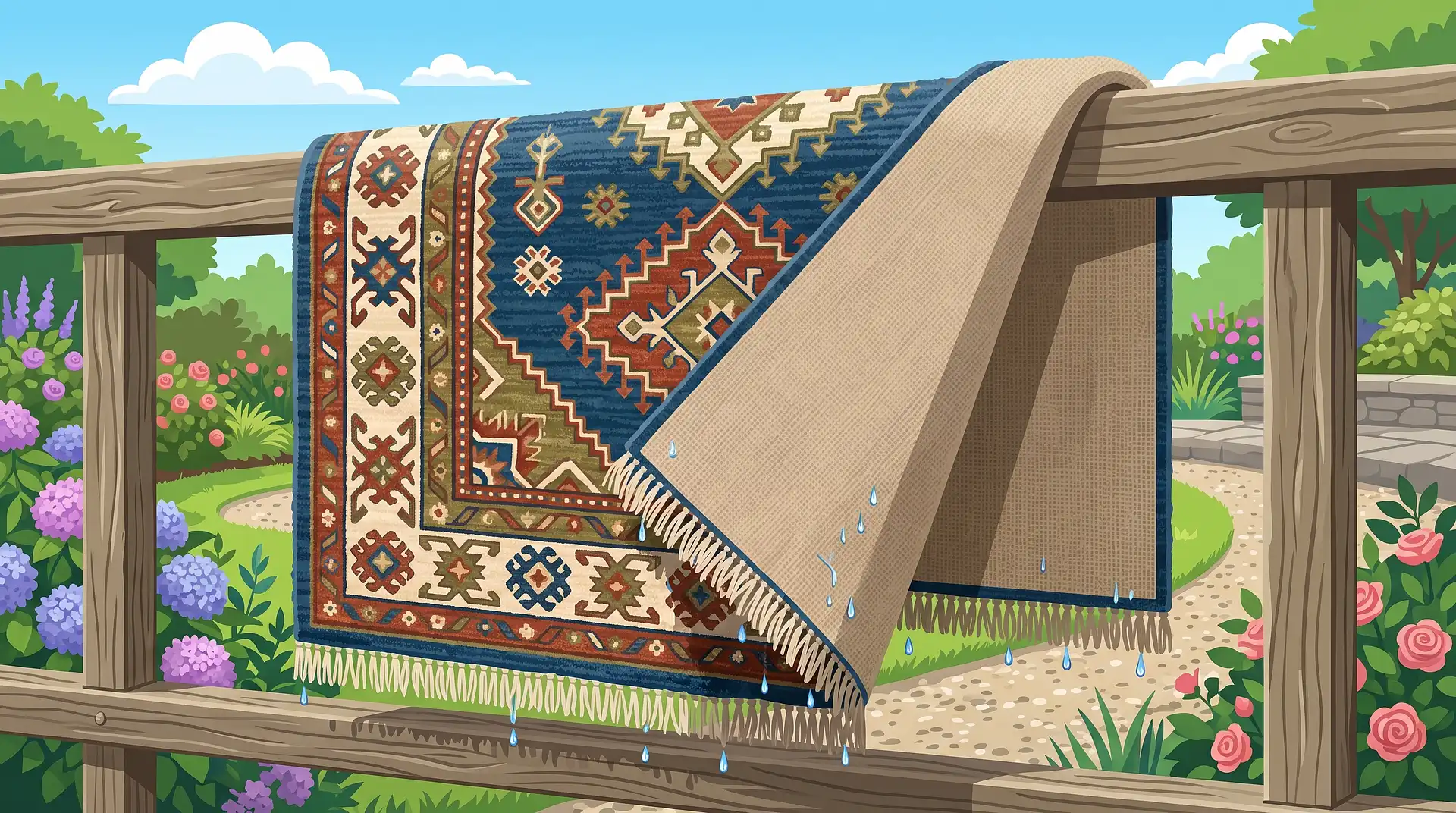
Elevate the rug or hang it. Drape a small rug over a washing line, a railing, or a garden chair so air can circulate on both sides. For a larger rug that can't be hung, prop it against a wall or fence on one end so the floor contact is minimal and air reaches most of the surface.
If drying indoors: raise the rug off the floor using chairs underneath, open windows, use a fan, and check the floor beneath regularly for moisture.
Outdoor drying on a dry, breezy day is by far the most effective option. Avoid direct strong sunlight for extended periods if the rug has a risk of colour fading.
Check both sides are dry before returning the rug to its position. The pile surface dries faster than the backing. Press your hand firmly onto the backing once the surface looks dry and check for coolness or residual dampness.
Stains on rugs
The same four-category framework established across the stain guides on this site applies here: protein stains need cold water and enzyme cleaner, tannin stains need cool water and mild detergent, oil and grease need absorption before anything wet, and dye stains are the hardest category on any textile.
The main additional consideration on rugs versus fitted carpet is the backing. Liquid pushed through the pile reaches the backing, which is often less stable than the pile, and from there can reach the floor surface. Work with as little moisture as possible, blot rather than rub, and elevate the rug for drying rather than leaving it flat.
Stain methods in detail for each category are covered in our carpet stain articles and the same principles apply directly to rug fibres.
When to send it to a professional
DIY is reasonable for routine cleaning of synthetic and robust wool rugs where colour-fastness has been confirmed. Consider professional cleaning when:
The rug is viscose, silk, jute or hand-knotted
The colour-fastness test showed dye transfer
The rug is antique, valuable or irreplaceable
A stain has resisted careful home treatment
The rug has a persistent smell after cleaning and drying
It is large enough that handling it wet at home is impractical or risky
There is any sign of moth damage or activity
InstantDry collects rugs, hand washes them in our studio using fibre-appropriate products and methods, and returns them wrapped. The rug is treated as an individual piece with its own assessment, not processed as a batch. This is the appropriate level of care for anything beyond a basic machine-made synthetic.
7. FAQ Section
How do you clean a rug at home? Check the care label and identify the fibre first. Test colour fastness by pressing a damp white cloth onto a hidden corner — if colour transfers, stop and contact a professional. For most synthetic and wool rugs: vacuum and beat, apply mild detergent solution via a cloth in the pile direction, rinse thoroughly, and dry with air circulating on both sides.
Can you wash a rug at home? Depends on the type. Synthetic rugs and many cotton rugs can be hand washed or, if small enough, machine washed on a gentle cold cycle. Wool rugs can be hand cleaned with care. Viscose, jute, silk and hand-knotted rugs should not be wet cleaned at home.
How do you dry a rug after cleaning? Hang it over a line or railing so air can reach both sides, or prop it upright against a wall or fence. Never lay it flat on a hard floor or carpet, which traps moisture against the backing and causes mould and floor staining.
How do you clean a wool rug at home? Cool water and a WoolSafe or pH-neutral cleaner, applied via a cloth rather than poured on. Gentle agitation in the pile direction, no scrubbing. Rinse very thoroughly. Dry flat with air circulating on both sides, away from direct heat.
Can you clean a viscose rug at home? Not safely with wet methods. Viscose loses tensile strength when wet, distorts easily and watermarks permanently. Vacuum and dry brush only. Any wet cleaning should be done by a specialist.
How do you clean a jute rug? Dry methods only: vacuum, brush and bicarbonate of soda for odour. Jute absorbs water readily, stiffens, can mould and may not lie flat after getting wet. For small marks, use the absolute minimum moisture on a barely damp cloth and blot dry immediately.
How often should you clean a rug? Vacuum weekly or fortnightly, depending on traffic. Beat outdoors and check underneath every few months. A full wash once a year is reasonable for a rug in regular use, more often for one in a high-traffic or dining area.
Why does my rug smell after cleaning? Almost always trapped moisture in the backing from insufficient drying. The rug must be elevated so air circulates on both sides, not laid flat on the floor. The smell is mould or mildew in the backing, and if it persists after proper drying it may need professional treatment.
Can you use a carpet cleaner machine on a rug? With care, on synthetic and robust wool rugs where the colour-fastness test has passed. The main risk is over-wetting: machines tend to put in more liquid than a hand clean, so use the lowest setting and make sure the rug is properly dried afterwards. Not appropriate for viscose, jute, silk or hand-knotted rugs.
8. Service Section
Too valuable to risk, or too large to handle at home?
For a wool, silk, viscose, jute or hand-knotted rug where home cleaning carries real risk, or for any rug that's too large to handle safely when wet, InstantDry collects rugs across England and Wales, hand washes them in our studio using fibre-appropriate products, and returns them wrapped. Each rug is assessed individually before cleaning begins, and if the colour-fastness or fibre assessment suggests a risk, we'll tell you before we start.
Rugs from £89.
Get your fixed quote in 60 seconds
Or call 07555 856988.