How to Get Rid of Carpet Beetles
3 September 2026
Quick answer: The adult beetles you spot on windowsills are not the problem — they don't eat fabric. The larvae are the problem, and they're hidden in dark, undisturbed areas that most DIY treatments miss. Start by finding the larval source: edges of carpets, under furniture, inside wardrobes, stored natural-fibre clothing and bedding. Vacuum thoroughly with a HEPA vacuum, wash affected items at 60°C or freeze them, then apply a residual insecticide spray to harbourage areas. Repeat after three to four weeks to catch newly hatched larvae. For an established infestation, professional treatment is significantly more reliable than DIY.
Carpet beetles are one of the most underestimated fabric pests in UK homes. They work quietly, in the dark, and most households only notice the damage months after an infestation has established. Knowing what to look for, where to look, and why the standard vacuuming response often fails is what separates an infestation that's resolved from one that keeps coming back. Instant Dry Carpet Cleaning carries out post-treatment mattress and carpet cleaning across England and Wales and works alongside pest controllers regularly — the cleaning step after treatment is what removes the biological residue that pest control alone leaves behind.
Carpet beetles versus carpet moths: telling them apart
Both damage natural-fibre textiles in UK homes and both are frequently misidentified. The treatment overlaps considerably but the identification differs.
Carpet beetles (most commonly Anthrenus verbasci, the varied carpet beetle, or Attagenus unicolor, the black carpet beetle in the UK) are small, rounded beetles roughly 2 to 4 millimetres as adults. Adults are often patterned with white, brown and yellowish scales in a mottled pattern (varied carpet beetle) or uniformly dark (black carpet beetle). They are commonly found on windowsills in spring, drawn to light. The larvae are the damaging stage: roughly 4 to 5 millimetres, banded with alternating light and dark sections, covered in stiff bristle-like hairs.
Carpet moths (the common clothes moth, Tineola bisselliella) are small, buff-coloured moths that avoid light and fold their wings flat when resting. The larvae spin silky webbing as they feed and are cream-coloured with a dark head. Carpet moth damage tends to appear in low-traffic wool carpet areas with concentrated irregular worn patches.
Key distinction: carpet beetle larvae leave behind cast skins that retain the shape and banded pattern of the larva. Carpet moth larvae leave silky webbing trails in the damaged area. Finding cast skins points to carpet beetles; finding webbing points to moths. Both can coexist in the same property.
The carpet moth guide on this site covers moth identification and treatment in detail.
How to identify a carpet beetle infestation
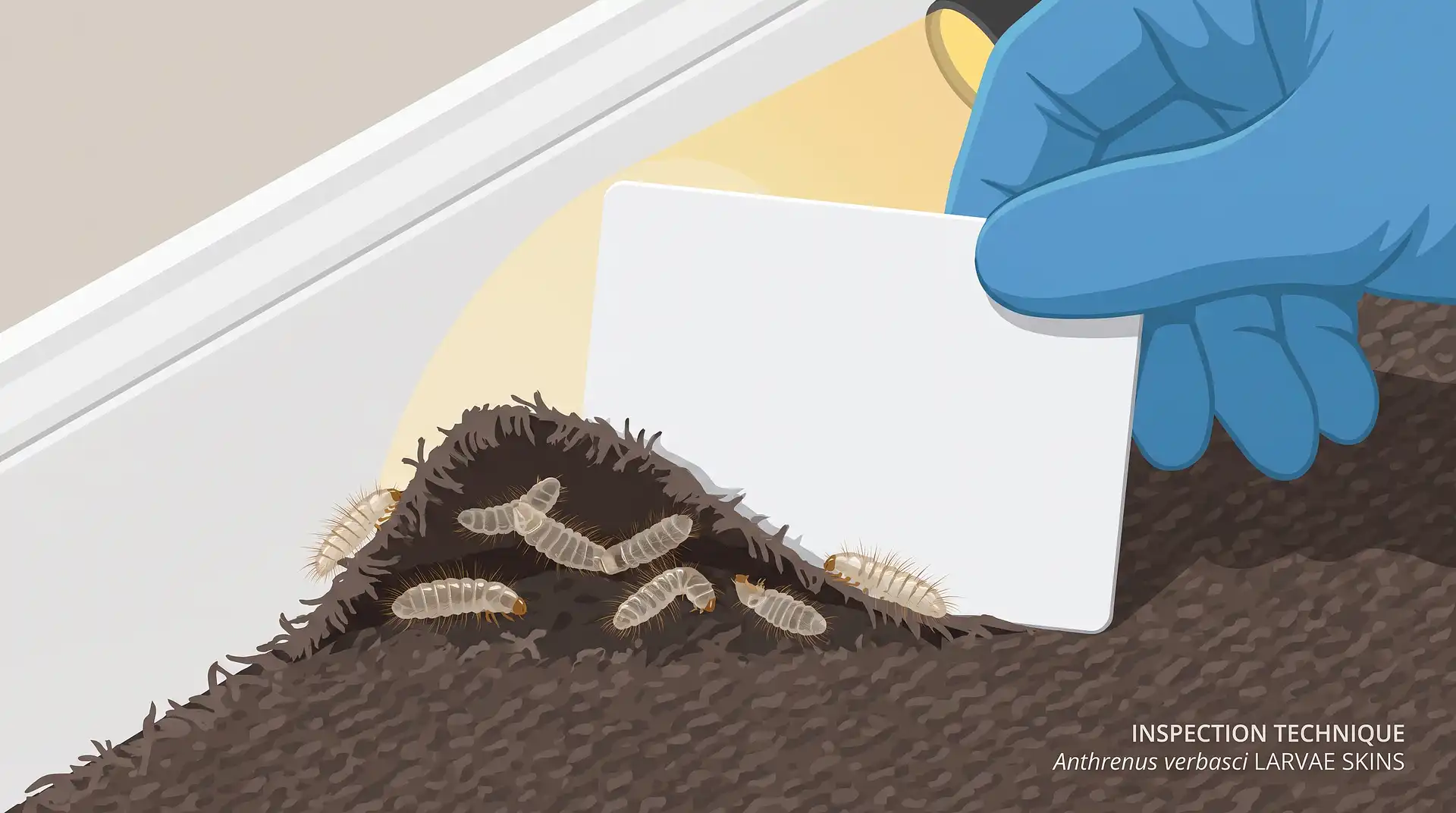
Cast skins. The most reliable sign. As larvae grow they moult, leaving their old skin behind. These skins are translucent, banded with light and dark markings, and have the distinctive bristle hairs of the live larva. They accumulate in harbourage areas — along skirting boards, under furniture, at carpet edges.
Adult beetles on windowsills. In spring, adult carpet beetles emerge and are drawn toward light. Finding them on windowsills or in the folds of curtains indicates an infestation somewhere in the property. The adults fly in from outdoors as well, so a single adult doesn't confirm an infestation, but multiple adults or repeated sightings do.
Damage patterns. Carpet beetle larvae eat keratin, the protein found in wool, silk, feathers, fur, leather and some synthetic blends with natural content. The damage appears as irregular thinning or bare patches in carpet, particularly along edges and under furniture where conditions are undisturbed. In clothing and stored fabrics, the damage appears as irregular holes. Unlike carpet moth damage, there is no associated webbing.
Faecal pellets. Tiny dark specks, similar in appearance to grains of pepper, found in areas where larvae are feeding.
Allergic reaction. The bristle hairs of carpet beetle larvae cause a skin reaction in some people — an itchy rash on skin that has been in contact with infested fabric. This is sometimes mistaken for bites, though carpet beetles don't bite.
The life cycle that explains why treatment fails
Most DIY treatment attempts fail because they address the adults and miss the eggs. Understanding the four-stage lifecycle makes it clear why.
Egg. Laid in batches in protected areas near food sources — inside carpet tufts, in fabric folds, in wall crevices. Eggs hatch in one to five weeks depending on temperature. Most insecticides do not kill eggs effectively.
Larva. The damaging stage. Larvae feed on keratin-based material and moult multiple times over several months to over a year, depending on temperature and food availability. They avoid light and remain in dark, undisturbed areas. This is what needs to be targeted.
Pupa. Larvae pupate in a protected location. Pupae are also relatively resistant to insecticides.
Adult. Emerges in spring and early summer, feeds on pollen and nectar outdoors, mates and returns indoors to lay eggs. Adults do not damage textiles.
The practical implication: a single treatment kills larvae on contact but leaves eggs and pupae alive. A second treatment three to four weeks later catches the newly hatched larvae from those eggs before they pupate and repeat the cycle. Two or three timed treatments are standard for complete eradication.
Finding the source: where larvae actually hide
This is the step that determines whether treatment works or fails. Treating where you see adults or obvious damage, without finding the primary larval source, almost always results in reinfestation.
Under furniture and along carpet edges. Larvae prefer dark, undisturbed conditions. The edges of fitted carpet where it meets the skirting board, and the areas under heavy furniture that is rarely moved, are primary habitats. Pull back the carpet edge at a corner and inspect with a torch.
Wardrobes and storage. Stored woolens, cashmere, silk, fur-trimmed clothing, feather pillows, down duvets and similar items are frequent primary sources. A carpet beetle infestation that appears to be in the carpet often traces back to an undisturbed box of stored clothing.
Chimneys and bird nests. Carpet beetles also feed on feathers, fur and dried biological material. Old bird nests in chimneys and roof spaces are a common entry point and sometimes a primary breeding site. Dead birds or rodents in wall cavities are another hidden source.
Natural-fibre upholstered furniture. Sofas with wool, horsehair or feather-fill cushions, particularly in areas that are rarely moved or vacuumed underneath.
Taxidermy and natural specimens. Any mounted specimen, dried flower arrangement, wool felt, natural bristle brush or similar item in the home.
Food storage areas. Carpet beetles also infest dried foodstuffs including cereals, spices and pet food in natural packaging.
DIY treatment step by step
Step 1: Thorough vacuum of all harbourage areas
Use a HEPA filter vacuum if available. Work methodically along all skirting boards, at carpet edges, under and behind all furniture, inside and behind wardrobes, and along any cornicing where larvae might travel. The vacuum physically removes larvae, cast skins, eggs and faecal material.
Remove the vacuum bag or empty the canister directly into a sealed bag and dispose of it outdoors. A bag containing live larvae and eggs inside the house is counterproductive.
Step 2: Wash or treat affected textiles
Clothing and fabrics that can be washed: machine wash at 60°C, which kills all life stages. Tumble dry on a high setting for at least thirty minutes.
Items that cannot be washed at 60°C: seal in a plastic bag and place in a freezer at minus 18°C or below for at least two weeks. This kills all life stages reliably.
Items that cannot be washed or frozen: dry cleaning, or disposal in a sealed bag directly to the outdoor bin.
Inspect every wool, silk, cashmere, feather and fur item in the property and treat or dispose of those showing damage or evidence of larvae.
Step 3: Apply residual insecticide to harbourage areas
Consumer insecticide products containing permethrin or deltamethrin are available in the UK and are effective against carpet beetle larvae. Apply as a residual spray to carpet edges, skirting boards, inside wardrobe bases and any crevices where larvae are likely to travel.
Follow the product's safety instructions. Keep children and pets out of treated areas until dry. Ventilate the room during and after application.
Do not spray the entire carpet surface indiscriminately. Focus on harbourage zones — edges, corners, under furniture, and the areas where you found evidence.
Step 4: Diatomaceous earth as a supplementary treatment
Food-grade diatomaceous earth, a fine powder made from fossilised diatoms, kills insects by damaging their waxy outer coating, causing dehydration. It is effective against larvae and does not require them to ingest it. Apply lightly along skirting boards and carpet edges, leave for several days, then vacuum up. Safe around children and pets once dry.
Step 5: Repeat treatment after three to four weeks
This is the step most DIY attempts skip, and it's why reinfestation follows. The repeat treatment targets newly hatched larvae from eggs that survived the first application.
When professional pest control is needed
DIY treatment manages light infestations when the source is identified and treated thoroughly. Consider professional pest control when:
The infestation is established across multiple rooms or areas
The source cannot be identified despite a thorough search
DIY treatment has been carried out twice without resolving the problem
The property has structural features that may contain bird nests or rodent remains in inaccessible areas
The infestation is in a commercial property, a heritage collection, or a museum context
The British Pest Control Association (BPCA) provides a directory of accredited pest controllers in the UK. A BPCA-registered contractor holds the appropriate qualifications and carries professional insurance.
After treatment: cleaning matters
This is the honest professional service connection, and it's absent from every competing guide.
After pest control treatment — whether DIY or professional — the carpet and any affected fabrics still contain dead larvae, cast skins, faecal material and egg cases embedded in the pile. Vacuuming removes what's on the surface. Professional extraction cleaning reaches deeper into the pile and removes the biological residue that vacuuming leaves behind.
For mattresses, sofas and rugs that have been affected, the same principle applies. The pest is gone after treatment; the debris from the infestation takes a further cleaning step to remove fully. Instant Dry Carpet Cleaning carries out post-treatment carpet and mattress cleaning across England and Wales. The how to clean a mattress guide covers what professional extraction achieves on a treated mattress. Allow the treatment's re-entry period to pass before booking a clean.
Prevention
Vacuum regularly and thoroughly, including edges. The single most effective preventive measure. Carpet beetle larvae need undisturbed conditions to develop. Regular vacuuming disrupts this, particularly along skirting boards and under furniture where they prefer to harbour.
Store natural-fibre clothing properly. Woolens and other natural-fibre garments stored long-term should be stored in sealed bags or airtight containers, not open wardrobes or cardboard boxes. Moth and carpet beetle prevention products including cedar blocks and pheromone traps help in storage areas.
Inspect second-hand items before bringing them home. Used upholstered furniture, vintage rugs and second-hand clothing are common introduction routes.
Check fresh flowers. Adult carpet beetles feed on pollen outdoors and can enter on cut flowers brought inside.
Address bird nests. Chimney stacks, loft spaces and roof eaves with active or old bird nests are a structural entry point. Removing old nests in autumn and installing chimney caps reduces this risk.
Keep dried food in sealed containers. Cereal, pet food and spices in their original packaging are vulnerable. Transfer to sealed containers.
Frequently Asked Questions
How do you know if you have carpet beetles? Look for cast skins — translucent, banded, bristle-covered casings — along carpet edges, skirting boards and in wardrobes. Irregular bare patches or thinning in wool carpet, holes in stored woolens, and adult beetles (small, rounded, mottled or dark) on windowsills in spring are the main signs.
What kills carpet beetles? Heat (60°C wash or tumble drying kills all life stages in textiles), freezing at minus 18°C for at least two weeks, HEPA vacuuming to physically remove larvae and eggs, and residual insecticide sprays containing permethrin or deltamethrin applied to harbourage areas.
Why do carpet beetles keep coming back? Usually because the primary larval source hasn't been found and treated, or because eggs survived the first treatment and hatched subsequently. A repeat treatment three to four weeks after the first is standard to catch newly hatched larvae. If reinfestation is persistent, a professional inspection to locate a hidden source (bird nest, stored fabric, rodent remains) is worth arranging.
How are carpet beetles different from carpet moths? Carpet beetle larvae leave cast skins (banded, bristly shells) in harbourage areas. Carpet moth larvae leave silky webbing in the damaged area. Adult carpet beetles are small and rounded with mottled patterning; carpet moths are buff-coloured and fold their wings flat when resting. Both damage natural-fibre textiles, but they are different species with slightly different habits.
Can carpet beetles live in mattresses? Yes, particularly mattresses with natural fill (wool, cotton, horsehair or feather) or wool ticking covers. Inspect the seams and tufting regularly. After pest control treatment, professional extraction cleaning removes the biological debris from a treated mattress.
How long does it take to get rid of carpet beetles? For a contained infestation treated thoroughly, two treatment cycles three to four weeks apart, combined with washing or freezing affected textiles, usually resolves the problem within six to eight weeks. Established or widespread infestations treated professionally may require two to three visits over a similar period.
Are carpet beetles harmful to humans? They don't bite, but the bristle hairs from carpet beetle larvae cause an itchy skin rash in some people when there is direct contact with infested fabric. This is sometimes mistaken for insect bites.
Do carpet beetles damage synthetic carpets? Generally not. Carpet beetle larvae need keratin, the protein found in wool, silk, feathers and fur. They do not feed on nylon, polypropylene or polyester. Damage to a synthetic carpet usually indicates it contains some natural-fibre content, or that the infestation is in an adjacent natural-fibre item.
Service Section
After treatment, a professional clean removes what vacuuming leaves behind
Pest control eliminates the infestation. What it leaves in the carpet and mattress — cast skins, faecal material, egg cases and biological debris embedded in the pile — takes a further cleaning step to address properly. Instant Dry Carpet Cleaning provides professional carpet and mattress cleaning across England and Wales following pest control treatment. Allow the treatment's stated re-entry period to pass before booking. Free survey and fixed price before any work begins.
Get your fixed quote in 60 seconds
Or call 07555 856988.