How to Get Rid of Carpet Moths
18 August 2026
Quick answer: The moths you see aren't the problem. The larvae are. They feed on keratin, the protein in wool, silk and other natural fibres, and they thrive in dark, undisturbed areas: under furniture, along skirting boards, behind radiators. Treatment has four stages: thorough vacuuming to physically remove eggs and larvae, targeted insecticide or natural treatment, monitoring with pheromone traps, and long-term prevention through regular cleaning and reduced humidity. Synthetic carpets are largely safe unless blended with natural fibres or contaminated with hair and skin debris. If damage is widespread or keeps returning after treatment, professional pest control is the right step.
If you've found bare patches in your carpet, tiny moths hopping along the skirting board, or strange silky webbing in the corners of a room, you're dealing with a textile moth infestation. It's common, it's fixable, and it's worth understanding properly rather than just spraying something and hoping.
What's actually eating your carpet
Not what most people assume, and the distinction matters.
The moths aren't eating anything. Adult textile moths don't feed at all. Their sole function is to mate and lay eggs, and they live only a few weeks. The small, pale, non-descript moths you spot fluttering near the floor or hopping along a skirting board are the adults, and killing them achieves very little on its own, because by the time you see them they've likely already laid their eggs.
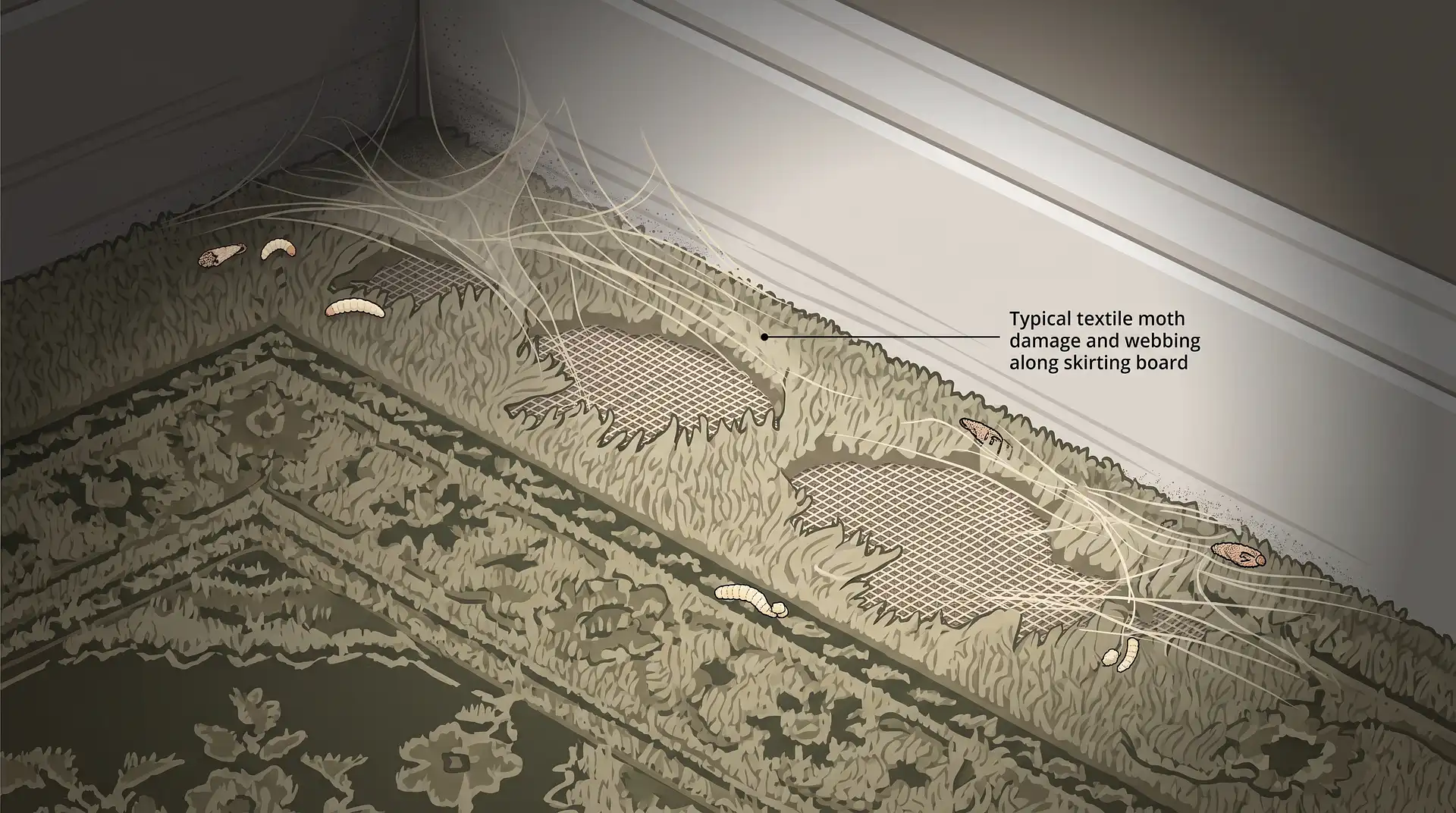
The larvae do the damage. They hatch from eggs laid deep in the carpet pile, in seams, in the folds of curtains, and anywhere dark and undisturbed. They're small, cream-coloured grubs roughly 5 to 10mm long, and they feed on keratin, a protein found in wool, silk, leather, feathers, fur and hair. Keratin is the same protein that gives wool its structure, which is why these are covered under the same fibre chemistry already established across this site.
They're probably not carpet moths either, strictly speaking. The true carpet moth (Trichophaga tapetzella) is actually rare in the UK. The moth responsible for almost all UK domestic carpet damage is the common clothes moth (Tineola bisselliella), sometimes followed by the case-bearing clothes moth (Tinea pellionella). The distinction is academic for treatment purposes, since the methods are the same, but getting the species right matters for accurate identification and for understanding that these moths attack clothes, upholstery and rugs as well as fitted carpet.
How to tell if you have them
Infestations often go unnoticed for months because the damage happens in places you don't look.
Bald patches or thinning pile in the carpet, usually in areas that are dark and undisturbed: under furniture, along skirting boards, behind sofas, under the edge of a rug, behind radiators. If the carpet looks intact in the middle of the room but threadbare around the edges, that's the pattern.
Silky webbing or small tubes on the carpet surface, particularly in corners and along edges. Case-bearing clothes moths build a small portable case around themselves as they feed, which looks like a tiny grain of rice made of fibre.
Small, pale moths near the floor. They tend to hop and scuttle rather than fly strongly. You're more likely to see them at floor level or crawling up walls than flying around lights.
Sand-like debris in the carpet pile, which is larval droppings.
Damage is always to natural fibres. If your carpet is 100% polypropylene or another pure synthetic, these moths have no interest in it, because synthetic fibres contain no keratin. Wool, wool-rich, silk and wool-blend carpets are the targets. However, larvae can survive on synthetic carpets that are contaminated with enough hair, skin cells, pet dander and food debris, which all contain keratin. A dirty synthetic carpet can still support a small population.
Why UK homes are particularly vulnerable
Two factors specific to UK domestic life make this worse than it might be.
Central heating. In the natural world, UK moth populations were controlled by cold winters, which killed off eggs and larvae before they could develop. Modern homes with year-round central heating have removed that seasonal brake. In a warm, centrally heated house, textile moths can complete two or even three full lifecycle generations per year instead of one. Your home is a more comfortable breeding environment than the outdoors.
Wool carpet is common in the UK. The UK has a strong tradition of wool and wool-rich fitted carpets, particularly in traditional properties and quality installations. Many UK homes still have 80/20 wool-blend or pure wool carpet, which is exactly the material these moths target. The rest of Europe tends toward more hard flooring and synthetic carpet, which gives UK homes a higher baseline risk.
Treatment: the four-stage protocol
Moth treatment isn't one thing. It's a sequence, and skipping steps is why people find the problem returns.
Stage 1: Thorough, aggressive vacuuming
This is treatment, not housekeeping. You're physically removing eggs, larvae and their food source from the carpet.
Move all furniture. Vacuum the entire room, paying particular attention to edges, corners, under skirting boards, behind radiators and anywhere dark and undisturbed. Use a crevice tool along every edge and in every join.
Empty the vacuum immediately afterwards, ideally into a sealed bag that goes straight into an outside bin. If your vacuum has a bag, replace it. Larvae can survive inside a vacuum and re-emerge.
Repeat within a week. One pass won't catch everything, particularly eggs that are well embedded in the base of the pile.
Stage 2: Deep clean or professional extraction
A thorough DIY clean or, better, a professional hot water extraction clean serves a specific purpose here: it reaches deeper than a vacuum can, removes eggs and larvae from the base of the pile and the carpet backing, and removes the hair, skin and food debris that sustain the population.
Steam cleaning and hot water extraction both expose larvae and eggs to temperatures well above what they can survive. This is a genuine treatment step, not general maintenance dressed up as moth advice.
Stage 3: Targeted treatment
Once the carpet is clean, apply an appropriate moth treatment to create a residual barrier that continues killing eggs and larvae for weeks after application.
Options:
Insecticide sprays. Choose a UK-authorised product specifically labelled for textile moths or clothes moths. Most contain permethrin or cypermethrin as the active ingredient. Apply a light, even spray along edges, under furniture positions, along skirting boards and into corners, following the manufacturer's instructions precisely.
Safety with insecticides:
Ventilate the room well during and after application
Wear gloves and avoid inhaling the spray
Keep children and pets out of the treated room until the product's instructions say it's safe
Read the CLP labelling and follow the precautionary statements
Don't use amateur products in quantities or concentrations beyond the label, and don't use professional-grade products unless you're qualified to
If the carpet is wool, look for a product that is WoolSafe approved or confirmed safe for use on wool, since some insecticides can damage or discolour natural fibres
Natural alternatives. Cedar and lavender are commonly recommended as moth deterrents. They have some limited repellent effect and are pleasant to use, but they don't kill larvae or eggs, so they're a supplement to treatment rather than a replacement. Diatomaceous earth (food grade) applied into the pile and left for several days before vacuuming can damage the larvae physically, though evidence for its effectiveness on textile moths specifically is less robust than for some other pests.
Stage 4: Monitoring
Pheromone traps are genuinely useful, but not in the way most people assume. They catch adult male moths using a synthetic female pheromone, and they're excellent for monitoring whether you still have an active population. They don't catch females, they don't catch larvae, and they don't eliminate an infestation on their own. Use them to track the problem rather than to solve it.
If traps continue catching moths four to six weeks after a thorough treatment cycle, you still have an active population and a second treatment round is needed.
Products that work, and how to use them safely
Product type | What it does | Limitations |
|---|---|---|
Permethrin or cypermethrin spray | Kills larvae and eggs on contact and creates a residual barrier | Must be used as directed. Ventilate. Check wool-safety |
Pheromone trap | Catches adult males, monitors population | Does not catch females or larvae. Not a standalone solution |
Cedar and lavender | Mild repellent | Does not kill moths. Supplement only |
Diatomaceous earth (food grade) | Physical damage to larvae | Variable effectiveness. Messy. Must be vacuumed out thoroughly |
Mothballs (naphthalene, paradichlorobenzene) | Kills moths in enclosed spaces | Unpleasant smell, potentially harmful fumes, not suitable for open carpet areas. Better for sealed storage |
Freezing (small items) | Kills eggs and larvae at sustained very low temperatures | Not practical for fitted carpet. Works for rugs and clothing |
When to call pest control
DIY treatment handles most moderate infestations well if you're thorough and persistent. Consider professional pest control when:
The infestation is widespread across multiple rooms
You've completed a full treatment cycle and pheromone traps show continued activity four to six weeks later
The property has been unoccupied and an infestation has established unchecked
Damage extends to upholstery, curtains, clothing and stored textiles beyond just carpet
You're dealing with a listed building, a historic property, or valuable antique textiles where the wrong treatment could cause more damage than the moths
Professional pest control options include targeted insecticide application, whole-room heat treatment (which raises the room to temperatures that kill all lifecycle stages), and fumigation for severe cases. Heat treatment is chemical-free and effective but typically costs more.
Prevention: the long game
Once you've treated an infestation, preventing it returning is about making your home less hospitable to moths than the outdoors.
Vacuum regularly, especially edges and hidden areas. This is the single most effective ongoing measure. Moths don't infest the middle of a busy room. They establish in the quiet, dark, undisturbed margins. Vacuum under furniture, along skirting boards and behind sofas at least weekly, and move furniture periodically so nothing stays undisturbed for months.
Reduce humidity where you can. Moth larvae need some ambient moisture. Good ventilation, particularly airing rooms regularly and avoiding drying laundry indoors over carpet, helps.
Have carpets professionally cleaned periodically. A professional clean every year or two removes the accumulated hair, skin and food debris that sustains a moth population even between visible infestations. It also exposes the base of the pile to temperatures that kill eggs and larvae.
Rotate and air rugs. Especially ones that sit in low-traffic areas. Lift them, shake them, expose them to daylight periodically. Moths prefer the dark, undisturbed underside.
Check and clean other natural fibre items. Wool coats in wardrobes, stored blankets, and upholstered furniture all provide alternative habitats. An infestation that seems to keep returning despite treating the carpet may have a secondary population in clothing or upholstery.
Lavender, cedar and pheromone traps are worth maintaining as ongoing deterrents and monitors even after the visible problem has gone.
Does professional carpet cleaning help?
Yes, and it genuinely fits at two points.
As treatment: hot water extraction reaches further into the pile and backing than domestic vacuuming, physically removes eggs and larvae, and subjects them to temperatures they don't survive. This is a treatment step, not a suggestion to have the carpets done while you're at it.
As prevention: regular professional cleaning removes the keratin-rich debris, hair, skin, pet dander, that moths feed on, reducing the food source that sustains a population between visible events. It's one of the most effective preventative measures available and it doesn't involve any chemicals.
A professional clean doesn't replace insecticide treatment for an established infestation, since it doesn't create the residual barrier that continues killing over weeks. But combined with targeted treatment, it's a meaningful part of the protocol rather than an afterthought.
8. FAQ Section
What do carpet moths look like? Small, pale, non-descript moths about 5 to 8mm long. They tend to hop and scuttle along the floor rather than fly strongly. The larvae, which cause the damage, are cream-coloured grubs about 5 to 10mm long. You're more likely to notice the damage, bald patches, webbing and thinning pile, before you see the moths themselves.
Are carpet moths the same as clothes moths? Effectively yes. The actual species causing damage in most UK homes is the common clothes moth (Tineola bisselliella), not the true carpet moth species, which is rare. The name "carpet moth" describes the behaviour rather than the species. Treatment is the same regardless.
Do carpet moths eat synthetic carpet? Not as a food source, since synthetic fibres contain no keratin. However, larvae can survive on synthetic carpets that are contaminated with hair, skin cells, pet dander and food debris, which all contain the protein they feed on. A dirty synthetic carpet is more vulnerable than a clean one.
Does vacuuming get rid of carpet moths? Thorough vacuuming is the single most important treatment step, since it physically removes eggs, larvae and their food source. One pass isn't enough. Vacuum aggressively, including all edges, corners and under furniture, empty the vacuum into a sealed bag immediately, and repeat within a week.
Will professional carpet cleaning help with moths? Yes, at two stages. As treatment, hot water extraction removes eggs and larvae from deeper in the pile than domestic vacuuming reaches and subjects them to temperatures they don't survive. As prevention, regular cleaning removes the hair and skin debris that moths feed on, reducing the food source that sustains a population.
What kills carpet moth eggs? Heat above 50 to 55°C kills eggs and all other lifecycle stages. Professional hot water extraction and steam cleaning both achieve this. Permethrin and cypermethrin based insecticide sprays also kill eggs on contact and provide a residual barrier.
Do moth traps work? Pheromone traps catch adult males and are excellent for monitoring whether you have an active population. They don't catch females or larvae and won't eliminate an infestation on their own. Use them to track the problem and judge whether treatment has worked.
Why do I keep getting carpet moths? Usually because treatment addressed the visible moths but not the eggs and larvae, or because the underlying conditions that support them haven't changed: undisturbed areas, accumulated debris, warmth and humidity. A thorough treatment cycle followed by regular vacuuming and reduced humidity is the long-term answer.
Are carpet moths worse in certain UK homes? Older properties with wool carpet, centrally heated homes where there's no natural winter cold period, and properties with undisturbed rooms or stored textiles are at higher risk. Central heating is the biggest factor, since it allows moths to breed year-round instead of being controlled by winter cold.
Is it safe to use moth spray on wool carpet? Check the product label carefully. Some insecticides can damage or discolour wool. Look for products that are WoolSafe approved or confirmed safe for use on wool, and always test on a hidden patch before applying to a visible area.
Can carpet moths damage upholstery and rugs as well? Yes. Any textile containing natural animal fibres, including wool upholstery, wool rugs, silk, cashmere and even feather-filled cushions, is a target. An infestation that keeps returning despite treating the carpet may have a secondary population in upholstery or stored clothing.
Instant Dry carpet cleaning carries out hot water extraction cleaning for carpets, rugs, upholstery and mattresses across England and Wales. If you're dealing with a moth problem, we can help with the cleaning stage of treatment, and regular professional cleaning is one of the most effective long-term preventative measures. Every visit starts with a free survey and a fixed price before any work begins.
Single rooms from £49. Whole home, including stairs and landing, from £179. Rugs collected, hand washed in our studio and returned wrapped from £89.
Get your fixed quote in 60 seconds
Or call 07555 856988.