How to Wash Wool Rugs
24 August 2026
Quick answer: Cool or cold water only, a WoolSafe or non-biological, pH-neutral detergent, and gentle handling with no scrubbing or wringing. Test colour fastness before any wet cleaning. Machine washing is possible on a wool cycle at 30°C maximum for machine-tufted rugs where the care label confirms it. Hand-tufted rugs with a latex backing should not be submerged. Hand-knotted rugs should be washed professionally. After washing, reshape while damp and air dry flat, away from all heat, with air circulating on both sides. No tumble dryer, no hairdryer, no radiator.
Wool rugs are among the most rewarding flooring investments you can make. Properly maintained, a quality wool rug outlasts several generations of synthetic alternatives, holds colour better, and improves with age. The care they need is not complicated, but it is specific, and the things that ruin wool are not obvious until they've happened.
Why wool needs different treatment from synthetic rugs
Wool is a protein fibre. Its structure is a helical chain of amino acids, similar in principle to the haemoglobin in blood and the keratin in hair — both of which appear across this site's stain guides for the same reason wool does. That protein structure is what makes wool behave as it does.
Heat causes felting. Wool fibres are covered in microscopic cuticle scales. When wool is warm, wet and subjected to mechanical agitation, those scales open and interlock with neighbouring fibres. The result is felting: irreversible matting and shrinkage that permanently changes the rug's texture, size and appearance. This is why cold water, low spin speeds and minimal agitation are non-negotiable on wool, not optional preferences.
Alkaline products damage the fibre. The cuticle scales on wool fibres are stable in acidic to neutral conditions (pH up to about 7), but alkaline conditions cause them to lift, swell and eventually break down. Biological detergents, bleach, bicarbonate of soda in sustained contact, and many household cleaners are alkaline. On a synthetic rug this is inconsequential. On wool it causes fibre damage that shows as dullness, shedding and loss of texture.
Biological enzyme cleaners break down protein fibres. This is the same mechanism that makes them effective at removing protein stains from other surfaces. On a pure wool rug, the enzyme cleaner cannot distinguish between the protein stain and the protein fibre. This is covered in the sheepskin rug guide on this site and applies equally here.
Wool is genuinely resistant to staining, because lanolin in the fibre repels liquid temporarily and gives you time to blot before a spill penetrates. This means wool rugs need washing less often than most owners assume, and gentle routine care extends the time between full washes considerably.
Identify your wool rug's construction before washing
Not all wool rugs can be washed the same way, and the construction matters as much as the fibre.
Construction | What it is | Safe to wash at home |
|---|---|---|
Machine-tufted | Pile tufted into a backing by machine, often with a latex secondary backing | Usually yes, at 30°C on wool cycle where label confirms |
Hand-tufted | Pile pushed through a canvas backing by hand, finished with a latex backing and a cloth underlay | Check label carefully. Submerging can degrade the latex backing and cause delamination |
Flatweave / kilim / dhurrie | No pile, woven structure throughout, often reversible | Generally the most washable wool type. Check for dye stability first |
Hand-knotted | Each knot tied individually, pile cut to finish. Traditional Persian, Afghan, Turkish rugs | Professional cleaning only. The structure is more complex and valuable than machine-made; home washing risks distortion, dye bleeding and warp damage |
Shaggy / high pile wool | Long pile, either tufted or woven | Wet washing causes significant tangling and matting risk. Use minimal moisture |
The latex backing issue. Many hand-tufted rugs and some machine-tufted rugs have a latex secondary backing applied to hold the tufts in place. Submerging a latex-backed rug causes the latex to absorb water, swell, and in some cases separate from the primary backing, which releases the tufts. If your rug has a latex backing, do not submerge it. Spot clean and hand clean only with minimal moisture.
Colour fastness first
Before any wet cleaning, press a damp white cloth firmly onto an inconspicuous corner of the rug. If any colour transfers, the rug has unstable dyes and wet cleaning will cause bleeding. Stop. This is a job for a specialist who can test and stabilise dyes before cleaning.
This is particularly important for hand-dyed rugs, older rugs, and any rug in rich or deep colours, which are more likely to bleed than neutral or pale rugs.
Routine care before washing
Good routine care significantly reduces how often a full wash is needed.
Vacuum with a suction-only attachment. No powered brush head, which pulls out wool fibres and can cause pilling. Vacuum in the direction of the pile for cut pile rugs. Vacuum flatweaves in one consistent direction.
Beat it outside. Hang the rug over a washing line or railing and beat the back with a broom. The dust that comes out tells you exactly how much was embedded.
Rotate every six months. Even wear prevents concentrated pile loss in high-traffic paths.
Air it outside occasionally. Fresh air and sunlight reduce dust mites and freshen the fibres without any moisture risk. Avoid prolonged direct sunlight on strongly coloured rugs.
Check underneath regularly for moth activity. Wool is the primary target for carpet moths (correctly the common clothes moth), and the underside of a rug in a low-traffic area is one of their preferred habitats. The moth guide on this site covers identification and treatment.
Hand washing a wool rug
The recommended method for most wool rugs, particularly those with any uncertainty about construction or dye stability.
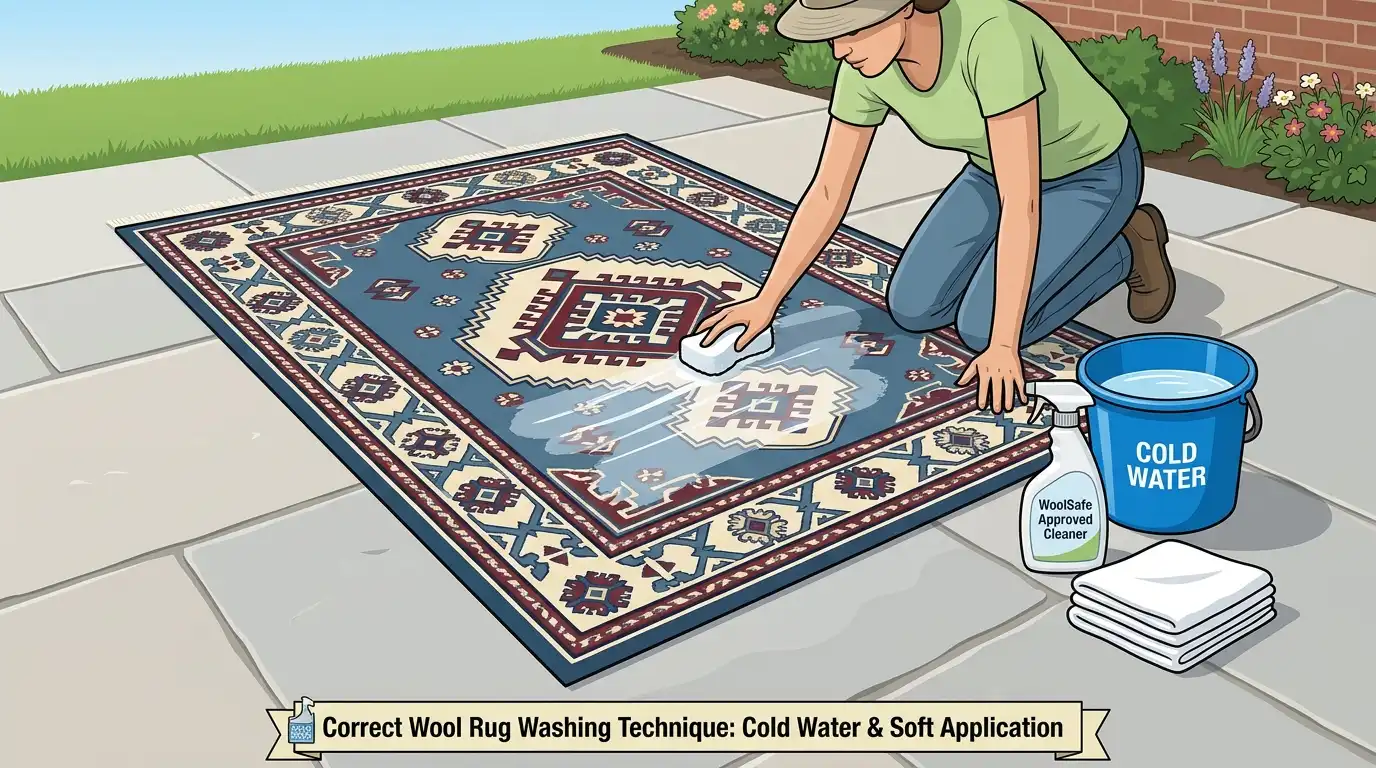
Best done outdoors on a dry day. Take the rug outside, lay it on a clean patio surface, fence or decking that won't stain it, and work there. Indoor washing creates moisture problems and limits where the dirty water can go.
Step 1: Beat and vacuum
Remove as much loose soil as possible before adding any moisture. Wet loose soil embeds it further.
Step 2: Colour fastness test
As described above. If it passes, proceed.
Step 3: Mix a cold or cool solution
A small amount of WoolSafe-approved cleaner or a non-biological, pH-neutral wool detergent in a bucket of cold water. Not warm, not cool-warm: cold. The difference between cool and cold matters less than the difference between cool and warm.
Never use biological detergent, alkaline cleaner, bleach, fabric conditioner, or bicarbonate of soda as part of a wet cleaning process on wool.
Step 4: Work gently in the pile direction
Apply solution via a soft sponge or white cloth to the rug surface. Work in one direction, following the pile direction on pile rugs. Flatweaves: one consistent direction throughout. Gentle, even strokes. No scrubbing, no circular motions, no going back and forth.
For a larger rug, work in sections from one end to the other.
Step 5: Rinse thoroughly
This is where most wool rug cleaning attempts fall short. Detergent residue left in wool fibres attracts soil and dulls the appearance, and alkaline residue from even a gentle detergent can cause cumulative fibre damage over time.
Rinse repeatedly with clean cold water applied via a sponge or cloth, working across the whole rug, until the water running off carries no visible soap and the rug feels clean rather than slightly slippery.
For a small rug, carefully rinsing under a garden hose on a low setting with the rug laid flat or supported on a railing is effective, provided the dye stability test passed.
Step 6: Remove excess water without wringing
Gently press water out with your hands or press a rolled dry towel across the surface. Do not wring or twist the rug — this stresses the fibres and distorts the weave structure.
Move immediately to drying.
Machine washing a wool rug
Only where the care label explicitly confirms it is safe, and only for machine-tufted or flatweave rugs without a latex backing.
Wool cycle
30°C maximum
Non-biological, pH-neutral wool detergent
Low spin speed or no spin — a full spin cycle stresses wool fibres and the rug structure. Remove and gently press out excess water by hand instead.
One rug at a time in a large-capacity machine
Remove promptly and reshape immediately
Never machine wash a hand-knotted rug, a hand-tufted rug with a latex backing, a high-pile shaggy rug, or any rug where the care label advises against it.
Drying: the step that causes most damage
This is where felting, shrinkage and distortion most often occur on a correctly washed wool rug, because decisions made during drying undo correct washing technique.
Reshape while still damp. Pull the rug back to its correct dimensions and shape immediately after washing, before it starts to dry. A wool rug that dries in a distorted position may stay that way permanently.
Dry flat, with air on both sides. Lay the rug on a raised surface, or prop it over a rail, fence or a couple of chairs so air reaches the back as well as the front. A rug lying flat on a hard floor or carpet traps moisture against the backing and causes mould.
No heat of any kind. No tumble dryer, no hairdryer, no radiator, no drying in a warm conservatory or near an Aga. Heat above 30 to 40°C causes felting in a wet wool rug. This cannot be reversed.
No direct strong sunlight while wet. Can cause colour fading and uneven drying.
Allow plenty of time. A medium to large wool rug can take 24 to 48 hours or more to dry fully. The pile holds moisture for longer than the backing appears to. Check by pressing firmly into the pile with a dry hand before returning to use.
Vacuum once fully dry to lift the pile and restore an even appearance.
Restoring a flat or matted wool rug
A flat, dull wool rug is usually a maintenance problem rather than a structural one, and regular care prevents it.
Vacuuming in the pile direction lifts the fibres with each pass.
Beating outside dislodges embedded soil and allows the pile to breathe.
A soft brush worked through the pile in the direction of the fibres separates and lifts them. On a high pile rug, a wide-toothed comb used carefully works well on matted sections.
Rotation prevents concentrated wear paths from developing into permanently flattened areas.
Direct sunlight and outdoor airing helps fibres relax and lift naturally.
Where a wool rug has permanent pile damage from excessive foot traffic concentrated in one area, that is wear rather than maintenance, and no amount of cleaning reverses it.
Stains on wool rugs
The four-category stain framework established across this site applies directly to wool rugs.
Protein stains (blood, milk, urine, food). Cold water only. Never warm or hot, which sets protein permanently into wool. Blot from outside in with a white cloth. For residual odour: a non-biological, wool-safe cleaner rather than an enzyme cleaner, which risks the fibre.
Tannin stains (tea, coffee, wine). Cool water and a WoolSafe cleaner applied via a cloth in the pile direction. Repeated light passes rather than one heavy treatment. The tannin chemistry covered in the coffee stain guide on this site applies directly.
Oil and grease. Absorb with a small amount of absorbent powder before any liquid. Vacuum off gently, then treat with a WoolSafe cleaner.
Dye and ink. Hardest category on wool as on any textile, and more consequential because wool accepts dye so readily. A WoolSafe specialist stain remover, tested on a hidden area first. Significant lightening is often achievable; complete removal on deep colours is not always possible.
When to use a professional
DIY washing is appropriate for machine-tufted and flatweave wool rugs where the care label confirms it and the colour fastness test passes. Consider professional cleaning for:
Hand-knotted, antique or Persian rugs of any kind
Any rug where the colour fastness test showed dye transfer
Any rug with a latex backing that should not be submerged
High-pile or shaggy wool rugs where home drying is difficult to control
A significant stain that has resisted careful home treatment
Any rug where the size makes home drying impractical and safe
InstantDry collects rugs, washes them in a controlled environment using fibre-appropriate products, and returns them wrapped. Each rug is assessed individually before cleaning begins.
7. FAQ Section
Can you wash a wool rug at home? Yes, for machine-tufted and flatweave wool rugs where the care label confirms it and the colour fastness test passes. Use cold water, a WoolSafe or non-biological pH-neutral detergent, gentle handling, and air dry flat. Hand-knotted rugs should be professionally cleaned.
Can you machine wash a wool rug? Only where the care label explicitly says it is safe, and only on a wool cycle at 30°C maximum with a low or no spin. Never machine wash a hand-knotted rug, a rug with a latex backing, or a high-pile shaggy rug.
What detergent is safe for wool rugs? A WoolSafe-approved cleaner or a non-biological, pH-neutral wool detergent. Never biological detergent, fabric conditioner, bleach, or alkaline cleaners. These all damage wool's protein fibre structure.
Why can't you use hot water on wool? Wool fibres have microscopic cuticle scales that open under heat. When wet wool is warm and subjected to movement, those scales interlock with neighbouring fibres and cause felting: irreversible shrinkage and matting. Cold water keeps the scales closed.
Can you use bicarbonate of soda on a wool rug? Not as part of a wet cleaning process. Bicarb is mildly alkaline, and alkaline products lift the cuticle scales on wool fibres and cause damage over time. A light dry application for odour absorption, followed by thorough vacuuming, carries lower risk, but even this should be used sparingly on wool.
How do you dry a wool rug after washing? Reshape while still damp, then dry flat with air circulating on both sides, away from all heat. No tumble dryer, no hairdryer, no radiator. Allow 24 to 48 hours or more depending on size. Check by pressing firmly into the pile before returning to use.
Can a wool rug shrink when washed? Yes, if washed at too high a temperature or with too much agitation. The shrinkage is caused by felting of the wool fibres, which is permanent. Cold water and minimal agitation prevent it.
How often should you wash a wool rug? Less often than most people assume. Wool's natural lanolin makes it resistant to soiling, and good routine care, vacuuming, beating and airing, keeps most wool rugs in good condition between washes. A full wash once a year or less is generally sufficient for a rug in regular use.
Can you use enzyme cleaner on a wool rug? No. Enzyme cleaners break down protein compounds, and wool is a protein fibre. Use a non-biological, WoolSafe or pH-neutral cleaner instead.
8. Service Section
A large, hand-knotted or valuable wool rug is worth sending to a professional
Home washing is appropriate for everyday machine-tufted and flatweave wool rugs. For anything hand-knotted, antique, or where the size or construction makes home drying difficult to control, InstantDry collects rugs across England and Wales, washes them in a controlled environment and returns them wrapped. Each rug is assessed before any cleaning begins.
Rugs from £89.
Get your fixed quote in 60 seconds
Or call 07555 856988.