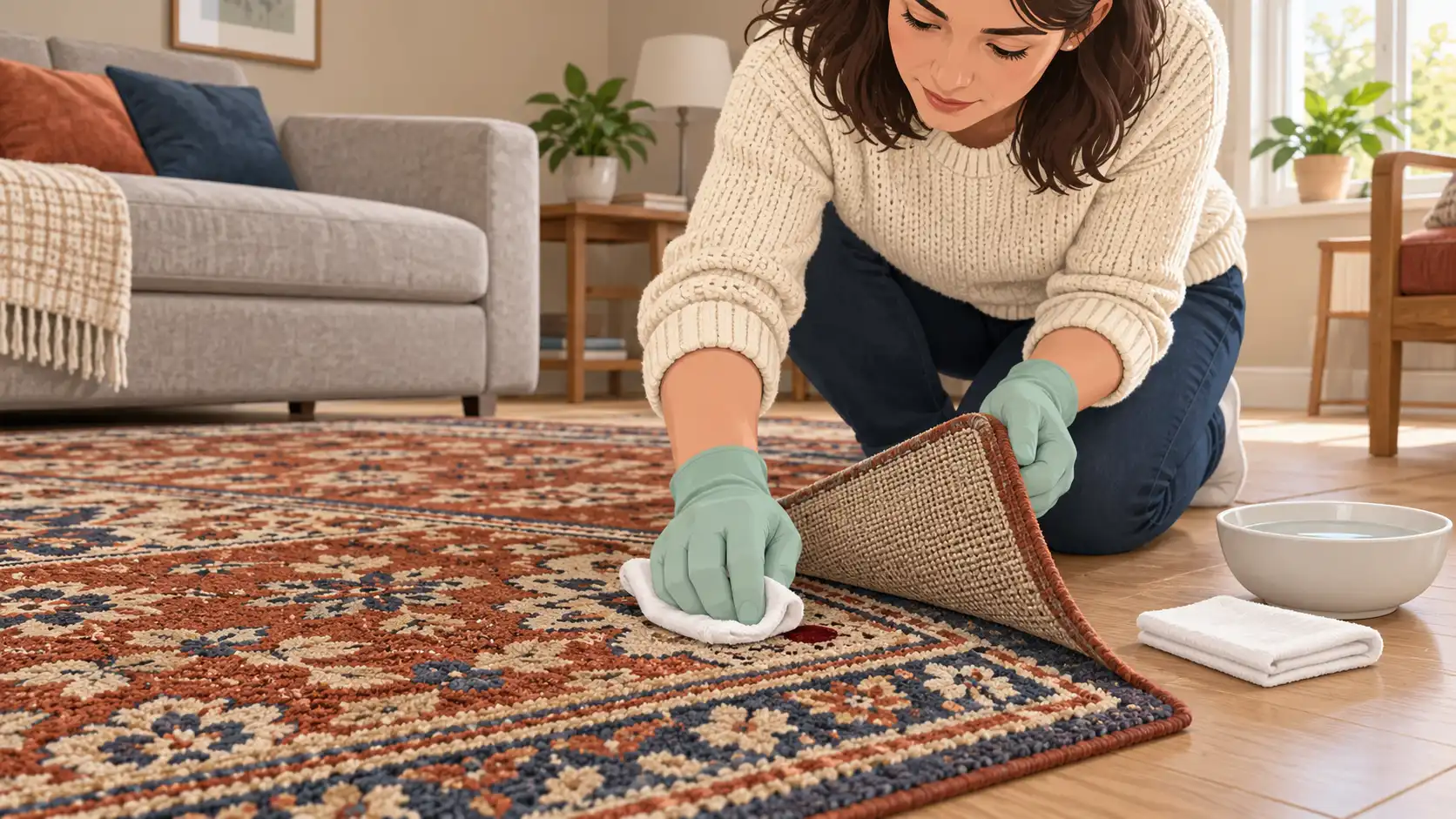
How to Get Blood Out of a Rug
15 October 2026
Would rather leave it to a professional? See our rug cleaning in Manchester.
Quick answer: Wear disposable gloves and blot fresh blood with a dry white cloth. Dab with cold water from the stain edge towards the centre. If needed, use a fibre-safe cleaner, rinse by blotting and dry both sides. Never use hot water, scrub the pile or soak the rug.
Blood stain do and don’t list
Do | Don’t |
|---|---|
Wear gloves and act quickly | Use warm water or steam |
Blot with clean white cloths | Rub, scrub or use a hard brush |
Use cold water sparingly | Pour cleaner directly onto the rug |
Dry the pile and backing fully | Put a damp rug back on the floor |
Why does cold water remove blood from a rug?
Blood contains proteins, including haemoglobin. Heat changes those proteins and can bind them more firmly to textile fibres. The iron in haemoglobin also oxidises as blood dries, which is why an older stain often changes from red to rusty brown.
Cold water helps dilute fresh blood without setting the protein. Speed matters because liquid can move from the pile into the rug’s foundation, backing and floor. Start blotting within minutes when possible.
What should you check before cleaning blood off a rug?
Identify the fibre, read the care label and look underneath the rug. Unlike fitted carpet, a rug has two accessible faces, edges or fringes, a woven foundation and sometimes a latex or jute backing. Moisture can pass through all these layers and mark the floor beneath.
Press a white cloth dampened with cold water onto a hidden corner. If rug dye transfers, stop wet treatment. Also stop if the rug is silk, viscose, antique, hand-knotted or labelled for professional cleaning only.
A small fresh mark on a stable synthetic rug is suitable for careful home treatment. Blood that has reached the back, crossed several colours or affected a valuable rug needs a rug specialist.
Which blood-cleaning method suits each rug fibre?
Rug fibre or type | Safe first method | Cleaner if needed | Avoid |
|---|---|---|---|
Polypropylene or polyester | Cold-water blotting | pH-neutral detergent or an enzyme cleaner labelled safe for that rug | Heat, soaking and untested peroxide |
Nylon | Cold-water blotting | Manufacturer-approved mild cleaner | Heat, bleach and hard scrubbing |
Wool | Cold-water blotting with minimal moisture | WoolSafe-approved, pH-neutral product | Biological detergent, alkaline cleaner, bleach and peroxide |
Cotton or washable rug | Cold-water blotting | Non-biological detergent if the label permits it | Hot wash, dye migration and unsupported handling while wet |
Jute or sisal | Dry blotting, then minimal cold moisture | Only a product approved by the maker | Saturation, steam and slow drying |
Silk, viscose, Persian, antique or hand-knotted | Dry blotting and specialist advice | Professional treatment | DIY stain remover and wet washing |
For more detail on protein fibres, read the guide to washing wool rugs safely. For a hand-knotted rug, follow the extra cautions in the guide to cleaning a Persian rug.
How do you get fresh blood out of a rug?
1. Put on gloves and remove excess blood
Keep children and pets away. Press a dry white cloth onto the stain, lift it and move to a clean section. Work from the outside towards the centre. Keep blotting until little liquid transfers.
2. Blot with cold water
Dampen a fresh white cloth with cold water. The cloth should be damp, not dripping. Press it against the stain for several seconds, then blot with a dry cloth. Repeat using clean sections.
3. Mix a mild cleaning solution
If cold water leaves a mark and the care label permits water-based cleaning, mix about 1 ml, roughly a quarter teaspoon, of clear pH-neutral detergent into 250 ml of cold water. Product directions take priority if they specify a different dilution.
Apply the solution to a white cloth rather than the rug. Dab the stain for up to one minute, then blot dry. Repeat once if the stain is still transferring. Do not keep adding detergent after colour stops moving onto the cloth.
4. Rinse out the detergent
Blot with a different cloth dampened with plain cold water. Then press a folded dry towel onto the spot for 30 to 60 seconds. Removing residue helps prevent a sticky patch and rapid resoiling.
5. Dry both faces of the rug
Raise the treated section so air reaches the pile and back. Put a waterproof layer beneath it if the floor is moisture-sensitive. Use a fan for airflow, but no heated appliance. Return the rug to the floor only when the backing feels dry rather than cool or damp.
Blood on a wool, silk or antique rug?
Book professional rug cleaning
How do you get dried blood out of a rug?
Put on gloves and lift any loose crust with a spoon or blunt plastic edge. Do not dry-brush or vacuum it. Hold a cold, damp white cloth against the mark for about five minutes to soften it, then blot.
Use the same 1 ml detergent to 250 ml cold-water solution if the fibre permits it. Apply it with a cloth, leave it in contact for up to five minutes and blot. Rinse with a plain cold-water cloth and dry both sides. Two gentle treatments with complete drying between them are safer than one aggressive soaking.
A remaining brown shadow may be oxidised blood, dye change or contamination within the foundation. More detergent will not necessarily remove it. This is the point to arrange an assessment.
How should you treat common blood stains on rugs?
Period blood
Use the fresh or dried method according to the stain’s condition. Cold-water blotting is the key step. Do not use hot water because the source of the blood does not change its protein chemistry.
Nosebleeds and shaving cuts
These usually create small drops. Blot each drop separately so the wet area does not become larger than the original stain. Start with cold water before introducing detergent.
Blood from a dog or cat paw
Move the animal away from the rug and deal with the injury first. Once the pet is safe, treat the rug with gloves and cold water. If the stain is on fitted flooring instead, use the separate guide to getting blood out of carpet.
Blood on a white or light rug
Start with cold water and mild detergent exactly as you would on a coloured rug. Hydrogen peroxide can brighten some white synthetic fibres, but it can also bleach wool, weaken delicate fibres or create a pale patch. Use it only when the manufacturer confirms it is safe. The guide to cleaning a white area rug explains the fibre checks in more detail.
Blood on a dark rug
Avoid peroxide and oxygen bleach because colour loss may be more visible than the blood stain. Test the approved cleaner on every distinct colour in a patterned rug.
Blood on rug fringes
Fringes are often cotton even when the pile is wool. Place a dry white towel beneath the fringe, blot with cold water and keep moisture away from the main rug body. Work in the direction of the fringe strands. Do not twist, scrub or pull them.
Blood on a machine-washable rug
Pre-blot with cold water. Machine wash only if the care label permits it, using the stated cold or low-temperature cycle and detergent. Do not place the rug in a warm wash or tumble dryer while any mark remains. Heat can set the stain.
Which home remedies work on blood stains?
Method | Should you use it? | Reason |
|---|---|---|
Cold water | Yes | The safest first treatment for fresh blood on water-safe rugs. |
Mild pH-neutral detergent | Yes, after testing | Helps lift residue when cold water is not enough. |
Enzyme cleaner | Only on compatible synthetics | It can break down protein residue, but it must be labelled safe for the fibre. Avoid ordinary enzyme products on wool and silk. |
Salt water or salt paste | Usually unnecessary | Salt can leave residue and does not outperform prompt cold-water blotting. |
Baking soda and vinegar | No | Foaming does not prove stain removal. The mixture can spread moisture and leave residue. |
Neat vinegar | No | Its acidity may affect dye or backing, and it is not needed for the first treatment. |
Saliva | No | It is unhygienic and introduces more biological material. |
Meat tenderiser | No | Proteolytic enzymes are uncontrolled and unsuitable for wool, silk and many rug dyes. |
Hydrogen peroxide or oxygen bleach | Only with manufacturer approval | It may help a confirmed white synthetic rug but can remove colour or damage delicate fibres. |
How do you clean blood safely?
Treat blood as a body fluid. Wear disposable gloves, prevent contact with your eyes, mouth and broken skin, and wash your hands with soap and water afterwards. The Health and Safety Executive guidance on blood-spill decontamination also says contaminated broken glass should never be collected by hand.
Seal used disposable cloths and gloves before disposal under local requirements. A small stain from a known minor cut can usually be handled at home. Extensive or unexplained blood, or contamination linked to a serious incident, requires a qualified biohazard cleaning service.
When should you call a professional rug cleaner?
Arrange an assessment if the rug is silk, viscose, antique, hand-knotted or valuable; dye transfers during testing; blood reaches the backing; a smell remains after drying; or the mark is large, old or still visible after two gentle treatments.
In InstantDry’s rug-cleaning work, the condition of the backing often decides whether a mark is still a surface stain or needs full controlled treatment. Tell the cleaner what caused the stain and list every product already used. This helps them assess dye migration, wicking and chemical residue. No cleaner can promise complete removal where blood, oxidation or a previous product has changed the fibre or dye.
Frequently asked questions
Does hot water set blood stains?
Yes. Heat changes blood proteins and can bind them more firmly to rug fibres. Use cold water and avoid steam, warm washing and heated drying until the stain is gone.
Can I use vinegar or baking soda on blood?
They are not needed. Baking soda and vinegar create foam but do not offer a better controlled treatment than cold water and fibre-safe detergent. They may also leave residue or affect the rug.
How do I get period blood out of a rug?
Wear gloves, blot with a dry white cloth, then dab with cold water. Use a tested fibre-safe detergent if a mark remains. Treat dried period blood with a cold damp cloth for about five minutes before blotting.
Can I machine wash a rug with blood on it?
Only if the care label permits machine washing. Pre-blot the stain, use the specified cold or low-temperature cycle and do not apply tumble-dryer heat while the mark remains.
Is an enzyme cleaner safe on my rug?
It may be suitable for polypropylene or polyester when the label names that fibre. Avoid ordinary biological or enzyme cleaners on wool and silk unless a specialist product is expressly approved for them.
How do I get blood out of a white rug?
Begin with cold water and mild detergent. Do not assume white means bleach-safe. Peroxide or oxygen bleach should be used only when the manufacturer confirms the white synthetic fibre, dye and backing can tolerate it.
Why did the blood stain turn brown?
The iron in haemoglobin oxidises as the blood dries. A brown mark may be older blood within the pile or backing and can need repeated gentle treatment or professional cleaning.
How do I stop a ring appearing after cleaning?
Use minimal liquid, work from the outer edge in, rinse out detergent and dry both sides evenly. A ring can form when dissolved residue moves to the edge of a wet patch during drying.
Will professional cleaning remove all traces of blood?
Not always. Results depend on the rug fibre, dye stability, stain age, contamination depth and products already applied. A specialist assessment gives the most realistic expectation.
What should I do if blood has reached the floor?
Lift the rug with gloves, protect the surrounding area and clean the floor using a method suitable for that surface. If contamination is extensive or has entered porous flooring, contact a specialist.
Need a rug stain assessment? Describe the rug fibre, stain size and products already used when requesting your quote.
How do you get blood out of a wool rug?
Blot with cold water only, then apply a wool-safe enzyme cleaner or a little cold salt water. Blot from the outside in and rinse with cold water. Never use hot water or hydrogen peroxide on wool, as they set the stain or bleach the dye.
Does hydrogen peroxide remove blood from a rug?
On white or colourfast synthetic rugs, 3% hydrogen peroxide can lift blood. Test a hidden corner first, because it can lighten dyes. Rinse with cold water afterwards and blot dry.
Related guides: how to get blood out of a sofa, how to get blood out of a mattress. For a professional finish, see our rug cleaning service or carpet cleaning in Manchester.
Related guides
Need it cleaned properly?
Book our rug cleaning service — from £39 (UK average £60), free in-home survey and pay on completion.