How to Clean a Rug With a Steam Cleaner
29 August 2026
Quick answer: Check the rug's care label and fibre type before using any steam cleaner on it. Synthetic rugs (polypropylene, polyester, nylon) handle steam cleaning well. Wool rugs can tolerate it with care, but slow passes, maintained distance and no scrubbing agitation are essential. Jute, sisal, seagrass and viscose should not be steam cleaned — the moisture from condensing steam causes the same browning and structural damage as liquid water on these materials. Always test colour fastness on a hidden corner first. Elevate the rug during and after cleaning so steam condensate doesn't trap moisture between the rug back and the floor.
Steam cleaning is a genuinely useful tool for maintaining rugs between deeper washes. It removes surface bacteria, refreshes the pile and deodourises without the moisture levels of a full wet clean. Whether it's the right method for your rug depends almost entirely on what the rug is made of. Instant Dry Carpet Cleaning cleans and collects rugs professionally across England and Wales and the fibre question comes up every time — it matters as much here as in any other cleaning context.
Which type of steam cleaner do you have?
Most guides treat all steam cleaning equipment as equivalent. It isn't, and the type you have changes what's appropriate on a rug.
Handheld steamer or garment steamer with upholstery attachment. Produces a directed jet of steam, typically without suction. Good for surface sanitising, refreshing pile and light maintenance. Low moisture output when used correctly. The most suitable option for most rug types that tolerate steam at all.
Upright steam mop. Designed for sealed hard floors. When used on a rug it can trap steam condensate between the mop pad, the rug and the floor beneath, with limited ability to extract it. The pad can also leave moisture sitting on the rug backing. Less suitable than a handheld steamer for rugs.
Steam extraction cleaner (sometimes called a steam cleaner or hot water extractor in the consumer market). Injects heated water or steam into the carpet or rug and extracts moisture with suction. More powerful than a handheld steamer and more effective at removing embedded soil. The same caution around fibre type applies, and the extraction function makes drying faster than a handheld steamer.
The steps below apply primarily to handheld steamers and steam extraction machines. If you're using an upright steam mop, elevate the rug on a frame or railing rather than cleaning it on the floor.
Which rugs can be steam cleaned?
Rug type | Steam safe? | Notes |
|---|---|---|
Polypropylene / synthetic | Yes | Most forgiving. Handles heat and moisture well |
Polyester | Yes | Generally safe. Check care label |
Nylon | Yes | Handles steam well |
Wool or wool-blend | With care | Slow passes, maintain distance, no scrubbing. WoolSafe cleaner if pre-treating stains |
Cotton | With care | Can shrink if over-wetted. Short passes, good airflow for drying |
Viscose / bamboo silk / art silk | No | Steam condenses as moisture and causes the same damage as liquid water |
Jute / sisal / seagrass | No | Moisture from condensing steam causes cellulosic browning and backing damage |
Silk | No | Extreme sensitivity to heat and moisture |
Hand-knotted antique rugs | No | Professional only |
When in doubt, treat the rug as wool and use the cautious approach: maintained distance, slow passes, no held positions.
Before you start: colour fastness is non-negotiable
Steam loosens the bond between dye and fibre more than cold water does, which means dye migration is a real risk on any rug that isn't thoroughly colourfast.
Test on a completely hidden area first. A corner tucked under a sofa or behind a door. Apply a small amount of steam for around five to ten seconds and immediately press a white cloth firmly onto the area. If any colour transfers to the cloth, the rug's dyes are unstable. Stop. This rug needs professional dry cleaning, not steam.
Do this test with every rug, every time, even rugs you've steam cleaned before. Dye stability can change over time as dyes age.
Use distilled or filtered water in the machine rather than UK tap water where possible. Hard water in much of England deposits minerals through the steam onto the rug pile over repeated cleaning, leaving a faint residue that dulls the appearance over time. It also causes limescale build-up inside the machine.
How to steam clean a rug, step by step
For synthetic and cautiously for wool and cotton rugs where the colour fastness test has passed.
Step 1: Vacuum both sides first
Vacuum the pile surface with the suction-only nozzle. Then flip the rug and vacuum the backing. Any loose debris left in the pile before steaming gets pushed into the fibres rather than lifted out.
Step 2: Pre-treat any stains
Treat visible stains with an appropriate spot cleaner before introducing steam. Steam can heat and partially set untreated stains rather than lifting them, particularly protein-based stains. Apply the pre-treatment, allow the dwell time, and blot before steaming over the area.
Step 3: Elevate the rug if possible
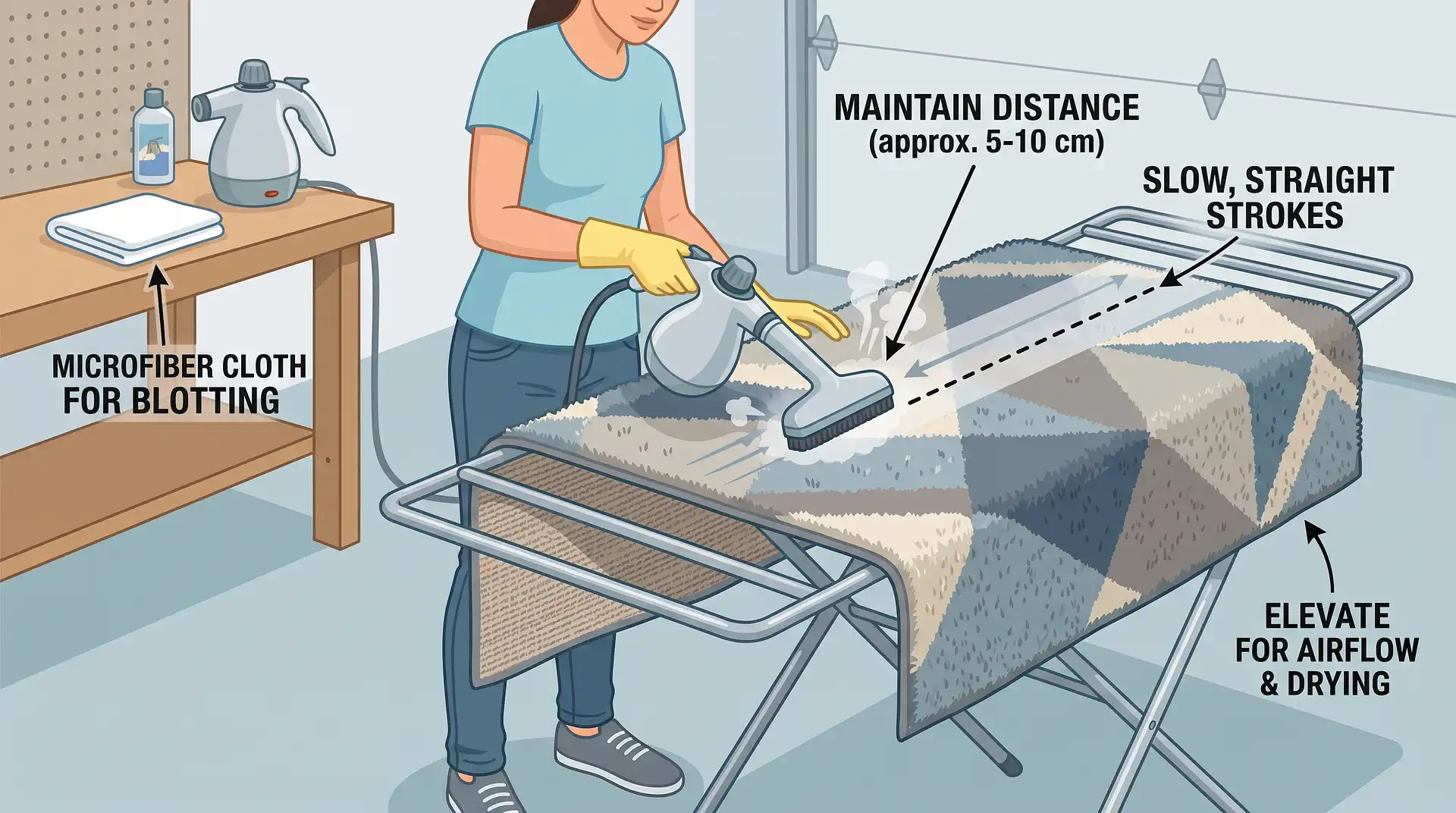
If you have a frame, chairs, or a railing available, work with the rug elevated rather than flat on the floor. This prevents steam condensate from being trapped between the rug backing and the floor surface beneath. On hard floors this causes moisture to pool under the rug. On carpet it causes moisture to transfer into the carpet backing.
Step 4: Work in sections, keep the head moving
Work in sections of roughly half a metre, moving the steam head in slow, straight, overlapping lines. Keep the steam head at the distance recommended for the rug type — closer for synthetic, further back for wool and cotton.
Never hold the steam head stationary on one spot. Concentrated steam on a fixed point superheats that area, risks dye migration and can damage the pile structure.
One pass with steam active, then one or two passes with steam off (or suction if using an extraction machine) to remove loosened soil and condensate before moving to the next section.
Step 5: Blot, don't rub
After each section, press a dry white microfibre cloth firmly onto the area to lift loosened soil and excess moisture. This both cleans and speeds drying.
Step 6: Dry thoroughly
Covered in the next section — this is where most steam cleaning problems originate.
Drying: the step that causes most problems
Steam introduces considerably less moisture than a full wet wash, which is one of its advantages. It still introduces moisture, and moisture in the wrong place causes the same mould, odour and structural damage as any other cleaning method.
The rug must not be returned to use on the floor while the backing is still damp. The backing holds moisture longer than the pile surface, and a rug placed backing-down on carpet or a hard floor before it's completely dry traps that moisture. On carpet this can cause backing mould on the rug and damp transfer into the carpet beneath. On hard floors it can mark the floor surface.
Elevate for drying. Hang over a railing, fence or washing line, or prop against a wall with the pile facing outward. Air must reach both the pile and the backing.
Open windows and increase airflow. On a typical UK day with the windows closed, a rug drying flat in a room can take considerably longer than the one to six hours quoted by some guides.
Check the backing before returning to position. Press your hand firmly against the backing. Any coolness or residual dampness means more time is needed.
Rugs that should never be steam cleaned
Jute, sisal and seagrass. Steam condenses as moisture on contact with these plant fibres. The moisture causes the same cellulosic browning — the natural plant compounds dissolving and depositing on the surface — as liquid water does. This is covered in detail in the jute rug cleaning guide on this site. The damage is often irreversible.
Viscose and bamboo silk. The condensed moisture from steam causes the same structural damage as liquid water — loss of tensile strength, distortion and permanent watermarking.
Silk. Highly sensitive to both heat and moisture.
Hand-knotted antique or Persian rugs. The dye stability of older rugs, the fragility of aged natural-fibre backings and the potential value make any home steam treatment a significant risk.
Steam cleaning versus professional extraction
A domestic steam cleaner refreshes the rug surface and kills bacteria and dust mites in the upper layers of the pile. It is not a deep clean in the same sense as professional hot water extraction.
Professional extraction cleaning forces heated water into the pile under controlled pressure and extracts it with powerful suction, pulling dissolved soil, biological matter and moisture out from significantly deeper in the pile and backing than a domestic steam cleaner reaches. The drying time after professional extraction is also managed with professional equipment rather than airflow alone.
For a rug in good general condition being maintained between washes, a domestic steam cleaner is a genuinely useful tool. For a rug with years of embedded soil, a significant stain, or a persistent odour, professional cleaning reaches what steam at home cannot. The how to clean a rug at home guide covers the full range of home cleaning options across rug types, and Instant Dry Carpet Cleaning collects, cleans and returns rugs across England and Wales for situations where home methods have reached their limit.
FAQ Section
Can you steam clean any rug? No. Synthetic rugs handle steam cleaning well. Wool and cotton can tolerate it with care. Jute, sisal, seagrass, viscose and silk should not be steam cleaned — the condensing steam moisture causes the same damage as liquid water on these materials, including browning, stiffening and structural distortion.
Can you steam clean a wool rug? With care, yes. Use maintained distance rather than close application, slow passes without lingering in one spot, and no scrubbing agitation. Check colour fastness on a hidden corner first. Use a WoolSafe product if pre-treating any stains before steaming.
Can you steam clean a jute rug? No. The moisture from condensing steam causes cellulosic browning in jute — the natural plant compounds dissolve and deposit on the surface as the moisture evaporates. This produces a brown staining that is distinct from the original soiling and is often permanent.
How do you dry a rug after steam cleaning? Elevate the rug so air reaches both the pile surface and the backing. Hang over a railing or fence, or prop against a wall. Don't lay it flat on the floor until the backing is completely dry. Open windows and increase airflow. Check the backing by pressing your hand firmly against it before returning the rug to use.
Is steam cleaning good for rugs? For synthetic, nylon and most cotton rugs it's a useful maintenance method between deeper washes. It refreshes the pile, kills bacteria and reduces dust mite populations in the upper layers without the moisture levels of a full wet clean. It's not a substitute for a thorough wash on a heavily soiled rug.
Should I use tap water or distilled water in my steam cleaner? Distilled or filtered water is preferable, particularly in areas with hard tap water. Mineral deposits from repeated steam cleaning can dull the rug pile over time and cause limescale build-up in the machine. Most domestic steam cleaners also recommend distilled water in their own care instructions.
Why does my rug smell musty after steam cleaning? Moisture was trapped between the rug backing and the floor surface. The rug needs to be elevated during and after cleaning so air reaches both sides. If the backing was damp and the rug was returned to the floor before it dried fully, remove it, elevate it and allow it to dry completely.
Can I use a steam mop on a rug? An upright steam mop is designed for hard floors and is less suited to rugs than a handheld steamer. If using one on a rug, elevate the rug on a frame or railing rather than cleaning it flat on the floor, which reduces the risk of moisture pooling under the rug.
Service Section
Steam cleaning refreshes. Professional extraction cleans deeper.
For a rug that needs more than a surface refresh — one with years of embedded soil, a stubborn stain or a smell that steam hasn't shifted — professional extraction reaches what a domestic machine can't. InstantDry collects rugs across England and Wales, cleans them in a controlled environment using fibre-appropriate methods, and returns them properly dried and wrapped. Each rug is assessed individually before cleaning begins. Rugs from £89.
Get your fixed quote in 60 seconds
Or call 07555 856988