How to Get Blood Out of a Mattress
20 August 2026
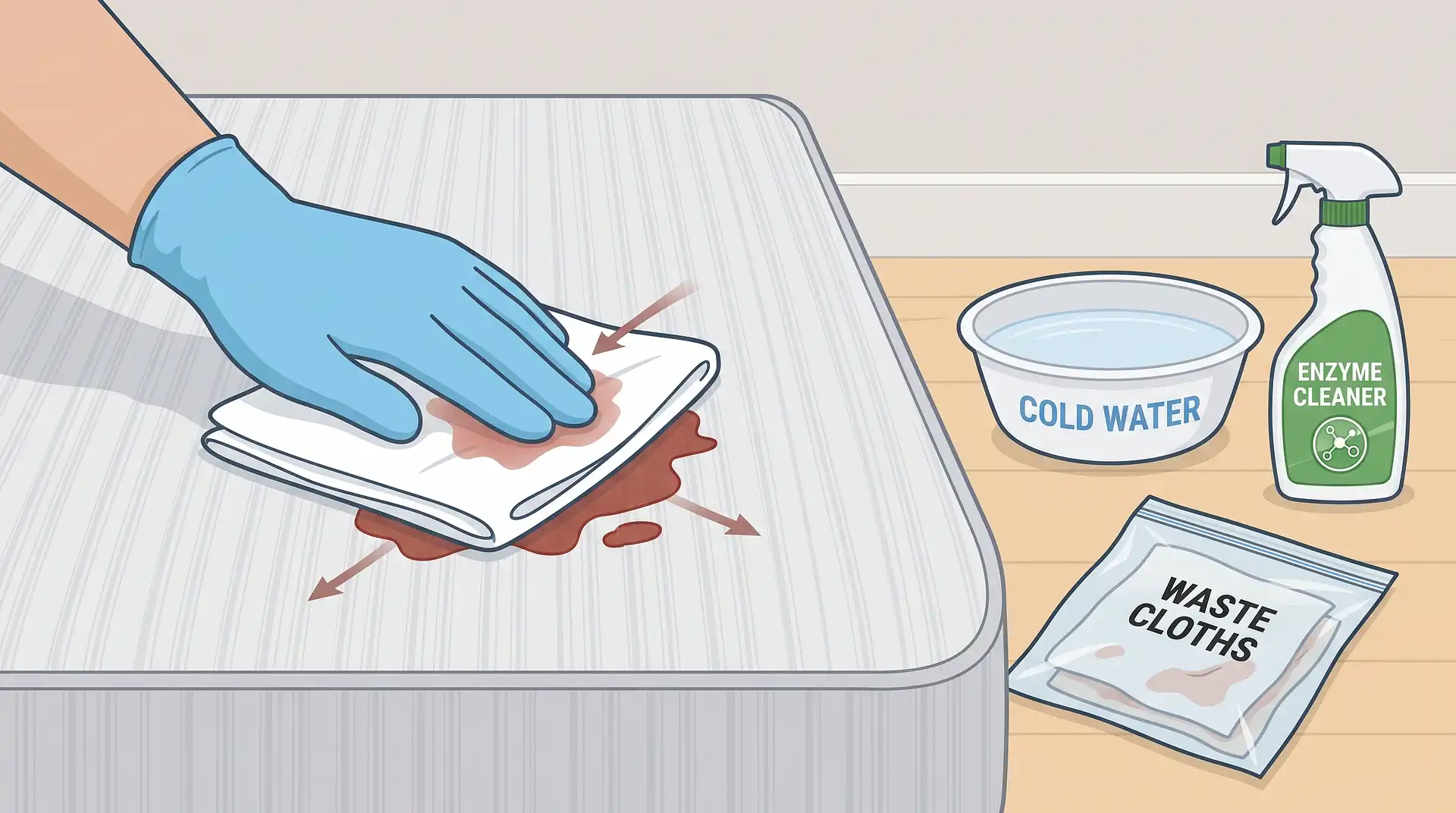
Quick answer: Cold water only, never warm or hot — heat sets the protein in blood permanently into the fibre and turns a recoverable stain into a permanent one. Put on gloves before touching anything. Blot with a white cloth, working from the outside of the stain in, and never rub. For fresh blood, cold water and blotting lifts most of it. For dried blood, rehydrate with cold water first, then use an enzyme cleaner with a long dwell time. Apply solution to a cloth rather than pouring onto the mattress, and dry thoroughly afterwards — a damp foam core left sealed in a warm bedroom causes odour problems of its own.
Finding blood on a mattress isn't unusual — a cut, a nosebleed, a period. The method is the same in every case, and it's simpler than most guides make it look. The cold water rule is the one thing that matters most, and it's the one most people get wrong when they're half-asleep and in a hurry.
Before you start: blood is a body fluid
Worth stating plainly, because every other mattress stain guide skips this.
Blood can carry bloodborne infections. The practical risk from your own blood, or blood from someone in your immediate household whose health you know, is low. The precautions below are sensible basics rather than an emergency protocol.
Put on gloves before you touch the stain. Nitrile or vinyl, not fabric. This applies even if it's your own blood — gloves keep cleaning products off any broken skin and keep the job sanitary.
Use white cloths. Coloured cloths can transfer dye into damp fabric.
Dispose of used cloths and gloves carefully. Into a sealed bag, then the outdoor bin. Don't leave blood-soaked material lying around.
Wash hands thoroughly afterwards with soap and water, even though you wore gloves.
If the blood is from someone outside your household and you don't know their health status, treat it with more caution: gloves, no bare skin contact, and the same disposal approach. The fuller hygiene guidance is in our blood stain article, which covers this properly.
Why cold water is the only option
Blood contains haemoglobin, an iron-based protein. When it contacts heat — warm water, a hot cloth, a hairdryer — that protein denatures: it changes structure and bonds permanently to the textile fibre. The same process turns a clear egg white opaque and solid in a frying pan.
A fresh blood stain treated with hot water becomes a set stain. A recoverable problem becomes a permanent one in seconds.
Cold water only. Always. This applies to the water you use, any cloth you apply, and anything you use to speed up drying afterwards. No hairdryers, no heated throws, no placing the mattress near a radiator.
Fresh blood: act in this order
Speed helps more with blood than with almost any other mattress stain. Fresh blood hasn't oxidised and hasn't had time to penetrate deep into the foam.
Step 1: Gloves on first
Before anything else.
Step 2: Blot, don't rub
Press a dry white cloth firmly onto the stain, working from the outer edge inward. Lift, refold to a clean section, repeat. Keep going until nothing more transfers.
Rubbing spreads the stain wider, drives it deeper into the mattress layers, and damages the cover fabric. Blotting is slower and more effective.
Step 3: Cold water dilution
Lightly dampen a clean cloth with cold water and continue blotting. This dilutes the haemoglobin concentration near the surface before it has time to bond.
Don't pour water directly onto the mattress. Apply to a cloth only. A mattress is foam or fill inside a sewn cover — liquid that reaches the core cannot dry from the inside out, and a blood-contaminated foam core left damp and warm will develop an odour.
Step 4: Salt or cornstarch paste for stubborn fresh stains
Mix salt or cornstarch with just enough cold water to make a paste. Apply to the stain, leave ten to fifteen minutes, then scrape off gently with a blunt edge and blot away the residue. The paste draws moisture and dissolved blood out of the fibre by osmosis.
Step 5: Enzyme cleaner if any mark or odour remains
An enzyme cleaner applied to a cloth, dabbed onto the area and left to dwell for at least ten minutes, handles both residual protein and any faint odour. Keep the area damp while it works, as enzymes stop working as things dry out.
Step 6: Rinse and dry
Mist lightly with cold water to remove product residue, blot thoroughly, and dry with good ventilation. Press a dry hand firmly into the treated area to check the foam is drying rather than just the surface.
Dried blood: the patient approach
Dried blood has oxidised — that's why it turns from red to brown. It takes longer than fresh blood but is often far from hopeless, particularly on synthetic mattress covers.
Vacuum first to remove any surface crust.
Rehydrate with cold water. Dampen a cloth and hold it against the stain for several minutes. The oxidised haemoglobin needs moisture before it becomes workable.
Apply enzyme cleaner with a longer dwell time than you'd use on a fresh stain — twenty minutes or more, keeping the area damp.
Blot, reapply, repeat over several passes. Dried blood lifts in layers rather than all at once.
Salt or cornstarch paste between passes can help draw up loosened material.
Judge progress by comparison — how it looks now versus how it started, not versus perfection. Stop when two or three full cycles produce no further improvement.
On hydrogen peroxide: it works on blood by oxidising the haemoglobin, which is why it's commonly recommended. It carries a bleaching risk on coloured or patterned mattress covers, and on any fabric of uncertain colour-fastness. Test on a hidden area — a side panel near the base, or under the mattress — in daylight, before using it on a visible stain. Use it diluted (three percent is sufficient), apply to a cloth rather than the mattress, and never combine it with other products. Never use it on a mattress with a latex core, since peroxide degrades latex.
Period blood: same method, different context
Period blood is chemically identical to other blood — the same haemoglobin, the same cold water requirement, the same enzyme cleaner approach. The method is exactly the same.
What's different is the context. For many people this is a monthly occurrence rather than a one-off accident, often discovered after waking, sometimes after several hours have passed.
A few practical points specific to this situation:
Dried period blood is very common and very treatable. A stain that's been there since overnight is not significantly harder to treat than one found after an hour. The rehydrate-then-enzyme approach works well on most mattress cover fabrics.
Colour variation is normal and doesn't change the method. Darker, older or brown-toned period blood has simply oxidised further. Treat it the same way.
A mattress protector is the most practical long-term solution. A waterproof protector stops blood reaching the mattress entirely and goes in the washing machine at 60°C. If period accidents are a regular occurrence, a protector is worth considerably more than any cleaning method. Two protectors with a sheet between them — the same layering approach recommended in the urine article — means that if an accident happens at night, stripping the top layer leaves a clean, made bed underneath without remaking in the dark.
The stain on the protector usually comes out easily in a cold machine wash, with an enzyme pre-soak for older marks if needed.
Why the stain came back
If you cleaned the stain, saw it fade, and then found it back — usually as a brown tide mark — that's wicking.
Blood that soaked below the cover surface into the foam underneath doesn't fully lift with surface treatment. As the mattress dries, moisture carries the remaining dissolved haemoglobin back up through the fibres to the surface, where it redeposits.
The fix: re-dampen lightly with cold water, blot thoroughly, then dry under a dry towel with weight on it. Repeat over two or three drying cycles.
If it keeps returning after several cycles, the blood reached the foam core and surface treatment can't reach it. That's where extraction equipment makes a genuine difference — pulling liquid out of the core rather than pushing more in.
What won't come out
Worth being straight about, because every competing page implies complete removal is always achievable.
Old, deeply set blood on white or cream quilted covers is the hardest case. Quilted ticking holds staining differently from a smooth jersey cover, and the quilted areas trap oxidised haemoglobin in the stitching where surface blotting can't reach it. Significant lightening is usually achievable. Complete removal sometimes isn't.
Blood that reached the latex or memory foam core cannot be treated from the surface regardless of the product used. Surface treatment reaches perhaps the first third of the pile depth.
The realistic goal on a difficult stain is a significant improvement that's invisible under a fitted sheet and protector, not necessarily complete removal when viewed in bright light at close range.
8. FAQ Section
How do you get blood out of a mattress? Put on gloves, blot with a dry white cloth working from outside in, then use cold water on a cloth to dilute the stain. For fresh blood, blotting and cold water often clears most of it. For dried blood, rehydrate first, then apply an enzyme cleaner with a long dwell time. Always cold water — heat sets blood permanently.
How do you get dried blood out of a mattress? Rehydrate the stain with a cold damp cloth held against it for several minutes, then apply an enzyme cleaner and leave it at least twenty minutes, keeping the area damp. Blot, reapply and repeat over several passes. Dried blood lifts in layers rather than all at once.
How do you get period blood out of a mattress? Exactly the same method as any other blood. Cold water, blotting, enzyme cleaner with a long dwell time. Period blood that's been there overnight is very treatable. A waterproof mattress protector is the most practical long-term solution for monthly accidents.
Why can't you use hot water on blood? Blood contains haemoglobin, a protein that denatures under heat the same way egg white does when cooked. Hot water bonds it permanently to the fibre. Cold water only — always.
Does hydrogen peroxide remove blood from a mattress? It works by oxidising haemoglobin but carries a bleaching risk on coloured covers. Test on a hidden area in daylight first. Use at three percent dilution on a cloth, not poured on. Never combine it with other products and never use it on a latex foam core.
Why did the blood stain come back after I cleaned it? Wicking. Blood that soaked into the foam underneath resurfaced as moisture carried it back up during drying. Re-dampen with cold water, blot thoroughly and dry under a weighted towel, repeating over two or three drying cycles.
Do I need to wear gloves to clean blood off a mattress? Yes. Even for your own blood, gloves keep cleaning products off broken skin and keep the job sanitary. Dispose of used gloves and cloths in a sealed bag.
Can old blood stains be removed from a mattress? Often substantially, though complete removal isn't always achievable. Old blood on white quilted ticking is the hardest case. Significant lightening to the point of being invisible under normal bedding is usually achievable with patient treatment.
Is a mattress still usable after a blood stain? Usually yes, particularly if the stain is surface-level and treated reasonably promptly. A mattress with blood in the core foam that continues to wick back or smell may eventually need replacing, but that's the exception rather than the rule for most accidents.
InstantDry offers professional mattress cleaning across England and Wales, with a free survey and a fixed price before any work begins. If we don't think the stain can be improved, we'll say so rather than take the booking.