How to Clean Infant Car Seats
22 August 2026
Quick answer: Get out the manual before you pick up a cleaning product. Every manufacturer has specific guidance for their seat, and that guidance overrides all general advice — including this article. The harness webbing must never go in a washing machine or be submerged, since machine washing degrades its load-bearing capacity. The cover may or may not be machine washable depending on the model. Bleach, sterilising sprays, fabric conditioner and fragrance products can all damage the flame-retardant properties of the seat fabric. Air dry everything, never use a tumble dryer unless the manual specifically permits it, and take photos before disassembling anything so you can safely reassemble it.
An infant car seat is the one piece of cleaning subject matter where general upholstery advice is genuinely not enough, and where following the wrong guidance causes a problem that isn't visible — because the damage is to structural and safety-critical components rather than to the appearance of the seat.
This article covers what you can and can't do, and why. But the authority on your specific seat is always the manufacturer's manual. If anything here conflicts with your manual, follow the manual.
The rule that overrides everything else
The number one rule when it comes to cleaning is: follow the guidelines in the user's manual. Cleaning methods and chemicals can affect the performance of the car seat.</cite>
Manuals are specific to models. A cleaning method safe for one brand's harness system may not be appropriate for another's. The general guidance below applies to most infant seats, but your manual takes precedence, and if you've lost it, every major manufacturer makes manuals available as PDFs on their website.
This is not a disclaimer, it's practical advice. The consequences of weakened webbing or a jammed buckle are different from the consequences of a watermark on upholstery.
Why child car seats are different from car upholstery
The general car seat cleaning articles on this site cover fabric and leather upholstery on adult car seats. Those are upholstery cleaning problems. A child car seat is a different category of object entirely.
The harness webbing is a structural load-bearing component. In a frontal crash, it restrains the child by absorbing the energy of deceleration Machine washing stretches and degrades the webbing prematurely, affecting its load-bearing capacity. The webbing cannot be seen to have weakened — it looks the same — but its performance in a crash is compromised. This is why the restriction isn't about aesthetics.
The fabric covering has flame-retardant properties. UK and EU child seat standards require seats to meet flame retardancy specifications. Certain cleaning products, including common household sterilising sprays, fabric conditioners and some detergents, can affect this chemical property. Sterilising wipes and sprays can damage the flame-resistant elements of the seats, as well as irritating a child's skin.
The buckle mechanism is precision engineered. The push-button release on a child seat buckle must operate reliably, including immediately after a crash when a first responder or panicked parent needs to release the child quickly. Rust, residue, or lubricant in the mechanism affects this.
The structural foam is part of the crash protection system, not seat cushioning. It should not be wetted heavily, chemically treated, or subjected to anything that alters its structure.
Before you start: photograph everything
Take photos as you go so you have a reference for how the seat should look. By the time you've washed and dried the fabric covers, you may have forgotten exactly where each component goes.</cite>
Photograph the harness routing, the cover attachment points, the buckle position, and the chest clip position before removing anything Many safety issues can occur if the seat is not reinstalled correctly.</cite> Reassembly is a safety step, not a finishing detail.
The cover and padding
Most infant car seat covers are removable, but what happens next depends entirely on the model.
Some covers are machine washable on a gentle cold or 30°C cycle. The manual will state this explicitly. Use a mild, fragrance-free detergent only — no fabric conditioner, which can affect flame retardancy, and no biological detergent with strong enzymes that may affect the fabric treatment.
Some covers are hand wash only. Cool water, mild detergent, gentle agitation, thorough rinse.
Some covers should only be spot cleaned. The manual will say so.
Covers should be hung or laid flat to air dry to prevent shrinking or damage to the cover and safety labels.</cite> Never tumble dry unless the manual explicitly permits it. Air drying is recommended for most car seats and fabrics should be kept away from direct heat sources such as radiators.
Safety labels on the cover must remain intact and legible. These carry information about the seat's standards compliance. If they become illegible, the seat's compliance status may be affected.
The harness straps
This is the component where the rules are most strict and most important.
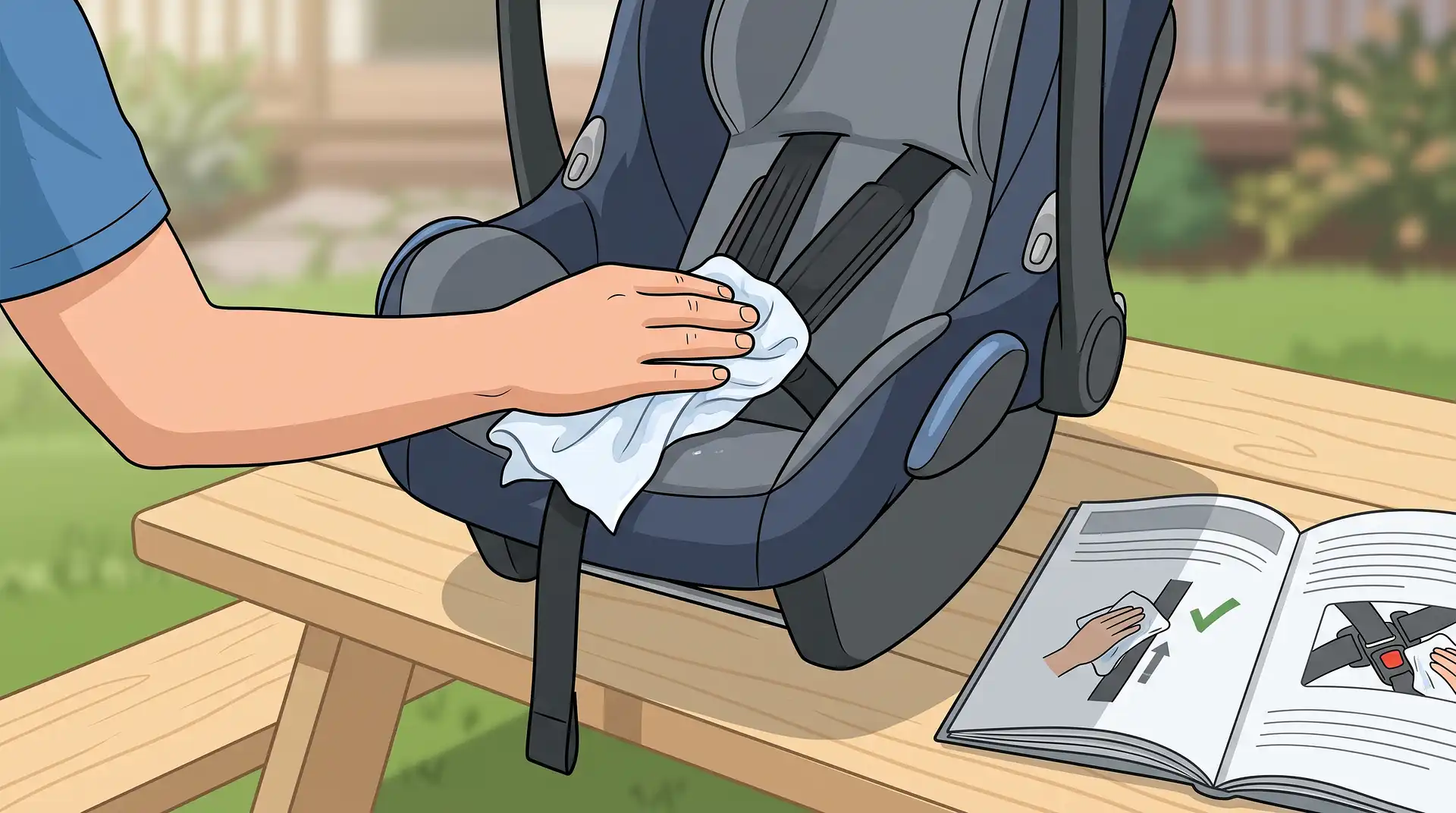
Never put them in the washing machine or clean them with abrasive scrubbers, and avoid submerging the straps completely in water.
The correct approach: wipe with a damp cloth and mild soap, cleaning in the direction of the strap rather than across it. Rinse by wiping with a plain damp cloth. Air dry flat.
That's it. No soaking, no machine, no scrubbing, no solvent, no bleach.
For stubborn staining on the straps, most manufacturers advise contacting their customer service rather than attempting aggressive cleaning, since the answer varies by model and strap construction.
The buckle and chest clip
<cite index="11-1">Buckles are best treated by being dunked into warm water and then moved around to dislodge any dirt, using a soft cloth for additional cleaning if necessary.</cite> Plain warm water only — no soap, no detergent in the mechanism, no lubricant.
After cleaning, work the buckle mechanism several times to confirm it releases freely. Air dry completely before reassembling.
Never lubricate a buckle with WD-40, cooking spray or anything else. Lubricant attracts debris and can affect the release mechanism.
The seat shell and structural foam
The hard plastic shell and the structural foam underneath it are part of the crash protection system.
Wipe the shell with a damp cloth and mild soap. Don't scrub hard, don't use abrasive cleaners, and don't allow water to pool in crevices where it can reach the structural foam or the harness anchor points.
The structural foam should not be wetted at all where this can be avoided. If liquid has reached it, air dry thoroughly before using the seat — a damp structural foam component that sits in a warm car can grow mould in exactly the same way seat cushion foam does, but replacing or professionally drying it is harder.
Stains by type
Milk and formula. The most common infant seat stain. Protein-based, so cool water and a mild detergent lifts it from the cover fabric. An enzyme cleaner applied to the cover, following the manufacturer's guidance on chemicals, deals with residual odour. Never hot water.
Vomit. Remove solids first, then treat as a protein stain on any removable cover. For the harness, wipe only with a damp cloth. The smell from vomit on webbing is persistent because protein residue stays in the fibres — patience and repeated wiping over several sessions is the method.
Urine. Common during potty training transitions when a child is moved to a forward-facing seat. Cool water, mild detergent on the cover if removable, enzyme cleaner for odour. The same uric acid chemistry covered in the urine mattress article applies — detergent lifts the visible mark, enzyme cleaner is what deals with the recurring smell.
Food and drink. Treat promptly. Dried food in the harness slots and buckle mechanism is the practical problem more than the fabric stain. A soft toothbrush with plain water clears debris from the buckle surround and harness slots without any chemical risk.
Sunscreen. A common and difficult stain on infant car seats. Oil-based, so blotting with a dry cloth first before any liquid. Mild detergent on the cover. Accept that some sunscreen staining is persistent.
What never to use
Bleach. Damages fabric, degrades flame retardancy, corrodes metal components.
Sterilising sprays and wipes (Dettol, Milton, Lysol and similar). May damage flame-retardant properties and can irritate a child's skin on next use.
Fabric conditioner. May affect flame retardancy.
Strong enzyme detergents. Check the manual — some manufacturers permit them on covers, others don't.
Solvents. White spirit, acetone, nail varnish remover — no application on any part of a child car seat.
Abrasive scrubbers. Damage harness webbing and cover fabric.
Tumble dryer. Unless the manual explicitly permits it on the cover.
Direct heat. Radiators, hairdryers, car heaters directed at the seat.
Lubricants on buckles. Affects the release mechanism.
One thing nobody mentions: post-crash replacement
If the car seat has been in any collision — even a minor one that caused no visible damage and in which the car drove away — it should be replaced.
UK car seat regulations require seats to meet specific safety standards.</cite> Impact, even at low speed, can stress structural components and harness anchors in ways that are not externally visible but that reduce the seat's ability to protect a child in a subsequent crash. Most manufacturers state this explicitly, and most car insurance policies cover child seat replacement after an incident.
This is not cleaning advice — it's the most important thing in the article, and it belongs here because it's the one situation where no cleaning method is the answer.
8. FAQ Section
Can you machine wash an infant car seat cover? It depends entirely on the manufacturer's guidance for your specific model. Some covers are machine washable on a gentle cold or 30°C cycle with mild detergent; others are hand wash only; others should only be spot cleaned. Check the manual before washing.
How do you clean car seat harness straps? Wipe with a damp cloth and mild soap in the direction of the strap, rinse with a plain damp cloth, and air dry flat. Never machine wash, submerge or scrub harness straps — machine washing degrades the webbing and reduces its load-bearing capacity in a crash.
Can you use antibacterial wipes on a baby car seat? Most sterilising and antibacterial wipes are not recommended, since they can damage the flame-retardant properties of the seat fabric and may irritate a child's skin. Use a damp cloth with mild, fragrance-free detergent instead.
How do you clean a car seat buckle? Dunk in plain warm water and work the mechanism to dislodge debris. Use a soft cloth to wipe the exterior. No soap in the mechanism, no lubricant. Air dry and test the release before reassembling.
Is it safe to tumble dry a car seat cover? Only if the manufacturer's manual explicitly states it is permitted. Most recommend air drying flat or hanging, away from direct heat.
How do you get the smell of vomit or milk out of a car seat? An enzyme cleaner on the removable cover, following the manufacturer's guidance on chemical use. For the harness straps, repeated wiping with a damp cloth over several sessions — you cannot use enzyme cleaner on webbing. Persistent odour in the webbing is common and difficult to fully remove without replacement.
What should I do if the car seat has been in a crash? Replace it. Even a minor collision with no visible damage can stress structural components and harness anchors in ways that reduce the seat's protective capacity. Most car insurance policies cover child seat replacement after an incident.
How often should you clean an infant car seat? Wipe down regularly — weekly for a seat in daily use. Wash the cover when soiled. Check the harness slots and buckle for debris monthly. A deeper clean every few months keeps the seat hygienic without excessive handling of safety components.
Can you use fabric conditioner when washing the car seat cover? Generally not recommended, since fabric conditioner can affect the flame-retardant properties of the seat fabric. Use a mild, fragrance-free detergent only.