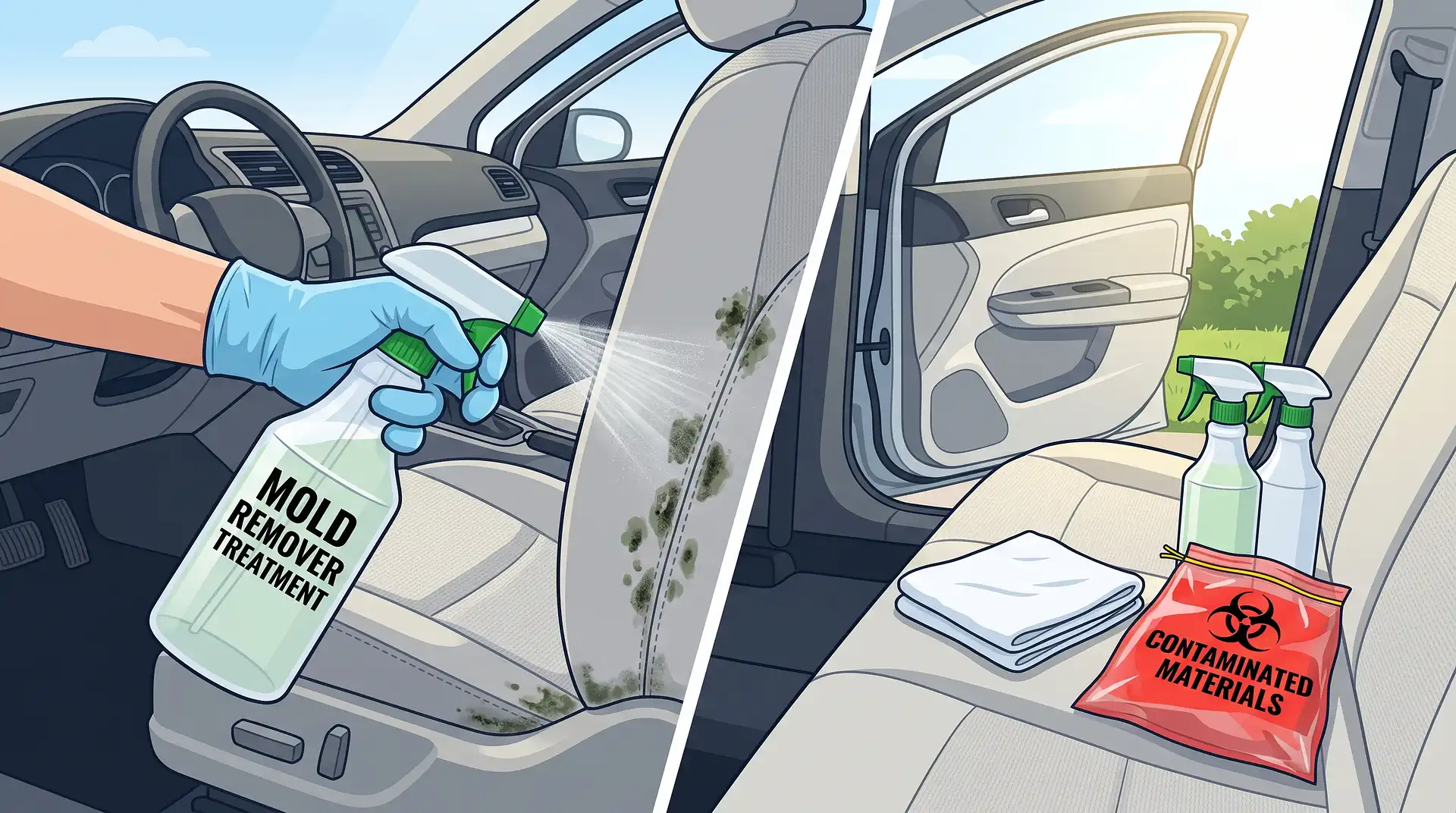
How to Clean Mould Off Car Seats
19 August 2026
Quick answer: Find and fix the moisture source before you clean anything, because treating the surface without addressing the cause means the mould comes back within weeks. Wear an N95 or FFP2 mask, nitrile gloves and eye protection, and open all the doors before you start. Don't dry-brush mould or vacuum it without a HEPA filter, since both release spores into the air. Dampen the mould before disturbing it, apply a suitable treatment, let it dwell, then clean and dry the seats thoroughly. Dry the car interior completely afterwards, since moisture left behind is what the mould grew from in the first place.
Finding mould on your car seats is unpleasant, and in a sealed car interior it's also a genuine health concern. The good news is that most cases are treatable at home if you approach them correctly. The approach matters, because the instinctive responses, brushing it off, wiping it with a damp cloth, giving it a spray with something, are the ones most likely to make it worse or push it further into the material.
Mould versus mildew: why it matters
Most guides use the two words interchangeably, and it's worth knowing they're different.
Mildew is a surface fungal growth, typically white, grey or powdery, that sits on the top of the material rather than penetrating it. It's the earlier stage of the same problem. It wipes away relatively easily, the smell is unpleasant but not severe, and while it shouldn't be ignored, the health risk at this stage is lower.
Mould is a deeper fungal growth, typically black, green or dark grey, with root-like structures that penetrate into the fabric or foam rather than sitting on top. It releases spores continuously into the surrounding air, and some species produce compounds called mycotoxins. In an enclosed car interior with the doors and windows shut, you breathe those spores every time you get in.
The distinction matters for treatment. Mildew can be wiped from the surface and the surface cleaned. Mould needs to be killed in place before it's disturbed, because disturbing live mould releases a cloud of spores into the car and into whoever is doing the cleaning.
If in doubt, treat it as mould. It's the cautious approach and it doesn't harm anything.
Is it dangerous?
Honestly, it depends on the severity.
A light surface mildew that appeared after leaving a wet umbrella on the seat, in a car that's otherwise dry and used regularly, carries a different risk level from deep black mould in a car that's been sealed and unused for months.
Common indoor mould species found in UK vehicles include Cladosporium and Aspergillus, both of which can trigger allergic reactions and respiratory symptoms in sensitive people. People with asthma, hay fever, mould allergies or a weakened immune system are at higher risk. Children and older people are also more vulnerable.
The practical advice is the same regardless of severity: don't drive in a car with active mould growth before it's been treated, don't let children travel in it, and take the protective precautions below seriously rather than treating this like an ordinary cleaning job.
If anyone in the household has experienced unexplained respiratory symptoms, headaches or fatigue that improve when away from the car, mould in the vehicle is worth investigating as a possible cause.
Find the moisture source first
This is the most important section in the article, and it's the one most people skip.
Mould doesn't grow without moisture. If you clean the seats and don't find and fix the source of moisture, the mould returns, usually within two to four weeks.
Common UK moisture sources in cars:
Sunroof drain blockages. Cars with a sunroof have drain tubes at each corner that carry water to the sills and out underneath. These block with leaves, debris and algae, particularly on cars parked under trees. Blocked drains back up and water enters the cabin, often pooling in the footwells and wicking up into the seats and carpets. <cite index="13-1">Automobile Valet correctly identifies this as a specific check: lift each mat and feel for dampness, and check under the boot carpet.</cite>
Failed door and window seals. Rubber seals perish over time, particularly on older cars. Water tracks in along the door frame, often appearing as damp patches along the seat edge or on the floor behind the front seats.
Air conditioning drain blockage. The AC system removes humidity from the cabin air and drains it away. A blocked drain tube lets that water pool inside the car instead.
Wet items left in the car. Wet coats, boots, towels, umbrellas and sports kit contribute significant moisture, particularly in a sealed car overnight in cold UK conditions.
SORN storage. A car that's been declared off-road and left for weeks or months without being opened and aired regularly accumulates condensation inside. Seasonal storage without a dehumidifier or regular airing is one of the most common causes of serious mould growth.
How to check: on a dry day, press your hand firmly into each seat and the carpet in each footwell. Any coolness or dampness indicates retained moisture. Check the underside of mats. Look along the door sills and the base of the windscreen for water staining or residue.
Fix any leak before cleaning the seats. If the leak is from a blocked sunroof drain or a failed seal, cleaning first and repairing later wastes the cleaning.
Safety before you start
This is the one cleaning job in a car where safety equipment is genuinely important rather than precautionary.
Wear an N95 or FFP2 mask. A standard dust mask or a fabric face covering doesn't filter mould spores effectively. An N95 or FFP2 rated mask does. Wear it before you open the doors and keep it on throughout.
Nitrile gloves, not fabric. Mould can enter through skin, and the cleaning products used against it are often not things you want on bare hands.
Eye protection is sensible, particularly if you're working overhead on headlining or if you're using any spray product.
Open all the doors before you start, and work with the doors open throughout. You want maximum airflow moving spores away from you, not recirculating them in an enclosed space.
Don't dry-brush mould. Don't wipe it dry. Don't vacuum it with a standard vacuum. All of these disturb the growth and release spores into the air without first killing the fungus. Dampen it slightly first, and if vacuuming, use a vacuum with a HEPA filter. A standard vacuum without a HEPA filter picks up spores and ejects them back into the air through the exhaust.
Work outdoors if you can. Taking the car somewhere you can open all the doors and have genuine airflow is significantly safer than working in a garage or on a sheltered driveway.
Bag and seal everything. Used cloths, gloves, masks and any material that's been in direct contact with mould goes into a sealed bag and straight into the outdoor bin. Don't carry them through the house.
Removing mould from fabric seats, step by step
Step 1: Dampen the mould before touching it
Lightly mist the affected area with clean water before doing anything else. This prevents dry spores becoming airborne when the growth is disturbed.
Step 2: Apply your treatment and let it dwell
White vinegar is the most widely available option and genuinely effective against most mould species. Apply undiluted or at a high dilution (around 70 to 80% vinegar) to a cloth and dab onto the mould, or use a spray bottle on a fine mist setting. Leave it at least ten to fifteen minutes.
Specialist mould and mildew cleaner formulated for upholstery or fabric is a better option if you can get one, since it's formulated to penetrate the material and kill the fungus rather than just cleaning the surface. Follow the product's dwell time.
Hydrogen peroxide, diluted to around three percent, is effective but carries the same bleaching risk covered in every previous article. Test on a hidden area first, particularly on coloured fabric. Apply to a cloth rather than spraying broadly.
What to avoid: bleach on fabric seats. It kills mould, but it also strips colour reliably and leaves a permanent pale patch. There are better options.
Step 3: Agitate gently and remove
Using a soft brush, work the treatment into the fabric with gentle circular motions. Don't scrub hard, which drives the mould deeper and distorts the pile. The treatment does the work; agitation just helps it reach the fibres.
Blot with a clean white cloth to lift the loosened material. Change to a fresh section constantly, and bag used cloths immediately.
Step 4: Enzyme cleaner for residual organic matter
Once the visible mould has been lifted, an enzyme-based cleaner applied and allowed to dwell handles the organic residue left behind, the same way it handles other biological contamination. It also helps with the lingering musty smell that often persists after the visible mould is gone.
Step 5: Rinse and dry
Lightly mist with clean water and blot to remove any product residue. Then dry as thoroughly as possible, covered below.
Removing mould from leather seats
Leather is more resistant to mould penetration than fabric, since the surface is less porous, but mould grows readily on the dust, skin oils and organic residue that accumulate on leather surfaces.
Dampen the mould first, as above.
Apply a pH-neutral leather cleaner to a cloth and work gently across the affected area. The same principles from our leather car seat guide apply: barely damp cloth, minimal moisture, dry immediately.
White vinegar works on leather mould but should be used sparingly and rinsed off, not left to dwell at high concentration, since acid left on leather contributes to the drying and oil-stripping covered in the leather care articles.
Never use bleach on leather. It strips colour and damages the surface permanently.
Dry immediately with a clean dry cloth after any wet treatment.
Condition afterwards. The cleaning and the mould itself both strip natural oils from leather. Once it's fully dry and confirmed mould-free, condition as normal.
Mould in stitching and seams is harder to reach and may need a soft brush with the treatment solution worked carefully into the stitch lines.
Drying, the step that decides whether it comes back
Mould grows because moisture was there. Leave moisture behind and it grows again.
Open all the doors and windows for as long as practically possible. If the car can stay open for several hours, do it.
Run the car's fan on the fresh air setting, not recirculate, at a moderate temperature. Fresh air mode exchanges cabin air with outside air rather than recirculating spore-laden air around the cabin.
A dehumidifier placed in the car with the doors closed for several hours removes far more moisture than ventilation alone, and it's the most effective tool for a car that's been heavily damp. Small portable dehumidifiers designed for cars and caravans are available from motor accessory retailers.
Check the seat foam is dry, not just the surface. Press firmly with a dry hand. Any coolness or residual dampness means there's still moisture in the foam, and foam that stays damp will grow mould again within weeks.
Prevention in a UK climate
The UK climate, damp, cool, with cars often parked in the open rather than in garages, makes this a recurring problem for certain vehicles rather than a one-off.
Air the car regularly. Open the doors for ten minutes whenever practical, particularly after wet weather or after passengers have been in the car with wet clothing.
Don't leave wet items in the car. Wet coats, umbrellas, sports bags, towels. Take them out rather than leaving them to off-gas moisture into a sealed cabin overnight.
Check for leaks annually. Sunroof drains, door seals and AC drain tubes are the main suspects, and catching a minor seal failure early is far cheaper than treating the mould it eventually causes.
Use a car dehumidifier regularly if the car sits unused for periods or is garaged in a damp space. Reusable silica gel dehumidifiers are inexpensive and effective for ongoing humidity control.
For SORN storage: open and air the car at least every two weeks. Leave a dehumidifier inside. Don't seal it up completely.
Clean the car interior regularly. Mould feeds on the organic debris, hair, skin cells, food particles, that accumulates in upholstery. A clean interior is a less hospitable one.
When DIY isn't enough
Surface mildew and early-stage mould on a car that's been used regularly is well within DIY territory if you approach it correctly. Consider getting professional help when:
The mould is extensive, covering large areas of multiple surfaces
It's black mould penetrating deeply into fabric or foam rather than surface growth
The car has had a flood or a significant water ingress event rather than condensation
A persistent musty smell remains after thorough cleaning and drying, which usually means mould in the foam, the carpet backing or the air conditioning system
Anyone who uses the car regularly is experiencing respiratory symptoms
The air conditioning and heating system smells musty when running, which suggests mould in the ductwork where DIY cleaning can't reach
Professional options include thorough extraction cleaning, ozone treatment (which penetrates into fabrics and kills mould spores without chemicals) and specialist mould remediation for severe cases. <cite index="5-1">Professional mould removal in the UK typically ranges from around £80 to £250 depending on the vehicle size and severity of the problem.</cite>
9. FAQ Section
Is mould on car seats dangerous? It depends on severity. Surface mildew in a car that's otherwise dry carries a lower risk than deep black mould in a car sealed for months. Common car mould species can trigger allergic reactions and respiratory symptoms, particularly in people with asthma or mould allergies. Don't use a mouldy car before treating it, and take protective precautions seriously when cleaning.
What causes mould on car seats? Moisture, primarily. Common causes in UK cars include blocked sunroof drains, failed door or window seals, blocked air conditioning drain tubes, wet items left in the car, and extended SORN storage without regular airing. Finding and fixing the moisture source is the most important step.
Can I vacuum mould off car seats? Only with a HEPA filter vacuum. A standard vacuum picks up spores and exhausts them back into the air. Vacuuming without HEPA spreads the problem rather than solving it. Dampen the mould first to prevent spores becoming airborne.
What kills mould on fabric car seats? White vinegar at high concentration, specialist upholstery mould cleaner, and diluted hydrogen peroxide all kill mould effectively on fabric. Bleach works but reliably strips colour. Let the treatment dwell rather than wiping straight away, since the fungus needs contact time with the product to die.
How do you remove mould from leather car seats? Apply a pH-neutral leather cleaner or diluted white vinegar to a cloth, work gently across the surface, dry immediately and condition afterwards. Never bleach leather. Avoid prolonged high-concentration acid on leather.
Why does mould keep coming back in my car? Because the moisture source hasn't been found and fixed. Clean the mould, and it returns to the same spot or nearby within weeks if there's a leak, blocked drain, condensation problem or persistent damp source. Finding and fixing the cause is more important than the cleaning product.
Do I need a mask to clean mould off car seats? Yes, a proper one. An N95 or FFP2 rated mask filters mould spores. A standard dust mask or cloth face covering doesn't. Wear it before opening the doors and keep it on throughout.
Is it safe to drive a car with mould? Not recommended before treatment, particularly for regular journeys or with children and vulnerable passengers. The mould releases spores into a sealed cabin continuously, and enclosed exposure accumulates faster than in an open space.
Can mould in a car make you ill? Yes, in susceptible people. Common car mould species can cause allergic reactions, respiratory symptoms, headaches and fatigue, particularly with repeated exposure in an enclosed space. If symptoms improve when away from the car, mould is worth investigating.
When should I use a professional instead of doing it myself? When mould is extensive, deeply embedded in foam, present in the air conditioning system, or when a persistent smell remains after thorough cleaning. Also when a flood or significant water event caused the problem rather than condensation.
Mould in a car and mould in upholstery or carpets at home grow for the same reasons: moisture, warmth, organic debris, and insufficient ventilation. For mould, musty smells or damp problems in carpets, rugs, mattresses and upholstery at home, InstantDry provides professional hot water extraction cleaning across England and Wales, with a free survey and a fixed price before any work begins.
Get your fixed quote in 60 seconds
Or call 07555 856988