How to Clean Fabric Car Seats
16 August 2026
Quick answer: Vacuum thoroughly first, including seams and under the seats. Test any solution in a hidden area. A mild solution of clear washing up liquid in warm water handles most cloth seat cleaning, applied to a cloth rather than sprayed onto the seat, worked panel by panel and blotted rather than scrubbed. Rinse each panel with a plain water cloth and blot dry. If you have a wet vacuum, use it to recover moisture, since moisture recovery is the main thing separating a home clean from a professional one. Then dry the car hard with all doors open, because a damp foam seat base in a UK winter is what turns a clean into a musty smell.
Cloth seats are the most common trim in UK cars and the most forgiving to clean, which is exactly why people get away with methods that quietly cause problems. Fabric tolerates a lot. The foam underneath it doesn't.
This guide covers both realistic scenarios: cleaning with nothing but cloths and household products, which is what most people actually have, and cleaning with a wet vacuum if you own or can borrow one.
What kind of fabric are your seats?
Most guides treat cloth as one thing. It isn't, and the differences change how you work.
Type | How to recognise it | What changes |
|---|---|---|
Woven cloth / tweed | Flat, tightly woven, no directional nap. The default in most UK mainstream cars | Most forgiving. Work in any direction. Standard method applies |
Velour | Soft, slightly plush, shows finger marks when you brush it | Has a nap. Clean and brush in one consistent direction or you'll see the difference once dry |
Technical mesh / sports weave | Open, slightly stretchy, often on bolsters of sports seats | Open structure lets liquid through fast. Use less moisture than you think, since it reaches the foam quicker |
Fabric with waterproof backing | Some family and utility trims | More forgiving of moisture, but liquid pools rather than absorbing, so blot more thoroughly |
If you're not sure, run a hand across the seat in two directions. If the surface changes appearance, you have a nap and should work directionally throughout.
Do you actually need a special cleaner?
Straight answer: usually not.
Dedicated automotive upholstery cleaners are formulated to rinse clean and are a perfectly good choice, particularly if you want to spend as little time as possible on it. But for general soiling on cloth seats, a quarter teaspoon of clear, uncoloured washing up liquid in half a litre of warm water does the job.
What matters far more than which product you use:
Don't make it stronger. Detergent residue left in fabric stays slightly tacky, attracts dirt, and produces a patch that looks worse in a month than it did before you cleaned it. This is the most common cause of "the stain came back", and it isn't the stain, it's new soil sticking to leftover detergent.
Rinse properly. More important than the cleaning step itself.
Avoid anything with bleach, and never mix products. One solution at a time.
Where a dedicated product does earn its money is on set-in grease and heavy soiling, where automotive formulations tend to outperform household detergent.
Method one: no machine, cloths only
This is the realistic method for most people and it works perfectly well on normal soiling.
Step 1: Strip and vacuum
Remove mats, child seats, everything from footwells and seat pockets. Vacuum the seats thoroughly with a crevice tool: the seat and backrest join, the seam channels, around seat belt anchor points, and underneath the seats where the real accumulation happens.
Do this properly. Wetting loose grit grinds it into the weave.
Step 2: Test in a hidden area
Underside of the seat base, or a section hidden behind a headrest. Apply your solution, let it dry fully, check for colour change. Cloth trims can and do fade unevenly.
Step 3: Pre-treat specific stains
Handle individual marks before the general clean, using the category method below. Cleaning the whole seat first and then attacking a stain leaves you with a clean seat and an obvious patch.
Step 4: Work panel by panel
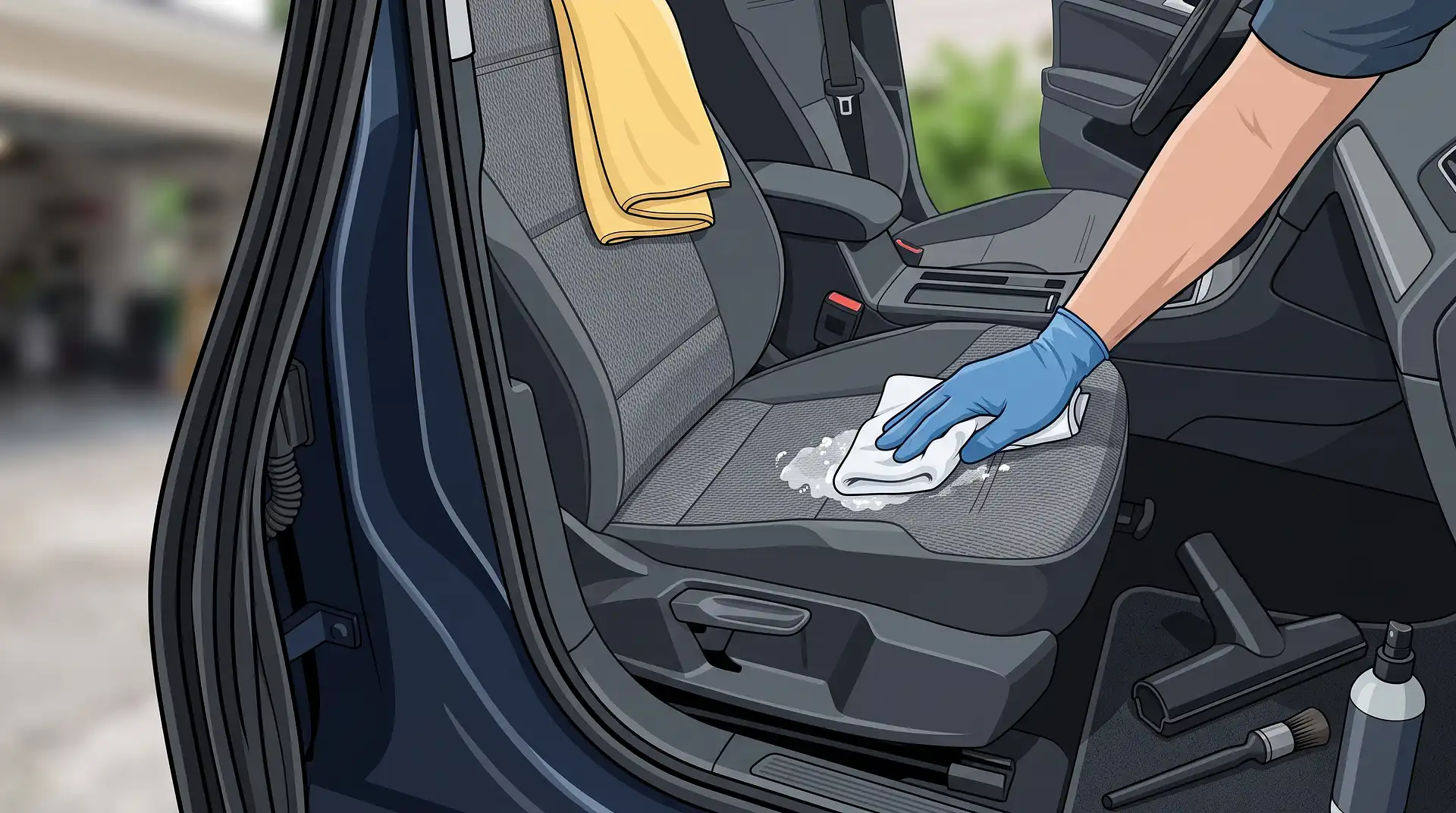
Dampen a white microfibre cloth with your solution and wring it out well. Never spray or pour directly onto the seat, since the foam underneath cannot dry from the inside and you have no way of knowing how deep the liquid has gone.
Work one panel at a time, base then backrest then bolsters. Blot and gently agitate. Don't scrub, which distorts the weave and pushes soil deeper.
If you have a soft upholstery brush, light agitation helps on ground-in soiling. On velour, brush in one consistent direction only.
Step 5: Rinse each panel
Second cloth, plain warm water only, wrung out well. Go over the panel to lift detergent residue. This step is where most people rush and it's where the long-term result is decided.
Step 6: Blot dry hard
Press a dry towel firmly into the fabric, using your body weight. You're mechanically pulling moisture out of the foam, and the more you get out now the less has to evaporate in a sealed car.
Repeat with a fresh dry section until the towel comes away barely damp.
Method two: with a wet vacuum or extractor
If you own a wet vacuum, a carpet washer with an upholstery attachment, or can borrow one, this is a meaningfully better result, for one reason: moisture recovery.
The gap between a home clean and a professional one isn't really the cleaning solution. It's how much of the liquid you put in comes back out. A cloth lifts surface moisture. Extraction pulls it from the foam.
The method is the same as above through the pre-treat stage. Then:
Apply solution sparingly, still via cloth or the machine's lowest setting, rather than saturating
Let it dwell two to three minutes so the chemistry does the work rather than the agitation
Extract in overlapping passes, then repeat the extraction pass a second time with no solution at all to pull out more moisture
Follow with a plain water pass and extract again, to rinse
The guidance in our Vax carpet cleaner guide on solution ratios and extraction passes applies directly here, since the principle is identical, just on a smaller and less forgiving surface.
One warning: a machine makes it much easier to overwet a seat than cloths do. More power is not more clean. Use less solution than you would on a carpet.
Stains by category
Four categories, not twenty recipes. Once you know the category, the method follows.
Protein (sick, milk, blood, food). Cold water only, since heat sets protein permanently. Enzyme cleaner for both the mark and the odour. Detergent alone lifts the mark and leaves the smell in the foam.
Tannin (coffee, tea, cola, juice). Cool water, never hot. Blot heavily first, then repeated light passes with cool water and mild detergent. Same mechanism as our coffee stain guide.
Oil and grease (takeaway, hand cream, sun cream, chips). Bicarbonate of soda directly onto the mark, left several hours to absorb, vacuumed off, then detergent on what's left. Going straight in wet spreads grease across a wider area.
Dye (ink, makeup, denim transfer). Hardest category. Denim dye transfer onto light grey cloth seats is extremely common in UK cars and notoriously stubborn. Expect partial results and don't escalate to something that damages the trim.
If a stain returns after drying, that's wicking. The spill reached the foam and travelled back up as the seat dried. Re-dampen lightly, blot hard, dry thoroughly, and repeat over two or three cycles if needed.
Odour, and where it's really coming from
Cloth seats hold smell more than leather, and the smell is rarely in the fabric surface.
It's usually one of three places: deep in the seat foam from an old spill, under the seats where something has been missed, or in the carpet and footwell rather than the seat at all. People clean the seat surface repeatedly and wonder why the smell persists.
Before treating the seats for odour, remove everything from under them and check the footwell carpet, particularly on the passenger side and behind child seats.
Bicarbonate of soda is genuinely useful here. Sprinkle over the seat, leave several hours or overnight, then vacuum thoroughly. It absorbs odour rather than masking it, and it involves no moisture at all, which makes it the safest option in a car.
Enzyme cleaner is the tool for organic odours (milk, sick, pet, urine), since it breaks down the compounds rather than covering them. Air fresheners do nothing to the source.
Persistent smell after proper cleaning and drying usually means contamination in the foam that surface treatment can't reach.
Drying, the step that decides everything
A car is the worst-ventilated space you own, and in the UK it's frequently cold and damp. This is the highest-risk part of the job.
Clean on a dry day when you can leave the car open for several hours afterwards. Not the night before you need it.
All doors open, not just windows. Cross-ventilation matters more than temperature.
A fan pointed into the open car does more than the heater. If you run the climate system, use fresh air rather than recirculate so you're exchanging air, not recycling moisture.
Check the foam, not the surface. Press firmly into the seat base with a dry hand. Surface-dry with a damp core is exactly what produces a musty smell three days later.
If you must close the car up damp, crack a window if it's safe where you're parked.
When to remove the seat
Not usually necessary, but worth knowing it's an option.
For a badly soiled or contaminated rear bench, many cars have quick-release rear seats that lift out in a few minutes. Cleaning outside the car means far better access, far better drying, and no risk of soaking the carpet underneath.
Front seats are a different matter. They're bolted, often wired for airbags, seat belt sensors and heating, and disconnecting them can trigger fault codes or affect airbag systems. Don't remove front seats unless you know what you're doing, and if there's any airbag wiring involved, that's a job for someone qualified.
8. FAQ Section
How do you clean fabric car seats at home? Vacuum thoroughly including seams and under the seats, test your solution in a hidden area, then apply a mild detergent solution to a cloth rather than spraying the seat. Work panel by panel, blotting rather than scrubbing, rinse each panel with a plain water cloth, blot dry hard, and ventilate the car until completely dry.
Can you clean fabric car seats without a machine? Yes, and for normal soiling it works perfectly well. Cloths, a mild detergent solution and thorough blotting handle most cloth seat cleaning. A wet vacuum gives a better result mainly because it recovers more moisture, not because it cleans more effectively.
Do I need a special cleaner for fabric car seats? Usually not. A small amount of clear washing up liquid in warm water handles general soiling. Dedicated automotive upholstery cleaners are formulated to rinse clean and are worth it for set-in grease or heavy soiling, but they aren't necessary for routine cleaning.
What household products can I use on car seats? Clear, uncoloured washing up liquid diluted well in warm water, bicarbonate of soda for odour and grease absorption, and an enzyme cleaner for organic stains and smells. Avoid bleach, avoid mixing products, and always test in a hidden area first.
Why do my car seats smell after cleaning? Usually trapped moisture in the seat foam, which cannot dry from the inside out in a sealed car. Use much less moisture, blot far more aggressively, and ventilate with all doors open. Check the foam is dry by pressing into it rather than judging by the surface.
How do you get stains out of cloth car seats? Work out the category first. Protein stains need cold water and an enzyme cleaner. Tannin stains need cool water and repeated light passes. Grease needs bicarbonate of soda to absorb before anything wet. Ink and dye are the hardest and often only partially removable.
How do you clean velour car seats? The same method as woven cloth, but work and brush in one consistent direction throughout, since velour has a nap that shows directional differences once dry. Uneven brushing leaves visible patches even when the seat is clean.
Why did the stain come back after I cleaned it? Wicking. The spill soaked into the foam and resurfaced as moisture travelled back up during drying. Re-dampen lightly, blot thoroughly and dry hard, repeating over two or three drying cycles if necessary.
How long do fabric car seats take to dry? Several hours with good ventilation on a dry day. In cold, damp UK conditions with the car outside, a heavily wetted seat can take considerably longer. The less moisture you put in and the harder you blot, the shorter this is.
Is it worth paying someone to clean cloth car seats? Worth considering for heavy soiling, a persistent smell that hasn't cleared, or contamination deep in the foam that surface cleaning can't reach. Professional extraction recovers far more moisture than any home method, which matters most in a vehicle where drying conditions are poor.
Get your fixed quote in 60 seconds
Or call 07555 856988.