How to Clean Car Seats
16 August 2026
Quick answer: Identify the material first, since fabric, leather and Alcantara each need a different approach. Vacuum thoroughly including seams and under the seats. For fabric, use a mild detergent solution applied to a cloth rather than sprayed onto the seat, work panel by panel and blot rather than scrub. For leather, use a barely damp cloth with a pH-neutral cleaner and dry immediately. For Alcantara, use minimal moisture and a soft brush. Whatever the material, the hardest part is drying: a car is the worst-ventilated space you own, and a soaked seat in a UK winter can stay damp for days and turn musty.
Car seats take more concentrated punishment than any upholstery in your house. Food, drink, sun exposure, body oils, wet coats, muddy boots and, if you have children, a fairly relentless combination of all of it in one small enclosed space.
The cleaning methods are straightforward and mostly transfer from domestic upholstery. The part that's genuinely harder, and that almost no guide addresses properly, is what happens after you've finished.
The drying problem nobody mentions
A car interior is sealed, low-airflow, and in the UK it spends much of the year cold and damp. That combination makes it the hardest place to dry upholstery you're likely to encounter.
Seat cushions are foam wrapped in a cover, exactly like a sofa cushion, and foam cannot dry from the inside out. Soak a car seat in November, park it outside, and it may still be damp three days later. What follows is the musty smell people then search separately for a cure to, not realising the smell is a consequence of the cleaning, not of the original dirt.
Everything below is built around that constraint: minimal moisture, spot treatment over surface-wide soaking, and a proper drying plan before you start rather than after.
The practical implication: clean your car seats on a dry, ideally warm day when you can leave the doors or windows open for several hours. Not the evening before you need the car.
Identify the material first
Material | How to recognise it | Approach |
|---|---|---|
Fabric / cloth | Woven texture, most common in UK mainstream cars | Most forgiving. Water-based cleaning fine, moisture control is the main issue |
Leather | Natural grain variation, distinct smell | pH-neutral cleaner only, barely damp cloth, dry immediately, condition periodically |
Leatherette / vinyl | Uniform repeating texture, common in mid-range trims | More moisture-tolerant than real leather but no conditioner designed for genuine leather |
Alcantara / synthetic suede | Soft, matte, napped surface, common in performance and premium trims | Least forgiving. Minimal moisture, soft brush, never soak or scrub hard |
If you're unsure whether seats are leather or leatherette, the leather identification guidance in our leather sofa guide applies directly, and treating it as the more delicate option is always the safer error.
Fabric seats, step by step
Step 1: Clear and vacuum
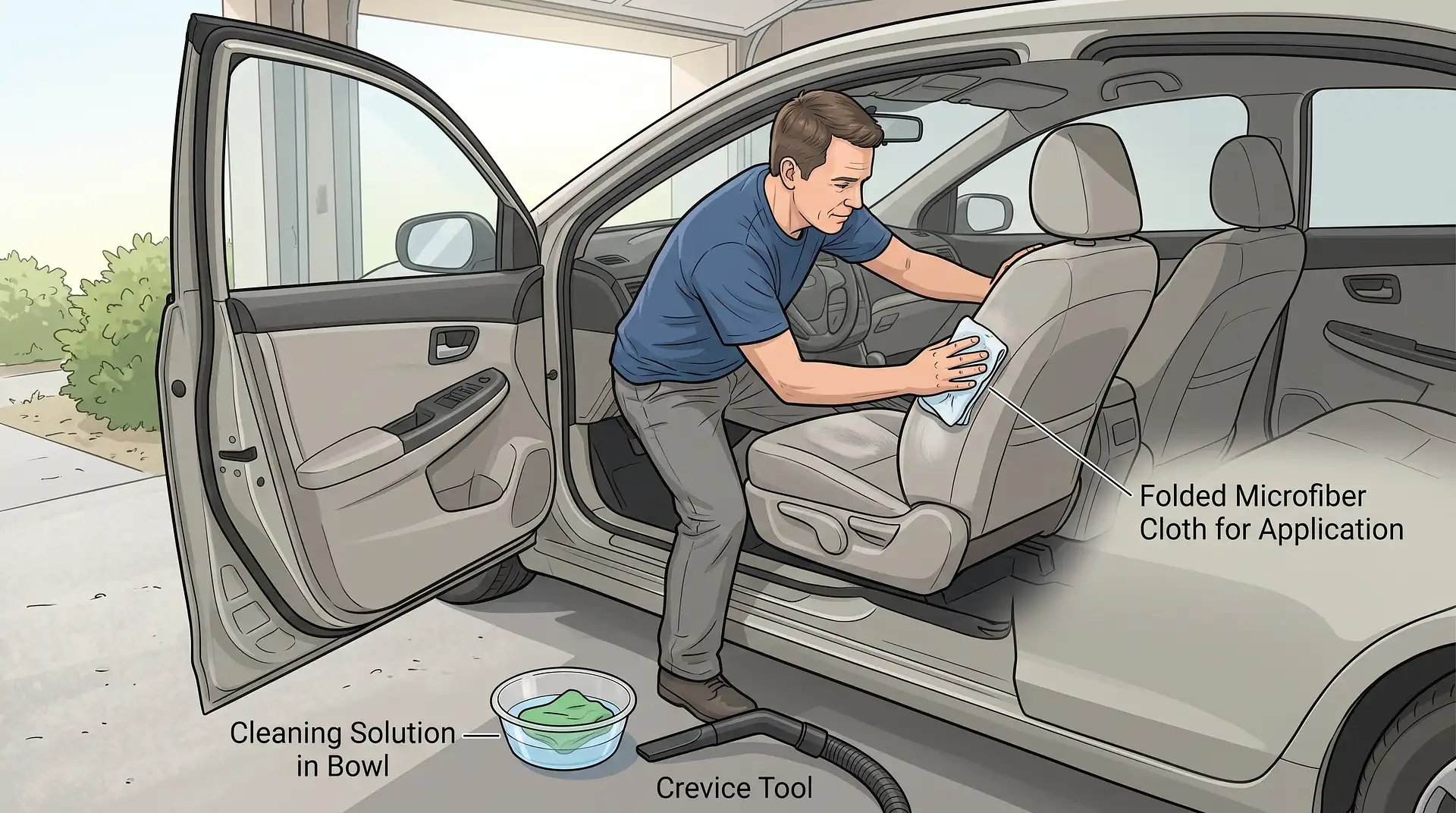
Remove mats, child seats and everything from the footwells. Vacuum thoroughly with a crevice tool, working seams, the join between base and backrest, and under the seats, which collect far more than people expect.
Vacuuming properly first matters as much here as anywhere else. Wetting loose grit drives it into the fabric.
Step 2: Test in a hidden area
The underside of a seat or a section normally hidden by a headrest works. Apply your solution, let it dry, and check for colour change before touching a visible panel.
Step 3: Mix a mild solution
A small amount of clear, uncoloured washing up liquid in warm water handles most jobs. A dedicated automotive upholstery cleaner is also fine and is formulated to rinse clean. Don't make homemade solutions stronger than needed, since detergent residue left in fabric stays tacky and attracts dirt faster than before you started.
Step 4: Apply to the cloth, not the seat
The single most important technique point, and the same one that applies to sofas and mattresses. Dampen a white microfibre cloth, wring it out well, and work with that. Spraying directly onto a seat sends moisture straight into the foam where you cannot get it out.
White cloths only, to avoid dye transfer.
Step 5: Work panel by panel
Blot and gently agitate, don't scrub. Work one panel at a time so coverage stays even, since a heavily cleaned patch surrounded by untouched fabric looks worse than uniform light soiling.
Step 6: Rinse and lift
Go over each panel with a second cloth dampened with plain water only, to lift detergent residue, then press a dry towel firmly into the fabric to draw out moisture.
If you have a wet vacuum with an upholstery attachment, a light pass here removes considerably more moisture than blotting. Worth borrowing one if you're doing a full interior.
Step 7: Dry, properly
Covered below. Don't skip it.
Leather and leatherette seats
Leather in a car has a harder life than leather in a living room, since it faces UV exposure, temperature swings and constant contact.
Vacuum first with a soft brush attachment, paying attention to perforations and seams.
Wipe with a barely damp microfibre cloth and a pH-neutral leather cleaner. Never household all-purpose cleaner, baby wipes, or anything containing alcohol, which strip the natural oils and lead to drying and cracking over time.
Dry immediately with a separate dry cloth rather than letting it air dry.
Condition periodically. Car leather dries out faster than domestic furniture because of sun exposure and heat cycling, so conditioning matters more, not less. Test any conditioner on a hidden area first.
Leatherette and vinyl tolerate slightly more moisture and don't need conditioner formulated for genuine leather, which can damage a synthetic finish. A mild detergent solution and a damp cloth generally works well.
Alcantara and synthetic suede
The least forgiving material in a car interior, and the one most often damaged by people treating it like fabric.
Use minimal moisture, a soft brush, and light passes. Avoid saturating it, avoid scrubbing hard, and avoid products not specifically suitable for it. Brush the nap in one direction afterwards to restore an even appearance.
If Alcantara has gone shiny or matted in high-contact areas, that's crushed nap rather than dirt, and gentle brushing does more for it than any cleaner will.
Stains by category
The same four categories that govern domestic upholstery apply here, and knowing the category is more useful than memorising individual recipes.
Protein stains (sick, milk, blood, food spills). Cold water only, since heat sets protein permanently. An enzyme cleaner handles both the mark and the odour, which is the part that matters most in a sealed car. Detergent alone lifts the mark and leaves the smell.
Tannin stains (coffee, tea, fizzy drinks, juice). Cool water, never hot. Blot heavily first, then treat with cool water and mild detergent in repeated light passes. The mechanism is the same one covered in our coffee stain guide.
Oil and grease (food, hand cream, sun cream, takeaway). Absorb first with bicarbonate of soda left on for several hours, vacuum off, then treat the residue with detergent. Going straight to a wet cleaner spreads grease rather than lifting it.
Dye stains (ink, makeup, transferred denim dye). Hardest category and often partial at best. Denim dye transfer onto light seats is extremely common and notoriously stubborn.
If a stain reappears after drying, that's wicking: the spill went into the foam and resurfaced as moisture travelled back up. Re-dampen lightly, blot thoroughly, dry hard. Repeated wicking means the spill is deep in the cushion.
Child seats and the areas people forget
Child seat covers are usually removable and often machine washable, but check the manufacturer's instructions carefully. Some covers must not be machine washed or tumble dried, since it can affect the material properties the seat's safety performance depends on. Never use harsh chemicals or bleach on a child seat, and follow the manufacturer's guidance rather than general upholstery advice.
The harness and straps should only be cleaned as the manufacturer directs. Some explicitly prohibit submerging or using detergents on webbing, since it can weaken it. This is a safety component, not upholstery, and it's worth being conservative.
Under and behind the child seat is where spilled milk and food actually accumulate, and it's usually the source of a smell people can't locate. Remove the seat entirely when cleaning.
Other commonly missed areas: seat rails and the floor beneath them, the gap between seat base and backrest, seat belt webbing (wipe with a damp cloth only, never soak or use solvents), and the underside of headrests.
Drying properly in a UK climate
The step that decides whether the job worked.
Pick your day. Dry and ideally warm, with several hours to spare afterwards.
Open everything. All doors, or at minimum all windows, for as long as possible. Cross-ventilation matters more than heat.
Use airflow, not heat. A fan directed into the open car does more than the heater. If you run the car's climate system, use it on a moderate setting with fresh air rather than recirculate, so you're exchanging air rather than recycling moisture.
A dehumidifier helps if you have a garage and can run one with the car doors open.
Check the foam, not the surface. Press firmly into the cushion with a dry hand. Surface-dry with a damp core is the exact situation that produces a musty smell three days later.
Don't close the car up while anything is still damp. If you must, leave a window cracked if it's safe to do so where you're parked.
8. FAQ Section
How do you clean fabric car seats? Vacuum thoroughly including seams and under the seats, then apply a mild detergent solution to a white cloth rather than spraying it onto the seat. Work panel by panel, blotting rather than scrubbing, rinse each panel with a plain water cloth, then blot dry and ventilate the car well until completely dry.
How do you clean leather car seats? Vacuum with a soft brush attachment, wipe with a barely damp microfibre cloth and a pH-neutral leather cleaner, then dry immediately with a separate dry cloth. Condition periodically, since car leather dries out faster than furniture leather due to sun and heat exposure.
Can you use household cleaner on car seats? Not recommended, particularly on leather, where all-purpose cleaners and anything containing alcohol strip natural oils and cause cracking over time. A mild washing up liquid solution is fine on fabric, and a dedicated automotive upholstery cleaner is a safer option generally.
Why do my car seats smell musty after cleaning? Almost always trapped moisture in the seat foam. A car is poorly ventilated, and foam cannot dry from the inside out. Use much less moisture, ventilate hard with all doors open, and check the foam is dry by pressing into it rather than judging by the surface.
How long do car seats take to dry? Several hours minimum with good ventilation on a dry day. In cold or damp UK conditions with the car parked outside, a heavily wetted seat can take days. Clean on a dry day when you can leave the car open afterwards.
How do you get sick out of a car seat? Remove solids first, then treat as a protein stain with cold water, never warm, since heat sets it. Use an enzyme cleaner for both the mark and the odour, following its stated dwell time. Ventilate throughout and dry thoroughly afterwards.
How do you clean child car seat covers? Check the manufacturer's instructions first, since some covers must not be machine washed or tumble dried and harsh chemicals can affect safety performance. Clean the harness and straps only as the manufacturer directs, since detergents can weaken webbing.
How do you clean Alcantara car seats? Minimal moisture, a soft brush and light passes. Don't saturate it or scrub hard. Brush the nap in one direction afterwards to restore an even appearance. Shiny patches in high-contact areas are usually crushed nap rather than dirt, and gentle brushing helps more than cleaning.
Why did the stain come back after I cleaned it? Wicking. The spill soaked into the foam and resurfaced as moisture travelled back up during drying. Re-dampen lightly, blot thoroughly and dry hard. Repeated wicking means the spill is deep in the cushion and surface treatment won't reach it.
Is it worth getting car seats professionally cleaned? Worth considering for a heavily soiled interior, a persistent smell that hasn't cleared, or leather and Alcantara you'd rather not risk. Professional extraction removes far more moisture than blotting by hand, which matters particularly in a vehicle where drying conditions are poor.