How to Get Water Stains Out of Car Seats
19 August 2026
Quick answer: Water rings on car seats form when moisture dissolves minerals and detergent residue from the surrounding fabric and deposits them at the drying edge. The fix is counterintuitive: don't try to clean inside the ring. Re-wet the whole surrounding panel evenly with distilled or filtered water, blending outward from the ring edge with decreasing dampness, so everything dries together without a new tide mark forming. Work quickly, blot rather than rub, and dry with good ventilation.
If you've ended up with a ring on your car seat after trying to clean it, you're not alone. Water marks are one of the most common things that go wrong during DIY car seat cleaning, and they often look worse than the original stain did. The frustrating part is that they're usually caused by the water you were using to fix something else.
Why water stains appear in the first place
When water touches fabric, it doesn't just sit there. It spreads outward, and as it spreads it dissolves whatever is in the fabric around it: mineral deposits from previous water exposure, residual detergent from earlier cleaning, body oils, dust. As the water evaporates, it draws this dissolved material toward the drying edge, where it concentrates and leaves a visible line.
That ring is a deposit of everything the water carried with it, left behind at the boundary between wet and dry fabric.
Two things make this worse in the UK:
Hard water. Much of England has hard tap water, which contains calcium and magnesium minerals. Every time hard water dries on fabric, it leaves those minerals behind. Over several cleaning attempts, the deposit builds up and the ring becomes more visible, not less.
Detergent residue. If a previous cleaning left detergent in the fabric, water spreading across the seat re-dissolves it and carries it to the new drying edge. This is why seats that have been cleaned before often show rings more quickly and more clearly than seats that haven't.
The same principle explains tide marks after rain: water that enters through an open window, splashes from a door, or tracks in on wet clothing spreads across the seat and leaves a mineral line at wherever it dried.
Fabric seats: removing a water ring
The instinct is to clean inside the ring. The correct approach is the opposite.
You need to re-wet the whole panel evenly so everything dries together, with no boundary between wet and dry fabric where new deposits can concentrate.
Step 1: Use distilled or filtered water
Plain tap water increases the risk of a new ring forming where the old one was, because the minerals in it deposit at the new drying edge. Distilled water, or filtered water from a jug filter, removes that risk. It's worth using for this specific job even if you use tap water for everything else.
Step 2: Test on a hidden area
Underside of the seat base or behind a headrest. Dampen, let it dry fully, and check for any colour change or new marking before working on a visible panel.
Step 3: Dampen the whole panel, not just the ring
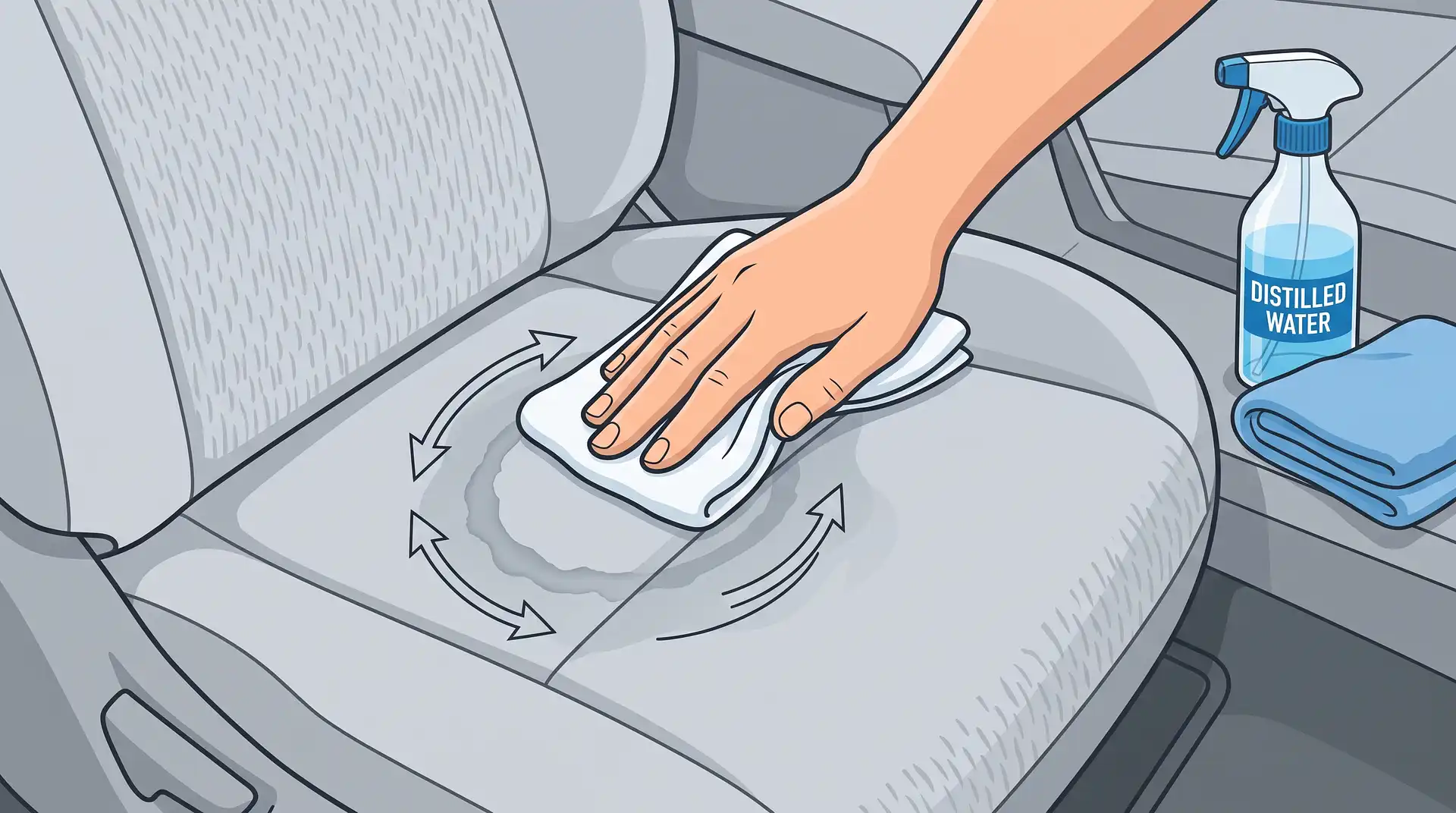
Using a barely damp white cloth, moisten the entire seat panel that contains the ring, working from the outer edges of the panel inward toward the ring. You're pre-wetting the surrounding fabric so there's no dry boundary for the dissolved deposits to collect at.
Step 4: Work the ring with the feathering technique
Dampen a fresh white cloth lightly and work across the ring with circular motions, gradually moving outward in decreasing dampness as you go. The goal is to re-dissolve the deposit and blend it back into the surrounding fabric rather than pushing it to a new edge. Work quickly and keep moving outward.
This is sometimes called feathering: you're not trying to lift the deposit cleanly, you're dissolving it back into a larger area so it's too dilute to be visible once dry.
Step 5: Blot, don't rub
Press a dry white towel into the panel, working from the outer edges inward. Lift moisture out rather than moving it around. Change to a dry section constantly.
Step 6: Dry evenly and quickly
Open all the car doors and use a fan if you have one. The key is even drying across the whole panel, not allowing any one area to dry significantly ahead of another. If one section dries much faster, the remaining moisture and dissolved material concentrates there and a new ring forms.
In a UK climate, this usually means cleaning on a dry, mild day rather than in cold or damp conditions where drying is slow and uneven.
Step 7: For stubborn rings, add a tiny amount of detergent, then rinse thoroughly
A very small amount of clear washing up liquid in distilled water helps lift older or more established mineral deposits. Apply to the cloth, not to the seat, work the panel, then rinse with plain distilled water applied the same way. Any detergent left behind becomes tomorrow's water mark.
Leather seats: water marks and what's different
Leather is much less prone to water marks than fabric because the surface is less absorbent, but tide marks do occur, particularly on lighter leather after rain or after cleaning with hard tap water.
The re-wetting principle is the same but the execution is gentler.
Dampen the whole seat panel with a barely damp microfibre cloth and distilled water, blend outward from the mark, dry immediately with a dry cloth, and condition once fully dry.
Never let leather sit wet. The re-wetting for leather is a very light, quick pass — enough to blend the drying boundary, not enough to soak the surface.
Condition afterwards. Repeated water exposure dries leather out. A conditioning pass after any wet treatment helps maintain the surface.
The same principles from our leather car seat guide apply throughout.
Preventing new rings while you clean
Every time you clean a car seat with water, you risk creating a new tide mark. These habits reduce that risk:
Use distilled or filtered water for the final rinse. Tap water is fine for lifting soil; distilled water for the rinse pass eliminates the mineral deposit risk.
Always work whole panels, not spots. Spot-treating a stain on a seat and leaving the surrounding fabric dry almost always produces a ring. Treat the stain, then lightly dampen and blend the surrounding panel.
Blot more, apply less. The less water goes in, the less there is to carry deposits to a drying edge.
Dry evenly and quickly. A fan directed into the open car and all doors open gives the best chance of even drying across the whole seat rather than patchy drying that creates marks.
Rinse out all detergent. Any residue left in the fabric becomes potential future water marking. Take the extra two minutes.
When the mark keeps coming back
A ring that returns to the same spot after each treatment usually means there's residual contamination or detergent deeper in the fabric that re-dissolves with every new wetting and migrates back to the surface as the seat dries.
Two or three re-wetting cycles across separate drying sessions, each followed by thorough drying, progressively reduces the concentration each time.
If it persists after several attempts, the deposit may be deeper than the fabric surface, in the foam padding, and surface treatment alone won't reach it. At that point extraction equipment that pulls moisture out of the pad rather than pushing more water in is the more effective tool.
8. FAQ Section
What causes water stains on car seats? Water dissolves minerals and residual detergent from the surrounding fabric as it spreads, then deposits them at the drying edge as it evaporates. The ring marks where wet fabric met dry fabric. Hard water makes it worse, and detergent left from previous cleaning accelerates it.
How do you remove a water ring from a fabric car seat? Re-wet the entire surrounding panel evenly with distilled water rather than trying to clean inside the ring. Work from the panel edges inward, blend the ring area with decreasing dampness outward using circular motions, blot with a dry cloth, and dry evenly with good ventilation.
Why does cleaning my car seat leave a ring? Usually because the cleaned area dried before the surrounding fabric, concentrating dissolved minerals and detergent at the boundary. Treating just a spot rather than the whole panel, or not rinsing detergent out thoroughly, are the two most common causes.
Should I use tap water or distilled water to remove water stains? Distilled or filtered water for this job specifically. Tap water contains minerals that deposit at the new drying edge and risk creating a new ring where the old one was. It's the main reason water stain removal attempts create new marks.
How do you get a tide mark out of a car seat? The same approach as a water ring. Re-wet the whole panel evenly with distilled water, feather the mark outward with decreasing dampness, blot dry, and dry the whole panel evenly and quickly with good ventilation and all doors open.
Can you get water marks off leather car seats? Yes. Dampen the whole seat panel lightly with a barely damp microfibre and distilled water, blend outward from the mark quickly, dry immediately with a dry cloth, and condition afterwards. Keep the process lighter and quicker than on fabric since leather shouldn't sit wet.
Why does my car seat water stain keep coming back? Residual contamination or detergent deeper in the fabric is re-dissolving with each wetting and migrating back to the surface as the seat dries. Repeat the re-wetting treatment across two or three separate drying sessions to progressively reduce the deposit concentration.
How do I stop water stains forming when I clean car seats? Always treat whole panels rather than spots, use distilled water for the final rinse, rinse all detergent out thoroughly, and dry the whole seat evenly and quickly with all doors open.