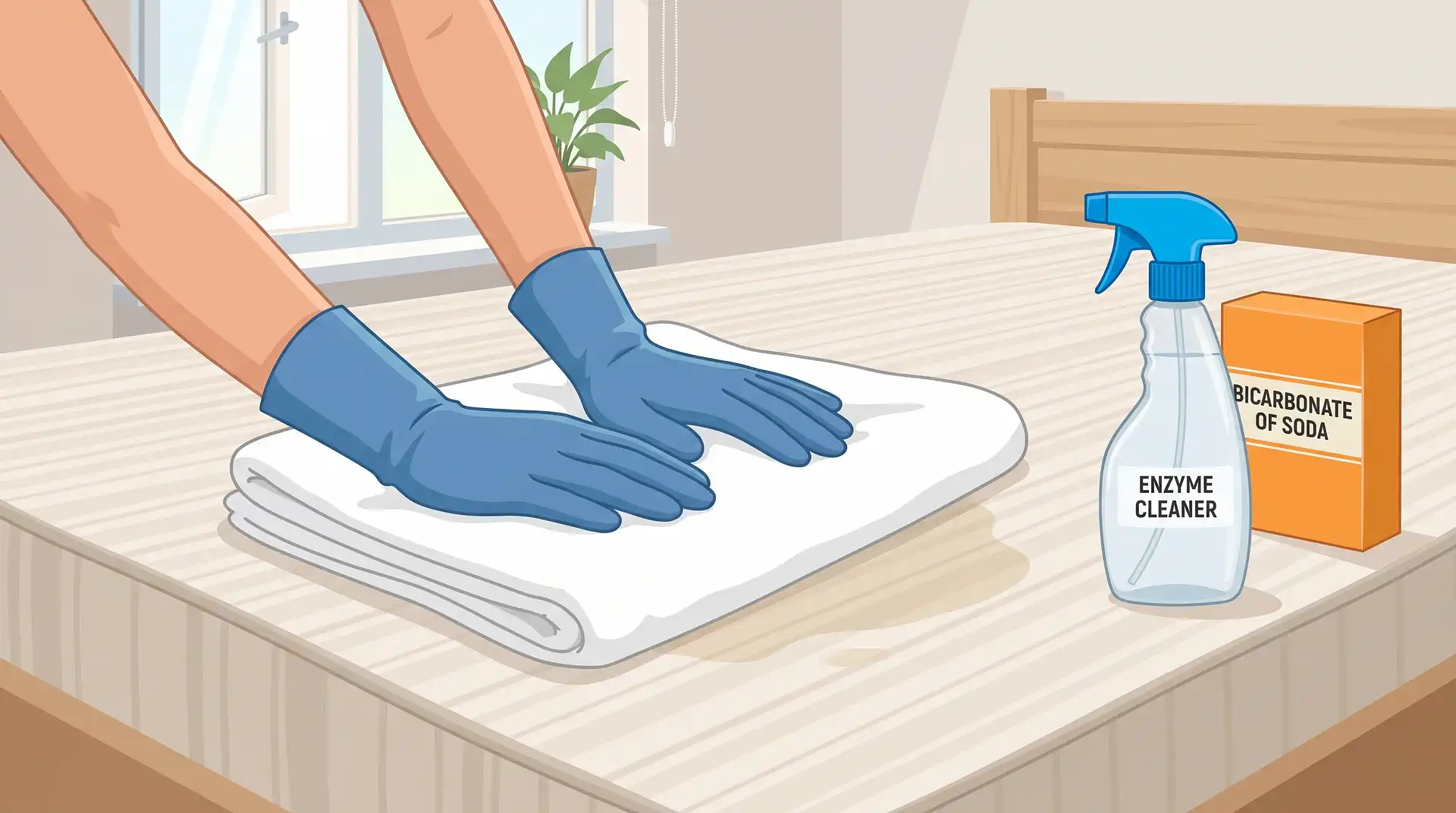
How to Get Urine Out of a Mattress
18 August 2026
Quick answer: Blot up as much liquid as possible with towels, pressing hard, and never rub. Use cold water, never warm, since heat sets the proteins in urine. Then use an enzyme cleaner and leave it far longer than feels necessary, at least fifteen minutes and ideally longer, keeping the area damp while it works. Enzymes are essential rather than optional here, because urine leaves uric acid crystals behind that water and detergent cannot dissolve, and those crystals are what makes the smell return weeks later. Finish by drying the mattress thoroughly with strong ventilation, since a damp core causes worse problems than the original accident.
Urine is the most misunderstood stain people deal with at home, and the confusion isn't the reader's fault. The visible mark and the smell are two separate problems, caused by two different substances, and only one of them responds to normal cleaning.
Why the smell keeps coming back
If you've cleaned a mattress properly, watched the stain fade, and then found the smell back a few weeks later on a warm or humid day, here's what happened.
Urine contains urea and salts, which dissolve in water. These lift out easily with blotting and a bit of detergent. That's the part that makes the visible mark, and it's why a fresh accident cleaned promptly usually looks fine afterwards.
Urine also contains uric acid, which forms crystals as it dries. These crystals are not water-soluble. Water doesn't touch them. Detergent doesn't touch them. Vinegar doesn't dissolve them and bicarbonate of soda doesn't remove them. They bond to the fibres and simply stay there.
And uric acid crystals absorb moisture from the air. On a humid day, in summer, or when someone warm lies on the mattress, the crystals take up moisture and release the odour compounds all over again. The smell returns from a mattress that looks completely clean.
That's the whole puzzle. It's also why pets return to the same spot: they can smell what you can't, because the crystals are still there.
Enzyme cleaners are the answer because enzymes actually digest uric acid. They break the crystals down rather than washing around them. This is the mechanism, not a marketing claim, and it's why an enzyme cleaner isn't one option among several here. It's the one that addresses the part of the problem everything else leaves behind.
Fresh accidents: act in this order
Speed genuinely helps, because the less that soaks into the core, the better every subsequent step works.
Step 1: Strip the bed immediately
Everything into the wash at 60°C if the labels allow. If there's a mattress protector, it's done its job and it goes in too.
Step 2: Blot hard, don't rub
Press dry towels or a thick wad of kitchen roll firmly into the area, using your body weight. Lift, swap to a dry section, repeat until nothing more transfers.
Pressing hard matters more than anything else at this stage. You're mechanically pulling liquid out of the foam before it can settle. Every millilitre you remove now is one you don't have to treat, dissolve or dry later.
Never rub. It spreads the contamination outward and drives it deeper.
Step 3: Cold water only
Lightly dampen with cold water and blot again. Never warm, never hot. Urine is a protein-based stain, and heat sets protein into fibres permanently, exactly as it does with blood.
Don't flood it. You're diluting what's near the surface, not washing it through.
Step 4: Enzyme cleaner, applied generously and given time
This is the step that decides the outcome, and it's the step people rush.
Test on a hidden area first, such as a side panel near the base, and let it dry before treating the visible area.
Apply the enzyme cleaner so it reaches as deep as the urine did. This is the one situation where being slightly generous with liquid is justified, because treating only the surface leaves crystals below it that will smell later. Follow the product's own instructions on quantity.
Then leave it alone. Enzymes are biological and they need time and moisture to work. Fifteen minutes is a minimum; many products specify longer, and for an older stain, longer still. Keeping the area damp during the dwell time helps, since enzymes stop working as things dry out. Laying a damp cloth over the treated area slows evaporation.
A two-minute spray and wipe does almost nothing, and this is the single most common reason people conclude enzyme cleaners don't work.
Step 5: Blot out and repeat if needed
Press dry towels down firmly to lift the treated liquid. For a significant accident, a second enzyme application after the first has been blotted is worthwhile.
Step 6: Bicarbonate of soda, last, not first
Once you've finished with liquids, sprinkle bicarbonate of soda over the area and leave it several hours or overnight. It absorbs residual moisture and helps with surface odour.
Then vacuum it off thoroughly, going over the area more than once.
Bicarb is a finishing step, not a treatment. It doesn't remove uric acid, and using it instead of an enzyme cleaner is why some people find the smell returns.
Step 7: Dry properly
Covered in its own section below.
Dried and older urine
Harder, but not hopeless. The uric acid is still there and still treatable, it just needs more patience.
Rehydrate the area with cold water. Crystals need moisture around them for enzymes to work.
Apply enzyme cleaner generously and give it a much longer dwell, an hour or more if the product allows, keeping it damp throughout with a cloth laid over the top.
Blot, and repeat the whole cycle. Old contamination typically needs two or three full treatments across separate drying cycles.
Judge by smell, not by sight. Press your face close to the area once it's fully dry. If there's still an ammonia note, treat again. The visual mark may never fully clear even when the odour has gone.
Bicarb and vacuum at the end of each cycle.
Realistic expectation on old stains: full odour removal is often achievable, and it's the outcome that actually matters night to night. The yellow mark frequently lightens rather than disappears, and it sits under a protector and a fitted sheet where nobody sees it.
Cat and dog urine: what's different
Concentration. Cat urine in particular is more concentrated than human urine, which means more uric acid per accident and a stronger, more persistent smell.
Re-marking. An animal returning to the same spot is responding to residual odour you can't detect. Full uric acid removal is the only reliable way to break that cycle, which makes proper enzyme treatment more important with pets, not less.
Never use ammonia-based cleaners. Ammonia is a breakdown product of urine and smells like urine to an animal. Cleaning with an ammonia-based product can actively encourage a pet to re-mark the same spot. Check labels, since some general household cleaners contain it.
If a pet has started urinating in unusual places, particularly a cat, and it's a change from their normal behaviour, it's worth a vet conversation. Sudden changes in toileting can indicate a medical issue such as a urinary tract problem, and no amount of cleaning addresses a cause that's medical.
The products that work, and the ones that don't
Product | What it does | Verdict |
|---|---|---|
Enzyme cleaner | Breaks down uric acid crystals | Essential. The only thing that addresses the recurring odour |
Cold water and mild detergent | Lifts urea and water-soluble salts | Useful first stage, insufficient alone |
Bicarbonate of soda | Absorbs residual moisture and surface odour | Good finishing step, not a treatment |
White vinegar | Mildly acidic, helps neutralise alkaline salts | Some benefit, does not remove uric acid |
Hydrogen peroxide | Oxidises, lightens the visible mark | Bleaching risk, see below |
Ammonia-based cleaners | Nothing useful here | Avoid, particularly with pets |
Warm or hot water | Sets the protein | Never |
On the hydrogen peroxide recipes. A mix of hydrogen peroxide, bicarbonate of soda and washing up liquid is the most commonly recommended urine treatment online, and it does lighten the visible yellow mark. Two cautions. It's an oxidising agent with a real bleaching risk, and mattress covers vary in colour-fastness, so test on a hidden area first, dilute well and treat the stain spot rather than broadly. And it addresses the visible mark rather than the uric acid, so used alone it produces a paler stain that still smells. If you use it, use it after enzyme treatment, not instead of it. Never mix it with other products beyond a simple single solution, and never combine anything with bleach.
Drying, and why it matters more here
Urine goes deeper than most spills, which means more liquid to remove, and a mattress is the hardest thing in the house to dry.
A mattress is foam or fill inside a sewn cover, lying flat on a base with restricted airflow underneath. Moisture that reaches the core cannot evaporate from the inside out. A core that stays damp can develop mould you won't see and won't smell until it's established, at which point the mattress usually isn't recoverable.
Ventilate hard. Windows open, fan directed at the mattress.
Stand it on its side against a wall if you can manage it physically. This is the single most effective thing you can do, since it exposes both faces to moving air. On a warm dry day, outside is better still.
No direct heat. Radiators and hairdryers dry the cover while leaving the core damp, which is the exact failure you're trying to avoid, and heat can damage foam.
Allow far longer than you think. Several hours minimum, longer after a significant accident. Treat it in the morning so it has the whole day.
Check by pressing firmly with a dry hand. Any coolness or dampness means it needs more time. Don't remake the bed until it's genuinely dry throughout.
When a mattress can't be saved
Worth being straight about, since nobody else is.
Repeated saturation into the core is the realistic limit. A mattress that has been soaked through multiple times, particularly over months or years, has contamination in the foam that surface treatment cannot reach at any depth.
A persistent ammonia smell after two or three full enzyme cycles and thorough drying means the same thing.
Visible mould or a musty smell distinct from the urine odour means moisture has been sitting in the core, and that's a different and more serious problem.
In those situations, replacement is the honest answer, and a professional clean is worth trying first only if the mattress is otherwise sound and relatively new. Our guide on how to dispose of a mattress covers the practical routes if it's genuinely finished, and includes a simple test for whether a mattress is structurally worn out or just stained.
Preventing the next one
For bedwetting and incontinence, where repeat events are expected, prevention is more useful than any cleaning method.
A waterproof mattress protector is the single most effective measure. It moves the problem from something you can't wash to something you can, and a good one is breathable rather than plasticky.
Two protectors, layered with a sheet between them, is a practical trick for children who wet regularly. When an accident happens at 3am, you strip the top sheet and top protector and there's a dry made bed underneath. It saves remaking a bed in the middle of the night.
Keep an enzyme cleaner in the house rather than buying one after the fact. Treating an accident within the hour is significantly more effective than treating it the next morning.
A brief word on the medical side. Bedwetting in young children is common and usually resolves with time. If a child who has been reliably dry starts wetting again, or if an adult experiences new or worsening incontinence, it's worth a GP conversation, since both can have underlying causes that are treatable. That's not a cleaning issue and it's not something to feel awkward about raising.
9. FAQ Section
How do I get urine out of a mattress? Blot hard with dry towels to remove as much liquid as possible, dampen with cold water and blot again, then apply an enzyme cleaner generously and leave it at least fifteen minutes, keeping the area damp while it works. Blot out, finish with bicarbonate of soda once dry, vacuum thoroughly and dry the mattress with strong ventilation.
Why does my mattress still smell of urine after cleaning? Because urine leaves uric acid crystals that water and detergent cannot dissolve. They stay in the fibres and absorb moisture from the air, releasing the smell again on humid days or under body heat. Only an enzyme cleaner breaks them down.
Does vinegar remove urine smell from a mattress? Partially. Vinegar is mildly acidic and helps neutralise alkaline salts, but it does not dissolve uric acid crystals, which are the source of recurring odour. It can be a useful supporting step but shouldn't replace an enzyme cleaner.
Do I have to use an enzyme cleaner? For lasting odour removal, effectively yes. Enzymes digest uric acid, which is the component that causes the smell to return weeks later. Detergent, vinegar and bicarbonate of soda all address other parts of the problem but leave the uric acid behind.
How long should I leave an enzyme cleaner on a mattress? At least fifteen minutes, and longer for dried or older stains, following the product's own instructions. Keep the area damp while it works, since enzymes stop functioning as things dry out. A short spray and wipe is the most common reason people think enzyme cleaners don't work.
Should I use hot or cold water on urine? Cold. Urine is protein-based and heat sets protein into fibres permanently, in the same way it does with blood. This applies to hairdryers and steam appliances too.
How do you get old, dried urine out of a mattress? Rehydrate the area with cold water, apply enzyme cleaner generously with a much longer dwell time, keep it damp with a cloth laid over the top, then blot and repeat over two or three separate cycles. Judge success by smell once fully dry rather than by the visible mark.
How do I get cat urine out of a mattress? The same method, but cat urine is more concentrated so expect to need more enzyme treatment and more cycles. Never use an ammonia-based cleaner, since ammonia smells like urine to a cat and can encourage re-marking the same spot.
Can hydrogen peroxide be used on urine stains? It lightens the visible mark but carries a bleaching risk on covers of unknown colour-fastness, and it doesn't remove uric acid. If you use it, test on a hidden area, dilute well, treat the spot rather than broadly, and use it after enzyme treatment rather than instead of it.
Can a mattress be saved after being soaked in urine? Often, if it's a one-off and treated properly. Repeated saturation over time puts contamination into the core that surface treatment can't reach, and a persistent ammonia smell after two or three full enzyme cycles usually means replacement is the honest answer.
How do I stop it happening again? A waterproof mattress protector is the single most effective measure. For children who wet regularly, layering two protectors with a sheet between them means you can strip the top layer at night and have a dry made bed underneath.
Smell still there after you've done everything right?
Urine that reached the core of a mattress is beyond what surface treatment can reach, however good the product. If you've been through two or three enzyme cycles and the ammonia note is still there once it's dry, the contamination is deeper than a cloth and a spray bottle can get to.
InstantDry offers professional mattress cleaning across England and Wales using controlled hot water extraction, which reaches further into the mattress and pulls moisture and contamination back out rather than pushing more in. Every visit starts with a free survey and a fixed price before any work begins, and if we don't think cleaning will get the result you need, we'll tell you that rather than take the booking.
Get your fixed quote in 60 seconds
Or call 07555 856988.