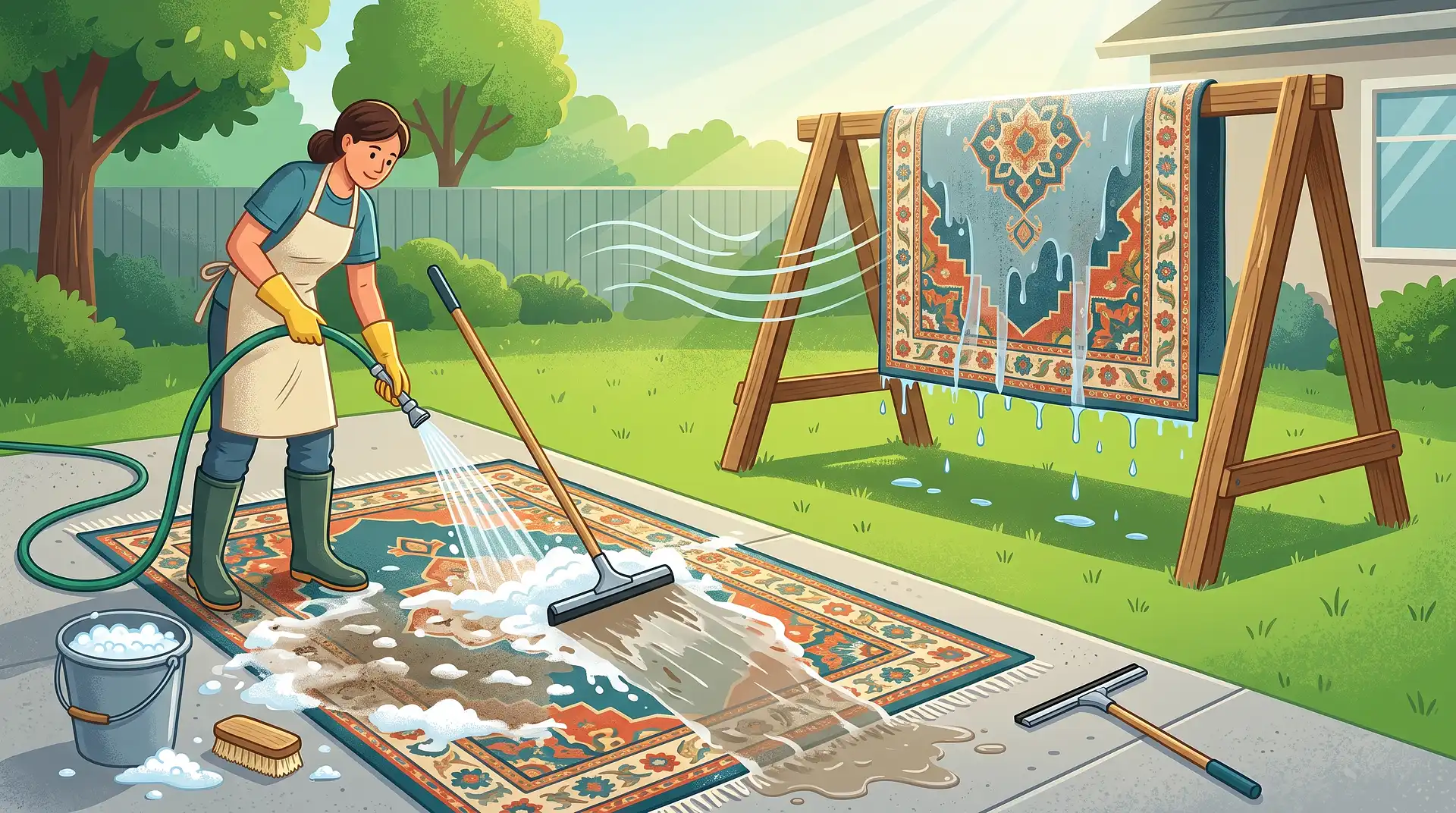
How to Clean a Really Dirty Rug
8 October 2026
Would rather leave it to a professional? See our rug cleaning in Manchester.
Quick answer: Start by checking the rug’s fibre, backing and care label. Remove loose grit with a suitable vacuum, deal with individual stains, then use only the wet-cleaning method approved for that rug. Do not soak, shampoo or steam a rug simply because it is very dirty. Wool, silk, viscose, jute, handmade rugs and unstable dyes can be damaged by the wrong treatment. Dry the rug fully before returning it to the floor.
A really dirty rug may contain several types of soil at once. Dust and grit settle near the backing, greasy marks hold more dirt, and old spills may leave stains or smells. One quick pass with a wet machine may brighten the surface while leaving soil underneath. A careful clean starts with identification and dry soil removal.
Check the rug before cleaning it
Look for a care label on the underside. If it is missing, check the original product information or ask the retailer. Record the face fibre, backing material and permitted cleaning method. A rug described as synthetic may still contain jute, cotton, latex, adhesive or natural-fibre edging.
Inspect the rug in good light. Look for worn edges, loose tufts, splits, brittle backing, colour migration and patches that feel sticky or unusually stiff. Smell the front and back separately, and inspect the underlay and floor for moisture or contamination.
Pause home cleaning if the rug is handmade, antique, silk, viscose, genuine sheepskin or difficult to identify. The same applies when colours transfer to a dry white cloth, the backing is breaking up, or pet urine, flood water or mould has reached deep into the rug. These conditions need a method chosen for the whole construction.
Work out what “really dirty” means
What you find | First response |
|---|---|
Loose dust, crumbs, hair or grit | Use careful dry soil removal before applying moisture |
Dark traffic lanes or greasy soil | Use a compatible pre-treatment only if the care instructions permit it |
Separate food, drink or mud marks | Identify and spot-treat each stain before cleaning the wider area |
Odour from pet accidents or vomit | Check the backing, underlay and floor because surface treatment may not reach the source |
Musty smell, dampness or visible growth | Stop and investigate the moisture source before cleaning |
This check prevents repeated treatments that add moisture without removing the cause. It also helps you decide whether the rug needs routine maintenance, stain treatment, a label-approved wash or specialist cleaning.
What you need
A vacuum with controllable suction and a suitable floor head
Clean white absorbent cloths or towels
A spoon or blunt plastic edge for lifting solids
A cleaning product approved for the rug, if wet treatment is allowed
Gloves when handling vomit, urine, faeces or unknown residue
Good airflow and enough protected space for complete drying
Avoid choosing a cleaner only because it says “carpet” on the front. Check that it suits the rug’s fibre, backing, colour and permitted cleaning process. Follow its dilution, contact-time and rinsing instructions.
How to clean a really dirty rug step by step
1. Clear and inspect the area
Move furniture and check for sharp objects before lifting the rug. Photograph any damage so you do not mistake an old defect for cleaning damage later. If the rug is large or heavy, get help to move it without folding or dragging it.
2. Remove loose soil slowly
Vacuum the top using the setting and attachment recommended for the rug. Work in overlapping passes and empty the vacuum when needed. Avoid a rotating brush on long pile, fringes or delicate fibres unless the maker specifically permits it.
If the rug can be turned safely, vacuum the floor and then clean the underside using a suitable low-suction setting. Grit trapped underneath can scratch flooring and work back into the rug. Do not beat or shake a weak, handmade or damaged rug.
3. Lift solids and blot wet residue
Use a spoon or blunt edge to lift dried mud, food and other solids towards the centre of the mark. Blot remaining liquid with a white cloth. Do not scrub, because rubbing can spread the stain, distort the pile or push residue deeper.
4. Test before using moisture
Test the approved product on a small hidden area. Use the same dilution and process planned for the main clean, then let the test area dry fully. Check for colour transfer, fading, texture change, shrinkage, watermarking or backing damage.
A successful patch test reduces risk but does not prove that soaking the entire rug is safe. Large-scale wetting can behave differently, particularly around borders, backing and glued sections.
5. Treat stains by type
Work on individual marks before the general clean. Apply the smallest practical amount of compatible product to a cloth rather than pouring it onto the rug. Work from the edge towards the centre, following the product instructions. Blot out residue and repeat only when the rug and product guidance permit it.
Do not combine homemade mixtures with commercial products. More chemical does not mean better cleaning, and excess detergent can leave a sticky residue that attracts fresh soil.
Is the rug heavily stained, smelly or unsafe to wash at home?
Ask About Professional Rug Cleaning
Rug too dirty for a home clean?
Book professional rug cleaning
Choose the correct deep-cleaning method
For a machine-washable rug
Use a washing machine only when the label permits it and the appliance can handle the rug’s size and wet weight. Remove loose soil first. Follow the stated programme, temperature, detergent and spin instructions. Do not add bleach, fabric softener or a hotter setting unless expressly allowed.
An oversized washable rug may need a suitable commercial machine. Forcing it into a domestic drum can prevent proper cleaning and place strain on both the rug and appliance.
For a rug that permits extraction cleaning
Confirm that the maker allows an extraction or carpet-cleaning machine. Check the machine instructions and use a compatible low-foaming product. Protect the floor beneath the rug, pre-treat only as directed and avoid flooding the backing.
Make controlled cleaning passes followed by extraction-only passes if the machine permits them. Stop if colours move, edges curl, the backing softens or the machine pulls fibres. Steam, hot water and extraction are different processes, so permission for one does not automatically allow the others.
For a rug marked spot clean only
Do not turn a spot-clean instruction into a whole-rug wash. After dry soil removal, treat individual marks with the stated method and keep moisture localised. If the overall rug remains grey or smells after suitable spot treatment, professional cleaning may be the safer next step.
For washable polypropylene rugs
Some polypropylene rugs tolerate more moisture than wool or viscose, but their backing and edging still control the method. Read our guide to cleaning a polypropylene rug before choosing a full wash. Do not assume every synthetic rug can be hosed or soaked.
Rinse only when the method requires it
Detergent left in the pile can make a rug feel stiff and attract soil. If the approved method requires rinsing, use the amount and process stated by the rug and product makers. Extract or blot moisture as directed without twisting the rug.
Do not keep adding water until the visible runoff looks clear unless full rinsing is specifically permitted. Water can carry unstable dye into lighter areas, weaken adhesive, distort natural fibres and leave the backing wet long after the surface feels dry.
Dry the rug thoroughly
Start drying immediately after wet cleaning. Follow the care label for flat drying, line drying or tumble drying. Support a heavy wet rug evenly, because lifting it by one corner can strain seams and backing.
Use airflow and, where suitable, a dehumidifier. Keep the rug away from radiators, hairdryers and strong direct heat. Turn or reposition it only when its instructions and weight allow safe handling. Check the backing, borders and deepest pile before returning it to the floor.
Do not place furniture on a damp rug. Trapped moisture can affect the rug, underlay and flooring, while furniture feet may leave marks or transfer colour.
When home cleaning is not suitable
The label says professional cleaning only or prohibits washing
The rug is antique, handmade, silk, viscose or has unstable colour
The backing is brittle, split, peeling or heavily contaminated
Urine, vomit or another spill has soaked through to the underside
There is a persistent musty smell, dampness or suspected mould
The rug is too large to clean, rinse, lift or dry safely
Previous home treatments have left sticky residue or spreading rings
A specialist can assess fibre, construction, dye stability and contamination before selecting a process. Deep-set soil may require controlled dust removal, targeted treatments, thorough rinsing and managed drying that are difficult to reproduce at home.
Safety guide
Read the rug label, cleaning-product label and machine instructions before starting.
Never mix cleaning products, including bleach, acids, ammonia-based cleaners or homemade mixtures.
Use the ventilation and protective equipment stated on the product label.
Keep children and pets away from products, equipment and damp rugs until instructions allow access.
Unplug electrical equipment before checking, filling or cleaning it.
Get help to lift a large wet rug and keep walkways clear.
Protect hard flooring from moisture and make sure the rug is completely dry before use.
The Hertfordshire Fire and Rescue Service guidance on household cleaning chemicals explains why products should never be mixed and why label instructions matter.
Frequently asked questions
Can I hose down a really dirty rug?
Only if the manufacturer confirms that full washing and rinsing are suitable. Hosing can saturate backing, move dyes and create a drying problem. Many wool, jute-backed, glued and indoor rugs should not be treated this way.
Can I use washing-up liquid on a rug?
Use only a cleaner approved for the rug and cleaning method. Washing-up liquid may create excess foam or leave residue when used in a carpet-cleaning machine. The machine may also require its own compatible formula.
Will baking soda deep-clean a dirty rug?
No. A dry powder does not remove embedded greasy soil, old spills or contamination from the backing. Powders can also remain trapped in dense pile. Use a method matched to the actual soil and the rug’s care instructions.
Can I use a steam cleaner?
Only when the rug maker and equipment instructions confirm that steam is suitable. Heat and moisture can affect fibres, dyes, adhesives and backing. A rug described as washable is not automatically steam-safe.
Why does the rug still smell after cleaning?
The source may remain in the backing, underlay or floor, or the rug may still be damp. Detergent residue can also hold soil. Stop adding fragrance and identify the source before applying another treatment.
How many times should I clean the rug?
Avoid repeated wet cleaning in one session. Let the rug dry fully and assess the result. Several treatments can cause overwetting, colour movement and residue build-up. Seek advice if a careful clean does not produce a safe result.
How do you deep clean a very dirty rug at home?
Take it outside, shake or beat it, and vacuum both sides. Check the fibre, then wash synthetic rugs with a carpet washer or a bucket of mild detergent and a soft brush. Rinse well and dry both sides fully. Wool, silk and natural fibres need gentler, specialist methods.
Why does my rug still look dirty after cleaning?
Deep grit at the base of the pile, soap residue or worn fibres. Too much detergent attracts dirt fast. Beat out grit first and rinse thoroughly so no residue is left.
When is a rug too dirty to clean at home?
When it smells after cleaning, has pet urine through the backing, colours that run, or is wool, silk, antique or hand-knotted. These need immersion washing by a rug specialist.
Clean the rug without creating a new problem
The best result comes from removing dry soil first, treating stains carefully and matching the deeper clean to the rug’s complete construction. When the label is unclear, contamination has reached the backing or safe drying is difficult, an assessment can prevent avoidable damage.
Need help with a heavily soiled rug?
Related guides: how to clean a rug at home, how to wash wool rugs, how to clean a Persian rug. For a professional finish, see our rug cleaning service or carpet cleaning in Manchester.
Related guides
Need it cleaned properly?
Book our rug cleaning service — from £39 (UK average £60), free in-home survey and pay on completion.