How to Make a Mattress Firmer (7 Simple Fixes)
6 October 2026
Would rather leave it to a professional? See our mattress cleaning in Manchester.
Can you make a mattress firmer?
You can often make the sleeping surface feel firmer. You cannot reliably make a failed mattress supportive again. The right option depends on the cause.
What is causing the soft feel? | What may help | What will not solve it |
|---|---|---|
A thick, soft topper or padded protector | Remove it for a few nights or replace it with a firmer topper | Adding more soft layers |
Bent slats, a weak centre rail or a tired sprung base | Repair or replace the base with one approved for the mattress | A topper placed above an unsupported mattress |
A mattress that needs routine rotation or an approved flip | Rotate it, or flip it only if it is designed to be two-sided | Flipping a one-sided foam, hybrid or pillow-top mattress |
A new mattress settling into normal use | Use the correct base and allow the maker’s stated settling period | Modifying it before reading the trial and care conditions |
A visible sag, failed springs or foam that stays compressed | Check the warranty and plan replacement if the support has failed | Boards, extra toppers or repeated rotation |
Check why the mattress feels too soft
Remove the extras first
Take off a topper, deep quilted protector, heated pad and several folded blankets. Sleep on the mattress with only a normal fitted sheet for a few nights if its care instructions allow. A soft layer can change the feel more than people expect.
If the bed feels firmer without the topper, the mattress may still be structurally sound. Choose a slimmer or firmer replacement only after checking the mattress underneath.
Inspect the mattress surface
Strip the bed and look across the mattress in daylight. Check for a dip at the usual sleeping position, loose stitching, visible damage or an area that remains lower after it has been unoccupied for a while.
Press several areas with both hands, including the centre and edges. A small amount of contouring is normal, especially in foam. A clear difference between the main sleeping zone and unused areas suggests uneven wear.
Inspect the bed base
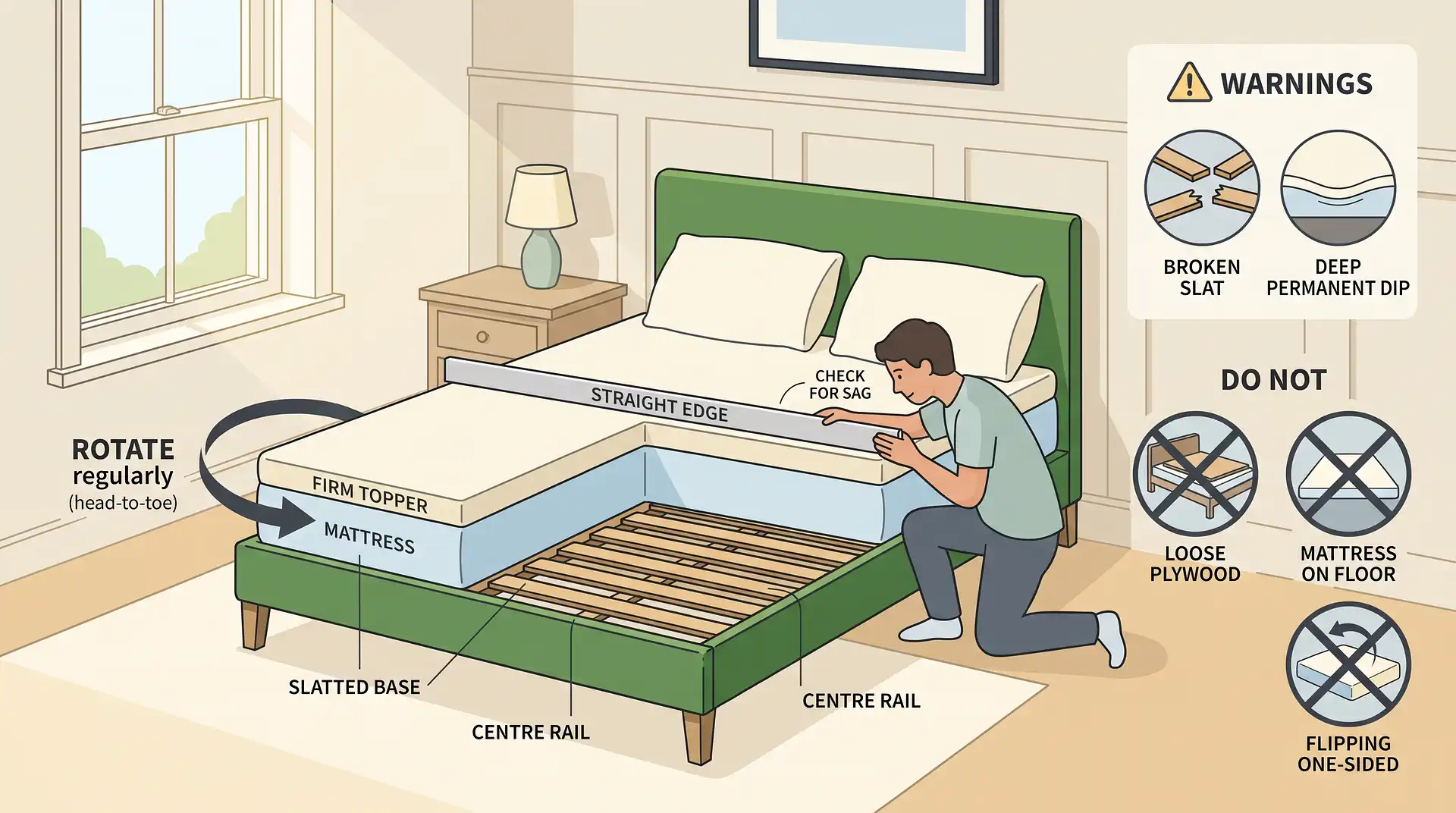
Check slats for cracks, gaps, loose ends and noticeable bowing. Look at the centre rail, centre legs and frame joints. On a divan or sprung base, check for a sagging section, damaged fabric or a base that dips under the mattress.
Use the mattress manufacturer’s guidance for slat spacing, base type and weight limits. A base that is too flexible or too widely spaced can make a mattress feel less supportive and may affect its warranty.
Consider the age and change in feel
A mattress that has always felt softer than you prefer needs a comfort adjustment. A mattress that has recently become soft in one area may be wearing out. Note when the change began, whether it is one-sided and whether you wake with new hip, shoulder or back discomfort.
Body pain has many possible causes, so a mattress cannot diagnose it. If pain is persistent, severe or affects daytime life, speak with an appropriate healthcare professional.
Mattress needs a refresh as well?
Five ways to make the bed feel firmer
1. Use the correct side of the mattress
Only flip a mattress if the label or manufacturer says it is two-sided. Many modern memory foam, latex, hybrid, pillow-top and pocket-sprung mattresses are one-sided. Their underside is a support layer, not a sleeping surface.
Most one-sided models should be rotated head to foot instead. Our guide on how often you should flip a mattress explains how to identify the correct method.
2. Rotate it to spread wear
Rotation does not make foam or springs firmer, but it can move a slightly softened sleeping area away from the heaviest pressure zones. Follow the maker’s schedule, which is often every three to six months.
Do not expect rotation to remove a permanent dip. If the same area feels much softer after it has rested, the support layers may be failing.
3. Replace a soft topper with a firm one
A firm topper made for your mattress size can change the first few centimetres you feel when lying down. It is most useful when the mattress is even and supportive but the comfort layer feels too plush.
Read the topper specification instead of buying by its word “firm” alone. Firmness labels are not standard between brands. Check the return conditions, thickness, heat retention, weight guidance and whether the topper changes the mattress height enough to affect your bed guard or fitted sheets.
A topper cannot bridge a deep sag or repair broken springs underneath. It may even make an uneven mattress feel less predictable because the soft area is still moving below it.
Is the mattress still supportive but looking tired or smelling stale?
4. Repair or replace an unsuitable base
Replace broken slats, secure loose supports and repair a damaged centre rail before judging the mattress. If the mattress maker allows a solid or platform base, moving from a flexible sprung base to the correct rigid support can make the bed feel firmer.
Do not add a loose sheet of plywood, place the mattress directly on the floor or block all ventilation as a quick fix. These changes can trap moisture, abrade the cover, reduce airflow and conflict with the mattress warranty. Use only a base or support system approved for the exact mattress.
5. Check the room and foam temperature
Memory foam reacts to temperature and can feel softer in a warm room. Keep the bedroom at a comfortable, stable temperature and follow the mattress maker’s care advice. Do not use extreme cold, direct heat or an electric blanket to force a change in firmness.
This may make a small difference to the feel of temperature-sensitive foam. It cannot restore foam that has lost its ability to recover.
Test the base before buying a replacement
When the manufacturer permits it, compare the mattress on its usual base with an approved, level support surface. Use the comparison to identify a base problem, not as a permanent improvised setup.
If the mattress feels evenly supportive on the approved surface but soft on the existing bed, deal with the base first. If it still dips or feels unstable, the mattress is more likely to be the cause.
Do not make the comparison by sleeping with the mattress on a hard floor. Floor placement can restrict airflow, collect dust and moisture, and may invalidate the product terms.
When a mattress should be replaced
Replacement is usually more sensible than modification when the mattress has:
A visible or permanent dip at the main sleeping position
Broken, noisy or felt springs
Uneven support that remains after rotation and base checks
Foam that stays compressed or has become noticeably softer in one area
Damage, deep contamination or mould that cannot be safely resolved
New discomfort that is clearly linked with sleeping on the bed
Document the problem with photographs and a straight edge before changing the base or using a topper. If the mattress is still within its warranty period, read the claim conditions before applying unapproved products or making alterations.
Firmness and support are not the same
A very hard mattress is not automatically more supportive. Support means that the mattress holds your body evenly enough for your usual sleeping position, while comfort means how much pressure you feel at the shoulders, hips and lower back.
If a bed feels soft but you wake comfortable and the surface is even, you may only need a firmer comfort layer. If it feels firm but causes pressure points, making it harder could make sleep worse. Test changes for several nights, unless the mattress has a clear fault or causes immediate discomfort.
Safety guide for moving and adjusting a mattress
Check the label and manufacturer instructions before flipping, rotating or changing the base.
Use two capable adults for a double, king or super-king mattress where possible. Foam and natural-fill models can be awkward even when they do not look heavy.
Clear the route of furniture, cables, rugs, pets and children before moving the mattress.
Keep fingers away from bed-frame hinges, slat brackets and adjustable-bed mechanisms.
Do not stand on the mattress or use it as a step while reaching the bed frame.
Do not modify the support base with unapproved boards, fixings or electrical equipment.
Read the Health and Safety Executive guidance on manual handling before lifting or carrying a bulky mattress. It explains that lifting, carrying and supporting heavy loads can create a risk of injury.
Common mistakes when trying to make a mattress firmer
Flipping a one-sided mattress and sleeping on its support core
Buying a topper before checking for a dip or damaged base
Assuming a higher spring count automatically means a firmer feel
Using plywood or the floor without checking ventilation and warranty rules
Ignoring broken slats or a weak centre support
Using cold, heat or an electric blanket to force foam to feel different
Trying to cover structural failure with another thick layer
Moving a large mattress alone
Frequently asked questions
Can a mattress topper make a mattress firmer?
A firm topper can make the surface feel firmer when the mattress underneath is level and supportive. It cannot restore sagged springs or foam that has broken down.
Will plywood make a mattress firmer?
A rigid support may change the feel, but loose plywood is not a safe universal fix. It can reduce ventilation, damage the cover and conflict with warranty conditions. Use only a base approved for your mattress.
Can I flip my memory foam mattress to make it firmer?
Usually no. Memory foam mattresses are generally one-sided, with the comfort layer on top. Check the label and rotate it head to foot if the maker instructs you to do so.
Why has my mattress suddenly become too soft?
Check for a topper, broken slats, a weak base, a change in foam temperature or a developing sag. A sudden local change is more likely to be a support or structural issue than a normal adjustment period.
Does rotating a mattress make it firmer?
Rotation distributes wear but does not make the materials firmer. It may improve comfort when one area has experienced more use, provided the mattress has not developed a permanent dip.
Can a soft mattress cause back pain?
An unsupportive mattress can contribute to poor sleep and discomfort, but back pain has many causes. Seek appropriate medical advice for pain that is persistent, severe or affects daily activity.
How do I know whether to clean or replace my mattress?
Cleaning can improve hygiene, stains and odour on a mattress that still provides even support. Sagging, broken springs and failed foam are structural problems that cleaning cannot repair.
Does putting a board under a mattress make it firmer?
A plywood board between a sagging base and the mattress can make it feel firmer by stopping it dipping. It reduces airflow, so lift the mattress regularly to air it and stop moisture building up.
Why has my mattress gone soft?
Foam and springs soften with use and body heat over the years, especially in the areas you sleep on most. Rotating the mattress every 3 to 6 months helps it wear evenly and stay firmer for longer.
Choose the fix that matches the problem
Start with the mattress label, topper and bed base. A firmer topper or correct base can be worthwhile when the support beneath is still sound. If the mattress has failed internally, use the evidence to check the warranty and plan a replacement instead of spending on temporary layers.
Need a hygienic refresh for a mattress that still supports you well?
Request a Mattress Cleaning Assessment
Related guides: how to clean a memory foam mattress, how to clean a mattress. For a professional finish, see our mattress cleaning service or carpet cleaning in Manchester.
Related guides
Need it cleaned properly?
Book our mattress cleaning service — from £35 (UK average £55), free in-home survey and pay on completion.