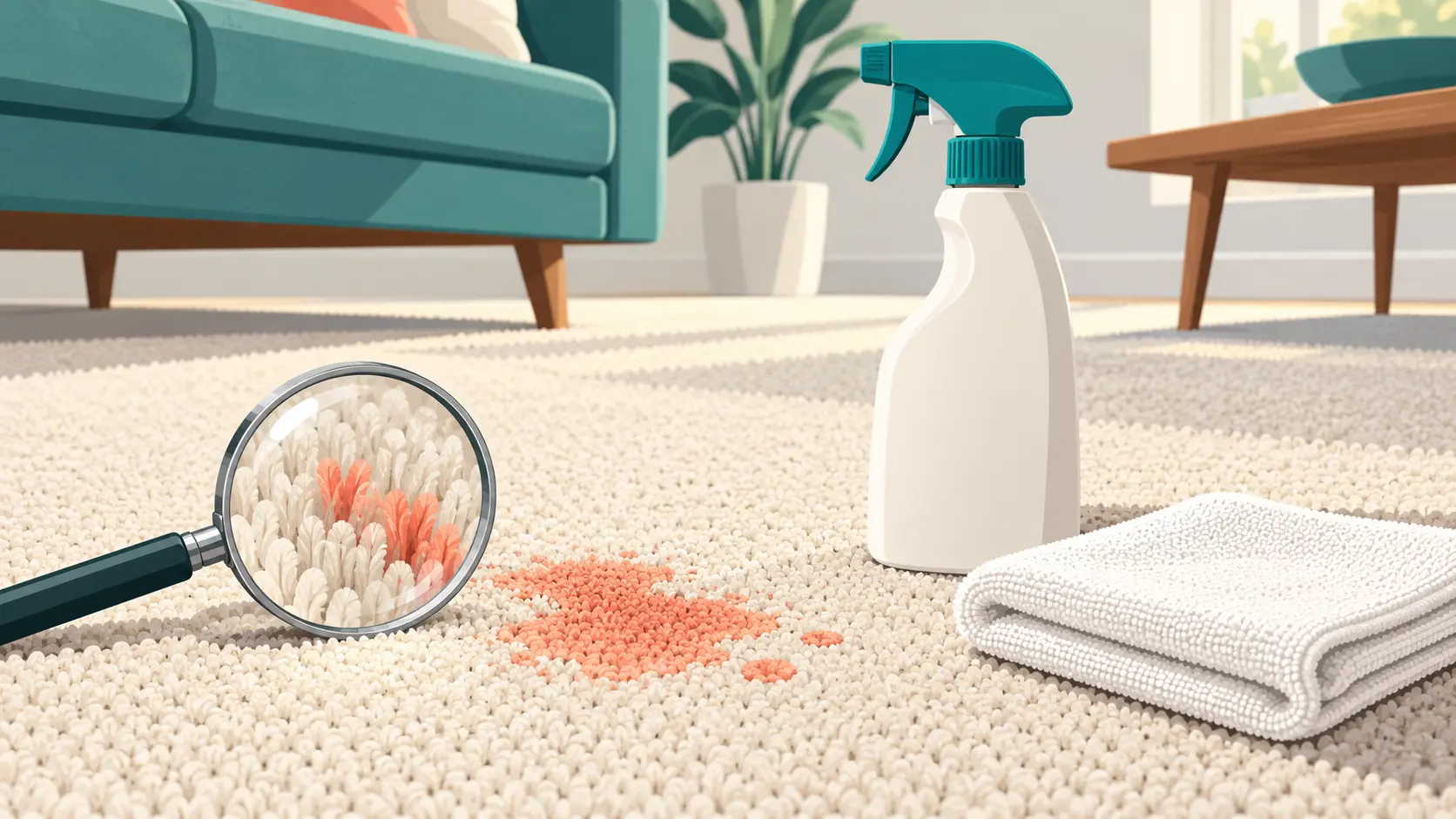
What Is a Good Carpet Stain Remover?
24 October 2026
Would rather leave it to a professional? See our carpet cleaning in Manchester.
Quick answer: For a useful UK all-rounder, look for a current WoolSafe-approved spotter such as instant dry carpet cleaning , checking the pack before purchase. Pet urine needs a compatible urine treatment, while grease and ink need specialist products. No single bottle is best for every stain or carpet.
Do | Don't |
|---|---|
Identify the stain and carpet fibre first | Assume one spray removes every type of stain |
Patch-test the product and let the test area dry | Judge colour safety while the carpet is still wet |
Blot from the outside towards the centre | Scrub hard or use a coloured cloth |
Use small amounts and rinse as directed | Mix products or soak the carpet backing |
The strongest bottle is rarely the best choice. Carpet stains behave differently. Coffee contains plant tannins, blood contains protein, cooking oil repels water, and ink is designed to leave colour behind. A product that works well on one may set, spread or bleach another.
A reliable stain remover should therefore state which materials and soils it treats, how long it should remain on the carpet, whether it needs rinsing and which precautions apply. If those details are missing, choose a better-labelled product.
Which carpet stain removers are worth considering in the UK?
The examples below are starting points, not the result of an InstantDry product test. Product formulas and approvals can change, so check the current packaging and the carpet maker's instructions before use. A familiar brand name does not replace a patch test.
Need | UK product examples | Why consider this type | Check before using |
|---|---|---|---|
General everyday spots | 1001 Carpet Stain Remover; Astonish Specialist Oxy Active Foaming Carpet Stain Remover | Both appear on the current WoolSafe consumer-product list | Confirm the WoolSafe mark on the pack and follow the stated dwell time |
Pet urine and odour | Vax Pet Stain and Odour Remover; Simple Solution Urine Destroyer | Purpose-made for pet contamination rather than fragrance alone | Check fibre suitability and whether the liquid reached the backing |
Common household marks | Dr. Beckmann Carpet Stain Remover; Vanish carpet spot products | Widely available options with product-specific directions | Different formulas have different exclusions; do not assume they suit wool |
Greasy residue | Carpet Power; SEBO Duo-P Powder | Current WoolSafe material lists these among options useful for greasy spots | Lift excess oil first and remove all powder or product residue |
Professional wool-safe spotter | Selden T12 Spot and Stain Remover; Jangro Spot and Stain Remover | Trade products listed in WoolSafe professional-product material | Availability varies; read the technical label and use only as directed |
Our practical pick: for an unknown everyday spill on wool or wool-rich carpet, begin with a current WoolSafe-approved general spotter and a white cloth. For pet urine on a compatible synthetic carpet, choose a dedicated urine product. For ink, paint, nail varnish or hair dye, stop treating it as an ordinary spill and use a specialist method.
The best product is the one that safely improves the mark without changing the carpet. A powerful oxidiser that removes coffee but leaves a pale patch has not produced a good result.
What type of carpet stain remover should you choose?
Stain type | Common examples | Useful product type | Main caution |
|---|---|---|---|
Protein | Blood, urine, vomit, milk and egg | Carpet-compatible enzyme or protein spotter | Use cool water; heat can set protein |
Tannin | Tea, coffee, wine and fruit juice | Tannin spotter or suitable general carpet spotter | Avoid heat and strong alkaline cleaners |
Oil and grease | Cooking oil, butter, makeup and shoe polish | Carpet-safe grease remover or solvent spotter | Overuse can affect backing or carpet dye |
Dye | Ink, hair dye, lipstick and some drinks | Specialist dye or solvent spotter | Colour loss may look worse than the stain |
Soil and mud | Muddy footprints and tracked-in dirt | Neutral carpet pre-spray or spot cleaner | Let wet mud dry before vacuuming loose soil |
Unknown | An old mark with no known cause | Mild, pH-neutral carpet spotter | Start gently because the wrong chemistry can set it |
What makes a carpet stain remover good?
It is suitable for the carpet fibre
A bottle marked for carpets is not automatically safe for every carpet. Wool and wool-rich pile can be damaged by high alkalinity, aggressive enzymes and oxidising products. Polypropylene is usually more tolerant of water-based cleaning, but its backing and dyes still need care. Sisal, jute and viscose can develop water marks, browning or distortion from ordinary spot cleaning.
If you cannot identify the fibre, check the fitting paperwork, an offcut or the manufacturer's label. When that is impossible, treat the carpet as delicate and use the mildest suitable method.
It targets the substance in the stain
Good stain removal is controlled chemistry rather than force. Enzymes break down some organic residues. Surfactants help water surround and lift soil. Solvent-type spotters act on grease, adhesive and some inks. Oxygen-based products can break down coloured compounds, but may also alter the carpet's own colour.
It gives precise instructions
Look for a clear dwell time, material exclusions, testing directions and a rinsing method. “Spray and wipe” is too vague for a product that may remain in an absorbent floor covering. The correct contact time matters: wiping immediately may waste the product, while leaving it much longer than directed can increase the risk of damage.
It rinses without leaving residue
A stain can seem removed while detergent remains. That residue attracts dust and traffic soil, creating a dark patch in the same place. Foaming sprays are especially easy to overapply because the foam hides the amount of detergent delivered. Use very little and rinse as directed.
What pH should a carpet stain remover have?
Approximate pH | Meaning | Carpet-care implication |
|---|---|---|
Below 6 | Acidic | May suit a specific tannin or browning correction, but is not automatically safe |
About 6 to 8 | Near neutral to mildly alkaline | A sensible range for many general spotters when the label approves the fibre |
About 8 to 10 | Alkaline | Can improve greasy-soil cleaning on compatible synthetics but needs careful rinsing |
Above 10 | Strongly alkaline | Greater risk to wool, dyes, stain protection and skin |
Neutral is pH 7, but pH alone does not tell you whether a formula is safe. Solvents, oxidisers, enzymes and concentration also matter. A spotter around pH 6.5 to 7.5 may be a useful general starting point, yet the label and independent fibre approval carry more weight than one number.
Get Help with a Difficult Carpet Stain
Are enzyme carpet stain removers good?
Enzyme products can be useful for organic contamination such as urine, vomit, food and some pet accidents. They need the label's full contact time to work, and the affected area must be reached at the same depth as the contamination. A light spray on the pile cannot treat urine that has soaked into the backing or underlay.
Do not assume an enzyme cleaner is suitable for wool. Wool is a protein fibre, so some enzyme formulations can damage it. Check for a clear statement of fibre compatibility. For recurring pet odour, the guide to eliminating pee smell from carpet explains why surface treatment sometimes fails.
Stain still there after a remover?
Book professional carpet cleaning
Are oxygen-based stain removers good?
Oxygen-based products can lighten tea, coffee, wine and other coloured organic marks on compatible synthetic carpets. They are not a universal first choice. Their oxidising action may fade a dark carpet, lighten a printed pattern or damage wool if the formulation is unsuitable.
Use one only when the label permits it on your carpet. Test a hidden area, use the stated amount and inspect the patch only after it has dried fully. Never increase the concentration or combine it with another cleaner.
Is a general carpet stain-remover spray enough?
A pH-neutral general spotter is a sensible product to keep for fresh, ordinary spills when its label covers the carpet. It can often handle food, soft drinks and light tracked soil. It is less likely to solve old dye, dried paint, nail varnish, heavy grease or contamination below the pile.
For a fresh liquid spill, absorption matters before chemistry. Press white towels onto the area, changing to a dry section until little more transfers. Then apply the product as directed. Pouring cleaner onto a wet spill merely increases the liquid that must later be removed.
Is a stain-remover spray or spot-cleaner machine better?
Situation | Spray or liquid spotter | Portable spot-cleaner machine |
|---|---|---|
Small surface mark | Usually enough and easier to control | May add more moisture than the mark needs |
Large drink spill | Useful for pre-treatment | Can recover liquid from deeper in the pile |
Repeated pet accidents | Targeted urine chemistry is still needed | Useful for rinsing and extraction if the carpet permits it |
Stairs or car carpet | Convenient for one or two spots | Hose and hand tool can make extraction easier |
Wool or delicate fibre | A compatible spotter gives tighter moisture control | Use only when the carpet and machine instructions allow it |
Machines such as the Vax SpotWash, BISSELL SpotClean and Shark StainStriker are examples of portable extraction cleaners sold in the UK. They spray cleaning solution and recover moisture through a hand tool. They do not make the wrong chemical safe, and they cannot always reach contamination in the underlay.
A machine is most useful when there is enough liquid to extract. A bottle and white cloth are usually simpler for a small surface mark. Whichever method you use, make extra suction-only passes and clean the hose and recovery tank afterwards.
Which stain remover is safest for wool carpet?
Choose a product that explicitly says it is suitable for wool carpet, ideally one carrying a recognised wool-care approval. Wool responds badly to high alkalinity, excessive heat, vigorous rubbing and long periods of dampness. A mild wool spotter used in small amounts is safer than an aggressive multipurpose spray.
Test for colour transfer with a white cloth. If dye transfers, the pile texture changes or the test patch develops a pale ring, stop. Valuable wool carpet and hand-made rugs are better assessed professionally.
Do stain-resistant and polypropylene carpets need different products?
Many modern polypropylene carpets use solution-dyed fibre. The colour is added while the fibre is made rather than applied only to its surface, so these carpets often resist water-based staining and tolerate a wider range of approved cleaners than wool. That does not make the whole carpet indestructible. Heat can distort polypropylene, and strong products may still affect the backing, joins or applied stain protection.
Stain-resistant nylon is different. Its protective finish helps slow absorption, but aggressive alkalinity, repeated detergent residue and hard scrubbing can reduce that protection. Always follow the carpet manufacturer's care information. The phrase “stain resistant” means easier maintenance, not stain proof.
How should you test a stain remover?
Choose a hidden part of the same carpet, such as inside a cupboard or behind furniture.
Apply the smallest label-approved amount to a white cloth, then dab the test patch.
Wait for the full contact time and remove or rinse the product as directed.
Press a fresh white cloth onto the area and check for transferred carpet dye.
Let the patch dry completely in good light before checking colour, texture and stiffness.
A wet test patch naturally looks darker, so an immediate glance is not enough. Drying reveals bleaching, watermarking and sticky residue that may be hidden while damp.
How do you use carpet stain remover correctly?
Remove solids. Lift food or other material with a spoon or blunt scraper without pressing it deeper.
Absorb liquid. Blot with white towels. Work from the edge towards the centre to limit spreading.
Check the label and patch-test. Confirm the carpet, stain and application method are covered.
Apply sparingly. Unless the label says otherwise, put the solution on a white cloth rather than flooding the carpet.
Allow the stated dwell time. Keep the product damp only as instructed; do not let a solvent or strong spotter sit indefinitely.
Blot and rinse. Remove loosened soil, then use a lightly damp white cloth if the label requires rinsing.
Dry thoroughly. Press with dry towels, improve airflow and keep people off the area until dry.
The correct method changes for specific substances. Read the dedicated guide for a coffee stain on carpet or for oil in carpet before treating either one.
How do you stop a damp stain from returning?
After the final rinse, place a folded white towel over the damp patch and add a flat, waterproof weight. Leave it for about one hour, then replace the towel if it is wet. This encourages moisture and remaining colour to wick into the towel rather than drying at the top of the pile.
Check the area again after 24 hours. If the mark returns, blot what has risen and avoid adding another heavy dose of cleaner. Repeated reappearance suggests that the spill reached the backing or underlay and may need controlled extraction.
What order do professional carpet cleaners use for difficult stains?
Trained cleaners identify the fibre and stain before choosing a sequence. For a mixed or uncertain mark, a cautious professional order is often:
Remove dry matter and vacuum. Chemistry should not be added to loose soil.
Treat oily material first. A compatible volatile or solvent-type spotter may release grease that would block a water-based product.
Rinse, then use the appropriate water-based spotter. This addresses the remaining food, drink or general soil without layering incompatible products.
Use a tannin treatment if coloured plant residue remains. Tea, coffee and wine may need this separate step.
Reserve an oxidiser for the final trace. It is used only where fibre, dye and label checks allow it.
This is not a recipe for combining chemicals. Each stage must be controlled and rinsed before the next. At home, stop when you cannot identify the product interaction or the carpet starts to change.
What should you keep in a home carpet-stain kit?
Plain white absorbent cloths and white kitchen roll
A spoon or blunt plastic scraper for lifting solids
A small spray bottle filled with cool water
A current wool-approved general spotter for wool or unknown fibres
A dedicated urine product for compatible synthetic carpet in pet homes
Nitrile or household gloves
A note of the carpet fibre, maker and care instructions
Keep every chemical in its original labelled container. Do not decant cleaner into a drinks bottle or prepare mixtures for long-term storage.
Do home remedies make good carpet stain removers?
Home remedy | Verdict | Reason |
|---|---|---|
Cool water | Useful first response | Dilutes many fresh water-based spills without adding residue |
Washing-up liquid | Limited use | Can help with grease in a very weak solution, but excess leaves sticky residue |
White vinegar | Not universal | May help in a suitable diluted treatment, but acidity can conflict with products and materials |
Bicarbonate of soda | Absorbent, not a complete remover | Can absorb moisture or oil but does not remove every coloured stain |
Salt | Poor general choice | Does not neutralise most stains and can be difficult to remove from the pile |
Household bleach | Do not use | Can remove carpet colour and create dangerous reactions if mixed |
Home mixtures are difficult to control because their strength, pH and residue are rarely measured. A correctly labelled carpet product is usually the more predictable choice. If plain cool water is still lifting colour from a fresh spill, continue blotting before adding anything else.
What mistakes make carpet stains worse?
Scrubbing: spreads the stain and can leave permanent pile distortion.
Using heat: may set protein and tannin stains and can damage synthetic fibres.
Overwetting: carries the stain into the backing and increases drying time.
Layering products: creates unpredictable chemistry and can fix the stain.
Skipping the rinse: leaves residue that attracts new soil.
Repeating after progress stops: increases damage without improving the result.
For routine care beyond individual marks, see the complete guide to cleaning a carpet.
When should you call a professional carpet cleaner?
Professional treatment is sensible when the carpet is wool, silk, viscose or otherwise delicate; the stain is an unknown dye or chemical; a large spill reached the backing; an odour keeps returning; or two careful treatments have stopped producing improvement. It is also safer for valuable carpets and contamination involving sewage or floodwater.
Some permanent dye changes cannot be removed safely. The result depends on the substance, fibre, age of the mark and products already used. Ask for an assessment and a quotation based on the actual condition.
How do you handle stain removers safely?
Read the whole label, including hazard symbols, ventilation advice, protective equipment and first-aid directions. The Health and Safety Executive guidance on cleaning-product labels explains how hazard and precautionary statements help users handle cleaning products safely.
Never mix stain removers with bleach, ammonia, vinegar or another product. Wear any gloves specified on the label, ventilate the room, keep children and pets away, and store the container closed in its original packaging. Keep liquids away from plugs and electrical carpet-cleaning equipment.
Frequently asked questions
What is the best all-round carpet stain remover?
A well-labelled, pH-neutral carpet spotter is a useful general option for common water-based spills. It still needs to be compatible with the carpet and will not replace specialist treatment for protein, grease or dye.
What is the best stain remover for old carpet stains?
It depends on the original substance. Rehydrate an old water-based mark cautiously, then use a compatible targeted spotter. Unknown old stains should receive the mildest treatment first.
Can carpet stain remover bleach carpet?
Yes. Oxygen products, solvents and strongly alkaline cleaners can alter carpet dye. Patch-test every product and judge the area only after it is completely dry.
Should I spray stain remover directly onto carpet?
Follow the label. Applying it to a white cloth gives better moisture control when direct spraying is not required, especially on wool and absorbent backing.
How long should carpet stain remover sit?
Use the exact dwell time on the product label. Different formulas need different contact times, and leaving a product longer may increase the risk of damage.
Is enzyme cleaner safe on every carpet?
No. Confirm that the particular enzyme product is approved for the carpet fibre. Some are unsuitable for wool and other protein-based materials.
Does bicarbonate of soda remove carpet stains?
It can absorb some moisture and oil and may reduce odour, but it does not break down every stain. It is normally a supporting step rather than a complete treatment.
Why did the stain return after cleaning?
Liquid may have reached the backing and carried remaining soil back to the surface while drying. Sticky detergent residue can also attract new dirt to the same patch.
Can I use upholstery stain remover on carpet?
Only if the label specifically includes the carpet fibre. Products intended for one textile may have the wrong pH, solvent strength or rinsing method for another.
When should I stop treating a carpet stain?
Stop if dye transfers, the carpet lightens, the pile changes, the area becomes very wet or two careful applications produce no further improvement.
Not sure which treatment is safe for your carpet?
Send Your Stain Details for an Assessment
Written by: InstantDry Carpet Cleaning Editorial Team
Last updated: 24 October 2026
What is the best carpet stain remover for pet stains?
An enzyme-based pet stain remover, because it breaks down the proteins and uric acid in urine, vomit and faeces. General stain removers often lift the colour but leave the smell behind.
Are oxygen-based carpet stain removers safe?
They are safe on most synthetic carpets and work well on tea, coffee, wine and food. They can lighten some dyes and wool, so always test on a hidden area and follow the label.
Can you make a carpet stain remover at home?
A mix of 1 tablespoon white vinegar, 1 tablespoon washing-up liquid and 500 ml warm water works on many food and drink stains. Blot, then rinse with clean water so no residue is left.
Related guides: how to get tea stains out of carpet, how to get red wine out of carpet. For a professional finish, see our carpet cleaning service or carpet cleaning in Manchester.
Related guides
Need it cleaned properly?
Book our carpet cleaning service — from £29 (UK average £45), free in-home survey and pay on completion.