How to Clean a Jute Rug
26 August 2026
Quick answer: Keep moisture away from jute wherever possible. Regular vacuuming with suction only, shaking and airing outside, and bicarbonate of soda for odour are the basis of good jute care. For spills, blot immediately with a dry cloth and remove as much liquid as possible without adding any. If any wet treatment is needed for a stubborn stain, use the absolute minimum moisture on a barely damp cloth, work only on the stain, and dry the area immediately and completely. Never pour liquid solutions onto jute. If the rug has already gone brown, that is a different problem to the original stain and requires professional assessment.
Jute rugs are one of the most attractive natural flooring options available in the UK, and one of the least tolerant of moisture. Understanding that relationship before a spill happens is what separates a jute rug that stays beautiful for years from one that browns, stiffens and develops mould within weeks of the first accident. Instant Dry Carpet Cleaning handles jute and natural fibre rug enquiries regularly and the browning issue is by far the most common problem that arrives after a well-intentioned cleaning attempt at home.
Why jute and water don't get along
Jute is made from the stalks of the jute plant, which contains natural tannins, lignins and plant-based compounds alongside the cellulose fibres that give it strength. Unlike synthetic rugs, which are essentially inert to water, jute fibres actively interact with moisture at a chemical level.
When water contacts jute in any quantity, it dissolves the tannins and other compounds in the plant fibre. As the water evaporates, those dissolved compounds are drawn toward the surface — the same mechanism that causes tide marks on any fabric — and deposit there as a brown or rust-coloured stain. This is called cellulosic browning, and it is caused by the jute itself rather than by the original spill. It looks like the spill has spread or worsened, but it is actually the rug reacting to the moisture used to clean it.
The second problem is structural. Jute fibres stiffen and become brittle when repeatedly wetted and dried. The open weave construction that gives jute rugs their characteristic texture becomes more fragile over time when moisture cycling is frequent.
The third problem is the backing. Jute holds any moisture it absorbs for a long time, particularly in cool UK conditions. The backing of a jute rug sitting in contact with a floor surface, with moisture trapped between them, is an ideal environment for mould growth.
All of this points in one direction: dry methods first, always. Moisture as a last resort, in the smallest possible quantity, on the smallest possible area.
What happens when jute browns
This section exists because it's entirely absent from every other guide on this topic, and it's what many readers actually need after they've already tried to clean the rug.
If your jute rug has developed a brown shadow or stain following a spill or a cleaning attempt, the brown is almost certainly cellulosic browning rather than the residue of the original spill. Applying more moisture, more cleaning solution, or vinegar to try to lift the brown makes it worse rather than better, because adding more liquid gives the tannins more to work with.
Mild browning sometimes fades as the rug dries completely and is aired over several days. More significant browning is difficult to reverse through further cleaning and typically requires professional assessment. Specialist natural fibre rug cleaners can use controlled drying methods and targeted treatments to address browning, though results depend on the severity.
The main practical takeaway: if you see browning developing, stop adding moisture immediately. Allow the rug to dry as quickly and completely as possible — outdoors in moving air is best — and assess the result once fully dry before deciding on further action.
Routine care: keeping jute looking its best
Good routine maintenance significantly reduces how often any wet cleaning is needed and keeps jute rugs in considerably better condition over their lifetime.
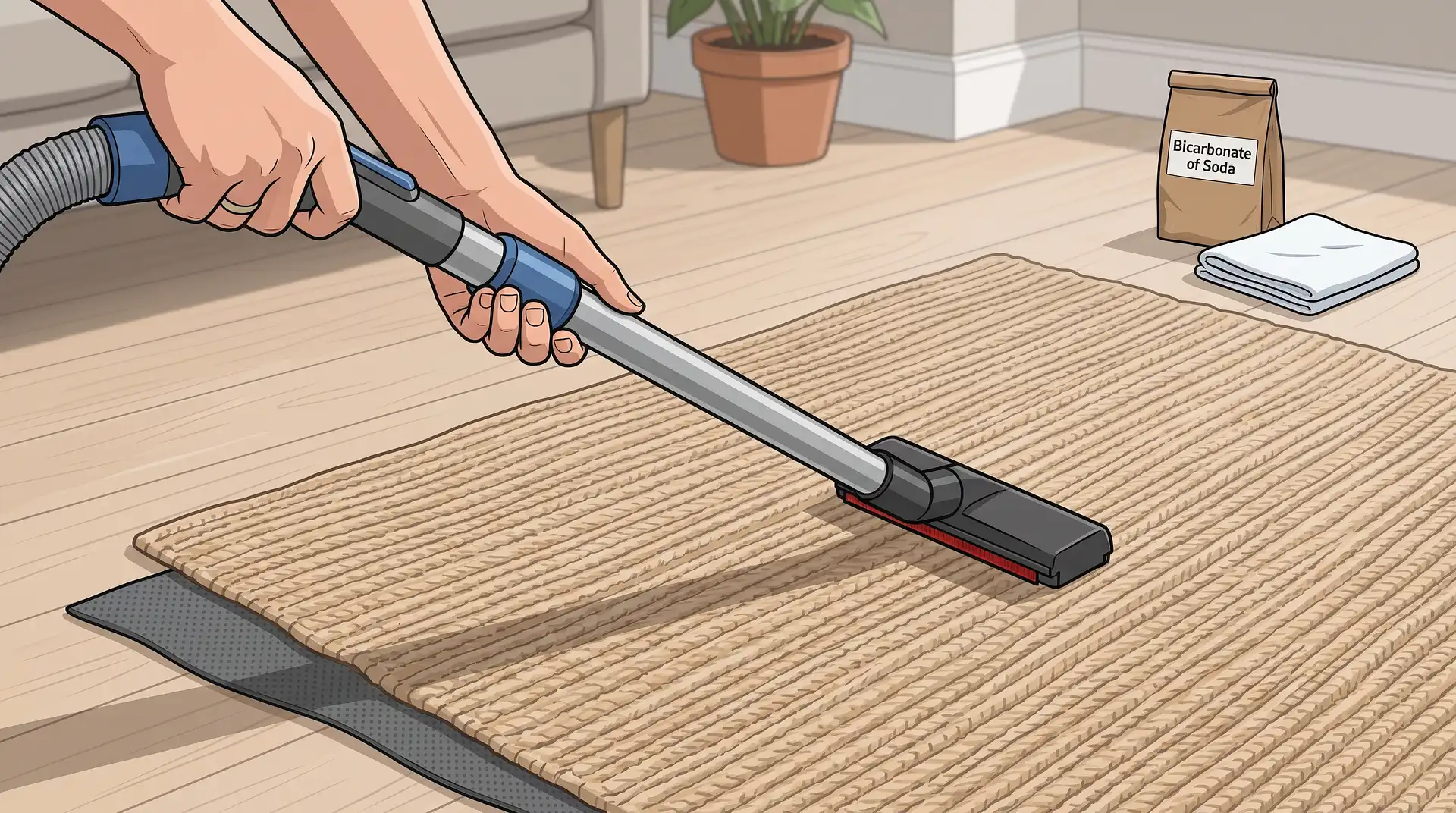
Vacuum regularly with suction only. Jute's open weave traps fine particles easily. Use the plain suction nozzle, not a rotating brush head which can catch in the weave and accelerate shedding. Move slowly in the direction of the weave. Vacuum the back of the rug once a month — more debris than expected collects at the base of the fibre near the backing.
Control shedding. New jute rugs shed loose fibres, which is normal and settles over the first few months. Over-vacuuming or vacuuming with a beater bar accelerates shedding and is the most common cause of jute rugs that lose their texture quickly. Stick to suction only and vacuum no more than once or twice a week for the first few months.
Shake and beat outdoors. Hanging the rug over a railing or fence and beating the back gently with a broom dislodges the fine dusty debris that vacuuming can't always reach. This is particularly valuable for jute because the open weave accumulates dust at a deeper level than densely woven rugs. The guide to cleaning rugs at home covers this in more detail for different rug types.
Rotate every few months. Uneven foot traffic across the rug causes the weave to open and wear faster in the path zones. Rotation distributes this.
Air regularly and avoid damp positions. Never place a jute rug in a bathroom, utility room, conservatory or anywhere moisture levels are consistently elevated. In a centrally heated UK home where windows are closed for weeks during winter, a jute rug can quietly accumulate enough background moisture to develop a musty smell or backing mould without ever having a visible spill. Airing outdoors on a dry day every few months, or simply opening windows regularly in the room where the rug lives, makes a meaningful difference.
Use a rug pad. A breathable rug pad underneath a jute rug serves two purposes: it allows air to circulate beneath the rug rather than trapping moisture against the floor, and it protects the backing from abrasion on hard floors.
When a spill happens
Act immediately. Every second the liquid sits on jute increases how much soaks into the fibre.
Blot with a dry white cloth or paper towel. Work from the outer edge of the spill inward and press firmly. The goal in the first minute is to get as much liquid out as possible before it reaches the fibre base. Keep switching to dry sections.
Do not add any liquid at this stage. No water, no vinegar solution, no cleaning spray. The spill liquid is already the problem. Adding more liquid increases the total moisture in the rug, which increases browning risk.
If solids are involved, use a blunt edge to lift them off the surface before blotting the liquid component.
Once blotted as dry as possible, allow the area to air dry completely before assessing what remains. Place the rug near an open window, or outdoors if the weather allows, on a dry, non-porous surface. Do not fold or roll a damp jute rug.
Assess when fully dry. If no significant discolouration remains, the spill is managed. If there is a residual mark, proceed to the stain treatment below.
Stain removal: the minimum-moisture method
For any residual mark after the initial dry blotting, the approach is to use the smallest possible amount of moisture on the smallest possible area.
For dry residue (dried food, mud once dry, dust): brush gently with a soft bristle brush and vacuum carefully. Attempting to wet dried mud on jute is a common mistake — letting it dry fully and then brushing out is significantly more effective and less risky.
For greasy stains: sprinkle a small amount of bicarbonate of soda or cornstarch directly onto the dry mark. Leave it for an hour to absorb the oil component, then vacuum off carefully. Repeat if needed. This dry absorption method removes a significant amount of oil without any moisture risk.
For liquid stain residue: if a faint mark remains after the spill has dried and the dry methods haven't resolved it, dampen a white cloth with plain cold water until barely damp — it should leave no wet mark on the back of your hand. Dab once or twice on the stain only. Blot dry immediately with a fresh dry cloth. Do not rub. Do not use more moisture if the browning appears to be developing. Stop and allow to dry.
What to avoid: never pour or spray a water-vinegar solution onto jute. The competing content landscape is full of this recommendation and it consistently produces browning in jute. Vinegar adds acid to a fibre that is already challenged by water. Any liquid treatment beyond a barely damp cloth is too wet for jute.
For pet accidents: the uric acid chemistry that causes recurring odour is covered in the dog pee rug guide on this site. On jute specifically, the dilemma is that the enzyme cleaner needed to address uric acid requires some dwell time with moisture, which jute can't tolerate well. Blot as much of the accident as possible dry, use the smallest possible amount of enzyme cleaner on a barely damp cloth, blot dry immediately and dry the rug completely as fast as possible. Significant pet contamination in a jute rug is one of the clearest cases for professional rather than home treatment.
Odour removal without moisture
Bicarbonate of soda is genuinely useful for jute rugs and is safe because it involves no liquid. Sprinkle a light, even layer across the rug surface, leave it for at least two hours and ideally overnight, then vacuum off thoroughly. It absorbs odour compounds from the fibre surface without any moisture risk.
For the back of the rug: flip it, apply bicarb to the backing too, leave, and vacuum. The base of the fibre near the backing often holds more odour than the pile surface.
Sunlight and fresh air are also effective deodorisers for jute. A few hours hanging outside on a dry day eliminates a remarkable amount of general staleness without any product needed.
When to call a professional
Given how limited safe home treatment options are for jute, there's a shorter list of situations that warrant a professional than with most other rug types.
Consider professional cleaning when:
The rug has developed significant browning that hasn't resolved after drying
There has been a large liquid spill that couldn't be completely blotted before it soaked in
A pet accident has saturated the rug or reached the backing
There is a persistent musty smell that airing hasn't resolved, suggesting mould in the backing
The rug is valuable or large enough that the cost of getting it wrong outweighs the cost of professional care
For professional rug treatment, Instant Dry Carpet Cleaning assesses each rug individually before any cleaning begins. For jute specifically, controlled drying is as important as the cleaning method itself, and professional equipment achieves more thorough moisture removal than home methods allow. Rugs from £89.
FAQ Section
Can you use water to clean a jute rug? In very small amounts on a barely damp cloth, for spot treatment only, and with immediate drying. Jute contains natural plant compounds that dissolve in water and deposit as brown staining as moisture evaporates. Any significant moisture application risks browning the rug and damaging the backing.
Why has my jute rug gone brown after cleaning? This is cellulosic browning: natural tannins and plant compounds in the jute fibre dissolve in the cleaning moisture and deposit at the surface as the rug dries. It is caused by the moisture rather than the original spill. Stop adding moisture, dry the rug as quickly as possible, and assess once completely dry. Significant browning often needs professional treatment.
Can you use vinegar on a jute rug? Not recommended. The competing advice to use a vinegar and water solution on jute carries a real risk of browning, because jute cannot tolerate moisture well and adding an acid compound increases the risk of fibre damage.
How do you get stains out of a jute rug? Blot any spill immediately with a dry cloth and remove as much liquid as possible. For dry residue once the spill has dried, brush and vacuum. For greasy marks, absorb with bicarbonate of soda before any wet contact. For any residual liquid stain, use a barely damp cloth with plain cold water on the stain only, blot dry immediately, and dry the rug completely.
How do you remove odour from a jute rug? Sprinkle bicarbonate of soda over the surface, leave for a minimum of two hours, then vacuum off thoroughly. Apply to the backing too for deeper odour. Hanging outdoors on a dry day for several hours is also effective without any product.
Why is my jute rug shedding so much? New jute rugs shed naturally for the first few months. Vacuuming with a rotating brush head or beater bar significantly accelerates shedding. Switch to suction-only vacuuming and vacuum less frequently during the break-in period.
Can you machine wash a jute rug? No. Machine washing will cause significant fibre damage, backing deterioration, mould and shrinkage. Jute should never be submerged in water.
How do you dry a jute rug after cleaning? Elevate it rather than laying it flat. Hang over a railing, fence or washing line so air reaches both the surface and the backing. Never lay it on a floor or carpet while damp. Dry as quickly as possible, preferably outdoors on a dry, breezy day.
Service Section
Browning, pet accidents or a spill that went too deep to treat at home?
Jute is one of the rugs most likely to need professional rather than DIY cleaning, not because it's high-maintenance in daily life, but because the consequences of over-wetting are significant and the home options are genuinely limited. InstantDry collects rugs across England and Wales, assesses each one before treatment begins, and returns them properly dried and wrapped. Rugs from £89.
Get your fixed quote in 60 seconds
Or call 07555 856988.