How to Stop Rugs Moving on Carpet
17 August 2026
Quick answer: Most rug pads sold as non-slip are designed for hard floors and don't work on carpet, because on a carpeted floor the surface underneath is itself moving. What you need is a carpet-to-carpet gripper, which has hooks or teeth that physically engage the pile below rather than relying on friction. Before buying anything, try turning the rug so its pile runs against the carpet's pile direction, which is free and genuinely reduces creep. Avoid cheap rubber and PVC-backed pads on light carpet, since some can discolour it over time in a way that doesn't clean out.
If you've already bought a non-slip rug pad, put it under your rug on a carpeted floor, and found the rug still travels halfway across the room by the weekend, you haven't done anything wrong. You bought the wrong category of product, and it's an easy mistake because almost nothing sold in this space explains the difference.
Why your rug pad didn't work
Stopping a rug moving on a hard floor is a friction problem. The rug slides across a smooth, static surface, and rubber, latex or PVC mesh underlay solves it by gripping against something that doesn't move.
Stopping a rug moving on carpet isn't a friction problem at all.
Carpet pile flexes. Every footstep bends the fibres, they spring back, and that constant small movement is happening underneath your rug all day. A rubber pad grips the pile perfectly well, and then the pile itself moves, taking the pad and the rug with it. You're gripping a surface that isn't fixed.
There's a second factor. Foot traffic in a room tends to run in consistent directions, so a rug on carpet doesn't wander randomly, it migrates steadily one way. That's why it always seems to end up in the same wrong place.
What works on carpet is mechanical engagement, not friction. Something that hooks into the pile below and physically locks the rug in position.
The free fix to try first
Before buying anything, try this.
Both your carpet and your rug have a pile direction, a nap. Run your hand across each: one direction feels smooth, the other feels slightly rough and changes the colour tone.
Lay the rug so its pile direction runs against the carpet's pile direction rather than with it. When the two naps oppose each other, the fibres interlock slightly rather than sliding over each other, which genuinely reduces creep.
It won't stop a lightweight rug on a high-traffic route by itself, but on a heavier rug in a moderately used room it's sometimes all you need. It costs nothing and takes two minutes.
While you're at it, check whether the rug is simply too light for the traffic it's getting. A thin, lightweight rug in a hallway will always be a struggle. A heavier rug, or the same rug in a lower-traffic room, may solve the problem outright.
Carpet-to-carpet grippers
This is the product category that actually addresses the problem.
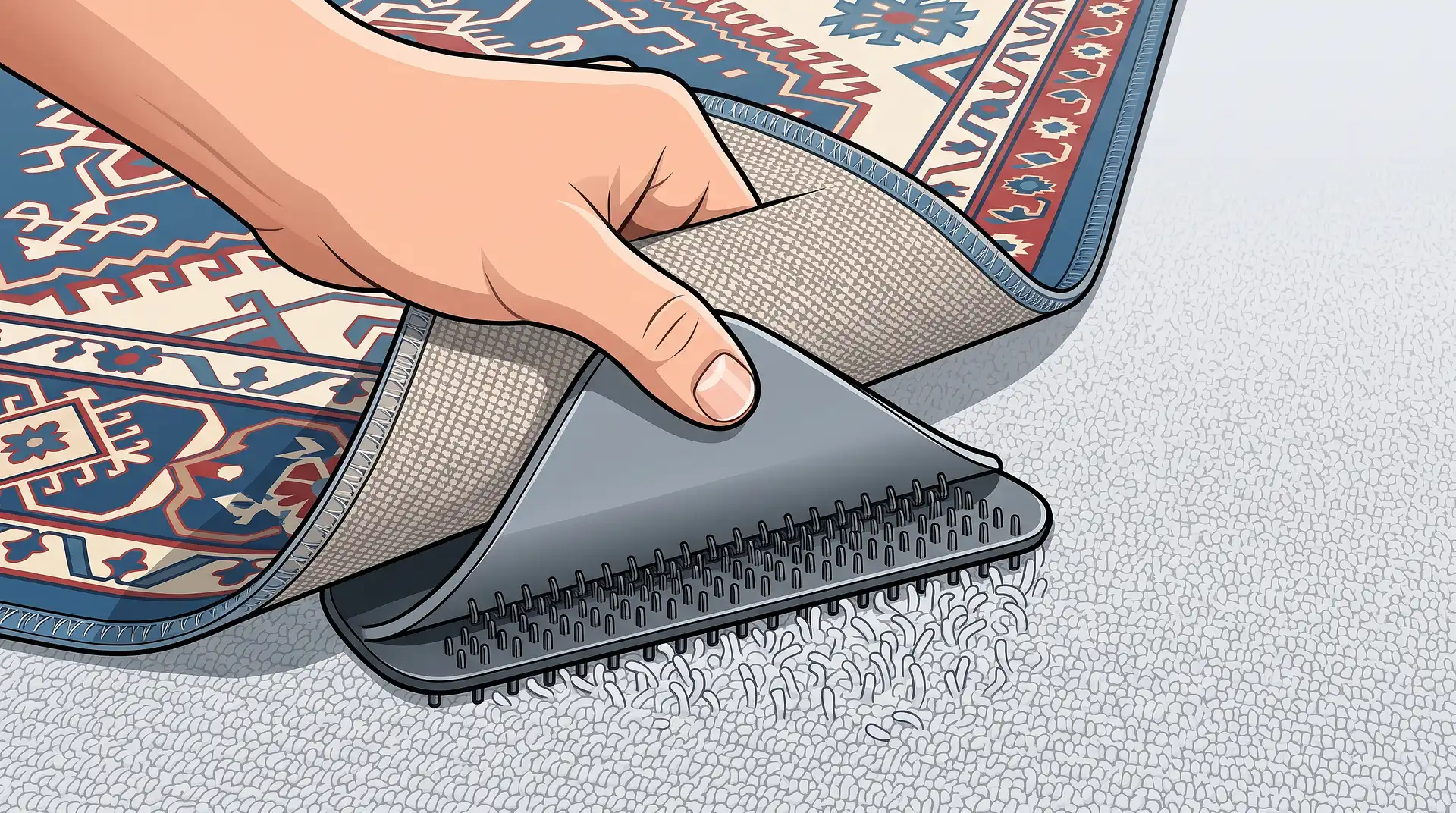
Carpet-to-carpet grippers work on a hook-and-loop principle. They have small stiff hooks, teeth or spikes on the underside that engage the loops and fibres of the carpet beneath, and a gripping or adhesive surface on top that holds the rug. The rug and the carpet become mechanically linked rather than just pressed together.
They're sold in a few formats:
Corner grippers, small triangular or square pads for each corner of the rug. Cheapest option, good for lighter rugs and moderate traffic. Corners are where movement usually starts.
Strip grippers, longer strips along the rug edges. Better for larger rugs and heavier traffic.
Full underlay grippers, a complete pad cut to the rug size. Most secure, adds cushioning, most expensive.
What to look for: confirm the product is specifically described for use on carpet. Many products described simply as "non-slip rug underlay" are the rubber, hard-floor type. The packaging distinction is often subtle, and it's the thing most people get wrong.
On cut-pile versus loop-pile carpet: hooked grippers engage best with loop pile, since there are loops to hook into. On dense cut-pile they still work but may hold less firmly, so a larger gripper area is worth considering.
A note on wool carpet: aggressive spiked or hooked grippers can pull at wool fibres over time. On a good wool carpet, a gentler gripper with more surface area, or a lower-tack option, is worth the extra cost.
Double-sided carpet tape
Effective, cheap and available anywhere. It also carries the most risk to the carpet underneath, which no competing page mentions.
It works well on lighter rugs and holds firmly, particularly on corners and edges.
The problem is removal. Carpet tape adhesive bonds to carpet fibres, and lifting it later can pull pile fibres out, leaving a bald or thinned strip. Wool is more vulnerable than synthetics. Some tapes also leave a residue that stays tacky and attracts dirt, producing a dark line exactly where the tape was.
If you use it:
Choose a tape specifically described as safe for carpet and removable, rather than general-purpose double-sided tape
Test on a hidden area first, leave it a week, then remove and check what happens to the pile
Use short lengths at corners rather than continuous runs along every edge, so there's less to remove later
Remove it slowly and at a shallow angle, not with a sharp upward pull
Avoid it entirely on wool or on anything valuable
Anchoring with furniture
The most reliable method, and often overlooked because it involves rearranging rather than buying.
Placing a sofa's front legs, an armchair, or a heavy piece of furniture onto the edge of the rug pins it in place permanently and does no damage to anything. In a living room this is often the natural layout anyway.
Anchor two opposite edges if you can, rather than one, since a rug pinned on a single side still swings and rucks at the free end.
Where it doesn't help: hallways, landings and open floor areas with no furniture, which are unfortunately exactly the places rugs move most.
What to avoid, and why
Cheap rubber and PVC-backed pads on light carpet. Beyond simply not working well on carpet, some rubber and vinyl products can leach compounds over months and years that discolour the carpet beneath, showing as a yellow or brown shadow the exact shape of the pad. It's not dirt and it doesn't clean out. If you're going to use a rubber-backed product on a light-coloured carpet, choose a reputable one and lift it occasionally to check underneath.
Silicone or caulk beads applied to the rug back. This DIY method appears in a lot of online advice. It's friction-based, so it has the same fundamental limitation as rubber on carpet, and it permanently alters the rug backing. On a good rug it's not worth it.
Sewing or stapling the rug to the carpet. Damages both. Sometimes suggested; don't.
Very aggressive spiked grippers on wool carpet. They work, but they can pull fibres over time and leave visible marks in the pile when moved.
Rucking and curling corners
Slightly different problem, same family.
Rucking, where the rug bunches into a ridge, usually means the rug is being pushed by traffic and has nowhere to go, or the rug backing has stiffened with age. Grippers along the leading edge, the side the traffic pushes against, help most.
Curling corners are common on rugs that have been rolled for storage or delivery, and often relax over a few weeks. Speed it up by rolling the rug backwards against the curl for a day, or weighting the corners with something heavy and flat. Corner grippers hold them down once flattened.
Both are worth fixing rather than living with, because a raised edge is where people catch their foot.
The safety side
Worth stating plainly. A rug that moves on a carpeted floor is a trip hazard, and a rucked or curled edge is a worse one.
The risk is meaningfully higher for older people, anyone with mobility or balance difficulties, and anyone using a walking aid, where a fall can have consequences well beyond the inconvenience. It also matters in homes with young children and in any rented or shared property where you have some responsibility for the people using the space.
If the rug is in a hallway, on a landing, at the top or bottom of stairs, or on a route someone uses at night, fixing the movement properly is worth doing rather than putting up with. In those specific locations, if a rug won't stay put reliably, the honest answer is sometimes to remove it rather than to keep trying products.
9. FAQ Section
Why does my rug keep moving on carpet? Because carpet pile flexes under footfall, so the surface your rug sits on is itself moving. Friction-based products like rubber underlay grip the pile, but the pile then moves anyway. Foot traffic also runs in consistent directions, which is why a rug migrates one way rather than wandering randomly.
Do rubber rug pads work on carpet? Not well. They're designed for hard floors, where increasing friction against a static surface solves the problem. On carpet you need a gripper that mechanically hooks into the pile beneath rather than relying on friction.
What is the best rug gripper for carpeted floors? A carpet-to-carpet gripper, which uses hooks or teeth on the underside to engage the carpet pile. They come as corner pads, edge strips or full underlay. Check the packaging specifically says it's for use on carpet, since many products labelled non-slip underlay are the hard-floor rubber type.
Will double-sided tape damage my carpet? It can. Adhesive bonds to carpet fibres and removal may pull pile out, particularly on wool, and some tapes leave a tacky residue that attracts dirt. If you use it, choose a tape described as carpet-safe and removable, test in a hidden area first, and use short lengths at corners rather than continuous runs.
Can a rug pad discolour the carpet underneath? Some can. Certain rubber and PVC-backed products can leach compounds over long periods that leave a yellow or brown shadow the shape of the pad. It isn't dirt and doesn't clean out. Use a reputable product and lift it occasionally to check, particularly on light-coloured carpet.
Does pile direction really make a difference? Yes, and it's free. Both the carpet and the rug have a nap. Laying the rug so its pile runs against the carpet's pile direction makes the fibres interlock slightly rather than slide over each other, which reduces creep. It won't fix a lightweight rug in a busy hallway on its own, but it helps.
How do I stop a rug bunching up on carpet? Rucking usually means traffic is pushing the rug and it has nowhere to go. Grippers along the leading edge, the side being pushed against, help most. Anchoring that edge with furniture is more reliable still if the layout allows it.
How do I flatten curling rug corners? Corners usually curl after the rug has been rolled for storage or delivery and often relax within a few weeks. Roll the rug backwards against the curl for a day, or weight the corners with something heavy and flat. Corner grippers keep them down once flattened.
Is a moving rug on carpet actually dangerous? It's a genuine trip hazard, and more so for older people, anyone with balance or mobility difficulties, and anyone using a walking aid. On stairs, landings and night-time routes it's worth fixing properly, and if a rug won't stay put reliably in those places, removing it is a reasonable answer.
Will a heavier rug solve the problem? Often, yes. Weight and thickness both reduce movement. A lightweight rug on a high-traffic route will always be a struggle, and swapping it for something heavier, or moving it to a quieter room, sometimes solves the problem outright without buying anything.
While you've got the rug up
Lifting a rug to fit grippers is a good moment to look at both the rug and the carpet underneath. Rugs trap a surprising amount of soil, and the carpet beneath one is often a different colour from the carpet around it, which shows up the moment you move the rug permanently.
Instant dry carpet cleaning collects rugs, hand washes them in our studio and returns them wrapped, from £89. We also clean carpets, upholstery and mattresses across England and Wales, with a free survey and a fixed price before any work begins.
Single rooms from £49. Whole home, including stairs and landing, from £179.
Get your fixed quote in 60 seconds
Or call 07555 856988.