How to Stop Cats Scratching Carpet
25 August 2026
Quick answer: You cannot stop a cat from scratching. You can redirect where they scratch. The most effective approach is to provide a horizontal scratching pad, not an upright post, placed exactly where the cat already scratches. Add double-sided tape or a physical barrier over the carpet target area temporarily to make it less appealing while the new habit forms. Clean the existing scratch site with an enzyme cleaner to remove the scent that draws the cat back. Most cats shift their habit within a few weeks if the alternative is right for them.
Cat scratching carpet is one of the most common reasons people search for carpet repair advice, and it is one of the most misunderstood cat behaviours in domestic life. Understanding why cats scratch is the key to stopping them from scratching your carpet specifically, and Instant Dry Carpet Cleaning sees the results when redirection hasn't worked, which is why this guide focuses on what the research and practical experience actually shows works, rather than what looks plausible in theory.
Why cats scratch carpet
Cats scratch for several reasons that have nothing to do with being destructive. Understanding the motivation helps you provide the right alternative.
Claw maintenance. Scratching removes the outer sheath of the claw as it grows, keeping claws sharp and healthy. It is a physical necessity, not a choice.
Muscle stretching. A good scratch involves the whole body, pulling through the back, shoulders and forelegs. For a cat, it is the equivalent of a morning stretch.
Scent marking. Cats have scent glands between their paw pads. Scratching deposits scent on the surface and leaves a visible mark, both of which signal territory to other cats and reinforce the cat's own sense of security in the space. This is why cats scratch most often in prominent places, near doors, at the top of stairs, in the middle of a room, rather than hiding away.
Stress or anxiety. A cat that has started scratching more than usual, or in new locations, may be responding to a change in the household, a new pet, a new person, a change in routine. Increased scratching is sometimes a signal rather than a habit.
A cat that scratches carpet is not misbehaving. It is doing something essential in a place you haven't yet given it a better option for.
The horizontal scratcher problem
This is where most cat owners go wrong, and it explains why a perfectly good scratching post gets ignored while the carpet continues to suffer.
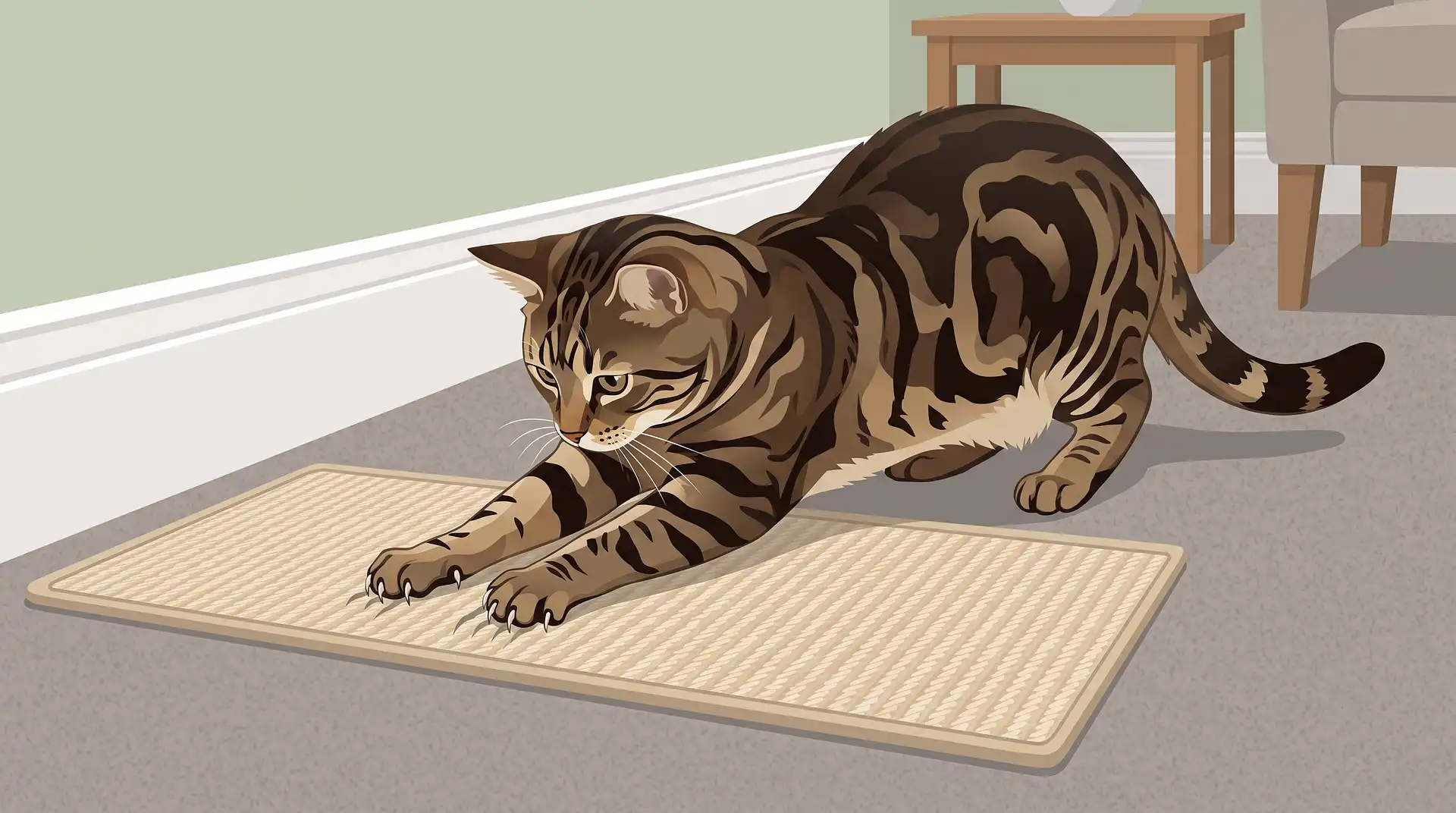
Cats scratch in two orientations: vertical and horizontal. A cat that stretches upward against a sofa or a door frame is a vertical scratcher. A cat that crouches and pulls at carpet or a doormat is a horizontal scratcher.
Most scratching posts sold in UK pet shops are upright poles, typically wrapped in sisal, designed for vertical scratching. If your cat scratches carpet, they are almost certainly a horizontal scratcher, and an upright post will be ignored because it does not match the scratching posture they're using.
The solution is a horizontal scratching pad, placed flat on the floor. These are sold as cat scratch mats, flat scratch pads, or horizontal scratchers. Common materials include sisal, corrugated cardboard and carpet. If your cat is attracted to carpet specifically, a carpet-covered scratching pad is a reasonable choice, though any horizontal pad is likely to be more successful than a vertical post.
Step one: place the right alternative in the right place
The scratch post needs to go where the cat already scratches, not where the owner would prefer it to be.
A post placed in a spare room the cat barely uses will be ignored. A pad placed directly on or adjacent to the existing scratch site will be used, because the cat is already motivated to scratch in that location for the scent and territorial reasons above.
Once the habit transfers to the pad, you can gradually move the pad a short distance at a time over several weeks, toward a location you prefer. Moving it suddenly or too far too quickly will result in the cat returning to the carpet.
One pad is rarely enough for a home with a cat that scratches in multiple locations. Provide alternatives in each area where scratching occurs.
Stability matters. A pad or post that wobbles, skids or tips when used is quickly abandoned. Make sure whatever you provide stays firmly in place when the cat pulls against it.
Step two: make the carpet less appealing
While the new scratching habit is forming, make the existing carpet target temporarily unattractive.
Double-sided tape is highly effective. Cats dislike the sticky sensation on their paws and will avoid it quickly. Specialist products sold as sticky paw sheets are available from pet retailers, or standard double-sided tape laid across the scratch area works similarly. Remove it once the habit is established, typically a few weeks.
Physical barriers. A carpet runner placed spike-side down, a chair mat, a piece of aluminium foil, or a plastic floor protector over the scratch area interrupts the behaviour without causing any harm. These are temporary measures only.
Scent deterrents. Cats generally dislike citrus, lavender and eucalyptus. A diluted citrus spray on the carpet target area, or citrus peel left nearby, deters some cats. Results vary considerably between individual cats, and the deterrent needs to be reapplied regularly to maintain its effectiveness.
Step three: clean the scent away
This step is missing from most guides and it is why deterrents applied over an existing scratch site often have limited effect.
Cats return to scratch sites partly because of the scent they deposited in previous sessions. The scent is invisible to us but clear to them, and it reinforces the location as a scratching spot. Placing double-sided tape over an old scratch site while the scent signal remains is fighting against the cat's own chemical signposting.
Before applying any deterrent, clean the scratch site with an enzyme-based cleaner. Enzyme cleaners break down the protein compounds in the scent deposits, removing the signal that draws the cat back. The same enzyme cleaners that deal with urine odour in carpets work on paw scent deposits, since both involve organic protein compounds.
Apply the enzyme cleaner to the area, allow the dwell time specified on the product, blot and dry, then apply your deterrent. Removing the scent signal first makes the deterrent considerably more effective.
For stubborn scent marking in carpets, particularly if the cat has been scratching the same spot for a long time, a professional carpet clean that extracts the embedded deposits from deeper in the pile is more thorough than a surface application. Instant Dry Carpet Cleaning uses hot water extraction that reaches the base of the pile rather than just treating the surface, which makes a meaningful difference to areas that have been repeatedly marked.
Dealing with scratching at doors
Scratching at the carpet in front of a door is a specific and common behaviour in UK homes. It is usually driven by frustration at a closed door and a desire to access the space beyond, combined with the carpet texture providing a satisfying scratching surface.
The most effective solution is a horizontal scratch pad placed directly in front of the door on the scratch side, providing an outlet for the behaviour in the same location. Combine with a scent deterrent on the carpet area on either side of the pad.
For persistent door scratching, a door scratch protector, a physical panel fixed to the door itself, prevents damage to the door while not addressing the carpet. Address the carpet separately with a pad and deterrent.
If the scratching is exclusively at night and at bedroom doors, it is likely attention-seeking or separation anxiety. Providing a comfortable sleeping option near the door, a cat bed placed where the cat wants to be, can reduce the motivation.
Nail trimming: does it help?
Yes, as a supporting measure. Trimming the sharp tip of the claw every two to three weeks significantly reduces the damage done when scratching occurs, without stopping the scratching behaviour itself.
Use proper cat nail scissors rather than human nail clippers. Trim only the clear tip, avoiding the pink quick inside the claw, which is a blood vessel and causes pain and bleeding if cut. If you are not confident doing this, a vet or groomer can show you the technique on the first occasion.
Nail trimming does not remove the motivation to scratch and should not be used as a substitute for providing appropriate scratch alternatives. It is most useful as a damage-limitation measure while you are working on redirecting the behaviour.
Is declawing an option in the UK?
No. Declawing, the surgical removal of the last bone of each toe from which the claw grows, is illegal in the UK under the Animal Welfare Act 2006 and is classified as a mutilation. It is also considered inhumane by the British Veterinary Association, the RSPCA and all major UK animal welfare organisations.
Beyond the legal position, declawing causes lasting pain, behavioural problems including increased aggression and inappropriate toileting, and significant long-term welfare issues. The behavioural and practical methods above are effective, legal and humane alternatives.
Repairing carpet damaged by cat scratching
Once the scratching behaviour has been redirected, you may be left with a carpet that has visible damage: pulled fibres, a worn or frayed patch, or a section where the pile has been separated from the backing.
For minor pile disturbance or pulled loops: carefully trim any loose fibres with scissors, and a warm iron applied through a damp cloth can help settle pile that has been disturbed. Don't pull at loops, which unravels more.
For a worn or bald patch: a carpet patch using an offcut from a hidden area, such as inside a wardrobe, can be cut and glued into place. This is a job for a carpet fitter rather than a DIY project if the rug is valuable or the patch is in a prominent location.
For embedded soil and organic material in the scratch area: professional extraction cleaning reaches the base of the pile and removes the accumulated debris and scent compounds that surface vacuuming doesn't clear. Instant Dry Carpet Cleaning can assess scratch-damaged areas as part of a wider carpet clean and advise on what can be restored versus what needs a fitter's attention. Single rooms from £49, whole home from £179.
Get your fixed quote in 60 seconds
Or call 07555 856988.
6. FAQ Section
Why does my cat scratch the carpet and not the scratching post? Almost certainly because the post is vertical and the cat is a horizontal scratcher. Cats that scratch carpet want to pull horizontally, and an upright post doesn't match that posture. Try a flat horizontal scratching pad placed directly where the scratching is happening.
How do I stop my cat scratching the carpet at the door? Place a horizontal scratching pad directly in front of the door on the scratching side. Apply an enzyme cleaner to the existing scratch area first to remove the scent signal, then add a deterrent such as double-sided tape. For night-time door scratching, a comfortable sleeping option near the door often reduces motivation.
What is the best deterrent for cats scratching carpet? Double-sided tape or sticky paw sheets are among the most effective physical deterrents. Citrus-based scent sprays work for many cats. Both work better when the existing scent deposits in the carpet are first removed with an enzyme cleaner.
Does trimming a cat's claws stop carpet scratching? No, it does not remove the motivation to scratch, but it reduces the damage. Trim every two to three weeks using proper cat nail scissors, removing only the clear tip.
Can you repair carpet damaged by cat scratching? Minor pile disturbance can be trimmed and settled. Bald patches and areas where the backing is exposed often need a carpet patch fitted by a professional. Deep cleaning of the area removes embedded soil and scent compounds that contribute to the cat returning to the same spot.
Is declawing legal in the UK? No. Declawing is illegal under the Animal Welfare Act 2006 and is classified as a mutilation. It is considered inhumane by all major UK veterinary and animal welfare organisations.
How long does it take to redirect a cat's scratching? Most cats establish a new scratching habit within two to six weeks when a suitable horizontal alternative is placed at the right location. Older cats or those with established habits may take longer but generally respond to the same approach with more patience.
Will a scent spray stop my cat scratching carpet? For many cats, yes, as a temporary deterrent while a new habit forms. Clean the existing scratch area with an enzyme cleaner first to remove the scent signal, then apply the deterrent. Reapply regularly since the deterrent effect fades.