How to Use a Vax Carpet Cleaner
11 August 2026
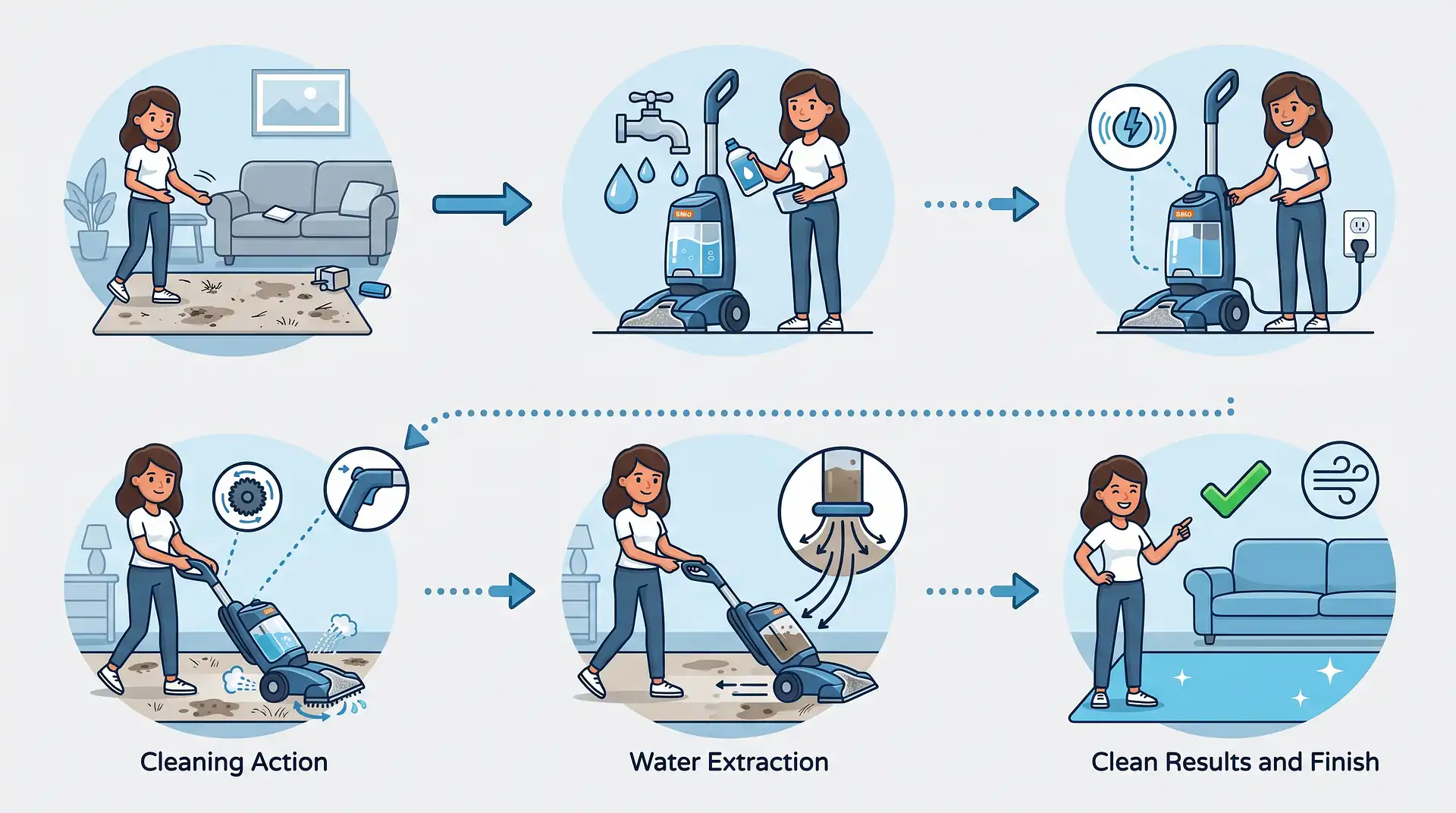
Quick answer: Vacuum the carpet thoroughly first. Fill the clean water tank with warm, not boiling, water and the correct amount of carpet washing solution for your model, usually stated on the bottle and in your manual. Test on a hidden patch. Work in overlapping strips from the far corner of the room back towards the door, squeezing the trigger to release solution on the forward pass and going over the same area again without solution to pick up the moisture. Empty the dirty water tank as soon as you finish and ventilate the room well while the carpet dries.
A Vax carpet washer is a genuinely useful bit of kit for keeping carpets looking fresh between deeper cleans, and it's a common sight in UK homes. Most of the frustration people have with these machines comes down to two things: too much water going down and not enough coming back up, and not quite understanding what the machine is and isn't designed to do. Get those two things right and it does a solid job.
This guide covers the general method that applies across most Vax carpet washer models. Vax sells several ranges with different tank sizes, control layouts and accessories, so always check your specific model's manual for exact fill lines, button positions and any model-specific settings. Nothing here replaces that manual, it sits alongside it.
Safety and prep, two minutes well spent
Clear the room and secure trip hazards. Move light furniture out of the way and be aware of the mains cable as you work. Fully extend the cable before you start rather than working with it coiled, and route it somewhere it won't be walked on or caught by the machine.
Household use only, indoors only. These are mains powered appliances not designed for outdoor use, and shouldn't be treated as a toy or left unsupervised around children.
Plug into an RCD protected socket where possible, particularly in an older property, since you're combining water and a mains appliance in the same room.
Vacuum thoroughly before you start. This genuinely matters and it's the step most often skipped. Loose dirt and grit will clog the machine and reduce how effectively it cleans, and vacuuming first also means the machine is working on ground-in soil rather than fighting surface debris too.
Test on a hidden patch first, especially on a wool or wool-rich carpet, a rug, or anything you're not confident about. Wet a white cloth with your diluted solution, dab it onto a hidden section of carpet such as inside a wardrobe or under a sofa, and check for any colour transfer or change after it dries. Domestic carpet washers put down more water than people generally expect, and that's the main reason delicate or natural fibre carpets need this extra caution.
What you need
Your Vax carpet washer and its manual, for your specific model's fill lines and settings
Warm tap water, not boiling. Most manuals specify a maximum temperature, often around 40°C
The carpet washing solution recommended for your machine, in the correct dilution ratio
A vacuum cleaner, for the pass beforehand
Towels, for blotting any particularly wet areas afterwards if needed
Good ventilation, an open window or a fan
Step by step: using a Vax carpet washer
Step 1: Prepare the room
Move furniture, vacuum the whole area thoroughly, and check the carpet for any stains that need pre-treating. Some Vax models come with a pre-treatment wand or allow a pre-treatment solution to be applied directly to stubborn marks before the main clean. If yours does, follow the instructions for that accessory before you start on the wider area.
Step 2: Fill the clean water tank
Remove the clean water tank, usually at the back or top of the machine, and fill with warm water up to the indicated line. Add the cleaning solution at the ratio stated on the bottle, since different solutions are concentrated differently and the ratio isn't always the same across products. As a general guide, many Vax solutions work out to somewhere around 40ml per litre of water, but always check your specific bottle rather than relying on that figure.
Don't be tempted to add more solution than instructed, thinking it'll clean better. Excess detergent left in the carpet is one of the main causes of a sticky, resoiling patch appearing days or weeks later, exactly as with any other carpet cleaning method.
Step 3: Work in a planned route
Start in the far corner of the room and work back towards the door, so you're not walking over carpet you've just cleaned. Work in overlapping strips.
Recline the handle to the working angle, squeeze the trigger to release the water and solution mix, and push the machine forward over the carpet. This also spins the brushes on most models, which agitate the pile and help lift ground-in dirt.
Step 4: Go over each area again without solution
Once you've laid down solution on a strip, go back over the same area with the trigger released, so the machine is only extracting moisture rather than adding more. This is the step that determines how wet your carpet ends up and how long it takes to dry, and it's the step people rush most.
Step 5: Empty the dirty water tank
Check the dirty water tank regularly during a larger job and empty it once it's getting full, rather than letting it sit right up to the maximum. A tank that's too full reduces suction efficiency, which means less moisture gets pulled back out of the carpet.
Step 6: Dry and ventilate
Open windows, put a fan on if you have one, and keep foot traffic off the carpet until it's dry. Depending on the machine, how much solution was used, and room ventilation, drying can take anywhere from around an hour on the faster end to considerably longer in a poorly ventilated room. Don't rely on marketing drying-time figures as a guarantee for your specific conditions.
Step 7: Clean the machine afterwards
Rinse the dirty water tank thoroughly and let it dry before storing. Check and clean the brushes and nozzles if your model allows easy access. A machine left with dirty water sitting in the tank will start to smell, and that smell can transfer to the next carpet you clean.
Common problems and how to fix them
Carpet still damp the next day. Almost always too much water went down relative to how much came back up. Go over the area again with the trigger released to extract more moisture, increase ventilation, and use less solution next time, going over each strip more slowly on the extraction pass.
A musty smell appears a few days after cleaning. This is usually residual moisture that didn't fully dry, sometimes combined with detergent residue that wasn't fully extracted. Increase ventilation next time and make sure you're doing a proper extraction-only pass over every area, not just the solution pass.
Streaky or patchy marks once dry. Often detergent residue left behind unevenly. Try reducing the solution ratio slightly and doing an additional plain water pass with the trigger released after the main clean, to rinse without adding more detergent.
The machine isn't picking up much dirty water. Check the dirty water tank isn't already full, check the nozzle and hose for blockages, and make sure the carpet was vacuumed properly beforehand, since a lot of loose debris can reduce suction efficiency quickly.
A stain reappears after the carpet dries. This is the same wicking effect that happens with any wet cleaning method, where a stain that had soaked deeper into the carpet resurfaces as the carpet dries. Re-treat the area with an extraction-only pass and dry it thoroughly.
Is a Vax as good as professional cleaning?
Honestly, it does a different job rather than a worse one, and it's worth understanding the difference so you can pick the right tool for what you actually need.
A domestic carpet washer is genuinely good for regular maintenance cleaning, refreshing a carpet's appearance, and dealing with everyday soiling between deeper cleans. It uses lower water temperatures and less powerful extraction than professional equipment, which is exactly why over-wetting and slow drying are the most common complaints.
Professional hot water extraction uses significantly more powerful vacuum recovery and controlled higher temperatures, which means more water and dissolved soil comes back out of the carpet than a domestic machine can manage, leaving carpets drier at the end of the clean and with less residue left behind. That matters more for a carpet that hasn't been deep cleaned in a long time, a heavily soiled area, a wool or wool-rich carpet where over-wetting risk is a bigger concern, or a stain that's already proven resistant to a home attempt.
Neither replaces the other. A Vax between professional cleans is a sensible routine. Relying on a Vax alone for a carpet that needs a proper deep clean, or for a wool carpet you're nervous about, is where people run into the problems covered above.
7. FAQ Section
How do you use a Vax carpet cleaner for the first time? Vacuum thoroughly, fill the clean water tank with warm water and the correct solution ratio for your model, test on a hidden patch, then work in overlapping strips from the far corner of the room back to the door, laying down solution on the forward pass and extracting it on a second pass without the trigger pressed.
How much solution should I use in a Vax carpet cleaner? This varies by product, so always check the bottle. A common general ratio for Vax solutions is around 40ml per litre of water, but different formulations are concentrated differently, so don't assume one product's ratio applies to another.
Why is my carpet still wet after using a Vax? Usually too much solution went down relative to how much moisture was extracted. Go back over the area with the trigger released to pull out more moisture, and improve ventilation while it dries.
Is a Vax carpet cleaner safe to use on wool carpet? Use extra caution. Always test on a hidden patch first, since domestic carpet washers apply more water than people often expect, and wool is more sensitive to over-wetting than synthetic fibres. If you're not confident, a professional clean is the safer route for a wool or wool-rich carpet.
Why does my carpet smell musty after using a Vax? Almost always residual moisture that hasn't fully dried, sometimes combined with leftover detergent. Improve ventilation, make sure you're doing a proper extraction-only pass over every area, and avoid overloading the solution tank.
How long does carpet take to dry after using a Vax? It varies by machine, how much solution was used, and room ventilation, commonly somewhere between one and several hours. A poorly ventilated room or an over-wet clean will take considerably longer.
Is a Vax carpet cleaner as good as professional carpet cleaning? They do different jobs. A Vax is well suited to regular maintenance cleaning between deeper cleans. Professional hot water extraction uses more powerful equipment and higher, controlled temperatures, which lifts more soil and leaves less moisture and residue behind, and is the better option for a heavily soiled carpet, a wool carpet, or a carpet that hasn't been deep cleaned in some time.
Can I use a Vax carpet cleaner on a stain that won't come out? You can try an extraction-only pass with fresh water over the area to rinse and lift what's already been loosened. If a stain has resisted proper treatment already, repeated passes with the same machine are unlikely to shift it, and it's worth considering a targeted spot treatment or professional attention instead.
Get your fixed quote in 60 seconds
Or call 07555 856988.