How to Get Paint Out of Carpet
17 August 2026
Quick answer: If the paint is still wet, scoop up the excess with a spoon or blunt knife working from the outside in, then blot with a white cloth. Never rub. For emulsion and water-based paint, blot repeatedly with cool water and a small amount of washing up liquid until it stops transferring. For oil-based gloss, you need white spirit, applied to a cloth and never poured, with the windows open. Dried paint needs softening first, which takes patience rather than force. Do not use a steam iron on carpet, do not use acetone unless you've confirmed your fibre and backing can take it, and test everything on a hidden patch first.
Paint is the one carpet stain that changes what it is while you're looking at it.
Coffee stays coffee. Blood stays blood. Paint starts as pigment suspended in a liquid carrier, and as that carrier evaporates the paint cures into a polymer film that physically locks itself around and between the carpet fibres. That's why wet paint is a straightforward cleaning job and dried paint is often a mechanical removal job, and why the same product can work brilliantly on one and do nothing at all on the other.
Speed matters here more than with almost any other spill.
Act now: the first two minutes
If the paint is still wet, do these three things before reading further.
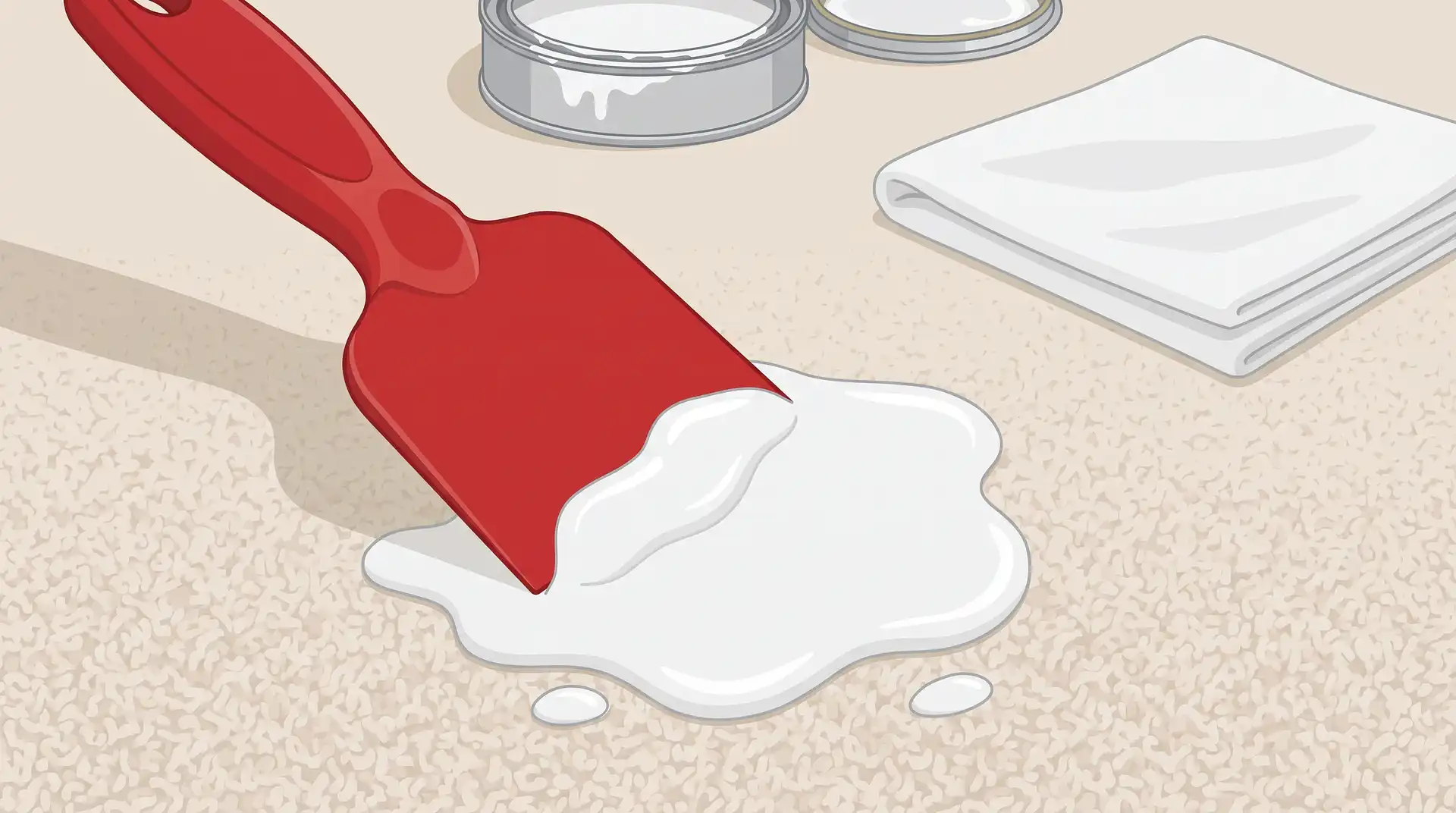
Scoop, don't wipe. Use a spoon, a blunt knife or a plastic scraper to lift the bulk of the paint off the surface. Work from the outer edge of the spill inwards so you're containing it rather than spreading it wider.
Blot with a white cloth. Press down firmly, lift, refold to a clean section, repeat. Never rub. Rubbing forces paint down into the pile and towards the backing, which turns a surface problem into a structural one.
White cloths only. A coloured cloth transfers its own dye into damp carpet and you'll have two stains instead of one.
Don't reach for water yet. Which liquid you use depends entirely on the paint, and using the wrong one makes things worse.
Safety first, and this one genuinely matters
Most stain guides need a brief safety note. This one needs a proper one, because paint removal is the only common carpet stain that routinely involves flammable solvents indoors.
Ventilate before you start, not after. Open windows and doors. Solvent vapour is heavier than air and pools at floor level, which is exactly where you'll be working and breathing.
No ignition sources. No smoking, no candles, no gas hob nearby, and be aware of pilot lights on older boilers and fires. White spirit and methylated spirit are flammable, and their vapour is flammable too.
Never use a heat source near solvent. This includes hairdryers, heaters and steam appliances. One competing guide recommends holding a steam iron over a paint stain, and I'd strongly advise against it for reasons covered below, but combining any heat source with solvent vapour in a closed room is the version of that advice that could genuinely hurt someone.
Gloves and eye protection. Nitrile gloves, since solvents pass through some glove materials. Eye protection is sensible with anything you're dabbing at floor level.
Never mix products. One solvent or one cleaning solution at a time, and rinse the area before switching. Don't combine anything with bleach.
Dispose of solvent-soaked cloths properly, and this is the one people don't know. Cloths soaked in oil-based paint or its solvents can heat up as they oxidise and, in the wrong conditions, catch fire on their own without any external ignition. It's a documented hazard, not a rare freak event. Don't leave them screwed up in a bin liner or a pile in the corner. Lay them flat outdoors to dry fully, or seal them in a metal container with a lid, then dispose of them according to your local council's guidance on hazardous household waste.
Check product labels. UK products carry CLP hazard pictograms and precautionary statements. Read them. HSE guidance on handling chemicals safely is worth a look if you're working with solvents indoors for any length of time.
Keep children and pets out of the room while you're working and until the area is fully dry and ventilated.
What kind of paint is it?
This decides everything that follows. Check the tin if you still have it.
Paint type | Common UK use | While wet | Once cured |
|---|---|---|---|
Emulsion (matt, vinyl matt, silk) | Walls and ceilings, the most common UK domestic paint | Water-soluble, removes easily | Water-resistant, much harder |
Acrylic | Craft, some trim paints, decorating | Water-soluble | Cures to a flexible polymer, resistant and stubborn |
Oil-based gloss, satin, eggshell | Woodwork, skirting, doors, radiators | Needs solvent even when wet | Very difficult, often permanent |
Undercoat and primer | Prep coats, may be either type | Depends on base | Depends on base |
Masonry paint | Exterior walls | Water-based but heavily pigmented and thick | Very difficult |
If you don't know: dab a small amount of the wet paint with a damp white cloth. If colour transfers to the cloth easily, it's water-based. If nothing shifts, it's oil-based.
Wet emulsion and water-based paint
The best case, and most UK spills fall here since emulsion is what most people are decorating with.
Scoop the excess with a spoon or blunt scraper, outside in.
Blot hard with a dry white cloth to lift as much as possible before adding any liquid.
Mix a mild solution. A quarter teaspoon of clear washing up liquid in 500ml of cool water. Not hot, for reasons in the "what not to do" section. Don't use neat washing up liquid, since it's too concentrated to rinse out of carpet properly and leaves a residue that attracts dirt.
Test on a hidden patch first. Inside a wardrobe, under a sofa, behind a door. Check for colour transfer onto a white cloth before going near the visible stain.
Apply to a cloth, not the carpet. Dab the solution onto the stain, working outside in. Let it sit briefly, then blot with a dry cloth.
Repeat patiently. Fresh cloth section each time. Judge progress by what's transferring onto the cloth, not by how the carpet looks while wet.
Rinse. Mist with clean cool water and blot out, at least twice. Detergent left in the pile stays tacky and pulls in dirt for months.
Dry under weight. Fold a dry towel over the area, put something heavy on top, ventilate the room.
Wet oil-based, gloss and eggshell
Harder, and this is where the solvent safety above becomes relevant rather than theoretical.
Scoop the excess as above. Get as much off mechanically as you can, since every gram you lift is a gram you don't have to dissolve.
Ventilate properly and put gloves on.
Use white spirit, which is the standard UK solvent for oil-based paint. Apply a small amount to a white cloth, never pour it onto the carpet, since solvent reaching the backing can dissolve the adhesive holding your carpet together.
Test on a hidden patch and wait. Let it dry fully and check for colour change, texture change or any stiffening of the backing before you commit.
Dab, don't scrub. Work from outside in, changing to a clean part of the cloth constantly so you're lifting paint rather than redistributing it.
Follow with detergent solution. Once the paint has lifted, the area needs a mild washing up liquid and cool water treatment to remove the solvent residue, then a clean water rinse.
Dry under weight with the windows still open.
Realistic expectation: wet gloss on a synthetic carpet often comes out well. Wet gloss on wool is harder. Anything that's had time to skin over is significantly harder again.
Dried paint, any type
The honest position is that dried paint is a mechanical problem more than a chemical one, and it rewards patience over aggression.
Scrape gently. A blunt knife, a plastic scraper, or the edge of a spoon. Work at the surface of the paint film to break it up and lift what you can without cutting fibres. A stiff brush can help agitate loose flakes out of the pile.
Soften what remains. For water-based paint, lay a cloth dampened with warm, not hot, water over the stain and leave it several minutes to rehydrate the film. For oil-based, use white spirit on a cloth, with all the safety precautions above.
Scrape again. Alternate softening and scraping. Multiple gentle cycles achieve more than one aggressive attempt.
Blot up loosened paint with a clean white cloth as it comes away.
Clean and rinse with mild detergent solution and cool water once you've lifted what you can.
Accept a plateau. When two or three cycles produce no further improvement, stop. Escalation from this point is where carpets get damaged, and a slightly lighter stain is better than a bald patch.
Vacuum first, before all of this, to lift loose flakes and grit so you're not grinding them in.
What not to do, including three things other guides recommend
Do not use a steam iron on carpet. You'll find this suggested online and it's poor advice. Polypropylene, which is very common in UK carpets, melts under direct heat. Direct heat also glazes and scorches other synthetic fibres permanently, and there's a fire risk in placing a hot appliance on a floor covering. If there's any solvent in the room, it's worse again. Softening dried paint with a damp cloth achieves the same thing without the risk.
Do not use acetone or nail varnish remover without knowing your carpet. Acetone dissolves the latex adhesive that bonds carpet pile to its backing, which causes delamination, the pile literally separating from the base. It also destroys acetate, triacetate and modacrylic fibres completely. Some guides recommend it casually as a paint thinner substitute. If you're going to use it at all, confirm your fibre type, test extensively in a hidden area, use the smallest amount possible on a cloth, and never let it soak through to the backing.
Do not use hot water as a default. It's fine on fresh emulsion in small amounts, but heat can set some paints and damages synthetic fibres. Cool or lukewarm is the safer default across the board.
Do not scrub. It drives paint towards the backing and permanently distorts the pile, leaving a fuzzy, lighter-looking patch that catches the light differently from everything around it. More carpets are ruined by scrubbing than by the original spill.
Do not over-wet. Liquid reaching the backing and underlay causes its own problems, including odour and, on older wool carpets with jute backing, browning as the natural dyes in the backing migrate up into the pile.
Do not pour solvent directly onto carpet. Cloth only, every time.
Fibre matters: wool, polypropylene and nylon
The same principle as every other stain on this site: what your carpet is made of changes what's safe.
Wool and wool-rich carpets are the most sensitive. Solvents can affect the fibre and its dyes, alkaline products damage it, and it holds pigment more readily than synthetics. Test scrupulously, work gently, and stop earlier than you would on a synthetic.
Polypropylene is the most forgiving for stain release, since it's solution-dyed and non-absorbent to most water-based staining. Its weakness is heat, which is another reason the steam iron advice is poor.
Nylon and polyamide sit in between and generally tolerate careful solvent use, though heat sets stains in them readily.
Acetate, triacetate and modacrylic are destroyed by acetone. Less common in fitted carpets but present in some rugs and blends.
If you don't know what you have, treat it as wool. That's the cautious route and it won't harm a synthetic. The fibre identification method in our coffee stain guide applies directly here.
When it can't be saved
Worth being straight about, since every competing page implies guaranteed success.
Cured oil-based gloss in wool pile is frequently unrecoverable by cleaning alone. The paint has bonded mechanically around individual fibres and the solvent needed to break it would damage the wool and its dye.
Large spills that soaked to the backing are a structural problem, not a surface one. Cleaning the top reaches perhaps the top third of the pile.
Anything that's already been scrubbed hard may have pile distortion that no amount of subsequent cleaning reverses.
What professionals can add: correct solvent selection for the specific paint and fibre, controlled dwell time, and extraction that pulls dissolved paint out of the carpet rather than pushing it deeper. That last part is the genuine difference, and it's why a professional attempt on a difficult paint stain has better odds than a fourth DIY attempt.
What nobody can promise: complete removal of cured paint from a light wool carpet, sight unseen. Be cautious with anyone who does.
When cutting is the answer. For a small, deeply cured spot on a good carpet, a carpet fitter can sometimes cut out the affected section and patch in a piece from an offcut, a wardrobe interior or under a radiator. It's a legitimate repair, not an admission of defeat, and on a valuable carpet it's often a better outcome than a bleached or distorted patch from repeated chemical attempts.
8. FAQ Section
How do you get paint out of carpet? Scoop up wet paint with a blunt edge working outside in, then blot with a white cloth without rubbing. For water-based paint, blot repeatedly with cool water and a small amount of washing up liquid. For oil-based gloss, use white spirit applied to a cloth with the room well ventilated. Test everything on a hidden patch first, and rinse and dry thoroughly afterwards.
How do you get dried paint out of carpet? Vacuum first, then gently scrape the paint film with a blunt knife or plastic scraper to break it up. Soften what remains with a damp cloth for water-based paint, or white spirit on a cloth for oil-based, then scrape again. Repeat in gentle cycles rather than one aggressive attempt, and stop when progress plateaus.
Does white spirit damage carpet? It can, particularly if it soaks through to the backing where it may affect the adhesive holding the carpet together. Always apply it to a cloth rather than pouring it on, test on a hidden area first, keep the room ventilated, and follow up with a detergent and water clean to remove the residue.
Is acetone safe to use on carpet? Not generally. Acetone dissolves the latex adhesive bonding carpet pile to its backing, causing delamination, and it destroys acetate, triacetate and modacrylic fibres entirely. If you use it at all, confirm your fibre type first, test extensively in a hidden area and use the minimum amount on a cloth.
Can you use a steam iron to remove paint from carpet? It's not advisable. Polypropylene, common in UK carpets, melts under direct heat, and other synthetic fibres scorch and glaze permanently. There's also a fire risk placing a hot appliance on a floor covering, and a serious one if any solvent is in use. Softening with a damp cloth achieves the same result safely.
Should I use hot or cold water on paint? Cool or lukewarm. Heat can set some paints and damages synthetic carpet fibres. Warm water is acceptable for softening dried water-based paint, but hot water isn't necessary and adds risk.
How do you get emulsion paint out of carpet? Emulsion is water-based and comes out relatively easily while wet. Scoop the excess, blot with a dry white cloth, then treat with a mild solution of clear washing up liquid in cool water, blotting repeatedly. Rinse with clean water and dry under a weighted towel.
How do you get gloss paint out of carpet? Gloss is oil-based and needs a solvent such as white spirit, applied to a cloth rather than poured, with the room ventilated and gloves on. Scoop as much as possible mechanically first, dab rather than scrub, then follow with a detergent clean to remove solvent residue. Cured gloss is often only partially removable.
Will paint ever come out of carpet completely? Wet water-based paint usually does. Wet oil-based paint often does on synthetics. Cured gloss on wool frequently doesn't, and the realistic goal there is significant improvement rather than invisibility. Speed is the single biggest factor within your control.
Is it safe to leave solvent-soaked cloths in the bin? No. Cloths soaked in oil-based paint or its solvents can heat up as they oxidise and, in the right conditions, ignite without any external flame. Lay them flat outdoors to dry fully, or seal them in a metal container with a lid, then dispose of them following your council's hazardous household waste guidance.
Can a professional remove a dried paint stain? Often, with better odds than a repeat DIY attempt, because they can identify the fibre and paint type, select the correct solvent, control dwell time, and extract the dissolved paint rather than pushing it deeper. Complete removal of cured paint from light wool can't be guaranteed by anyone.
Get your fixed quote in 60 seconds
Or call 07555 856988.