How to Get Wax Out of Carpet
20 August 2026
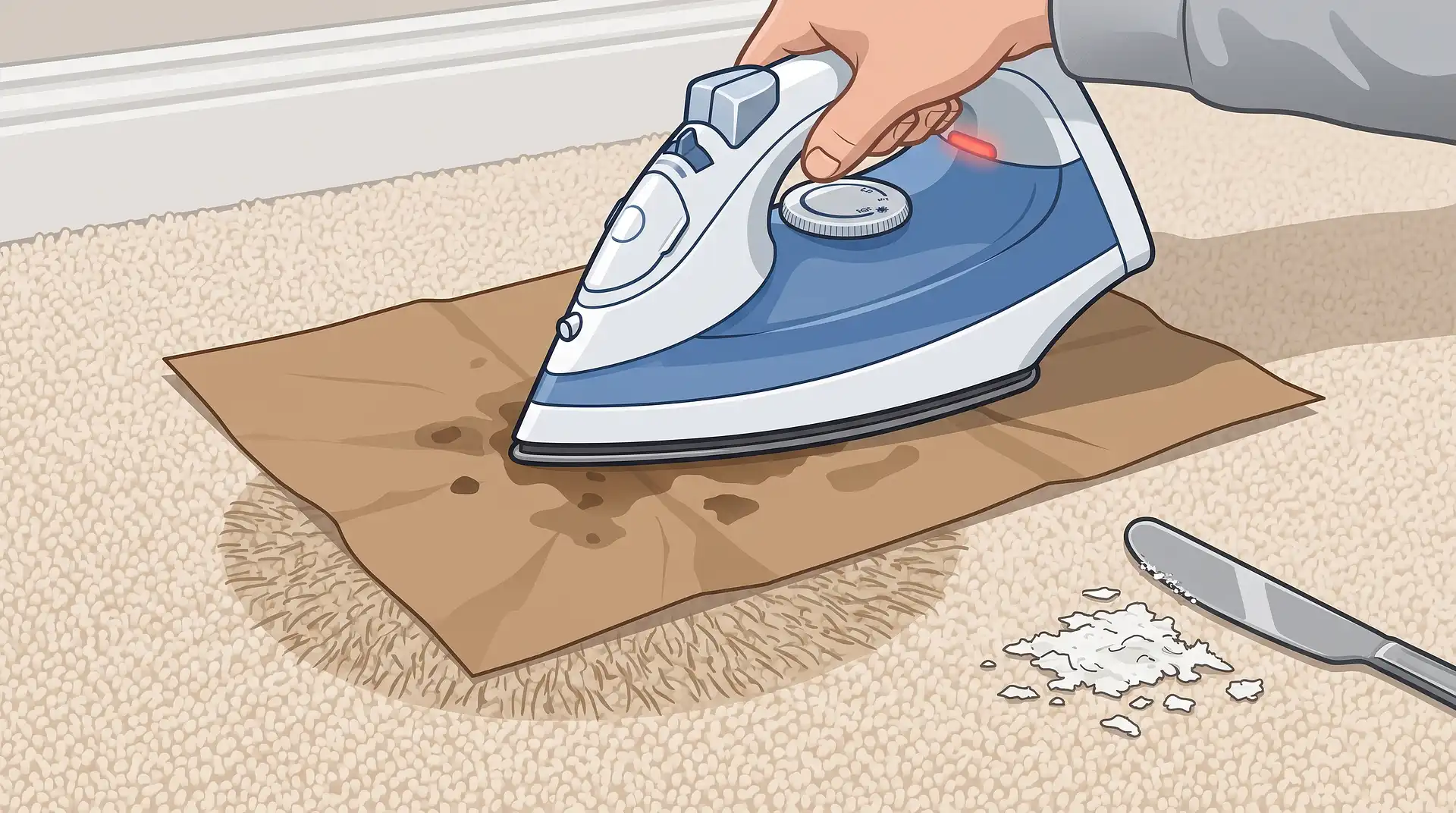
Quick answer: Freeze the wax first with ice or a bag of frozen peas, then scrape away the brittle solid carefully with a blunt knife. Follow with a warm iron over a clean brown paper bag or a thick white cloth, pressing briefly and moving constantly, which re-melts the embedded wax and absorbs it into the paper. If the candle was coloured, treat the remaining dye stain separately with a small amount of surgical spirit or white spirit on a cloth. Never apply heat directly to the carpet without a barrier, and identify your carpet fibre first if it's synthetic.
Candle wax on carpet tends to happen at the worst moments — a dinner party, a birthday cake, an evening that was going well. The method for removing it feels unintuitive because it involves cold, then heat, on a surface where heat is usually wrong. Understanding why helps you do it correctly.
Why wax is different from other stains, and why heat helps here
Every other stain covered on this site gets a firm "no heat" instruction, and for good reason. Heat sets protein stains like blood and urine permanently, and it drives tannin stains from coffee and tea deeper into the fibre. In both cases, heat causes a chemical reaction between the stain and the fibre that makes the problem harder.
Wax doesn't work like that.
Wax is a lipid, and it doesn't react chemically with carpet fibres at all. It sits mechanically between the fibres, solidified. There's no chemical bond to set. When you heat wax, you don't trigger a reaction, you simply re-melt it from solid to liquid, making it mobile enough to be absorbed into whatever you've placed over it.
This is why an iron, which would be a serious mistake on a coffee stain, is the correct tool for wax. The physics are different. The heat is doing something entirely different.
The constraint is still real though: heat damages synthetic carpet fibres. Polypropylene melts. Nylon and polyester can be affected at sustained high temperatures. A barrier between the iron and the carpet is not optional, and on polypropylene specifically the iron method needs to be kept brief and the iron kept moving.
Step one: freeze and scrape
Don't try to scrape wax when it's soft. Soft wax smears across the fibres and makes the problem significantly larger.
Freeze it first. Place a bag of ice cubes or a bag of frozen peas over the wax and leave it for several minutes until the wax has hardened completely and is brittle to the touch.
Scrape carefully. Use a blunt knife, a plastic scraper, or an old credit card. Work at the surface of the hardened wax, breaking it up and lifting the pieces rather than pushing them into the pile. Work from the outside edge inward.
Vacuum the pieces. Once you've removed as much as the scraping will shift, vacuum the area thoroughly to lift the loose fragments from the pile before adding any heat.
You won't get everything this way. There will always be wax embedded deeper in the pile that scraping can't reach. That's what the next step is for.
Step two: lift the remaining wax with heat
What you need: a cool iron (a wool or synthetic setting, not cotton or linen), and either a clean brown paper bag with no print on it, or a thick white cloth. The brown paper from inside a delivery package works perfectly. Do not use newspaper, since the ink transfers.
Test your carpet first. On a hidden patch, press the iron briefly through the paper or cloth and lift. Check the pile for any melting, glazing or distortion before committing to a visible area. On a synthetic carpet, keep the iron moving constantly and never let it rest in one place.
Place the paper or cloth over the remaining wax. Press the warm iron onto it briefly, a few seconds at a time, then lift and check. You'll see the wax transferring from the carpet into the paper or cloth as a greasy spot.
Move to a clean section of the paper as it becomes saturated. Using a wax-saturated section just puts wax back into the carpet.
Keep the iron moving. Never hold it stationary on carpet, even through a barrier. Move it slowly and lift to check frequently.
Repeat until no more wax transfers. The pile should feel clean rather than waxy when you run your fingers through it.
Step three: deal with the colour
This is the step most guides either skip or handle in one sentence, and it's the step that decides whether the job looks finished.
If your candle was white or uncoloured, you're done after the heat stage, barring a light clean with mild detergent solution.
If your candle was coloured, the wax has carried dye into the carpet fibres. Lifting the wax with heat removes the wax; the dye stays behind, exactly as it would if you'd spilled a dye-based product directly. You'll often see a red, green, blue or dark mark remaining after the wax has gone.
This is now a dye stain, not a wax stain. The four-category stain framework established on this site across the coffee stain guide and the mattress stains article includes dye as the hardest category, and candle dye falls there.
For the dye residue:
Test on a hidden area first. As always.
Try surgical spirit first, applied to a white cloth in small dabs. It's less aggressive than white spirit and works on some dye formulations.
If surgical spirit doesn't shift it, try white spirit applied to a cloth, not poured, with the room ventilated and gloves on. The same solvent safety precautions from the paint article apply here.
Blot repeatedly with a dry cloth after each application, and change to a clean section constantly.
Follow with a mild detergent solution once the solvent work is done, to remove solvent residue, then rinse with cool water and dry under a weighted towel.
Be realistic about deep red and dark dye on light wool. Candle dye on a light-coloured wool carpet is the difficult end of the scale. Wool accepts dye readily, which is why it's used for brightly coloured carpets in the first place, and that same property makes removing an unwanted dye harder. Significant lightening is often achievable. Complete removal sometimes isn't.
Fibre warnings
Polypropylene: the most common UK synthetic carpet fibre, and the one that melts under sustained direct heat. The iron method works but must be done with the iron on its lowest setting, a thick cloth or multiple layers of paper as a barrier, the iron moving constantly, and brief contact times. Check a hidden patch first without exception.
Wool and wool-rich: more heat-tolerant than synthetics and generally handles the iron method well. The main risk is dye treatment in step three, since some solvents affect wool. Test before applying any solvent.
Silk and delicate natural fibres: do not use the iron method. Have these professionally treated.
Nylon and polyester: generally tolerate the iron method at low settings with a proper barrier, but test first.
If you don't know what your carpet is, the identification method in the coffee stain guide applies here, and treating it as wool (cautious, low heat, tested barrier) is the safe default.
Mistakes to avoid
Trying to scrape or rub soft wax. It smears across a much wider area.
Applying the iron directly to the carpet without a barrier. Burns pile tips permanently.
Holding the iron still. Even with a barrier, a stationary iron on synthetic carpet risks melting.
Using newspaper as a barrier. The ink transfers to the carpet.
Treating coloured wax as a single-stage problem. The wax and the dye need separate methods.
Skipping the solvent safety steps. Same hazards as any other solvent use indoors: ventilate, gloves, no ignition sources.
8. FAQ Section
How do you remove candle wax from carpet? Freeze the wax with ice until it's brittle, then scrape away the solid pieces with a blunt knife. Follow with a warm iron over a clean brown paper bag or thick white cloth, pressing briefly and moving constantly to re-melt and absorb the embedded wax. If the candle was coloured, treat the remaining dye stain separately with surgical or white spirit on a cloth.
Why does wax removal use heat when other stain guides say no heat? Wax is a lipid that sits mechanically in the carpet fibres without any chemical bond. Heat re-melts it into liquid so it can be absorbed into a cloth or paper. That's entirely different from protein or tannin stains, where heat causes a chemical reaction that sets the stain permanently. The physics are different, so the method is different.
Does an iron remove wax from carpet? Yes, through a barrier. Place a clean brown paper bag or thick white cloth over the remaining wax, press a warm iron briefly onto it, and the melted wax transfers into the paper. Always use a barrier, keep the iron moving, and test on a hidden area first, particularly on synthetic carpet.
How do you get coloured candle wax out of carpet? In two stages. First remove the wax using the freeze-scrape-iron method. Then treat the remaining colour separately as a dye stain, using surgical spirit or white spirit applied to a cloth, tested on a hidden area first. The wax and the dye are two separate problems.
How do you get red wax out of carpet? Freeze and scrape first, then use the iron method to lift the wax. The red colour that remains afterwards is dye, and you treat that with surgical spirit or white spirit on a cloth, followed by a detergent rinse. Red dye on light wool is the hardest case and may not clear completely.
Is the iron method safe on all carpet types? No. Test on a hidden patch first. On polypropylene use the lowest iron setting, keep it moving constantly, and use a thick cloth barrier. On silk or delicate fibres, don't use the iron method and have it professionally treated instead.
What do you do if wax stains a wool carpet? The iron method generally works well on wool at a low setting with a proper barrier. The coloured dye residue is the harder part, since wool accepts dye readily. Test any solvent on a hidden area first and accept that complete removal of a dark dye on light wool isn't always achievable.
Can wax stains be removed professionally? Yes, and with better odds on difficult coloured dye residue, particularly on light wool carpet. A professional has the ability to identify the fibre accurately, select the correct solvent, and use extraction to remove dissolved residue rather than leaving it in the carpet.
InstantDry carries out hot water extraction cleaning for carpets, rugs, upholstery and mattresses across England and Wales. Every visit starts with a free survey, fibre identification and a fixed price before any work begins. If we don't think the stain can be improved we'll say so rather than take the booking.
Single rooms from £49. Whole home, including stairs and landing, from £179. Rugs from £89.
Get your fixed quote in 60 seconds
Or call 07555 856988.