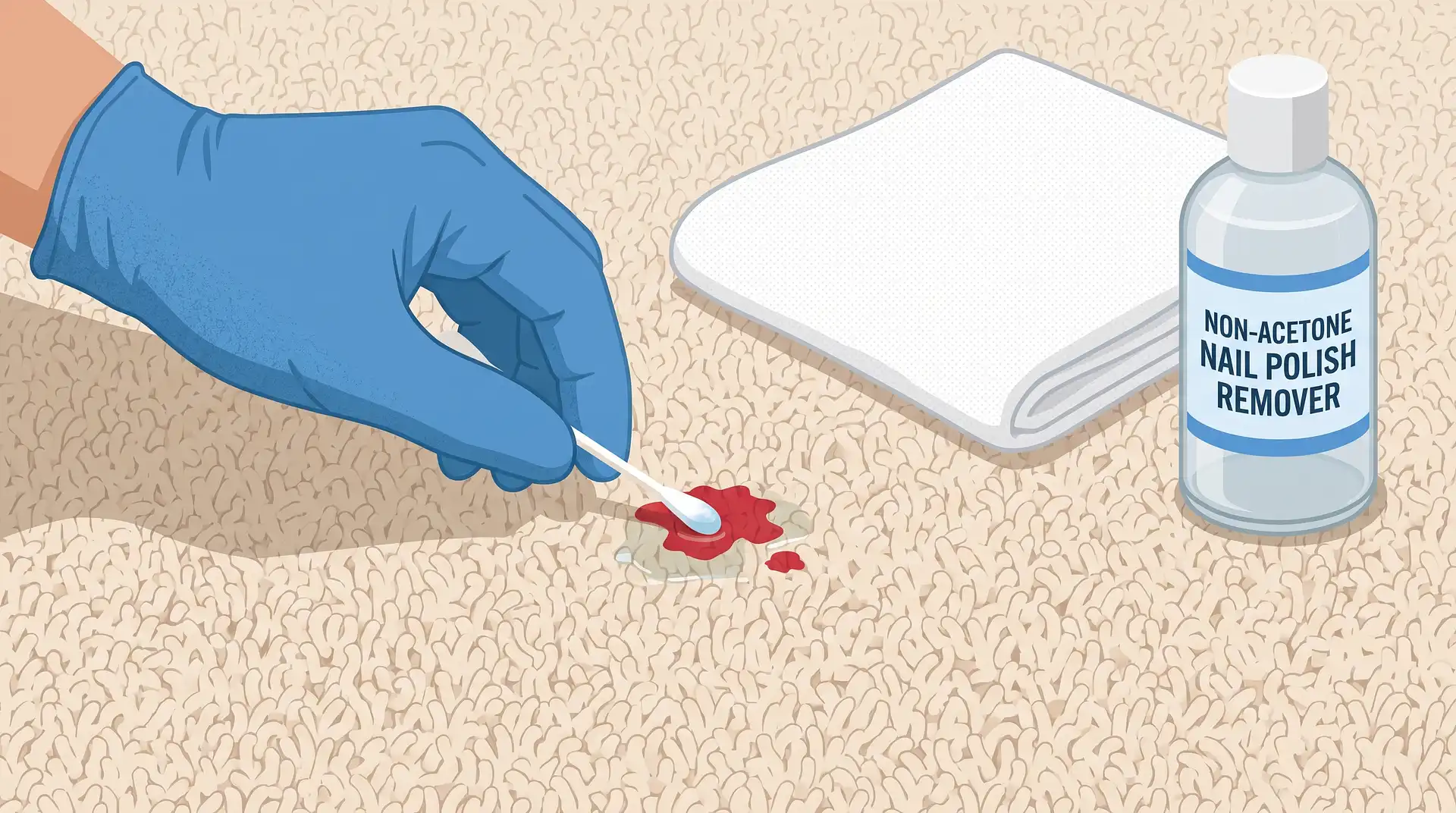
How to Get Nail Varnish Out of Carpet
17 August 2026
Quick answer: Don't rub, and don't reach for acetone straight away. Blot wet varnish gently with a white cloth working from the outside in, lifting rather than spreading. Then test a non-acetone nail varnish remover on a hidden patch of carpet first, since acetone can dissolve the adhesive holding your carpet's pile to its backing and destroys some fibre types outright. Apply the remover to a cotton bud or cloth, never pour it on, and work in small dabs. Once the lacquer has lifted, treat any remaining colour separately with a mild detergent solution. Dried varnish is far more recoverable than dried paint, so don't panic if you've only just found it.
Nail varnish looks like the worst possible thing to spill on a carpet. Bright pigment, fast-drying, and it goes everywhere.
It's genuinely better news than that, for one specific reason worth understanding.
The good news, and the catch
Nail varnish doesn't cure. It just dries.
Paint cures. The polymer cross-links into a new, chemically different film, which is why dried emulsion won't re-dissolve in water even though it was water-based when wet. That's what makes dried paint so difficult.
Nail varnish is nitrocellulose lacquer dissolved in solvent. When it dries, the solvent evaporates and leaves the lacquer sitting there. It hasn't chemically changed. Put the same family of solvent back onto it and it re-dissolves.
That means a nail varnish spill you found two weeks later is far more recoverable than a paint spill of the same age. It's the most encouraging fact in this article and almost nobody mentions it.
The catch: the solvent that dissolves it best is acetone, and acetone is one of the more damaging things you can put on a carpet. Most guides recommend it without saying so. Here's what you actually need to know.
Safety before you start
Ventilate the room. Open a window. Nail varnish remover vapour is unpleasant in an enclosed space and heavier than air, so it pools where you're working.
It's flammable. Both acetone and non-acetone removers. No candles, no smoking, no heat sources nearby. This matters more than people assume for something that lives in a bathroom cabinet.
Gloves. Nitrile rather than latex, since solvents pass through some glove materials. Solvent strips skin oils quickly and stings anything already broken.
Keep children and pets out until the area is fully dry and aired.
Never mix products. One solvent at a time, rinsed out before you try anything else, and nothing combined with bleach.
Read the label. UK products carry CLP hazard pictograms and precautionary statements.
What kind of varnish is it?
Three different problems, and they need different answers.
Type | How to recognise it | Difficulty |
|---|---|---|
Conventional nail varnish | Standard bottle, air dries, chips over time | Most recoverable, re-dissolves in solvent |
Glitter or shimmer varnish | Visible sparkle particles | Lacquer dissolves, glitter doesn't. Mechanical removal needed |
Gel or shellac polish | Cured under a UV or LED lamp | Hardest. Cured like paint, doesn't re-dissolve in ordinary remover |
Most spills are conventional varnish. If you've spilled uncured gel from the bottle before it went under a lamp, treat it as conventional varnish and act fast, since it won't cure on its own without UV.
Removing wet nail varnish
Speed helps, but don't rush into the wrong action.
Step 1: Blot, don't wipe
Press a white cloth or kitchen roll gently onto the spill, working from the outer edge inwards. Lift, refold to a clean section, repeat.
Do not wipe or rub. Wet varnish spreads dramatically under a wiping motion, and a 2cm spill becomes a 10cm one in a single careless pass. Rubbing also drives it towards the backing and permanently distorts the pile.
White cloths only. A coloured cloth transfers its own dye into the damp area.
Step 2: Work out your fibre before using solvent
This determines whether acetone is even an option.
Acetone destroys acetate, triacetate and modacrylic fibres outright. These are uncommon in fitted carpets but do appear in rugs and blends.
Acetone also dissolves the latex adhesive that bonds the carpet pile to its backing. If solvent soaks through, the pile can separate from the base. That's delamination and it isn't repairable by cleaning.
Wool and wool-rich carpets need a cautious approach with any solvent, and they hold pigment more readily than synthetics.
If you don't know what your carpet is, treat it as wool and start with the gentlest option. The fibre identification method in our coffee stain guide applies directly.
Step 3: Start with non-acetone remover
This is the step most guides skip and it's the sensible first attempt.
Non-acetone removers are typically ethyl acetate based. They're slower than acetone and need more patience, but they're substantially gentler on carpet fibres and backing adhesive. For a small spill, the extra few minutes are worth it.
Test on a hidden patch first. Inside a wardrobe, under a sofa, behind a door. Apply a little, let it dry fully, and check for colour change, texture change or any stiffening or lifting of the backing. Do this in daylight.
Step 4: Apply precisely, never pour
A cotton bud is ideal for a small spill, since it gives you control and keeps solvent off the surrounding carpet. For a larger area, apply to a white cloth.
Never pour solvent onto carpet. The problem isn't the surface, it's what happens when solvent reaches the backing.
Step 5: Dab and lift, outside in
Dab the varnish, wait a few seconds for the solvent to work, then blot with a clean dry cloth to lift the dissolved lacquer away. Change to a clean section constantly, so you're removing varnish rather than moving it around.
Repeat patiently. Several light applications beat one heavy soaking every time.
Step 6: Deal with the colour separately
Once the lacquer film has gone you may still see colour in the fibres. That's the pigment, and it's a different problem. Covered below.
Step 7: Rinse and dry
Once the varnish and colour are dealt with, clean the area with a mild solution of clear washing up liquid in cool water applied to a cloth, to remove solvent residue. Rinse by misting with clean cool water and blotting, at least twice. Dry under a dry towel with something heavy on top, with the window still open.
Removing dried nail varnish
Better odds than you'd expect, for the reason explained above.
Gently scrape the surface film. A blunt knife, a plastic scraper, or the edge of a spoon. Break up and lift the brittle top layer without cutting fibres. Vacuum the flakes away.
Apply solvent to soften what's left. Non-acetone remover first, on a cotton bud, giving it longer to work than you would on a wet spill. Dried lacquer needs dwell time to re-dissolve.
Blot as it softens. Clean cloth section each time.
Alternate scraping and softening. Gentle cycles rather than one aggressive attempt.
Escalate only if needed. If non-acetone remover has plateaued and you've confirmed your fibre and backing can take it, acetone works faster. Use the minimum amount on a cotton bud, keep it off the backing, and stop the moment progress stalls.
Treat remaining colour, then clean and rinse as above.
The colour left behind
This is the part that catches people out, and it's why so many people think they've failed when they're actually most of the way there.
A nail varnish spill is two stains. The lacquer film is a polymer problem, dissolved by solvent. The pigment is a dye problem, and solvent doesn't necessarily lift it. Dark reds, deep purples and blacks are the worst for this.
Once the film has gone, treat the remaining colour as a dye stain: a mild solution of clear washing up liquid in cool water, applied to a cloth, dabbed and blotted repeatedly with patience. Cool water, not hot.
Be realistic about dark pigment on light wool. Wool accepts dye readily, which is exactly why it takes colour so well in manufacture, and that same property works against you here. Significant lightening is usually achievable. Complete removal sometimes isn't.
Glitter varnish and gel polish
Glitter varnish is a mechanical problem wearing a chemical disguise. The lacquer around it dissolves normally, but the glitter itself is polyester film and it doesn't dissolve in anything you'd safely use on a carpet. Once the lacquer has lifted, the glitter is loose in the pile, so vacuum thoroughly and repeatedly. Sticky tape pressed onto the pile lifts stubborn particles. Expect to find the occasional sparkle for a while.
Gel and shellac polish that has cured under a UV or LED lamp is a genuinely harder problem, because curing changes it chemically in the way paint changes. Ordinary nail varnish remover often won't touch it. Gentle mechanical removal of the surface film, patience, and realistic expectations are your best route. This is one of the situations most worth handing to a professional early rather than experimenting with progressively stronger solvents.
What not to do
Don't rub or wipe. Spreads wet varnish and distorts the pile permanently.
Don't pour solvent onto the carpet. Cloth or cotton bud only. Solvent reaching the backing is how carpets delaminate.
Don't reach for acetone by default. Try non-acetone first, and confirm your fibre before escalating.
Don't use hairspray. It appears in a lot of older advice from when formulations were high in alcohol. Modern formulations vary widely, it's an uncontrolled way to get solvent onto carpet, and it leaves a sticky residue that attracts dirt.
Don't bother with white vinegar. It does very little against nitrocellulose lacquer.
Don't use hot water or a hairdryer. Heat sets the pigment element and damages synthetic fibres.
Don't over-wet the area. Liquid reaching the backing and underlay brings its own problems, including odour and, on older wool carpets with jute backing, browning.
When to stop
When two or three cycles produce no further improvement, stop.
The realistic outcome on a difficult varnish spill, particularly a dark colour on a light wool carpet, is substantial improvement rather than invisibility. Escalating past that point with stronger solvents is how a stain becomes a bald patch or a delaminated section, and those aren't fixable by cleaning.
What a professional adds is correct solvent selection for the specific fibre and backing, controlled dwell time, and extraction that pulls dissolved lacquer and pigment out of the carpet rather than pushing it deeper. On a spill that's plateaued, that's a meaningfully better bet than a fourth DIY attempt with something stronger.
8. FAQ Section
How do you get nail varnish out of carpet? Blot wet varnish gently with a white cloth from the outside in, never rubbing. Test a non-acetone nail varnish remover on a hidden patch, then apply it with a cotton bud rather than pouring it on, dabbing and blotting repeatedly. Treat any remaining colour separately with mild detergent and cool water, then rinse and dry.
Can you use nail varnish remover on carpet? Yes, with care. Start with a non-acetone remover, which is gentler on carpet fibres and backing. Test on a hidden area first, apply to a cotton bud or cloth rather than pouring, and never let solvent soak through to the backing.
Does acetone damage carpet? It can. Acetone dissolves the latex adhesive bonding carpet pile to its backing, which causes the pile to separate, and it destroys acetate, triacetate and modacrylic fibres completely. Confirm your fibre type and test thoroughly before using it, and use the minimum amount possible.
How do you get dried nail varnish out of carpet? Better odds than dried paint, because nail varnish doesn't cure, it just dries, so it re-dissolves in solvent. Gently scrape the brittle surface film, then apply non-acetone remover with a cotton bud and give it longer to work than on a wet spill. Alternate scraping and softening in gentle cycles.
Why is there still colour after the varnish came off? A varnish spill is two stains. The lacquer film comes off with solvent; the pigment is a separate dye problem. Treat remaining colour with a mild washing up liquid solution in cool water, dabbing and blotting patiently. Dark reds and blacks on light carpet are the hardest.
How do you get glitter nail varnish out of carpet? The lacquer dissolves normally with remover, but glitter is polyester film and doesn't dissolve. Once the lacquer has lifted, vacuum thoroughly and repeatedly, and press sticky tape onto the pile to lift stubborn particles.
Can you get gel or shellac polish out of carpet? It's much harder. Gel polish cures under a UV or LED lamp, which changes it chemically in the same way paint cures, so ordinary remover often won't touch it. Gentle mechanical removal and realistic expectations are the best route, and it's one of the situations most worth getting professional help with early.
Will nail varnish stain carpet permanently? Often not, particularly on synthetic carpets treated reasonably promptly. Dark pigment on light wool is the difficult case, where substantial lightening is usually achievable but complete removal sometimes isn't. Speed and not rubbing are the two things most within your control.
Does hairspray remove nail varnish from carpet? It's unreliable. The advice dates from when hairspray formulations were high in alcohol, and modern formulations vary considerably. It's an uncontrolled way to apply solvent and leaves a sticky residue that attracts dirt. A proper non-acetone remover is a better choice.
Should I use hot or cold water? Cool. Heat sets the pigment element of the stain and damages synthetic fibres. This applies to hairdryers and steam appliances too.
Nail varnish is one of the stains where a fourth attempt with something stronger usually does more damage than the spill did. If the stain has plateaued, if it's dark varnish on a light wool carpet, if it's cured gel polish, or if you've already used acetone and are worried about what it's done to the backing, it's worth getting it looked at before the carpet takes any more.
InstantDry carries out hot water extraction cleaning for carpets, rugs, upholstery and mattresses across England and Wales. Every visit starts with a free survey, including fibre identification and a colour fastness check, and a fixed price before any work begins. If we don't think the stain can be improved, we'll tell you rather than take the booking.
Single rooms from £49. Whole home, including stairs and landing, from £179. Rugs collected, hand washed and returned wrapped from £89.
Get your fixed quote in 60 seconds
Or call 07555 856988.