How Long Does a Tempur Mattress Last
30 August 2026
Quick answer: A Tempur mattress typically lasts 10 to 15 years in the UK with proper care, longer than most standard memory foam and the majority of spring mattresses. Tempur UK provides a 10-year Quality Guarantee on its mattresses. That guarantee covers manufacturing defects and significant sagging — it doesn't cover the gradual softening of the foam that happens naturally over years of use. The mattress can be within specification while feeling different from when it was new. Whether that softening has crossed the line into needing replacement, or whether cleaning and maintenance is what's actually needed, depends on a straightforward physical test.
A Tempur mattress is one of the larger furniture investments most UK households make. Understanding what determines how long it lasts, what the guarantee does and doesn't cover, and when it's actually finished versus when it needs attention is useful information that most buyers only go looking for years after purchase. For professional mattress cleaning that extends the hygienic life of any mattress, Instant Dry Carpet Cleaning covers England and Wales with a free survey before any work begins.
What the 10-year Quality Guarantee actually covers
Tempur UK provides a 10-year Quality Guarantee on its mattresses. It's one of the stronger manufacturer guarantees in the UK market, and it's worth understanding precisely what it does and doesn't include before relying on it.
What it covers: manufacturing defects in materials and workmanship, and visible sagging or body impressions beyond a defined threshold — typically 0.75 inches of permanent indentation. If the mattress develops a visible dip at the sleeping position that exceeds this measurement, that's a covered defect under the guarantee.
What it doesn't cover: the natural process of foam softening over time. TEMPUR material is designed to respond to body heat and weight and mould to your shape. Over years of use, that material naturally becomes somewhat softer than it was new. This is not a defect — it's the material working as designed, and gradual softening is explicitly excluded from the guarantee.
The practical implication is that a Tempur mattress at seven or eight years may still be within guarantee specification — no sagging exceeding the threshold, no manufacturing fault — while feeling noticeably softer and less supportive than it did in year one. The guarantee won't help with that. Whether the mattress needs replacing at that point is a different question from whether it's faulty.
The difference between lasting and staying comfortable
This distinction runs through every Tempur lifespan discussion and is worth separating clearly.
Structural lifespan is how long the mattress maintains its physical integrity — no significant sagging, no foam breakdown that changes its support profile in a clinically meaningful way. For a Tempur mattress, this comfortably reaches ten years in most cases and often considerably beyond.
Comfort lifespan is how long the mattress continues to feel the way it did when new. Foam naturally softens with sustained use. In softer Tempur models, this softening may be perceptible within five to eight years for heavier sleepers, while remaining a minor change in firmer models used by lighter sleepers.
These two timelines don't always match. A mattress at year twelve might be structurally sound — supporting evenly, no visible impressions beyond normal — but feel softer to its owners than when purchased. Whether that softening has reached a point that affects sleep quality is a personal judgement rather than a specification threshold.
What affects how long a Tempur mattress lasts
Body weight. Higher body weight concentrates more pressure on the foam at the sleeping position over thousands of nights. The foam compresses more with each sleep cycle and the recovery rate slows somewhat over time. Heavier sleepers tend to find noticeable softening earlier than lighter sleepers on the same model.
Sleeping position. Side sleepers apply concentrated pressure at the hip and shoulder, which creates a more focused wear pattern in those zones. Back and combination sleepers distribute weight more evenly across the mattress surface, producing more uniform wear over a longer period.
Mattress model and foam density. Entry-level Tempur models use somewhat less dense foam than the premium tiers. Denser foam resists compression better and maintains its recovery characteristics longer. A premium-tier Tempur model will typically outperform an entry-level one in longevity even with identical usage conditions.
Foundation and base. Tempur mattresses require consistent, even support across the full surface. An incompatible base, a slatted frame with gaps too wide, or a divan base that has itself lost structural integrity will cause uneven wear and accelerate foam breakdown in unsupported areas. Using a Tempur-approved foundation or a solid base with appropriate slat spacing preserves the mattress's performance significantly.
Temperature and humidity. TEMPUR material responds to heat. A consistently warm bedroom causes the foam to work in a more responsive state throughout each night, which over very long periods affects how the material maintains its shape. UK bedrooms tend toward the cooler end of the range, which is favourable for foam longevity compared to consistently hot environments.
Care and maintenance. Rotating the mattress regularly, using a quality mattress protector and addressing spills promptly all contribute to how long the mattress stays in good condition.
How Tempur compares to other mattress types
The general mattress lifespan guide on this site covers the full range of mattress types and their typical lifespans. In that context, Tempur sits at the upper end of the memory foam category.
Standard memory foam mattresses typically last seven to ten years. High-density foam mattresses — of which Tempur is a prominent example — perform better, with the mattress lifespan guide placing premium foam types toward the higher end of their category ranges. Tom's Guide UK notes that Tempur's high-density foam is more resistant to sagging than average spring mattresses, which typically last seven to eight years.
The comparison that matters most is cost per year of use. A Tempur mattress at the UK retail price, used for twelve to fifteen years, often represents better value than a budget mattress replaced every five to six years, provided the higher initial cost is within reach.
Signs your Tempur mattress genuinely needs replacing
Visible body impression that doesn't recover. Press the mattress surface at the sleeping position and observe. If there is a visible, permanent dip that doesn't recover when unoccupied, the foam has lost its recovery capacity in that area. This is structural deterioration.
Uneven support across the surface. Press systematically across the mattress in several places. Consistent support indicates the foam is still performing. Significantly softer areas in the sleeping zone compared to unused areas indicate concentrated wear.
Waking with new pain that resolves during the day. Back, hip or shoulder pain that appears during the mattress's lifespan and wasn't there before, and that improves once you're up and moving, can indicate the mattress is no longer providing adequate support for your sleeping position.
Age beyond fifteen years with heavy daily use. Even a well-maintained Tempur mattress at this point has accumulated significant foam cycling and biological material. Replacement is reasonable regardless of how it appears.
Signs it needs cleaning or maintenance, not replacing
Staining or discolouration. Yellow patches, sweat marks, spill residue — these are hygiene problems, not structural ones. Professional mattress cleaning removes the biological material and surface contamination that causes staining and contributes to the mattress looking worn. The mattress stain guide covers home treatment options.
Persistent odour. A musty smell, a stale smell, or a smell associated with a previous spill is a hygiene issue. It doesn't indicate structural failure. Professional extraction cleaning reaches deeper into the mattress surface layers than home cleaning and addresses what routine vacuuming can't.
Surface feeling slightly different from when new. Some degree of foam softening is normal and doesn't indicate a problem. The press test below distinguishes normal softening from structural deterioration.
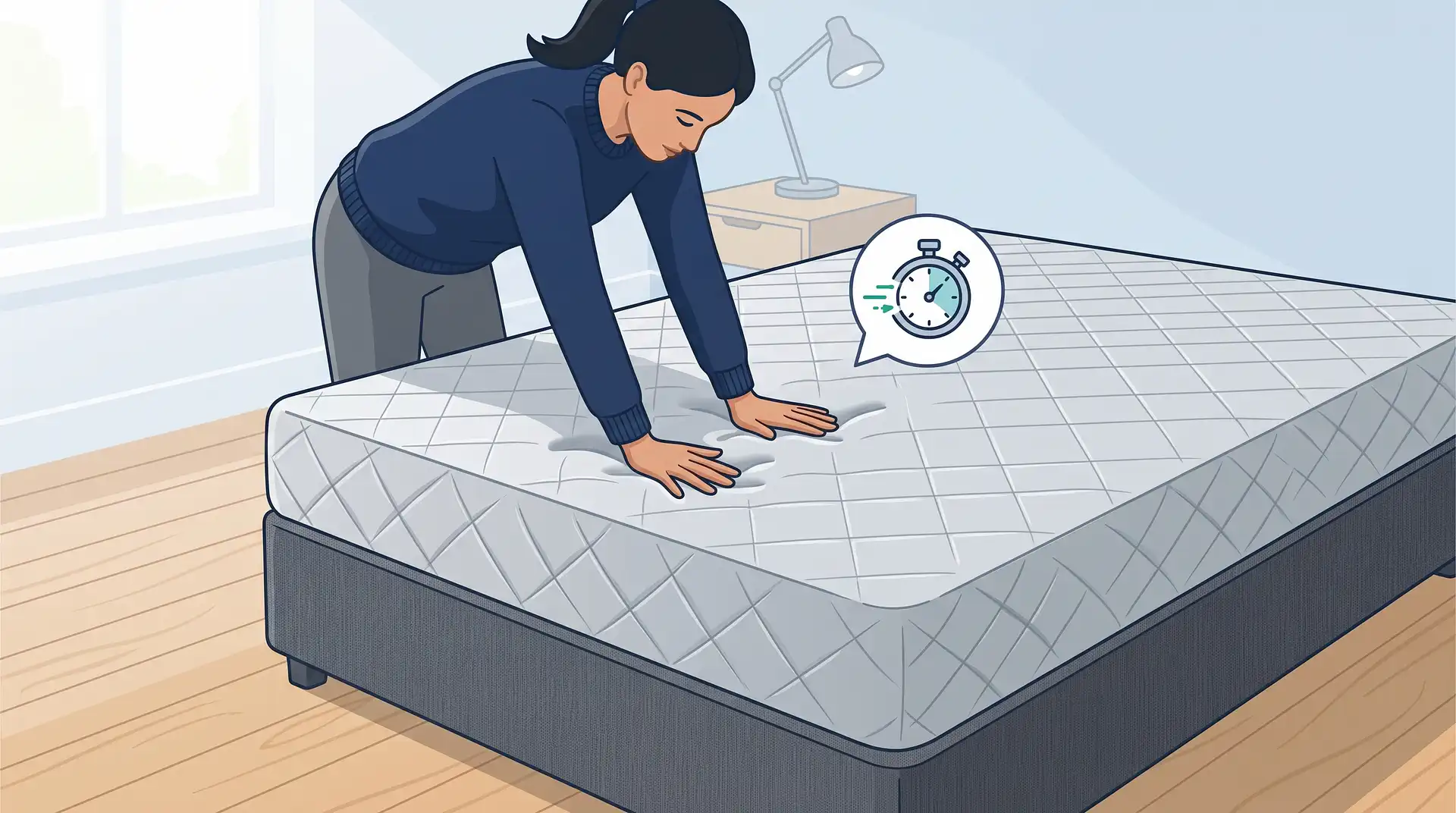
The press test: press firmly with both hands on the sleeping area and hold briefly, then release. If the foam rises back evenly and reasonably promptly, the structural support is still functional. If it stays down or rises very slowly and incompletely, the recovery capacity has deteriorated.
How to make a Tempur mattress last longer
Use a quality mattress protector from day one. Sweat, body oils and spills degrade foam over time. A protector that goes in the machine wash keeps biological contamination off the mattress surface itself. It is the single most effective maintenance measure.
Rotate head to foot every three to six months. Tempur mattresses are one-sided and must not be flipped, but rotating distributes the sleeping position wear more evenly across the foam surface. This is particularly important for single sleepers where all the pressure falls on one side of the mattress.
Use a compatible, solid base. Check Tempur's current guidance on compatible foundations. A base that has itself lost structural integrity compromises the mattress's performance.
Address spills immediately. The same guidance from the how to get stains out of a mattress guide applies: cold water and blotting for protein stains, minimal moisture applied to a cloth rather than poured onto the mattress, and thorough drying before the mattress is used again.
Professional cleaning periodically. Instant Dry Carpet Cleaning provides professional mattress cleaning across England and Wales using hot water extraction that removes accumulated body oils, biological matter and surface contamination from the mattress layers. For a mattress at the price point of a Tempur, a professional clean every one to two years is worth considerably less than the cost of premature replacement.
FAQ Section
How long does a Tempur mattress last in the UK? Typically 10 to 15 years with proper care. Tempur UK provides a 10-year Quality Guarantee. Some well-maintained Tempur mattresses have remained comfortable for considerably longer, though the natural softening of the foam over time means comfort life can vary from structural lifespan.
What does the Tempur 10-year Quality Guarantee cover? Manufacturing defects in materials and workmanship, and visible sagging or body impressions beyond a defined threshold. It does not cover the natural gradual softening of the TEMPUR material that occurs with use over time, which is considered normal wear.
Do Tempur mattresses last longer than normal mattresses? Yes, typically. Standard memory foam mattresses last seven to ten years. Tempur's high-density foam is more resistant to sagging and body impressions than average memory foam, and most UK sources place Tempur lifespan at ten to fifteen years. Premium spring mattresses last seven to ten years in comparable quality brackets.
Why has my Tempur mattress gone soft? TEMPUR material naturally softens with sustained use. This is the material working as designed — it responds to body heat and weight and over years of this cycling it becomes somewhat softer. Some degree of softening is normal and not a fault. Whether the softening has crossed into affecting support can be assessed with the press test: press both hands firmly into the sleeping area and release. If it returns to shape reasonably, the structural support remains.
Can you flip a Tempur mattress? No. Tempur mattresses are one-sided. Flipping would mean sleeping on the support base, which is not designed as a sleep surface and would deteriorate rapidly. Rotate head to foot every three to six months instead.
Does a mattress protector help a Tempur mattress last longer? Significantly. Body oils, sweat and biological material degrade foam over time. A washable mattress protector keeps these off the mattress surface and is the single most effective measure for extending both hygienic and structural lifespan.
How do I know when my Tempur mattress needs replacing? Press firmly across the surface, particularly at the sleeping position. If the foam returns evenly and reasonably promptly, structural support is still functional. Visible permanent indentation, consistently uneven support, or new persistent morning pain that wasn't there previously are the clearest signs of genuine structural deterioration.
Is it worth cleaning a Tempur mattress rather than replacing it? Yes, if the structural test passes. Staining, odour and surface contamination are hygiene problems, not structural ones, and a professional clean at a fraction of replacement cost addresses them on a mattress that is structurally sound.
Service Section
A Tempur mattress is a significant investment worth maintaining
Professional mattress cleaning removes the accumulated body oils, biological matter and surface contamination that degrade foam over time and cause the staining and odour that leads many owners to replace a structurally sound mattress prematurely. For a mattress at Tempur's price point, a professional clean every one to two years is a straightforward way to protect the investment.
Instant Dry Carpet Cleaning provides professional mattress cleaning across England and Wales using hot water extraction, with carpets and mattresses typically up to 90% dry on completion. Free survey and fixed price before any work begins.
Get your fixed quote in 60 seconds
Or call 07555 856988.