How to Store a Mattress Without Damage
7 October 2026
Would rather leave it to a professional? See our mattress cleaning in Manchester.
Quick answer: Store a mattress clean, completely dry and lying flat on a suitable raised support, with nothing resting on top. Choose a dry indoor space, protect the mattress with a cover suited to the storage conditions and check it during its stay. Follow the manufacturer’s instructions for position and packaging. Do not fold, roll or vacuum-pack an expanded mattress unless it is specifically designed for that treatment.
Whether you are moving home, decorating or keeping a spare bed, storage should protect both the fabric and the layers inside. A mattress can look tidy in a bag while moisture or uneven pressure is causing damage underneath. Preparing the mattress and choosing the space matter as much as wrapping it.
Check the mattress before deciding to store it
Find the brand, model and care instructions before packing. Check the rules for cleaning, moving, storage position and permitted covers. A mattress delivered in a compressed box does not necessarily allow you to compress it again at home.
Inspect the cover, seams, underside and sleeping surface. Note any stains, damp patches, musty smell, broken springs or permanent dips. Photograph its condition so you can compare it when you take it out of storage.
Storage will not restore worn support or resolve mould. If the mattress already feels uneven or uncomfortable, assess whether keeping it is worthwhile. Our guide to how long mattresses last explains the difference between routine wear and a mattress that needs replacing.
How to prepare and store a mattress
1. Remove bedding and separate accessories
Take off the duvet, sheets, pillows, protector and separate topper. Wash and dry washable items according to their labels, then pack them separately. A topper may have different storage instructions from the mattress beneath it.
Do not remove a zipped mattress cover unless its maker permits removal. Some covers are part of the mattress construction or have special care requirements.
2. Clean using the permitted method
Remove loose dust with a soft brush or vacuum, depending on the care guide. Vacuuming is unsuitable for some delicate covers and natural fillings, so avoid treating it as a universal step.
Spot clean only where needed and only with approved products. Apply as little moisture as the instructions require. There is no need to wet-clean an already clean mattress just because it is going into storage.
3. Allow it to dry fully
Leave the mattress uncovered in a dry room with good airflow after any cleaning. Seams, thicker padding and the underside can take longer to dry than the top cover. A dry surface cannot prove that deeper filling is dry after a large spill or heavy wetting.
Postpone packing if moisture remains. Arrange an assessment if the mattress has been soaked or smells musty. Sealing it away will make inspection and drying harder.
4. Protect it for the move
Use a correctly sized mattress bag or suitable protective cover to keep the fabric away from dirt and rubbing during transport. Check that the bag accommodates the mattress depth without squeezing it out of shape.
Keep tape on the packaging rather than directly on the mattress fabric. Protect corners and keep the load away from sharp furniture edges. A transit bag and a long-term storage cover may serve different purposes.
5. Move it without bending or crushing it
Follow the maker’s handling directions and plan the route before lifting. Do not force a mattress around a tight corner by folding it, or use straps to compress it into a smaller shape.
Check the clear width of doors, the space at stair turns and the storage entrance. Get suitable moving help if the mattress cannot pass safely. Handles may be intended only for positioning on the bed, rather than carrying the full weight.
6. Lay it flat on appropriate support
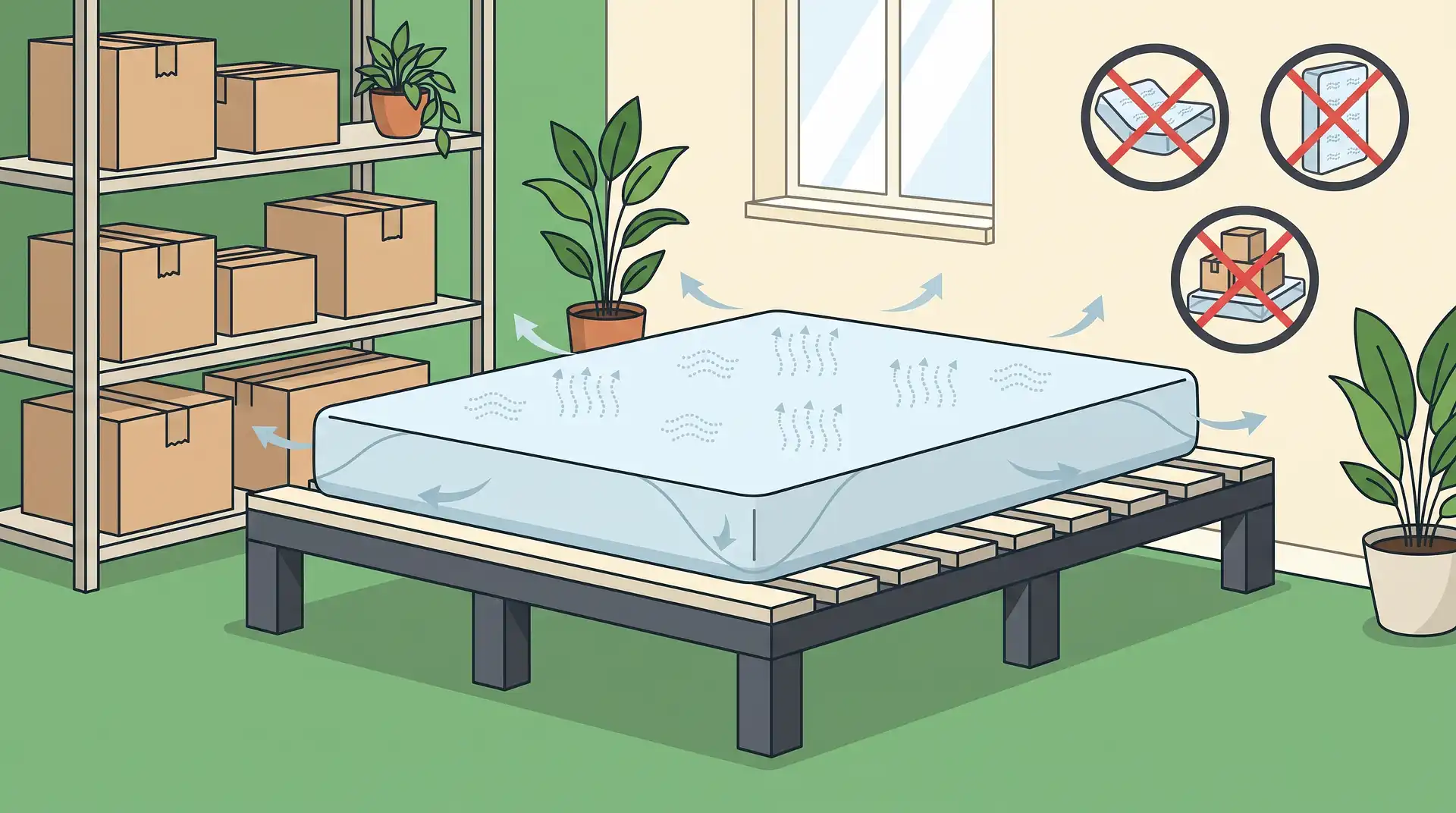
For a standard mattress, plan space to store it horizontally in its normal shape. Use a clean, dry, stable support that suits the mattress and keeps it clear of the floor. Its usual bed base can be a practical option if there is room.
Keep the whole mattress supported without overhanging edges, uneven pressure or large unsupported gaps. Leave space around it for inspection and airflow. Keep boxes, furniture and other stored items off the sleeping surface.
Can you store a mattress on its side?
Do not assume that a position used briefly during a move is suitable for weeks or months. Prolonged upright storage can distort the edge or allow internal materials to shift. TEMPUR, for example, requires its mattresses to be stored flat.
Some manufacturers allow a limited period on the side during handling, while others require the mattress to stay flat during transport too. Check your exact model rather than using a general time limit.
If the only available space requires long-term upright storage, find another space or ask the manufacturer for an approved alternative. Leaning the mattress against a wall and regularly turning it is not a reliable substitute for correct support.
Want it cleaned before it goes into storage?
Which cover should you use for storage?
In a clean, dry indoor space, a breathable mattress storage cover can protect against dust while allowing moisture to escape. Clean cotton sheets can provide basic dust protection for a short stay, but they offer less protection against tearing or spills.
Plastic bags can protect during transport, but sealed plastic may hold moisture already inside. Before keeping the transit wrapping on, check the mattress maker’s packaging instructions and the bag’s intended use.
There are exceptions. Some manufacturers recommend their original packaging for storage, so do not discard it solely because it is plastic. Follow that guidance and make sure the mattress and surroundings are dry. Avoid tightening packaging around an expanded mattress to reduce its size.
Does your mattress need cleaning before it goes into storage?
Ask About Cleaning Before Storage
Where should you store a mattress?
Storage place | What to check |
|---|---|
Spare room | Dry conditions, enough flat support, clear exits and space for airflow |
Storage unit | Humidity control, leaks, access for inspections and sufficient floor space |
Garage, shed or cellar | Damp, condensation, temperature changes, pests and contact with cold floors or walls |
Loft | Safe access, suitable load-bearing floor, leaks and stable storage conditions |
A dry indoor room is usually easier to monitor than an outbuilding. A garage is unsuitable if it has damp walls, condensation, water entry or strong fumes. Raising and covering a mattress does not make a damp room suitable.
For a storage unit, ask how temperature and humidity are managed. Check the actual conditions rather than relying only on a description such as climate controlled. Choose enough space to follow the mattress maker’s storage position and inspect the cover without unpacking a stack of furniture.
How to store a mattress for several months
Keep a record of the date, mattress model and storage location. Leave the care instructions accessible, and set a reminder to inspect the mattress periodically. Check again after a leak, condensation, a major change in conditions or damage to the cover.
Look for damp packaging, water marks, musty odour, pests and changes in shape. Do not assume that a moisture absorber or waterproof bag will make a poor storage environment safe. If dampness develops, move the mattress to a suitable dry space and assess it before repacking.
There is no universal safe storage duration. Condition, construction and the storage environment matter. For a new mattress still in its factory box, check the required unpacking deadline before leaving it compressed. The limit for one model does not apply to another.
Check the mattress before using it again
Bring it into a dry room and remove the storage covering carefully. Place it on the correct base and allow it to air and adjust to room conditions according to the manufacturer’s instructions.
Inspect the top, sides, underside and seams. Check for moisture, mould, insects, damaged fabric and uneven support. Compare it with the photographs taken before storage.
If it is clean, dry and supportive, fit clean bedding and a suitable protector. Use the permitted brushing or vacuuming method if light dust has collected. Seek advice if a musty smell persists, dampness is suspected or the shape has changed. Air freshener cannot establish that the mattress is safe to use.
Safety guide for moving and storing a mattress
Clear the route, secure doors open and remove trip hazards before lifting.
Use capable help for a bulky mattress. Arrange professional handling if you cannot control it safely.
Keep your view of the route clear, and avoid twisting while carrying the load.
Use mattress handles only as the maker directs. Do not assume they are lifting handles.
Keep plastic mattress bags and loose packaging away from children because of the risk of suffocation.
Keep exits, electrical equipment and heaters clear of stored bedding and packaging.
Use stable support and avoid balancing the mattress where it could fall.
Do not carry a mattress into a loft without suitable access and a floor designed to support the load.
Read the Health and Safety Executive’s good handling technique guidance before moving a heavy or awkward mattress. It explains the value of planning the lift, keeping the load close where practical and moving your feet to avoid twisting.
Frequently asked questions
Can I store a mattress upright to save space?
Check its instructions. Many mattresses require flat storage, and permission for brief upright handling does not mean it is suitable for long-term storage. Choose a space that allows the approved position.
Can I roll a mattress that arrived in a box?
Do not try to recreate factory compression at home. An expanded mattress may contain springs or bonded layers that rolling can damage. Only roll it if the maker expressly allows it.
Can I put boxes on a stored mattress?
Keep the mattress clear of stored items. Sustained weight and concentrated pressure can compress or distort its comfort layers. Use separate shelving for boxes.
Can I store a mattress in a plastic bag?
It depends on the maker’s guidance and the conditions. A bag can protect a fully dry mattress, but it can also trap remaining moisture. Some manufacturers recommend original packaging; others prefer breathable protection.
Does a mattress need cleaning after storage?
Inspect it first. A well-protected mattress may only need airing and permitted dust removal. Persistent odour, staining or suspected moisture needs assessment before use. Cleaning cannot repair a mattress that has lost its support.
Should a mattress be stored flat or on its side?
Store it flat whenever you can, as standing it on its side for weeks can shift the fillings and springs. If space means it must stand up, keep it upright for no more than a few days and support it so it does not bend.
How do you protect a mattress in storage?
Clean and fully dry it first, then use a breathable mattress bag rather than sealed plastic, which traps moisture and causes mould. Keep it off the floor in a dry, temperature-stable space and do not stack heavy items on it.
Can you store a mattress in a garage or loft?
Only if the space is dry and does not get very cold, hot or damp. Many UK garages and lofts swing in temperature and humidity, which can cause mould and damage foam. A climate-controlled storage unit is safer for long periods.
Prepare early enough for cleaning and drying
Measure the storage space and plan the move before packing day. If cleaning is needed, arrange it with enough time for complete drying before wrapping. Tell the cleaner about the mattress material, care label, stains and planned storage so the advice suits its condition.
Need help with stains or odour before packing your mattress away?
Request a Mattress Cleaning Quote
Related guides: how to clean a mattress, how to clean a mouldy mattress, how to dispose of a mattress. For a professional finish, see our mattress cleaning service or carpet cleaning in Manchester.
Related guides
Need it cleaned properly?
Book our mattress cleaning service — from £35 (UK average £55), free in-home survey and pay on completion.