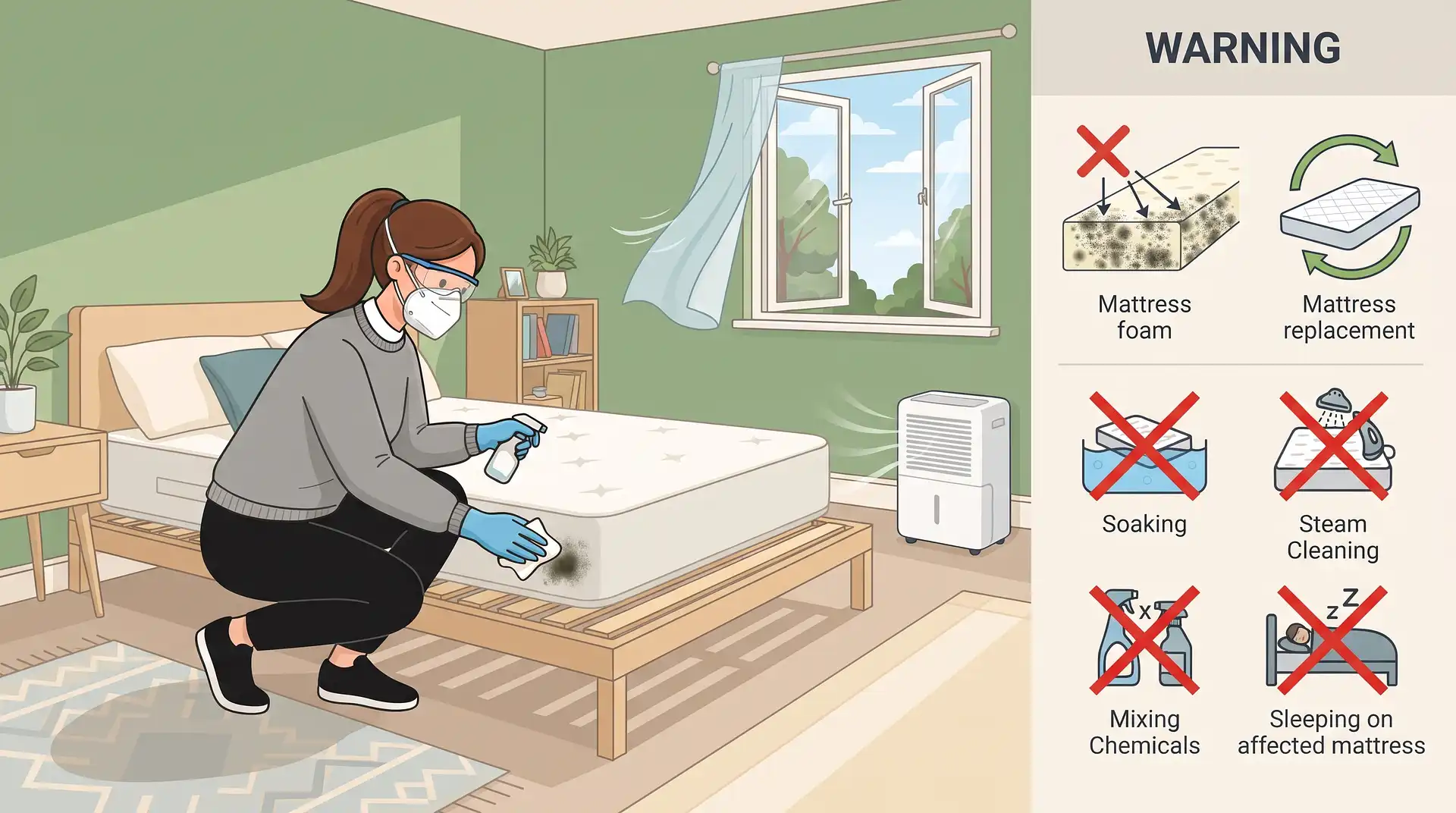
How to Clean a Mouldy Mattress
5 October 2026
Would rather leave it to a professional? See our mattress cleaning in Manchester.
Quick answer: Do not sleep on a mouldy mattress until you know how far the growth has spread. Mattresses are porous, so wiping away visible marks cannot prove that mould has been removed from the foam or filling. A tiny, recent spot limited to an intact surface cover may be treatable if the manufacturer permits it and the inside is clean and completely dry. Replace the mattress or arrange a professional assessment when mould covers a wider area, reaches seams or filling, appears on more than one side, follows flooding, smells strongly musty or returns after cleaning. Find and stop the moisture source before treating or replacing anything.
A mouldy mattress is different from an ordinary stain. The visible dots are only the part you can see, while fine roots and spores may be deeper in the cover or core. Adding more liquid can hide the mark temporarily while making the conditions inside the mattress worse.
Can you safely clean mould from a mattress?
Sometimes, but only when the problem is genuinely superficial. The condition of the cover, the size of the affected area, the mattress material and the cause of the moisture all matter.
What you find | Sensible next step |
|---|---|
A few recent spots on a removable, washable cover, with a clean and dry mattress beneath | Follow the cover’s washing instructions, dry it fully and monitor the mattress |
A small mark on a fixed cover, no deep smell and no dampness | Check the maker’s care instructions and consider controlled surface treatment or professional assessment |
Mould in seams, foam, filling or several parts of the mattress | Replacement is normally the safer option because internal removal cannot be confirmed |
A strong musty smell, even where no growth is visible | Stop using the mattress and have it assessed; hidden moisture or internal growth may be present |
Contamination after flooding, sewage or repeated soaking | Do not attempt routine home cleaning; arrange safe disposal and deal with the wider contamination |
Mould returns after treatment and complete drying | Replace the mattress and investigate the unresolved moisture source |
Do not judge the mattress only by the colour of the mark. A pale patch can extend deeper than it looks, while an old non-fungal stain may look dark without being mould. When the cause or depth is uncertain, avoid experimenting with several products.
How to tell whether the mark may be mould
Mould often appears as clusters of black, green, grey, brown or white dots. The surface may look powdery, speckled or slightly fuzzy, and the mark may spread out from a damp edge. A persistent earthy or musty smell is another warning sign.
Do not put your face close to the mattress to smell it, rub the patch with a dry finger or scrape it to see whether it moves. Disturbing dry growth can release particles into the air.
Inspect the whole sleeping area
Check the top, sides, seams and underside of the mattress. Inspect the bed base, slats, headboard, wall, carpet and objects stored beneath the bed. Use a torch rather than lifting a heavy mattress alone.
Look for water marks, cold wall surfaces, condensation, a leaking radiator or pipe, a damp floor and restricted airflow. Photograph the affected areas before cleaning, especially in rented accommodation or when a building defect may be involved.
Check whether the mattress is still damp
Press a clean dry cloth firmly against the area and check it for moisture. A mattress that feels cool compared with the surrounding surface may still be damp inside, although touch alone cannot confirm that the core is dry.
If moisture entered through a large spill or previous wet cleaning, the visible cover may have dried while the foam or filling remained damp. A musty smell that becomes stronger when the room is warm can indicate a deeper problem.
Why mattresses develop mould
Mould needs moisture. The lasting solution is to identify why the mattress stayed damp enough for growth to begin.
Condensation: moisture can collect where the mattress meets a cold wall, floor or solid base.
Poor airflow: a mattress placed directly on the floor or surrounded by tightly packed storage cannot release overnight moisture easily.
A leak: water may come from a window, roof, pipe, radiator or adjoining wall.
A spill or accident: liquid can enter the core when it is not blotted and dried quickly.
Over-wet cleaning: soaking, steam cleaning or repeated spraying can leave hidden layers damp.
High room humidity: regular condensation on windows and external walls suggests that the mattress is part of a wider moisture problem.
Damp bedding or protector: putting layers back before every part is dry traps moisture against the cover.
Cleaning the mattress without correcting the cause usually leads to another patch. Check the room, base and wall before deciding that the mattress alone is responsible.
What you need for a limited surface treatment
Use this list only for a small, recent surface mark that the mattress manufacturer says may be treated. It is not a method for widespread or internal mould.
Disposable gloves
A well-fitting FFP2 mask and eye protection
Clean white disposable cloths
Seal-able rubbish bags
A product approved for the exact mattress cover and intended use
A second cloth barely dampened with clean water, only if the product requires rinsing
Dry towels
A dehumidifier or moving air for the drying stage
Read the mattress care label and the complete cleaning-product label before starting. A removable zip cover is not automatically washable, and a product suitable for a bathroom wall may damage fabric, foam, adhesive or fire-resistant treatments.
When to stop and replace the mattress
Do not try to rescue a mattress when any of the following applies:
The affected area is larger than a small isolated surface patch.
Mould is visible in seams, buttoning, foam, fibre filling or ventilation holes.
Growth appears on the top and underside or on several edges.
The whole mattress or bedroom smells musty after airing.
The mattress was soaked by flood water, sewage or repeated accidents.
The core is still damp or cannot be dried with confidence.
The marks or smell return after the room and mattress have dried.
The sleeper has breathing symptoms, significant allergies or a weakened immune system.
Covering the mattress with a protector or topper does not isolate internal mould. Turning it over only moves the visible problem away from view.
Not sure if your mattress can be saved?
How to treat a small surface patch
Continue only when the mark is small and recent, the mattress is dry, there is no deep musty smell, the filling appears unaffected and the manufacturer permits surface cleaning.
1. Keep other people out of the room
Keep children, pets and anyone with asthma, allergies, lung disease or reduced immunity away from the mattress and cleaning area. Open a window where safe, close the room door and avoid directing a fan at visible growth before it has been removed.
2. Remove and contain the bedding
Take off sheets, the protector and other washable layers carefully without shaking them. Place them directly into a bag or washing basket and follow each care label. Do not carry loose mouldy bedding through the home.
3. Check a removable cover separately
Remove the mattress cover only when the manufacturer says it is designed to be taken off and washed. Handle it gently, use the stated programme and detergent, then dry it completely before refitting.
Inspect the mattress beneath the cover. If the foam, filling or inner casing has spots, staining or a musty smell, stop. Washing the outer cover does not make an affected core safe.
Unsure whether the mattress can be cleaned safely?
4. Test the approved product
For a fixed cover, test the permitted product on a hidden section and allow it to dry. Check for fading, dye transfer, texture change or a water ring. Do not continue if the label prohibits the product or the test changes the material.
5. Use the smallest practical amount
Follow the product directions exactly. Apply it to a white cloth rather than pouring liquid into the mattress, unless its instructions specifically state another method. Dab the surface gently and work from the outside of the patch towards the centre.
Use a fresh part of the cloth after each pass so removed material is not spread back over the cover. Do not scrub, scrape or force liquid into seams.
6. Remove residue as directed
If the product requires rinsing, blot with a second white cloth that is only barely damp. Press dry towels against the treated area to draw out moisture. Bag disposable cloths and gloves before leaving the room.
7. Dry the mattress completely
Once visible residue has been removed, improve ventilation and use a dehumidifier or fan to move dry air around the mattress. Stand the mattress on its side only if this can be done safely and the manufacturer allows it.
Do not remake the bed while any part feels damp or cool. Check the underside, seams, cover and bed base. Drying may take much longer than the surface appearance suggests.
8. Monitor the area
Check the treated area, underside and base regularly over the following days. If spotting or a musty smell returns, stop using the mattress. Recurrence suggests that growth remains inside or that the moisture source has not been resolved.
Why common mattress mould remedies can fail
Bleach
Bleach can discolour the cover, damage fibres and foam, leave irritating residue and fail to reach growth inside a porous core. Never mix bleach with another cleaning product.
Vinegar and bicarbonate of soda
These household products may change odour or surface appearance, but that does not confirm that internal mould has gone. Combining several homemade treatments also adds moisture and makes the result difficult to control.
Steam cleaning
Steam adds heat and moisture to material that is already vulnerable to damp. It can wet foam, affect adhesives and leave the centre of the mattress damp after the cover appears dry.
Dry brushing or ordinary vacuuming
Brushing dry growth can release particles. An ordinary vacuum may blow fine material back into the room. Do not use either as a quick test or as proof that the mattress is clean.
Air freshener or fragrance
Fragrance may cover a musty smell briefly but does not remove the moisture or growth causing it. A smell that returns is a reason to investigate further.
Clean the base and solve the moisture problem
Remove or isolate the mattress, then inspect the complete bed base. Hard, non-porous parts may be cleaned with a suitable product and dried according to its directions. Upholstered divan bases, fabric headboards and cracked timber need closer assessment because contamination can sit beneath the surface.
Our guide on how to clean a mattress explains routine low-moisture care once the mould problem has been resolved.
Repair leaks, report building damp, manage condensation and improve airflow beneath and around the bed. Use a base that supports the mattress according to its instructions. Avoid placing it directly on the floor, leave space from a cold external wall where possible and do not pack the entire under-bed area so tightly that air cannot move.
If the property is rented, document the mattress, wall, floor and base, then report suspected leaks or building damp promptly. Replacing the mattress without resolving the room problem can allow mould to affect the new one.
Safety guide for mattress mould
Do not sleep on a visibly mouldy or damp mattress while it is being assessed.
Keep babies, children, older people and anyone with asthma, COPD, allergies, lung disease or weakened immunity away from the affected room.
Wear gloves, suitable respiratory protection and eye protection when handling a small surface patch.
Do not shake bedding, scrape dry growth or direct a fan at visible mould.
Follow every cleaning-product label and never mix bleach, ammonia, acids or other treatments.
Wash exposed skin and clothing after the task and keep used cloths contained.
Stop if the affected area is larger or deeper than expected, or if cleaning causes coughing, wheezing, eye irritation or breathing difficulty.
Read the official UK government guidance on damp, mould and health, which explains that damp and mould can affect the lungs, airways, eyes and skin, with some people at greater risk.
Seek medical advice if symptoms develop or existing breathing problems become worse. Call emergency services for severe breathing difficulty.
How to prevent mould returning
Air the bedroom and bedding regularly without allowing the room to remain cold and damp.
Use extractor fans and address regular window condensation.
Keep the mattress on a suitable, supportive base with airflow beneath it.
Leave a gap between the bed and a cold outside wall where the room allows.
Use a washable, breathable mattress protector and dry it fully before refitting.
Blot spills immediately and avoid soaking the mattress during cleaning.
Check the underside and bed base every few weeks if the room has had a damp problem.
Use a dehumidifier where appropriate while also correcting leaks and ventilation problems.
Frequently asked questions
Can a mouldy mattress be saved?
A very small, recent surface patch may be treatable when the manufacturer permits it and the inside is dry and unaffected. Widespread, deep or returning mould normally means the mattress should be replaced.
Is it safe to sleep on a mattress with a small amount of mould?
Do not use it until the mark has been identified, the cause has been corrected and the mattress has been assessed as clean and completely dry. A small visible area does not show how far growth has travelled inside.
Does vinegar remove mould from a mattress?
Vinegar may affect some surface growth, but it cannot confirm that mould has been removed from foam or filling. It also adds moisture. Follow the mattress manufacturer’s instructions rather than relying on vinegar as a complete treatment.
Can you use bleach on mattress mould?
Bleach is unsuitable for many mattress covers and foams. It may fade fabric, damage materials, leave residue and fail to reach internal growth. Never mix it with another product.
Can sunlight kill mould on a mattress?
Fresh air and dry conditions help with drying, but sunlight alone does not prove that mould inside a mattress has been removed. Some foams and covers can also be damaged by prolonged heat or direct sunlight.
Should a mouldy memory foam mattress be replaced?
Replacement is usually safer when mould has reached memory foam because the material is highly porous and difficult to dry or inspect internally. A removable cover with a tiny surface mark is different only when the foam beneath remains completely clean and dry.
Why is mould growing underneath the mattress?
The underside often receives little airflow and can sit against a cold base where moisture condenses. A mattress on the floor, a solid base, packed under-bed storage or a damp room can make this worse.
Can professional cleaning remove all mattress mould?
No responsible cleaner can guarantee removal from an affected core that cannot be opened and inspected. A professional assessment can help distinguish a limited surface issue from a mattress that should be replaced.
What kills mould on a mattress?
Vacuum the area with a HEPA vacuum outdoors if possible, then wipe with a cloth dampened with white vinegar and water (1:1) or a fabric-safe mould cleaner. Dry it fully in sunlight or with a fan and dehumidifier. Wear gloves and a mask.
Why is my mattress going mouldy?
Moisture builds up under the mattress, often from a solid bed base, a damp room or sweat. Use a slatted base, air the bed daily, keep the room ventilated and use a breathable protector.
Deal with the moisture before replacing the mattress
Surface treatment is worthwhile only for a small and clearly limited problem. If the core may be affected, protect health and replace the mattress after the room and bed base are dry. Fixing the leak, condensation or airflow problem first prevents the same damage from reaching the replacement.
Need help deciding whether mattress cleaning is appropriate?
Related guides: how to store a mattress, how to clean mould off car seats. For a professional finish, see our mattress cleaning service or carpet cleaning in Manchester.
Related guides
Need it cleaned properly?
Book our mattress cleaning service — from £35 (UK average £55), free in-home survey and pay on completion.