How Often Should You Buy a New Mattress
12 September 2026
Quick Answer
Most mattresses last between seven and ten years, though this varies by type, with innerspring mattresses often needing replacement closer to five to seven years and memory foam or latex lasting longer, sometimes up to fifteen to twenty five years for high quality latex. Age alone is not the only signal. Sagging, visible wear, waking with aches and pains, noisy springs, and worsening allergy symptoms are all reasons to assess a mattress properly rather than assuming it is automatically fine simply because it has not reached a certain age.
Typical Lifespan by Mattress Type
Innerspring or pocket sprung. Around five to seven years on average, since the coil structure tends to wear and lose support faster than foam or latex based construction
Hybrid. Roughly five to ten years, with the pocket spring core generally carrying the structural load for longer than foam alone would manage
Memory foam. Around ten years on average, though heat and moisture exposure over time can affect how well the foam holds its shape
Natural latex. Often fifteen to twenty five years, making it the longest lasting mattress type when properly cared for
Synthetic latex. Typically five to ten years, shorter than natural latex due to differences in material durability
These figures are averages rather than fixed rules. A high quality mattress that is well looked after can outperform its typical range, while a lower quality one used heavily every night may need replacing sooner than expected.
Signs It Might Be Time to Replace Your Mattress
Visible sagging or a permanent body shaped dip. This usually means the internal support structure has broken down rather than something that rotating the mattress can fix
Waking with aches, stiffness, or pain that eases once you are up and moving. This pattern suggests the mattress is no longer supporting your spine and joints properly through the night
Lumps or an uneven surface. This generally means fillings have broken down or shifted, and a healthy mattress should keep a reasonably flat, even surface
Noisy springs. Creaking or pinging sounds usually mean the coils have worn and are no longer providing consistent support
Visible damage. Rips, exposed springs, or fabric that has worn through are straightforward signs the structure is failing
Worsening allergy or asthma symptoms. This is worth investigating properly before assuming replacement is the only answer, since it does not always mean the mattress itself has failed structurally
A Practical Way to Check for Sagging
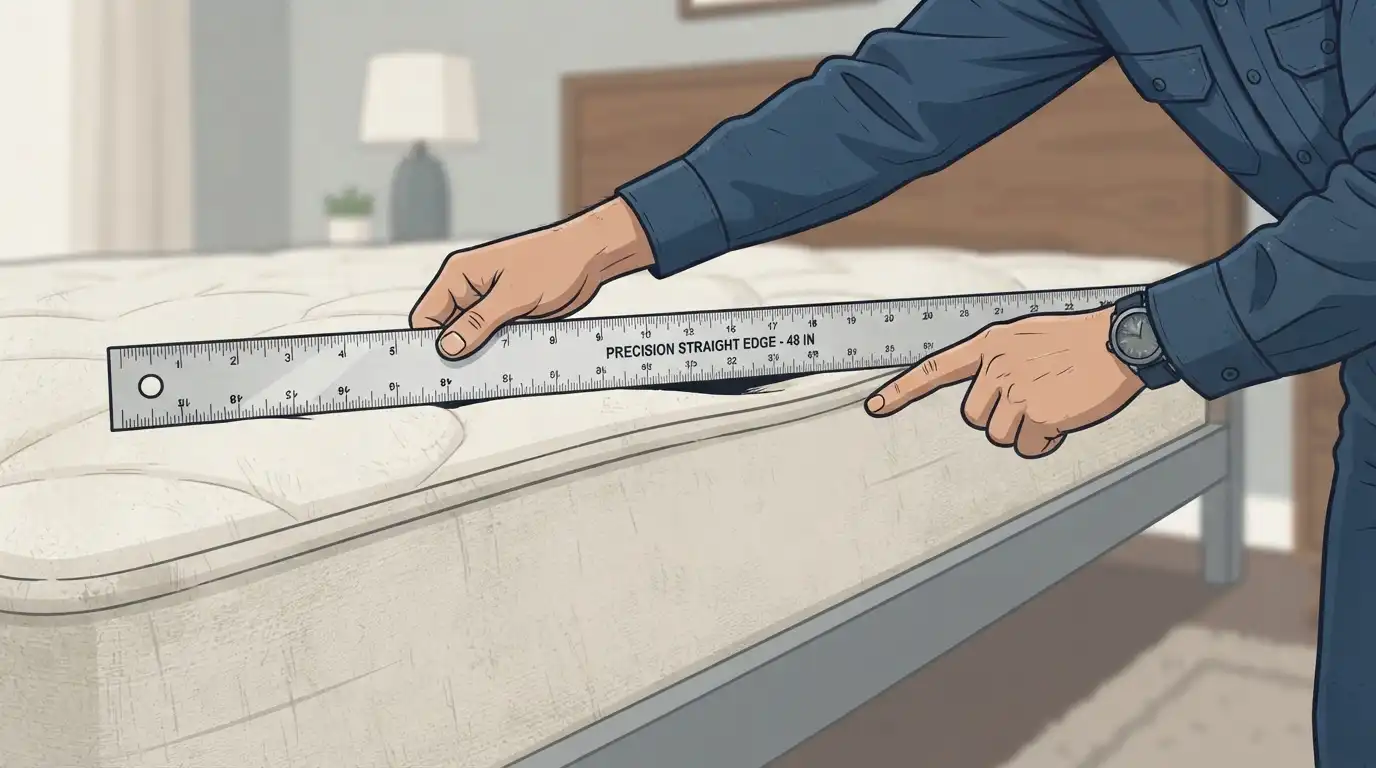
Looking at a mattress is not always enough to spot a genuine sag, particularly on a mattress with a thick topper or cover. Lay a straight edge, such as a broom handle or spirit level, across the bare mattress surface where you usually sleep. A visible gap or valley underneath the straight edge means the support core has likely failed in that area, and this kind of structural sag cannot usually be corrected with a topper or protector.
Ruling Out the Base Before Blaming the Mattress
A mattress that feels like it is sagging or providing poor support is not always the actual problem. Worn slats, a base that has lost its tension, or a frame that no longer sits level can all create a sagging sensation even when the mattress itself is in reasonable condition. Checking the base and frame for wear or damage before assuming the mattress needs replacing can save an unnecessary purchase, particularly on a divan or slatted base that has been in use for many years alongside the mattress.
When Odour or Allergy Symptoms Do Not Mean You Need a New Mattress
Mattresses do accumulate dust mites, skin cells, and sweat over years of use, and this is often cited as a reason to replace one every seven to ten years regardless of its physical condition. What is less often mentioned is that a genuinely thorough clean can address a large part of this problem directly, rather than the only solution being a full replacement.
If the main issue is a musty smell, worsening allergy symptoms, or general staleness rather than sagging, physical damage, or a lack of support, it is worth having the mattress properly cleaned before assuming it needs to go. The general method covered in the guide on how to clean a mattress can resolve a surprising amount of this, and a professional clean goes further than a home vacuum and bicarbonate of soda ever can, particularly on a mattress that has not been cleaned properly in several years. Structural problems such as sagging or broken springs cannot be solved by cleaning, but hygiene related symptoms very often can.
How Care Affects Where a Mattress Falls Within Its Range
A mattress used with a washable protector from day one, rotated regularly according to the manufacturer's guidance, and kept on a supportive base tends to sit at the longer end of its expected lifespan range. One that is never rotated, has no protector, and sits on a worn or unsupportive base is more likely to need replacing at the shorter end, regardless of how good the original construction was. Only flip a mattress if it is specifically designed to be double sided, since flipping a one sided mattress can damage the internal layers rather than helping it last longer.
Frequently Asked Questions
How long does the average mattress last?
Most mattresses last between seven and ten years, though this depends heavily on the type of mattress and how well it has been cared for. Innerspring mattresses tend to wear out sooner, while natural latex can last considerably longer.
Do I need to replace my mattress if it smells musty?
Not necessarily. A musty smell is often a sign the mattress needs a proper deep clean rather than replacement, particularly if there is no sagging, physical damage, or loss of support alongside it.
How can I tell if my mattress is actually sagging?
Lay a straight edge such as a broom handle across the bare mattress where you usually sleep. A visible gap underneath means the support structure has likely failed in that area, which cannot usually be fixed with a topper.
Can a worn bed base cause a mattress to feel like it is sagging?
Yes, worn slats or a base that has lost its tension can create a sagging feeling even when the mattress itself is in reasonable condition. It is worth checking the base before assuming the mattress needs replacing.
Does a mattress protector actually extend a mattress's lifespan?
Yes, a washable protector used from the start helps prevent sweat, skin cells, and spills from reaching the mattress core, which generally means it stays in better condition for longer compared to one used without any protection.
Should I flip my mattress to make it last longer?
Only if the manufacturer states it is designed to be double sided. Flipping a one sided mattress can damage the internal layers, so rotating head to toe is the safer option for most modern mattresses.
Suggested Internal Links
Anchor text | Destination | Purpose |
|---|---|---|
how to clean a mattress | Resolving odour and allergy symptoms before assuming replacement is needed | |
how long does a Tempur mattress last | Related lifespan topic, same mattress cluster | |
how to dispose of a mattress | Next step once replacement is confirmed, same mattress cluster | |
professional mattress cleaning | Service page, branded link | |
get a fixed quote | Conversion link |
Service Section
If odour, dust, or allergy symptoms are the main reason you are considering a new mattress, it is worth ruling out a hygiene issue first. Instant Dry Carpet Cleaning offers professional mattress cleaning across England and Wales, using low moisture methods that go further than a home clean.
Get a free quote: instantdrycarpetcleaning.co.uk Call or WhatsApp: 07555 856988