How to Wash a Mattress Cover
7 October 2026
Would rather leave it to a professional? See our mattress cleaning in Manchester.
Quick answer: Wash a mattress cover only if the manufacturer confirms that it is removable and washable. Take off the permitted outer cover or top panel, follow its care label for temperature, cycle, detergent and drying, then refit it only when completely dry. Leave inner liners and fire barriers in place. A zip alone does not mean the cover can go in the washing machine.
A mattress cover can mean two different things: the original fabric surrounding the mattress, or a separate protector fitted beneath your sheet. This guide focuses on the original outer cover. It may have different washing rules from the protector, even when both look like ordinary bedding.
Can your mattress cover be washed?
Find the mattress model and its care instructions before opening a zip. Confirm two things separately: whether you may remove the cover, and whether you may wash it. Some covers can come off for airing but cannot be laundered.
Check each section if the cover separates into a top panel and base. One panel may be machine washable while another needs spot cleaning. Do not apply the top panel’s temperature or drying instructions to the whole cover.
What the instructions say | What you should do |
|---|---|
Removable and machine washable | Wash the specified section using its stated programme and temperature |
Hand wash only | Use the hand-washing method permitted by the maker |
Removable for airing only | Air it as directed; removal does not permit washing |
Do not remove or spot clean only | Leave the cover fitted and use the approved surface treatment |
Missing or unclear instructions | Ask the manufacturer before removing or washing it |
If you mean a separate fitted protector, use that item’s own label. Our guide on washing a mattress protector covers its routine care. A protector’s instructions do not apply to the mattress’s original cover.
What you need before washing
The exact mattress and cover care instructions
A detergent suitable for the cover, used at the permitted dose
A washing machine with enough capacity for the cover and its approved programme
A clean white cloth and an approved stain treatment, if needed
A suitable drying space or permitted tumble-drying programme
Help if removing the cover requires moving a heavy mattress
Plan the drying stage before starting. A thick quilted cover may stay damp at seams and corners after the flat areas feel dry. Arrange another sleeping place if the original cover cannot be refitted by bedtime.
Mattress underneath needs cleaning too?
How to wash a removable mattress cover
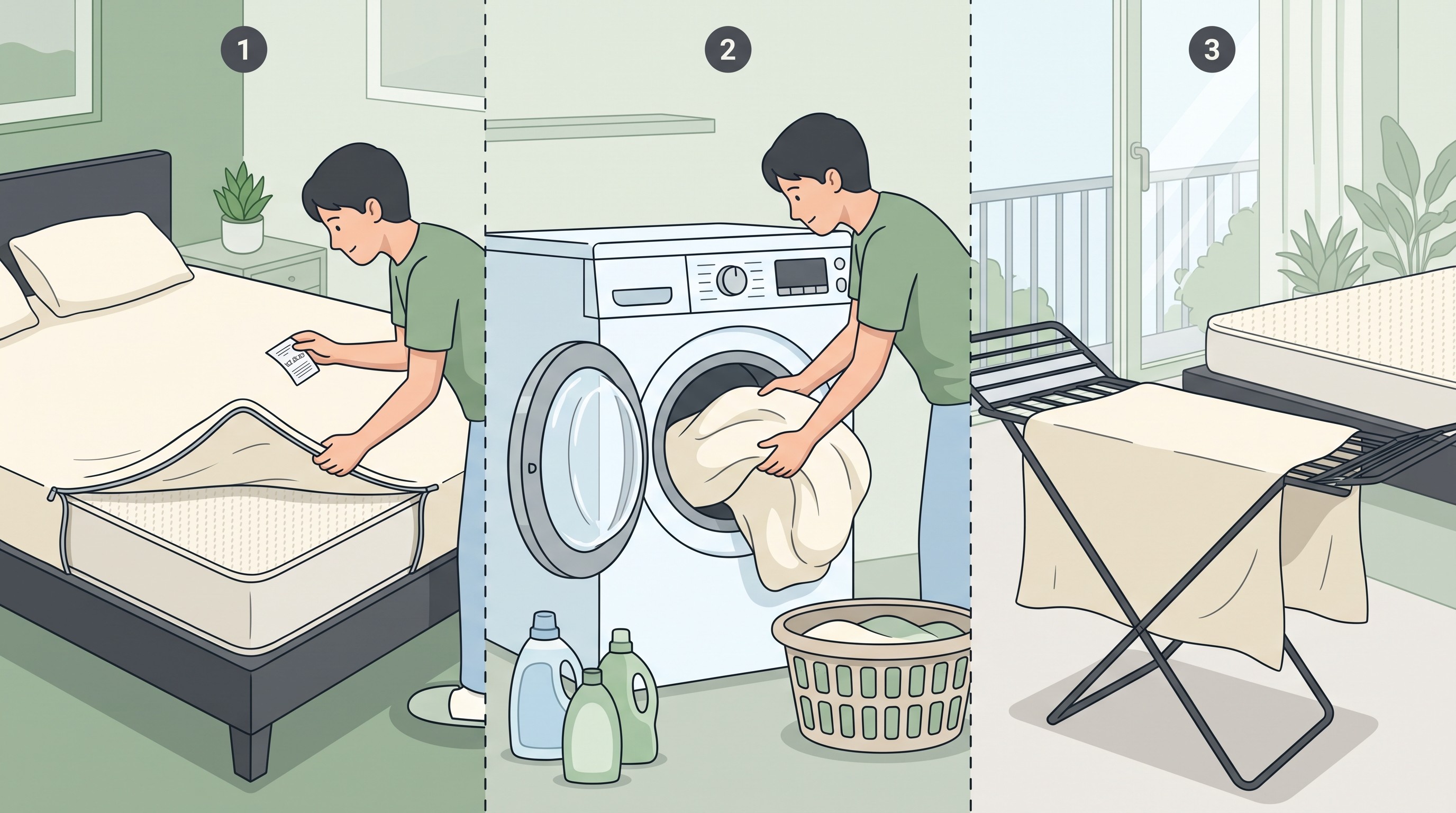
1. Remove the approved cover carefully
Strip the bedding, protector and separate topper. Photograph the fitted cover, its label and the position of the zip so you can put everything back correctly.
Open only the zip identified in the manufacturer’s instructions. Some models allow removal of the top panel while the base stays fitted. Do not force a clipped zip, cut stitching or peel off an inner liner. Keep the exposed mattress clean and dry while the cover is being washed.
2. Check stains before loading the machine
Blot a fresh spill with a white cloth. If pretreatment is allowed, use a product suitable for the cover and follow its contact-time and rinsing instructions. Test a hidden section where the product label recommends it.
For fresh blood, cold-water treatment may help before washing, provided the cover’s instructions allow it. Avoid starting with heat, which can make blood stains harder to remove. Do not scrub delicate fabric or use a stronger mixture to force out an old mark.
3. Set the temperature, cycle and detergent
Follow the cover’s label rather than choosing the same wash as your sheets. The label may specify a gentle cycle, reduced spin or a particular maximum temperature. Different panels of the same mattress can need different settings.
Use a detergent approved for the fabric and any specialist finish. Measure it according to the product instructions, load and water conditions. More detergent is not a stronger cleaning method and may leave residue.
Avoid bleach, fabric softener and other additives unless the cover maker allows them. Turn the cover inside out and close or secure zips only as instructed. Do not assume every mattress cover needs the same preparation.
4. Give the cover enough room to wash
Check the appliance manual for suitable bulky loads. Do not force the cover into a tightly packed drum or add other bedding if this prevents it moving freely. A large cover may need a larger machine or separate washing of approved detachable panels.
If your domestic machine cannot handle it, ask the manufacturer whether a suitable laundrette or professional laundry is appropriate. Give the laundry the care instructions. Do not choose a hotter commercial programme simply because the cover looks heavily soiled.
Run the permitted wash and rinse. If there is still residue afterwards, follow the cover and appliance instructions for further rinsing. Do not improvise a high-speed spin or wring out padded fabric to shorten drying.
Has a spill reached the mattress beneath the cover?
5. Dry it using the permitted method
Check the drying label separately from the washing label. A machine-washable cover may still prohibit tumble drying. If tumble drying is allowed, use the specified heat and programme.
For air drying, follow the maker’s instructions for laying flat or hanging. Support the fabric so its weight does not pull it out of shape, and allow airflow around thicker sections. Keep it away from direct heaters and do not iron it unless permitted.
Check seams, zip edges, corners and quilted areas before refitting. Drying time varies with the cover, room conditions and method. A fixed number of hours cannot confirm that every cover is dry.
6. Refit the cover without forcing it
Confirm that the cover and mattress are both dry. Align the head, foot, top and base using your photographs or the maker’s instructions. Position each corner before gently closing the zip.
If it catches, stop and check the alignment. Do not pull hard on the zip or fit a damp cover in the hope that it will stretch back. The cover should sit correctly without compressing or distorting the mattress.
What temperature should you wash a mattress cover at?
Use the temperature stated for the exact cover. Some washable covers permit 30°C or 40°C, while others allow 60°C. These are examples of label settings, not one rule for every mattress.
For example, TEMPUR’s PRO SmartCool top and base covers have different washing limits. Other covers containing foam may be removable for airing but unsuitable for washing. Checking the model and individual panel avoids using a setting meant for a different item.
Do not raise the temperature beyond the label to remove a stain or try to disinfect the fabric. A permitted wash cleans the cover; it does not establish that contamination inside the mattress has been removed.
What if the mattress cover is not washable?
Keep it fitted if removal is prohibited. Use the maker’s approved brushing, spot-cleaning or airing method. Avoid soaking it, spraying the full mattress or replacing washing with steam unless that method is expressly allowed.
If the label is missing, look up the mattress model or contact the manufacturer. A cold wash can still damage a cover that was never designed to be washed, so it is not a safe default.
Ask for an assessment when a large spill has entered the filling, odour remains, or the cover has visible mould. Cleaning the outer fabric alone cannot show that the inner mattress is dry or free from contamination.
What to do if the cover shrinks or will not fit
First check the orientation and whether you have matched the correct panels. If it still will not fit after it is fully dry, stop pulling. Forcing the zip can tear the fabric or damage the fastening.
Do not rewet, steam or stretch the cover as a repair without the manufacturer’s advice. Ask whether it can be refitted safely or whether an approved replacement cover is available. A separate fitted sheet cannot replace the original cover’s protective functions.
Safety guide for washing a mattress cover
Leave inner liners and fire barriers intact. Only remove the section identified as removable by the maker.
Keep detergent and stain removers in their original containers, with lids closed and out of children’s reach.
Do not mix cleaning chemicals or add homemade mixtures to a wash or stain treatment.
Follow product instructions for gloves, ventilation and avoiding eye or skin contact.
Keep children and pets away while handling chemicals and exposed mattress layers.
Get help if removing or refitting the cover requires moving a heavy mattress.
Refit the complete original cover before using the mattress, and never enclose damp fabric against the filling.
The Northern Ireland government’s chemical safety guidance for the home includes laundry products and explains how to read labels, store chemicals safely and avoid mixing products.
Frequently asked questions
Can I wash every zipped mattress cover?
No. Some zips are used during manufacture, and some removable covers are intended only for airing. Confirm removal and washing permission before opening the cover.
Can I tumble dry a mattress cover on low heat?
Only if its care instructions permit tumble drying. Low heat is still unsuitable for a cover marked “do not tumble dry”.
Can I hand wash a cover that cannot be machine washed?
Only when hand washing is allowed. A machine-wash restriction may mean that all washing is unsuitable, rather than permission to soak it in a bath.
How often should I wash the original mattress cover?
Follow the maker’s care schedule and respond to spills using the permitted method. A washable protector can reduce how often the original cover needs attention. Avoid applying a protector’s washing schedule to a cover with different care requirements.
Can I sleep on the mattress while its cover dries?
Keep the complete original cover fitted for use. Use another bed or an approved spare cover while it dries, rather than putting sheets directly over exposed inner layers.
How do you wash a mattress cover in the washing machine?
Check the label first. Most removable covers go on a 30 to 40°C gentle cycle with mild detergent. Close any zips, wash it alone or with light items, and avoid fabric softener, which reduces breathability.
Can you tumble dry a mattress cover?
Many covers shrink in the dryer, which makes them hard to fit back on. Air-dry flat or over a line, and put it back on the mattress while very slightly damp so it stretches into shape.
Can you wash a memory foam mattress cover?
Only the removable outer cover, if the label allows it. Never wash the foam itself. Some covers are designed to be spot-cleaned only, so check before removing them.
Check the mattress as well as its cover
Before remaking the bed, check whether a spill reached below the washable cover. Tell InstantDry about the mattress model, care instructions, stain and any products already used if you need advice on suitable cleaning. Refit a fully dry cover and clean protector once the mattress is ready for use.
Need advice on a stained or stale-smelling mattress?
Request a Mattress Cleaning Quote
Related guides: how to clean a mattress, how to clean a memory foam mattress. For a professional finish, see our mattress cleaning service or carpet cleaning in Manchester.
Related guides
Need it cleaned properly?
Book our mattress cleaning service — from £35 (UK average £55), free in-home survey and pay on completion.