How to Clean a Velvet Sofa
23 August 2026
Quick answer: Check the cleaning code on the label before using any product. Velvet pile wicks liquid downward fast, so act on spills immediately and blot rather than rub. Always work in the direction of the pile, never against it. When wet cleaning, dampen the whole panel from seam to seam rather than spot treating a stain, since velvet watermarks where a damp area meets a dry one as it dries. Brush the pile back into place once fully dry. Never use heat to speed drying.
A velvet sofa looks more demanding to own than it actually is. The main risks are over-wetting, rubbing against the pile, and applying heat. All three are avoidable, and a velvet sofa maintained correctly holds its appearance better than most people expect.
What type of velvet do you have?
The word velvet describes a pile structure, not a fibre, and the fibre underneath it matters for cleaning.
Type | Feel and appearance | Water tolerance | Common in UK homes |
|---|---|---|---|
Cotton velvet | Soft, warm, rich depth of colour, matte sheen | Lower. Can watermark and stiffen if over-wet | Older and higher-end sofas |
Synthetic velvet (polyester or viscose blend) | Similar appearance to cotton, often slightly brighter | More forgiving with light moisture | Most modern UK velvet sofas |
Performance velvet | Often has a stain-resistant treatment applied | Most forgiving of everyday spills | Family-oriented ranges |
Crushed velvet | Pile set deliberately in multiple directions, creates a rippled light effect | Similar to synthetic | Feature and statement pieces |
Most velvet sofas sold in the UK today are synthetic or performance velvet, which is considerably more practical to clean than traditional cotton velvet. If you're unsure of your type, check the manufacturer's label or the retailer's product description.
Check the cleaning code first
The care label on any UK sofa carries a cleaning code that governs what's safe.
W means water-based cleaning is safe
S means solvent only, no water
WS means either is safe
X means vacuum only, no liquid
Most velvet sofas are W or WS coded. An S-coded velvet is unusual but does exist, particularly on antique or silk velvet pieces. Never apply water to an S-coded fabric. The full cleaning codes guide is in our how to clean a fabric sofa article.
Test any new product on a hidden area first, such as the underside of a cushion or behind a back cushion where it meets the frame. Let it dry fully and check for colour change or pile damage before moving to a visible area.
Why speed matters more on velvet than other fabrics
Velvet pile is dense and directional. When liquid hits it, the fibres wick it downward rapidly, pulling the spill deeper into the pile and toward the cushion core faster than on a flat woven fabric.
This is the same wicking behaviour covered across this site's stain guides, but it happens more quickly on velvet. A spill that sits on a flat fabric for two minutes is still largely at the surface. On velvet, those two minutes can mean the liquid has already moved several centimetres into the pile depth.
Speed on the initial blot is the most important factor in determining how much of the spill you recover before it becomes a deeper problem.
The second consequence is that over-wetting velvet risks moisture reaching the foam cushion core, which cannot dry from the inside out. A velvet cushion that stays damp inside develops the same musty smell and potential mould risk as any other upholstered foam cushion, but it takes longer to detect because the dense pile insulates the surface from the core.
Routine care: the weekly habit that prevents most problems
A velvet brush and a vacuum with a soft brush attachment, used weekly, prevent the majority of velvet sofa problems from developing in the first place.
Vacuuming: use the upholstery attachment on a low suction setting. Work in the direction of the pile with gentle, overlapping strokes. Never run the vacuum against the pile or in circular motions, which disrupts the fibres and leaves visible marks.
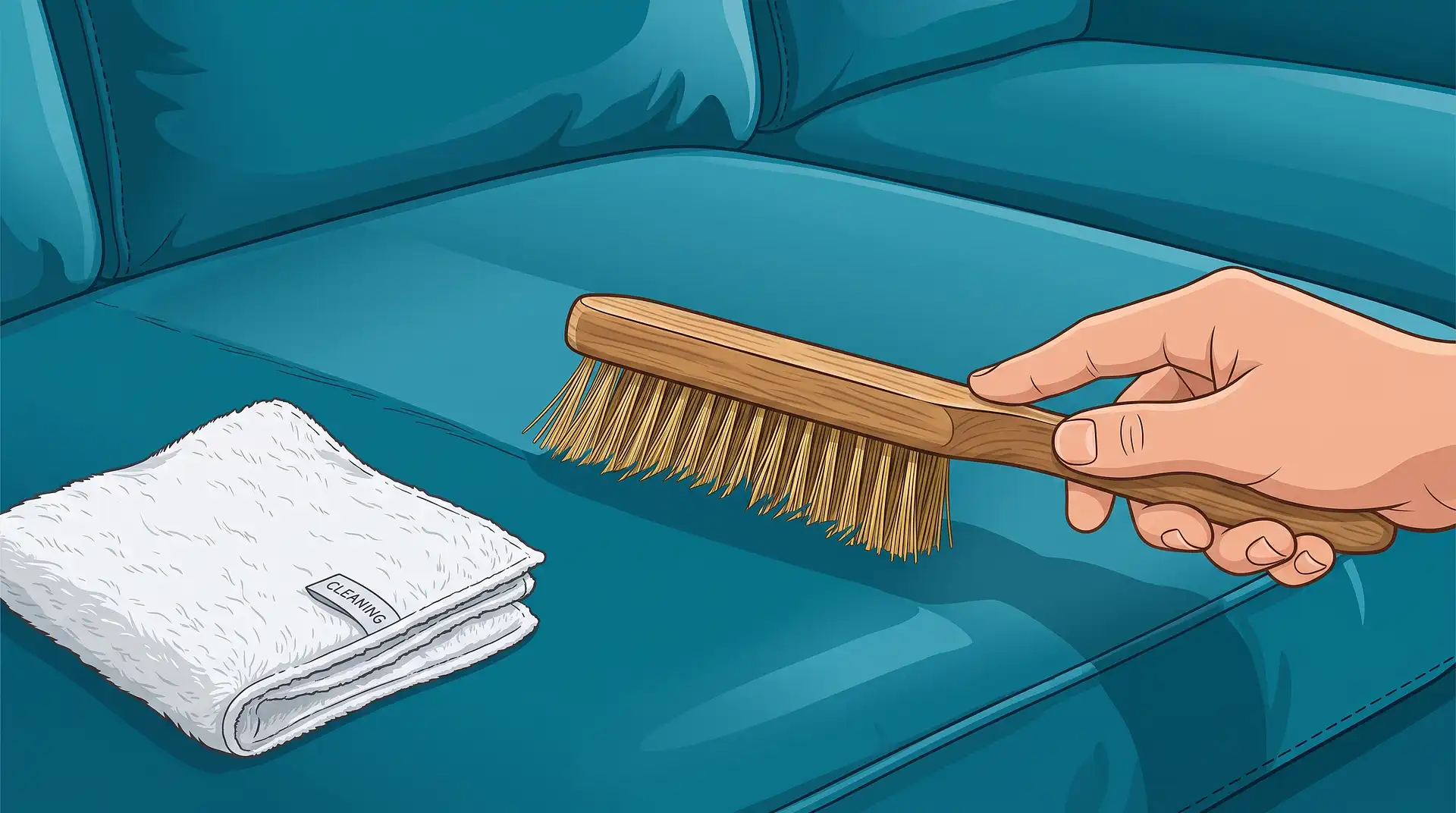
Brushing: a velvet brush with soft brass or nylon bristles, used in the pile direction, lifts surface dust and debris the vacuum misses, prevents pile compaction, and keeps the sheen even across the whole sofa. Brush in the direction the fibres naturally lie, which is the direction that looks smooth when you run your hand across it.
Sunlight: velvet fades more readily than most upholstery fabrics in direct sunlight. Position the sofa away from windows that get sustained direct light, or use blinds or curtains during the brightest part of the day. Cotton velvet is particularly susceptible.
Wet cleaning, step by step
For a W or WS coded velvet sofa.
Step 1: Vacuum first
Always. Wetting surface dust drives it into the pile rather than lifting it.
Step 2: Colour fastness test
Damp white cloth on a hidden area. Wait for it to dry fully. Check for any colour transfer or pile damage.
Step 3: Prepare your solution
A very small amount of clear, mild washing up liquid in cool water, worked to a light foam. For most everyday soiling, you want the foam rather than the liquid, since less moisture goes into the pile. Alternatively, a dedicated upholstery cleaner formulated for velvet gives better control over moisture than a spray bottle.
Step 4: Apply to a cloth, not the sofa
Dampen a white microfibre cloth with the solution and wring it out well. Apply it to the velvet surface rather than spraying liquid directly onto the pile.
Step 5: Work in the pile direction
Use gentle, short strokes in the direction the pile lies. Never rub against the pile, which permanently disrupts the fibres and leaves a patch that looks different from the surrounding fabric. Never use circular motions.
Step 6: Rinse with a plain water cloth
A second white cloth, barely damp with plain cool water, to lift detergent residue. Detergent left in velvet pile attracts dust and dulls the appearance.
Step 7: Dampen the whole panel to prevent watermarks
This is the step that prevents velvet watermarks, and it's the one most guides omit. Covered in detail below.
Step 8: Air dry fully
Open windows, use a fan on a cool setting directed at the sofa. No hairdryer, no radiator, no direct sunlight while damp. Keep foot and sitting traffic off the sofa until it is completely dry, including the cushion core.
Step 9: Brush once dry
Once fully dry, use the velvet brush in the pile direction to restore the sheen and realign any fibres disturbed during cleaning.
Avoiding watermarks: the whole panel rule
Velvet watermarks where a damp area meets a dry one as it dries. The pile fibres at the edge of the damp patch dry in a slightly different orientation from the still-wet fibres beside them, leaving a visible line.
The fix is to prevent that boundary from forming. Once you have finished spot cleaning or treating a stain on a cushion or panel, lightly dampen the entire panel from seam to seam with a barely damp cloth and plain water. You are not cleaning the rest of the panel, you are pre-wetting it so everything dries together at the same rate, with no dry edge for the moisture to concentrate at.
This is the same principle used for water rings on car seat upholstery and on any napped or pile fabric. It feels counterintuitive to add moisture to fabric you aren't trying to clean, but the alternative is a watermark that often looks worse than the original stain.
Stains by type
Fresh spills. Act immediately. Blot firmly with a dry white cloth from the outer edge inward. Never rub. Once you have absorbed as much as possible, treat as described above and dampen the whole panel.
Protein stains (food, milk, blood). Cold water only on the cloth, never warm. Enzyme cleaner applied to the cloth and dabbed onto the area, with an appropriate dwell time, deals with residual protein and odour. Follow with a plain water rinse cloth, then dampen the whole panel.
Tannin stains (tea, coffee, wine). Cool water and mild detergent solution, applied in the pile direction. Repeated light passes rather than one heavy treatment. Dampen the whole panel and dry evenly.
Oil and grease. Sprinkle a small amount of bicarbonate of soda directly onto the mark and leave it for at least twenty minutes to absorb the oil before applying any liquid. Vacuum or brush off gently, then treat the residue with a mild detergent cloth.
Ink and dye. The hardest category on velvet as on any fabric. A specialist velvet or upholstery stain remover tested on a hidden area first. Expect partial improvement rather than guaranteed removal on dark or concentrated ink.
Odour without a visible stain. Bicarbonate of soda sprinkled lightly over the surface, left several hours, then vacuumed off thoroughly. For persistent organic odour (pet, food, smoke), an enzyme cleaner applied to a cloth and dabbed onto the area, allowed to dwell and then blotted out, addresses the source rather than masking it.
Pressure marks and crushed pile: two different problems
Most people searching "how to restore crushed velvet sofa" are actually dealing with one of two distinct issues, and they need different fixes.
Pressure marks are areas where the pile has been flattened temporarily by sitting, leaning, or placing objects on the sofa. The fibres are undamaged but lying flat. Lightly steaming the area and immediately brushing in the pile direction while the fibres are slightly warm from the steam lifts them back into position. For small pressure marks, holding a clean damp cloth a few centimetres above the mark and running a medium iron over the cloth, so the steam rises up toward the velvet rather than pressing down onto it, works on most synthetic velvets. Let the area dry and then brush.
Pile crushing is permanent flattening from sustained heavy use, often at the seat cushion centre or on armrests. The fibres are stressed rather than just displaced, and steam and brushing will improve but not fully restore very heavily crushed pile. This is a wear issue rather than a cleaning issue.
The distinction matters because attempting aggressive methods on pressure marks out of frustration can turn a temporary mark into permanent pile damage.
Can you steam clean a velvet sofa?
It depends on the type.
Synthetic and performance velvet generally tolerates a handheld steamer used carefully: held at least 10 to 15 centimetres from the surface, moving continuously, never held stationary in one spot, working in the pile direction. The steam helps lift flattened pile and freshens the fabric. Brush immediately while still slightly warm.
Cotton velvet is more sensitive. Steam can cause shrinkage, colour change or pile distortion on some cotton velvets, particularly older or more delicate examples. Test on a completely hidden area first and allow it to dry fully before assessing the result.
Crushed velvet varies. The deliberately set multi-directional pile can be altered by steam in ways that may not be desirable. Check the manufacturer's guidance before steaming a crushed velvet sofa.
Never hold a steamer stationary on any velvet. A single spot exposed to concentrated steam can flatten and matt the pile in a way that doesn't recover. Keep it moving continuously.
7. FAQ Section
How do you clean a velvet sofa at home? Check the cleaning code on the label first. Vacuum with a soft brush attachment in the pile direction. For stains, blot immediately with a dry white cloth then apply a mild detergent solution to a cloth and work gently in the pile direction. Rinse with a plain water cloth, then lightly dampen the whole panel from seam to seam to prevent watermarks. Air dry fully and brush the pile back into place once dry.
Why does my velvet sofa have watermarks after cleaning? Velvet watermarks where a damp area dries unevenly alongside a dry one. The fix is to dampen the whole cushion panel from seam to seam after treating a stain, so everything dries at the same rate with no boundary forming. Never spot treat a stain on velvet and leave the surrounding fabric completely dry.
How do you remove stains from a velvet sofa? Act immediately on fresh spills by blotting with a dry white cloth. For protein stains use cold water and enzyme cleaner. For tannin stains use cool water and mild detergent. For grease, absorb with bicarbonate of soda first before any liquid. Always work in the pile direction and dampen the whole panel afterwards to prevent watermarks.
Can you use a steam cleaner on a velvet sofa? On synthetic and performance velvet, yes, with care. Hold the steamer at least 10 to 15 centimetres from the surface, keep it moving continuously and work in the pile direction. On cotton velvet, test on a completely hidden area first as steam can cause shrinkage or pile distortion on some types.
How do you restore a crushed velvet sofa? Lightly steam the affected area and brush in the pile direction while still slightly warm. For temporary pressure marks this usually restores the pile well. For areas that have been heavily used over a long period, improvement is likely but full restoration may not be possible.
Is it safe to use washing up liquid on a velvet sofa? A very small amount in cool water, worked to a light foam and applied via a cloth rather than poured directly onto the sofa, is generally safe on W or WS coded velvet. Always test on a hidden area first and rinse thoroughly afterwards to prevent residue dulling the pile.
How do you get pet hair off a velvet sofa? A velvet brush or a rubber-bristled pet hair remover used in the pile direction lifts most pet hair. A lint roller works on surface hair. For embedded hair, slightly dampening a rubber glove and wiping across the surface in the pile direction gathers hair effectively before vacuuming.
How often should you clean a velvet sofa? Vacuum and brush weekly as routine. Address spills immediately. A full damp clean every few months, or when visible soiling warrants it. Regular brushing and vacuuming prevents most deeper cleaning from being needed.