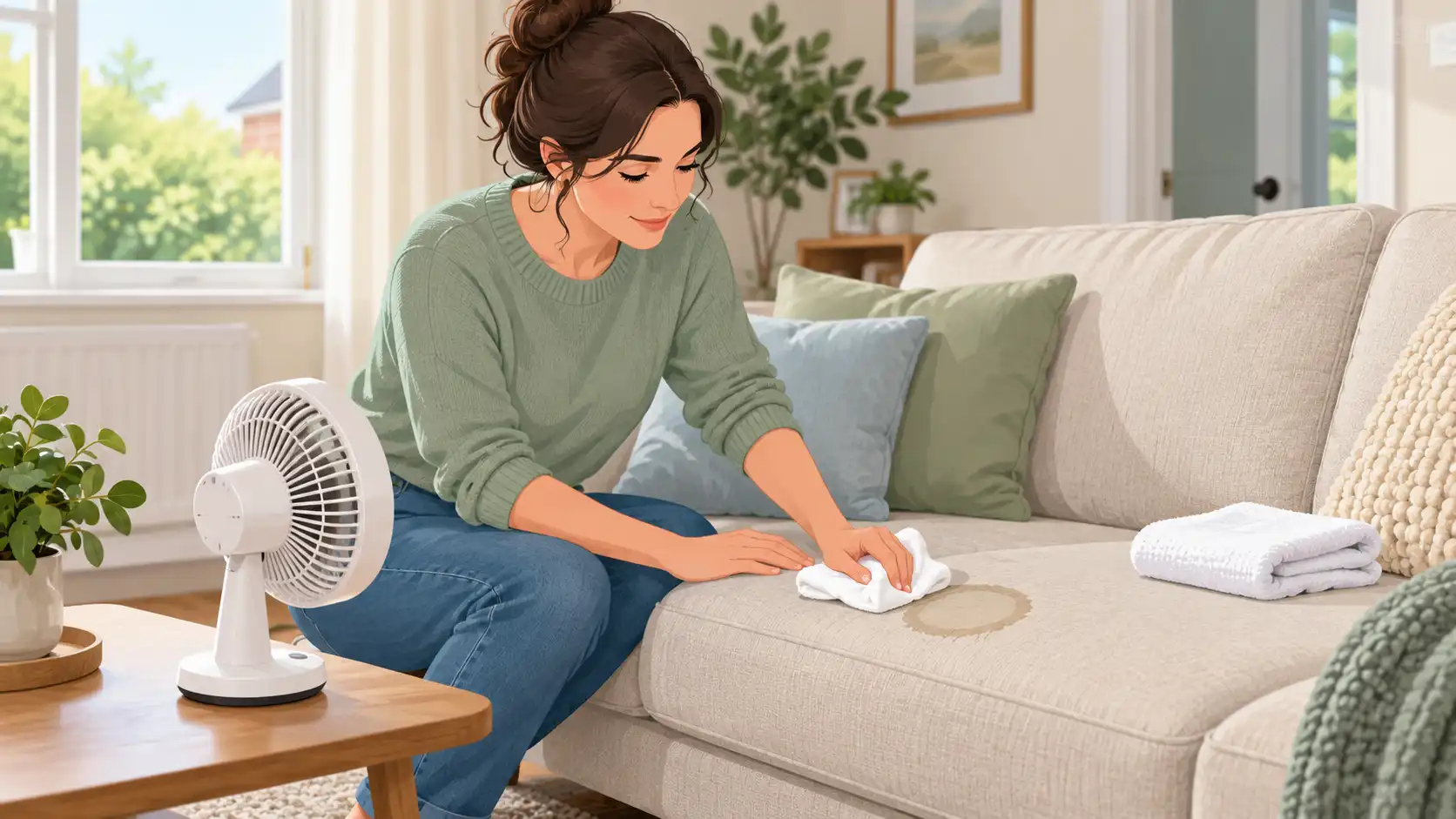
How to Get Water Stains Out of a Sofa
10 October 2026
Would rather leave it to a professional? See our sofa cleaning in Manchester.
Quick answer: Check the sofa’s care label before adding more water. A water ring often forms when moisture carries dirt, detergent or minerals to the edge of a damp patch as it dries. On water-safe upholstery, vacuum first, patch-test with distilled water, then lightly dampen the whole affected panel so it dries evenly instead of treating only the ring. Blot out moisture with white towels and use good airflow. Do not wet S-coded, X-coded or unidentified fabric.
A mark left by water is not always a simple stain. It may be a line of mineral residue, dirt pulled from inside the fabric, detergent from an earlier clean, dye movement or browning from a natural fibre. Adding another wet circle can make the boundary larger.
The safest treatment depends on why the mark appeared and whether the upholstery permits water-based cleaning.
Work out what caused the water stain
Think about what happened before the mark appeared. A ring after spot cleaning may contain detergent or loosened soil. Rainwater from an open window may carry dirt from the frame or clothing. A mark from a leaking ceiling, radiator or pipe may contain contaminants and needs the leak investigated first.
Appearance | Possible cause | What to check |
|---|---|---|
Clear darker outline | Soil, minerals or cleaner moved to the drying edge | Previous products and tap-water use |
Yellow or brown area | Natural-fibre browning or soil wicking from below | Fabric content and cushion filling |
Pale patch | Colour loss or pile change rather than residue | Whether colour transfers to a white cloth |
Ring that returns after drying | Residue or contamination wicking from deeper layers | Foam, padding and earlier spill history |
Musty mark or odour | Slow drying or an ongoing moisture problem | Back of sofa, filling, wall and floor |
Let the area dry before judging its colour. Wet fabric naturally appears darker. If the patch stays pale after drying, cleaning may have removed dye or changed the pile, which cannot be corrected by adding more water.
Check the sofa care instructions
Find the label under a cushion or on the frame, and check the manufacturer’s instructions for the exact model. Some sofas use cleaning codes, but the full instructions still take priority.
W: a suitable water-based upholstery cleaner may be allowed.
S: use an approved solvent-based product only; do not apply water.
WS or SW: an approved water-based or solvent-based treatment may be allowed.
X: vacuum or use the maker’s stated dry method; do not apply liquid at home.
If there is no readable label, contact the manufacturer before wetting the upholstery. Our guide on how to clean a fabric sofa explains how cleaning codes, fibre and cushion construction affect the method.
What you need
A vacuum with a clean upholstery attachment
Several clean white absorbent cloths
Distilled or demineralised water for water-safe fabric
A maker-approved upholstery cleaner if residue or soil needs treatment
Clean dry towels
A fan or good room ventilation
A soft upholstery brush only when the fabric instructions allow it
White cloths reveal whether upholstery dye or residue is transferring. Distilled water avoids adding the minerals found in tap water, but it does not make a water-sensitive fabric safe to wet.
How to remove water stains from a fabric sofa
Use this method only when the manufacturer permits water-based cleaning. Stop if the sofa is S-coded, X-coded, dry-clean-only or difficult to identify.
1. Vacuum the affected panel
Vacuum the whole cushion face or upholstery panel using the recommended attachment and suction. Include seams and piping. Removing dry dust first reduces the amount that moisture can carry towards a new drying edge.
2. Test a hidden area
Lightly dampen a white cloth with distilled water and press it against an inconspicuous part of the same fabric. Do not start on the visible ring. Let the test dry fully and check for colour transfer, watermarking, shrinkage or texture change.
If water alone causes a mark, stop. The upholstery needs its approved solvent or specialist cleaning method.
3. Dampen the entire affected panel evenly
Use a fresh white cloth that is evenly damp but not dripping. Work across the whole panel bounded by seams, such as one cushion face or one section of an arm. Use light, overlapping passes so no sharp wet-to-dry boundary remains around the old ring.
The aim is controlled, even dampness, not saturation. Do not pour water, spray heavily or press moisture into the cushion filling.
4. Feather the visible edge
Where the ring remains visible, blot gently across it and blend into the surrounding damp area. Work with clean sections of cloth. Avoid scrubbing, because friction can roughen the fibres and create a patch that looks like a stain even after it is clean.
5. Treat residue only when needed
If the mark came from an earlier cleaning product or dirty spill, distilled water alone may not remove the residue. Use a cleaner approved for the sofa and follow its dilution and rinsing instructions. Apply it to a cloth rather than directly to the upholstery.
Do not add washing-up liquid, vinegar, bicarbonate of soda or another home mixture unless the manufacturer approves it. Several products can leave more residue than the original mark.
6. Blot out as much moisture as possible
Press clean dry towels onto the panel and lift them straight up. Move to a dry section as moisture transfers. Do not twist removable cushions or sit on them to force water out.
7. Dry the whole panel evenly
Stand a removable cushion on an edge if its construction and care instructions allow it. Use moving air across the surface and leave space around it. Avoid radiators, hairdryers and strong direct heat.
Keep people and pets off the sofa until the surface, seams and filling are fully dry. Inspect the result in daylight before repeating any treatment.
Does the water ring keep returning after the sofa dries?
Ask About Professional Sofa Cleaning
How to treat an old or recurring water ring
An old ring may contain several layers of residue from repeated attempts. Do not make each attempt stronger. Photograph the dry mark, list every product already used and check whether it feels sticky, stiff or different from the surrounding fabric.
On water-safe upholstery, one controlled whole-panel clean with proper rinsing and extraction may work better than repeated hand blotting. A suitable upholstery extraction machine can remove dissolved residue instead of pushing it deeper, but use one only when the sofa and equipment instructions permit it.
If the line returns in the same place, moisture may be drawing contamination from the cushion filling or old spill back to the surface. Surface wiping cannot reliably remove material held deeper in the cushion.
Water marks on different sofa materials
Velvet
Velvet can show both a drying mark and a change in pile direction. Check whether the mark changes as you view it from different angles. Use only the maker-approved method, avoid rubbing and groom the pile only after it is fully dry if the instructions permit it.
Linen and cotton
Natural fibres can shrink, move colour or develop yellow-brown marks when overwet or dried slowly. A large ring, browning or an unknown fabric blend is safer to clean professionally than to repeatedly re-wet at home.
Microfibre and synthetic upholstery
Some synthetic fabrics tolerate controlled water cleaning, while others are S-coded and must remain water-free. Do not decide from appearance alone. Follow the label and reset the dry pile with an approved soft brush if needed.
Genuine leather
Leather needs a different approach. Identify the leather finish first. A very light, even wipe with a barely damp cloth may blend a small mark on protected leather when the maker permits it, followed by immediate drying. Porous aniline leather can darken permanently with water and is better assessed by a leather specialist.
Artificial leather
On PU or vinyl, a pale or dull patch may be coating damage rather than a water deposit. Use only the maker-approved low-moisture wipe method. Avoid genuine-leather conditioner, solvent and aggressive rubbing unless specifically approved for the synthetic surface.
What not to do
Do not clean only inside the ring and leave another hard wet edge.
Do not apply water to S-coded, X-coded or unidentified upholstery.
Do not saturate foam, feather or fibre filling.
Do not scrub with a stiff brush or abrasive sponge.
Do not mix stain removers, detergent, vinegar, bleach or ammonia.
Do not use steam unless the sofa maker specifically approves it.
Do not dry the sofa with a radiator, iron or hairdryer.
Do not keep re-wetting a mark that returns from the cushion interior.
Safety guide
Read the sofa instructions and cleaning-product label before treatment.
Never mix cleaning chemicals or transfer them into an unlabelled container.
Use ventilation, gloves and eye protection where the label requires them.
Keep children and pets away from products and damp upholstery.
Unplug an electric recliner before cleaning near controls, motors, plugs or cables.
Keep the floor dry and remove trip hazards around fans and equipment.
Do not use the sofa until every treated area is fully dry.
The Hertfordshire Fire and Rescue Service guidance on household cleaning chemicals advises following product instructions, providing ventilation and never mixing cleaning products.
When professional cleaning is safer
The sofa is S-coded, X-coded or has no readable instructions
The ring is on velvet, linen, silk, viscose or valuable upholstery
The fabric has browned, lost colour or changed texture
The mark returns after each drying cycle
The cushion filling or sofa frame became wet
The water came from a leak, flood or unknown source
There is a musty smell, visible growth or slow drying
Previous products have left a sticky or spreading area
A cleaner can assess the fibre, residue and cushion construction, then use controlled rinsing and extraction where suitable. Explain what caused the mark and every treatment already attempted.
Frequently asked questions
Why did plain water stain my sofa?
Water can dissolve dirt, minerals and old detergent, move them through the fabric and leave them at the drying edge. Tap water may also add mineral residue. Some natural fibres change colour when wet.
Can I use distilled water?
Distilled water helps avoid new mineral deposits, but use it only on upholstery approved for water-based cleaning. It cannot make an S-coded or X-coded sofa water-safe.
Should I clean the whole cushion?
For water-safe fabric, treating the entire visible panel bounded by seams often produces more even drying than wetting only the ring. Do not soak the cushion or wash the filling unless its own instructions allow it.
Will vinegar remove a water ring?
Do not use vinegar unless the sofa manufacturer approves it. The mark may be dye movement, browning or detergent residue rather than mineral scale, and vinegar can create another problem.
Can I use a hairdryer?
No. Concentrated heat can set a drying boundary, distort fibres or affect foam and finishes. Use room-temperature airflow instead.
Why does the stain disappear when wet and return when dry?
Moisture temporarily hides the contrast. As it evaporates, dissolved residue moves back to the surface or edge. A recurring mark may need controlled extraction from deeper layers.
Remove the cause as well as the ring
Begin with the care label and the history of the mark. On water-safe fabric, use distilled water sparingly, treat a complete panel and dry it evenly. Stop when colour moves, the fabric browns or the mark keeps returning. Those signs point to a deeper residue or material change that another wet cloth may make worse.
Need help with a water stain or cleaning ring?
Related guides
Need it cleaned properly?
Book our upholstery & sofas service — from £49 (UK average £70), free in-home survey and pay on completion.