How to Clean a Suede Sofa
25 August 2026
Quick answer: Check the cleaning code label and identify whether you have real suede or a synthetic microsuede before applying anything. A suede brush used regularly handles the majority of what a suede sofa needs. For stains, use a specialist suede cleaner or suede eraser, apply to the whole panel rather than the stain alone to prevent watermarks, and air dry with no heat at all. No vinegar directly on natural suede, no hairdryer, no baking soda paste. For anything that doesn't respond to careful home treatment, professional upholstery cleaning is the appropriate route.
A suede sofa is one of the most satisfying pieces of furniture to own and one of the most anxious to clean. The anxiety is partly justified: suede does show marks more readily than fabric, and it does not tolerate the wrong product or technique. But most of what suede needs is routine dry care rather than wet cleaning, and understanding that changes the whole approach. For professional results on suede and all upholstery, Instant Dry Carpet Cleaning covers England and Wales with a free survey before any work begins.
Real suede or microsuede: which do you have?
The distinction matters for cleaning, and it is worth confirming before you start.
Real suede is split leather, the underside of animal hide buffed to a soft nap. It is warm, tactile and genuinely luxurious, but more sensitive to moisture and more vulnerable to permanent watermarking than synthetic alternatives.
Microsuede, faux suede or ultrasuede is a synthetic polyester or polyamide microfibre engineered to look and feel like real suede. It is considerably more moisture-tolerant, generally more stain-resistant and more practical in a household with children or pets. Most modern UK sofas sold as suede or suede-effect are microsuede rather than real hide.
How to tell the difference: real suede has a leather underside on the cushion or frame, natural variation across the surface, and a distinct smell when slightly damp. Microsuede has a woven or knitted backing and perfectly uniform fibre texture. If you can't confirm by inspection, check the manufacturer's label or product description.
Both benefit from the same routine care approach. Where methods differ, the article flags it clearly.
Check the cleaning code first
Every UK sofa should carry a care label with a cleaning code.
W means water-based cleaning is safe
S means solvent only, no water
WS means either method is safe
X means vacuum only
An S-coded suede sofa must not be cleaned with any water-based product. Water on an S-coded suede leaves permanent watermarks and can cause fibre damage. If your sofa is S-coded, wet cleaning is not an option at home.
Most microsuede sofas are W or WS coded. Real suede varies. If there is no label or it is unreadable, treat the sofa as S-coded and use dry methods only until you can confirm otherwise.
Test any new product on a completely hidden area first, such as the underside of a seat cushion or behind a back cushion. Let it dry fully and check for colour change or watermarking before touching a visible surface. Do this in daylight, where any colour shift is easiest to see.
The suede brush: your most important tool
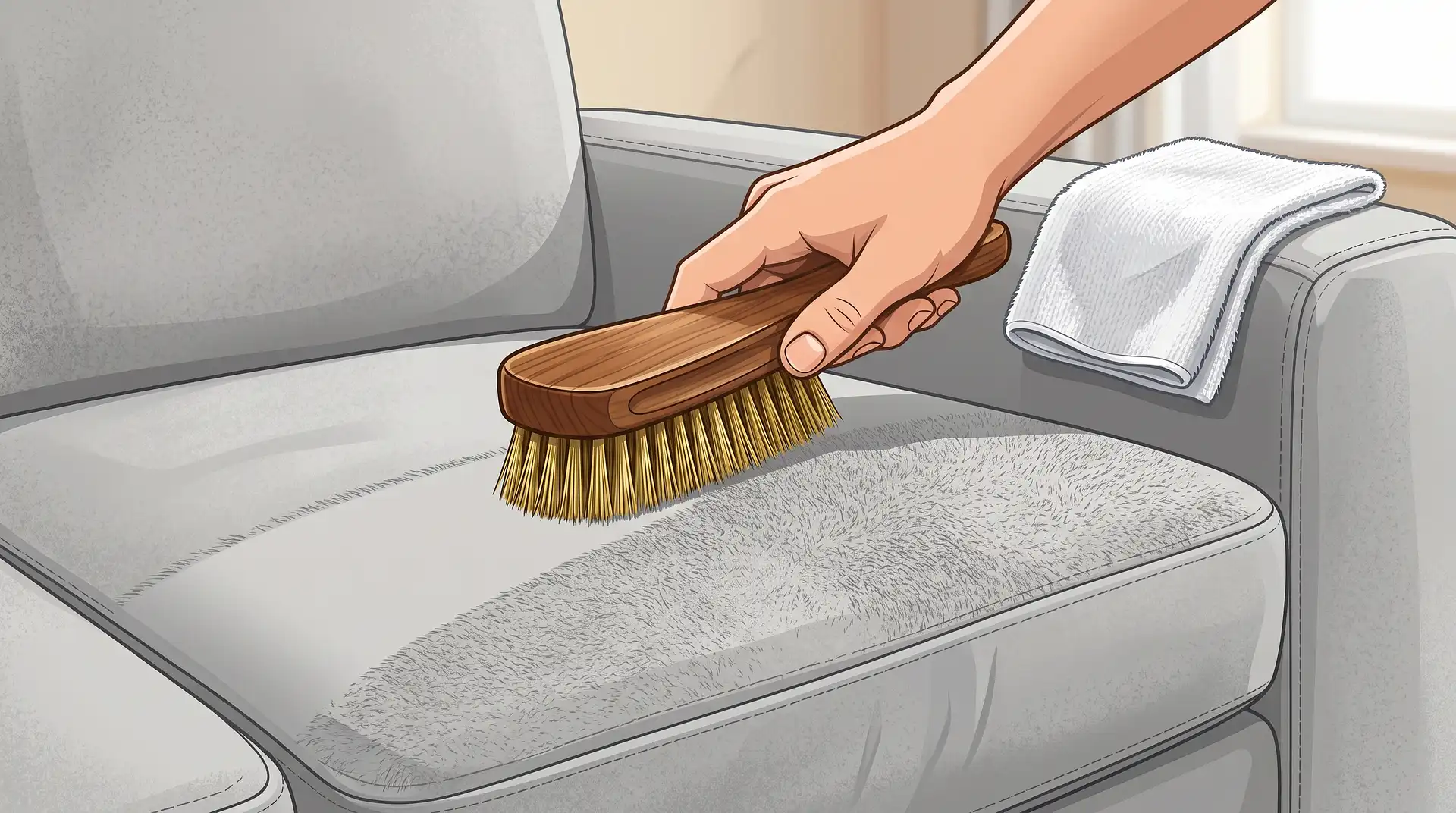
A proper suede brush, with soft brass or nylon bristles, does more for a suede sofa than any cleaning product. Most of what a suede sofa needs between deeper cleans is handled by regular brushing.
Brushing lifts the nap, removes surface dust and debris that has settled between fibres, restores the even appearance that daily use gradually dulls, and raises any areas of flattened pile before they become compacted.
Work in the direction of the nap for most of the sofa, and use light circular motions on any particularly flat or matted areas before finishing in the nap direction for a consistent appearance across the panel.
A suede brush used once a week prevents most of the deeper cleaning problems from developing in the first place.
Routine care
Vacuum with the soft brush attachment, working in the direction of the nap. No powered brush head, which can abrade and mat the suede surface.
Brush with the suede brush immediately after vacuuming to lift the nap back up.
Rotate and plump cushions regularly to distribute wear evenly across the surface.
Keep away from direct sunlight. Suede, particularly naturally dyed real suede, fades under sustained UV exposure. Position the sofa away from windows that receive direct afternoon sun, or use blinds during the brightest hours.
Keep away from direct heat. Radiators and open fires dry out real suede and cause it to stiffen and crack over time.
Address spills immediately. Blot with a dry white cloth from the outer edge of the spill inward. Never rub. The more liquid you lift mechanically before the suede absorbs it, the less the stain penetrates.
Wet cleaning: the watermark rule
This is the step most guides either skip or handle in one sentence, and it is the reason suede cleaning attempts so often leave the sofa looking worse than before.
Suede watermarks where a damp area dries unevenly against a dry one. The nap fibres at the boundary between wet and dry fabric dry in a slightly different orientation, leaving a visible tide mark at the edge of wherever was treated.
The fix is to dampen the whole panel, not just the stain. Once you have treated a mark or applied any cleaning product to a visible area, lightly dampen the entire surrounding panel from seam to seam with a barely damp white cloth and plain water, or plain solvent if the sofa is S-coded. You are not cleaning the rest of the panel. You are pre-wetting it so everything dries at the same rate, with no dry boundary for the moisture to concentrate at.
This is the same principle covered in the water stains car seat guide and the velvet sofa guide on this site. It is counterintuitive but it is the technique that prevents the most common suede cleaning failure.
On real suede, use the minimum moisture possible. Microsuede is more tolerant of dampness. Real suede should be barely touched with moisture, and the panel-wide damp pass should be even more restrained.
Step by step for a marked or soiled panel
Vacuum and brush the whole sofa first.
Colour fastness test on a hidden area. Let it dry fully.
Apply a specialist suede cleaner or suede eraser to the mark, following the product's instructions. A suede eraser is particularly useful for dry marks and scuffs. A specialist cleaner in a foam or cream formulation is better for liquid stains.
Work gently in the nap direction, never scrubbing.
Lightly dampen the whole panel with a barely damp cloth to even the drying.
Air dry completely at room temperature, no heat.
Brush the whole panel once fully dry to restore the nap.
Stains by type
Fresh spills. Blot immediately with a dry white cloth from outside in. The suede will wick liquid quickly, so speed matters. Once you have blotted as much as possible, dampen the whole panel lightly and allow to air dry. Brush once dry.
Protein stains (food, milk, blood). Cold water on a barely damp cloth, blotted gently rather than rubbed. An enzyme cleaner can be used on microsuede for organic staining and odour; check the product is suitable for synthetic microfibre. On real suede, use a specialist suede cleaner rather than enzyme cleaner, which may affect the hide.
Oil and grease. Sprinkle a small amount of bicarbonate of soda or cornstarch directly onto the mark and leave it for at least twenty minutes to absorb the oil before brushing or vacuuming off. Then treat any residue with a specialist suede cleaner on a cloth. Never apply baking soda as a wet paste on suede; dry absorption only.
Dry marks and scuffs. A suede eraser rubbed gently across the mark is often all that's needed for surface scuffs that haven't penetrated the nap. Follow with a brush.
Ink and dye. Hardest category on any upholstery. A specialist suede stain remover, tested on a hidden area first, gives the best chance. Accept that complete removal is not always achievable on suede.
What to avoid
Vinegar directly on natural suede. Several guides recommend vinegar as a cleaning solution for suede. The safe, unambiguous recommendation is a specialist suede cleaner. Vinegar's acidity carries a real risk of watermarking and surface change on real suede, particularly on dyed pieces, and the risk is not worth taking when a proper suede cleaner exists. On microsuede it is lower risk, but a dedicated product is still better.
A hairdryer or any direct heat. Two competing guides recommend this. Heat causes suede to harden, change texture and potentially shrink slightly. Air drying at room temperature is the only correct method.
Baking soda paste. Wet paste is mildly alkaline and abrasive. Dry absorption for oil is fine; a wet paste applied to suede is not.
Rubbing or scrubbing. Permanently damages the nap. Blot and dab only.
Coloured cloths. Dye transfer into a damp suede surface.
Steam cleaning. The combination of heat and moisture is damaging to both real and synthetic suede. Even handheld steamers held at a distance carry risk on real suede.
General upholstery cleaner not specified for suede. Formulations for flat fabric may be too alkaline or too wet for suede. A specialist suede or nubuck product is worth the small additional cost.
When to call a professional
For a suede sofa that has responded well to routine care and modest spot cleaning, DIY is entirely reasonable. Consider professional upholstery cleaning when:
A stain has not responded to careful home treatment
The sofa has watermarks left from a previous cleaning attempt
The sofa is real suede and you are not confident treating it
It is S-coded and requires solvent-based treatment that needs controlled application
The sofa has not been properly cleaned in a long time and general soiling has embedded into the nap
For reliable results on any upholstered surface, Instant Dry Carpet Cleaning uses controlled extraction that removes more soil and moisture than hand cleaning can achieve, with a free survey and fixed price before any work begins.
6. FAQ Section
How do you clean a suede sofa at home? Check the cleaning code label and identify whether you have real suede or microsuede first. Use a suede brush regularly for routine care. For stains, use a specialist suede cleaner on a white cloth, work gently in the nap direction, then dampen the whole panel lightly to prevent watermarks. Air dry completely with no heat, then brush to restore the nap.
Can you use vinegar to clean a suede sofa? Not recommended on natural suede. Vinegar's acidity carries a risk of watermarking and surface change, particularly on dyed pieces. A specialist suede cleaner is the safer choice. On microsuede the risk is lower, but a dedicated product is still preferable.
How do you remove watermarks from a suede sofa? Lightly dampen the whole affected panel from seam to seam with a barely damp cloth, so everything dries evenly with no new dry boundary forming. Allow to air dry at room temperature and brush once dry. This blends the existing mark into the surrounding fabric rather than isolating it.
How do you get stains out of a suede sofa? Use a specialist suede eraser for dry marks and scuffs. For liquid stains, blot immediately with a dry white cloth, then apply a specialist suede cleaner to the mark and lightly dampen the surrounding panel to prevent watermarking. Oil and grease: absorb with bicarbonate of soda first before any wet treatment.
What is the best way to clean microsuede? Microsuede is considerably more forgiving than real suede. The cleaning code check still applies. A mild upholstery cleaner on a white cloth, applied to the whole panel rather than just a stain, and air drying. A suede brush to restore the nap once dry.
Can you use a steam cleaner on a suede sofa? Not recommended. The combination of heat and moisture is damaging to both real and synthetic suede. Air drying at room temperature is the correct method after any wet treatment.
How do you restore a flat or dull suede sofa? Regular brushing with a suede brush in the nap direction lifts and separates the fibres. For flattened areas, light circular motions with the brush followed by a directional stroke restores consistency across the panel.
How often should you clean a suede sofa? Brush and vacuum weekly as routine. Address spills immediately. A fuller clean with a specialist product every few months, or when visible soiling warrants it. Regular dry maintenance reduces how often wet cleaning is needed.
7. Service Section
Suede sofa needing professional attention?
For a stain that hasn't responded to careful home treatment, a watermark from a previous attempt, or a sofa that hasn't been properly cleaned in some time, professional upholstery cleaning removes more soil and moisture than home methods can achieve. Every visit starts with a free survey, a fabric assessment, and a fixed price before any work begins.
Get your fixed quote in 60 seconds
Or call 07555 856988.