How Do You Clean Suede Car Seats
22 August 2026
Quick answer: A suede brush is the most important tool you own for these seats, and it does more than any cleaning product. Most marks and shiny patches on Alcantara are crushed nap, not dirt, and gentle circular brushing followed by a directional stroke restores the texture. For actual soiling, use a barely damp cloth with a small amount of mild upholstery cleaner or pH-neutral soap, work with the nap rather than against it, agitate very gently and let it air dry. No aggressive solvents, no scrubbing, no heat.
Suede and Alcantara seats look better than almost anything else in a car interior and are more demanding to maintain than anything else. The good news is that the tool doing most of the heavy lifting costs very little: a proper suede brush, used correctly and regularly, handles the majority of what these seats need.
Real suede or Alcantara: which do you have?
Worth confirming before you clean anything, because the differences affect what's safe.
Real suede is split leather, the underside of a hide that's been buffed to a soft, directional nap. It's occasionally found in premium and classic car interiors. It's warm to the touch, has slight natural variation across the surface, and responds to a suede eraser in a way synthetic materials don't.
Alcantara is a synthetic microfibre trademarked by an Italian manufacturer and licensed to car makers. It accounts for the overwhelming majority of what's described as suede, suede-effect or microsuede in modern UK car interiors. It looks and feels like suede but is more consistent across the surface and more resistant to water than real hide.
The simplest identification method: check whether the seat has a small Alcantara certification tag, usually on the underside of the seat or on a seam. Genuine Alcantara carries this. Alternatively, check the car's original specification — most manufacturers list seat materials clearly.
If you can't confirm which you have, treat it as real suede. The real suede method is the more cautious one and won't harm Alcantara.
Key difference for cleaning: Alcantara tolerates light moisture considerably better than real suede, which can water-spot badly. Both are damaged by aggressive solvents and scrubbing.
The shiny patch problem, and why cleaning won't fix it
The most common complaint about Alcantara and suede seats isn't staining — it's sections that look darker, shinier, flatter or worn compared to the surrounding material.
This is almost always crushed nap, not soiling.
The nap, the fine directional fibres that give suede and Alcantara their characteristic texture, flattens under sustained contact. The bolster edges where you slide in and out, the area where the back of your legs rests, the centre of the seat where you sit — all of these see more friction and compression than the surrounding fabric and gradually crush flat. The crushed areas reflect light differently, which is what makes them look shiny or darker.
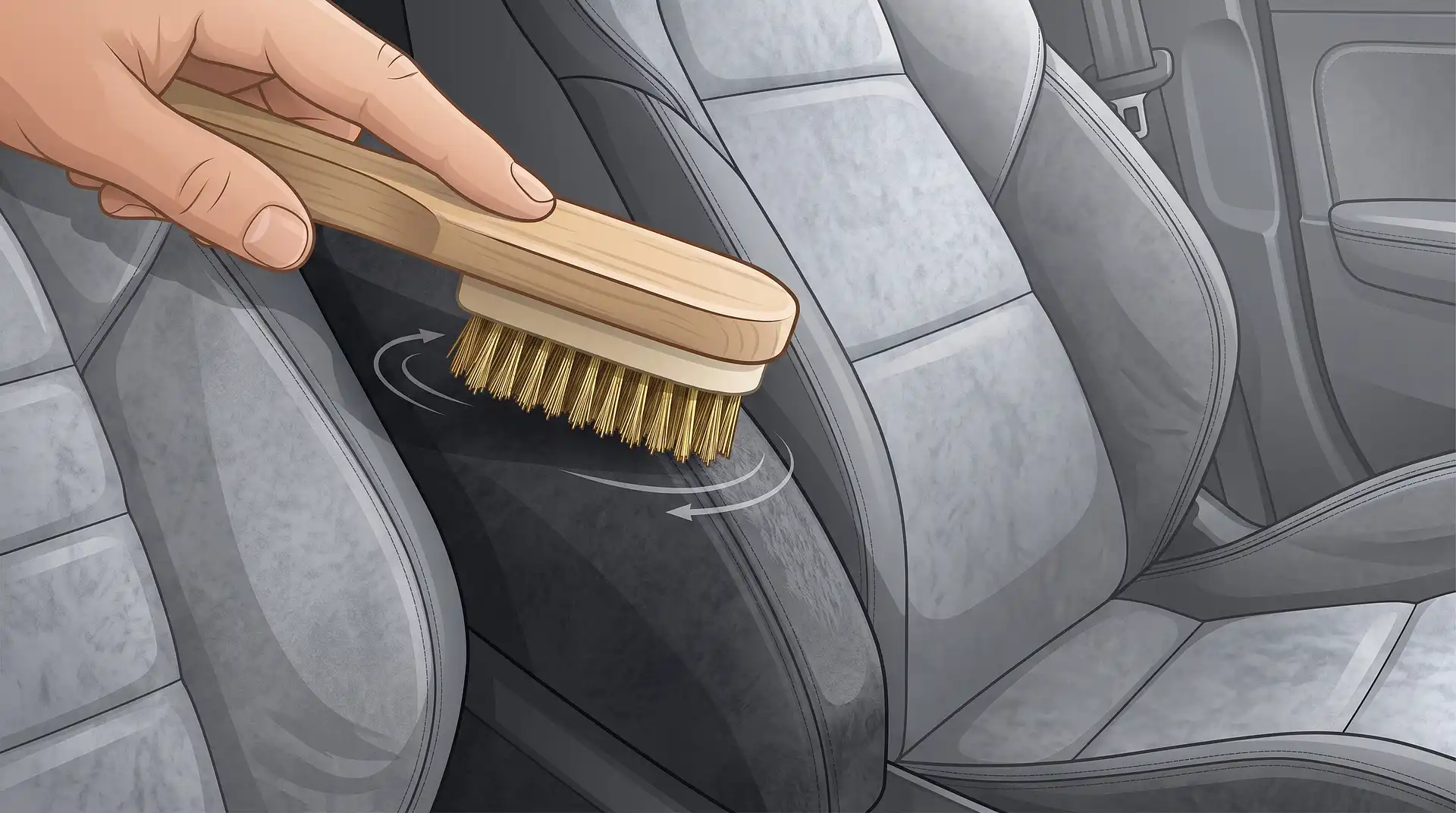
No cleaning product removes this, because there's nothing to remove. The fibres are there, they're just flat. The fix is a suede brush used in gentle circular motions to lift the flattened nap back up, followed by a light directional stroke to align it evenly.
This is also why Alcantara seats benefit from regular brushing as maintenance even when they look clean. It keeps the nap lifted and consistent, which is what makes the seat look and feel its best.
What you need
A proper suede brush, with soft brass or nylon bristles. Don't substitute a stiff brush or a clothes brush.
A soft microfibre cloth
A small amount of mild upholstery cleaner or pH-neutral soap
Clean cold water
Good ventilation
A suede eraser is also useful for scuff marks and light surface soiling on real suede specifically.
The cleaning method, step by step
Step 1: Vacuum first
Use the soft brush attachment and go over the whole seat, including seams and stitching. This removes loose surface debris before any moisture goes near it.
Step 2: Brush the nap
Before applying any cleaner, go over the seat with the suede brush in gentle circular motions to lift the nap and loosen surface soil that hasn't embedded. Follow with light strokes in the direction of the nap to align it evenly.
This step alone often removes light dust and surface marks without any liquid needed.
Step 3: Test in a hidden area
A section behind the headrest or under the seat. Apply a small amount of your cleaner on a damp cloth, let it dry fully, and check for colour change, watermarking or texture change before moving to a visible area.
Step 4: Apply sparingly to a cloth
Dampen a microfibre cloth with water and a small amount of mild upholstery cleaner or pH-neutral soap. The cloth should be barely damp, not wet. Never spray or pour directly onto suede or Alcantara.
Step 5: Work gently with the nap
Work in the direction of the nap rather than against it, or in light circular motions on localised marks. Don't scrub. The goal is to lift soil from the fibre surface, not to force it deeper or abrade the fibres. On Alcantara in particular, aggressive scrubbing can damage the microfibre structure permanently.
Step 6: Blot with a dry cloth
Press a dry microfibre gently onto the area to absorb moisture. Don't rub.
Step 7: Allow to air dry fully
With all car doors or windows open for ventilation. No hairdryer, no heat — heat can set staining and affect the fibre structure of Alcantara. Don't close the car while anything is still damp.
Step 8: Brush again once dry
Once fully dry, go over the seat again with the suede brush to restore the nap. Finish with directional strokes to align it evenly across the whole seat.
This final brush is what makes the seat look restored rather than just clean.
Water spots on real suede
Real suede water-spots badly. A single drop of water that dries unevenly can leave a visible ring even on a clean seat.
The fix for a water spot is the same counterintuitive approach as water rings on fabric: don't try to treat the spot in isolation. Dampen the entire affected panel lightly and evenly with a barely damp cloth so everything dries together without a new boundary forming. Work quickly, blot gently, and dry with good ventilation and all doors open.
Alcantara is considerably more resistant to water spotting. Light moisture applied and dried evenly usually leaves no mark.
Stains on suede and Alcantara
The same four-category framework applies here as across the rest of the site.
Protein stains (milk, sick, blood). Cold water only, blot from outside in, enzyme cleaner for residual odour on Alcantara. On real suede, use the minimum moisture possible and dry quickly.
Tannin stains (coffee, tea). Cool water and mild cleaner applied with a barely damp cloth. Work quickly and dry evenly. The same tannin chemistry from the coffee stain guide applies.
Oil and grease (sun cream, food, hand cream). A small amount of bicarbonate of soda left on the area to absorb the oil before any liquid is applied, then brushed or vacuumed off. Follow with a barely damp cloth and mild cleaner. Oil is difficult to lift from both materials and may require several light passes.
Dye stains (ink, makeup, denim transfer). The hardest category on any fabric, and particularly on Alcantara which accepts dye readily. A specialist Alcantara cleaner or suede stain remover is the right product rather than a general detergent. Accept that complete removal may not be possible.
On solvents: dry-cleaning solvents and some alcohol-based products that are safe on other fabrics can degrade the polyester binder in Alcantara's microfibre structure. Stick to a mild water-based upholstery cleaner or a product specifically described as safe for Alcantara or microsuede. On real suede, avoid anything that would damage a natural leather product.
What to avoid
Scrubbing. Permanently damages the nap on both materials. Gentle agitation only.
Dry-cleaning solvents on Alcantara. Can degrade the fibre structure.
Harsh detergents and household all-purpose cleaners. Too alkaline for both materials.
Direct heat for drying. Hairdryers, radiators, sun exposure while damp.
Excessive moisture on real suede. Leads to water spotting and can stiffen the material.
Stiff brushes or abrasive cloths. Abrade and permanently mat the nap.
Treating shiny patches with cleaning products. The problem is crushed nap, not soiling. Clean first if needed, then brush to restore texture.
8. FAQ Section
How do you clean Alcantara car seats at home? Vacuum first, brush the nap with a soft suede brush to lift surface soil, then apply a mild upholstery cleaner to a barely damp cloth and work gently with the nap. Blot dry, air dry fully with doors open, and brush again once dry to restore the texture. No solvents, no scrubbing, no heat.
Is Alcantara the same as suede? No. Real suede is split leather. Alcantara is a synthetic polyester microfibre that looks and feels similar. Most modern UK car interiors described as suede or suede-effect use Alcantara or an equivalent synthetic, not real hide. Genuine Alcantara carries a manufacturer's certification tag.
Why do my Alcantara seats look shiny? Crushed nap from contact and wear, not dirt or staining. The fine directional fibres flatten under sustained friction. Cleaning won't fix it — a suede brush used in circular motions followed by directional strokes lifts the nap and restores the texture.
How do you get stains out of Alcantara car seats? Work out the stain category first. Protein stains need cold water and enzyme cleaner. Tannin stains need cool water and mild cleaner. Grease needs bicarbonate of soda to absorb first. Ink and dye are the hardest and often only partially removable. Always apply to a cloth rather than directly to the seat.
Can you use water on suede car seats? Alcantara tolerates light moisture well. Real suede is more sensitive — water that dries unevenly can leave visible spots. On real suede, use the minimum moisture possible, dampen any affected panel evenly rather than spot-treating, and dry quickly with good ventilation.
How do you restore Alcantara car seats? Regular brushing with a soft suede brush maintains the nap. For flattened or shiny sections, work in circular motions with the brush to lift the fibres, then finish with directional strokes aligned with the surrounding nap. For soiling, clean with a mild upholstery cleaner, dry, then brush to finish.
What should I avoid using on Alcantara? Dry-cleaning solvents, harsh detergents, alcohol-based products not specifically formulated for Alcantara, stiff or abrasive brushes, scrubbing motions, and direct heat when drying.
How often should you clean Alcantara car seats? Light brushing every few weeks keeps the nap consistent and prevents surface soil from embedding. A full clean with mild cleaner every few months, or when visibly soiled. Regular brushing is more valuable than frequent wet cleaning for these materials.
9. Service Section
The same fabric expertise, for everything indoors
Suede, microfibre, velvet and other napped fabrics in the home, on sofas, armchairs and ottomans, need the same gentle approach as Alcantara car seats. For upholstered furniture that needs professional attention, Instant Dry Carpet Cleaning provides cleaning across England and Wales with a free survey and fixed price before any work begins.
Get your fixed quote in 60 seconds
Or call 07555 856988.