How to Get Vomit Out of a Mattress
4 October 2026
Would rather leave it to a professional? See our pet stain removal in Manchester.
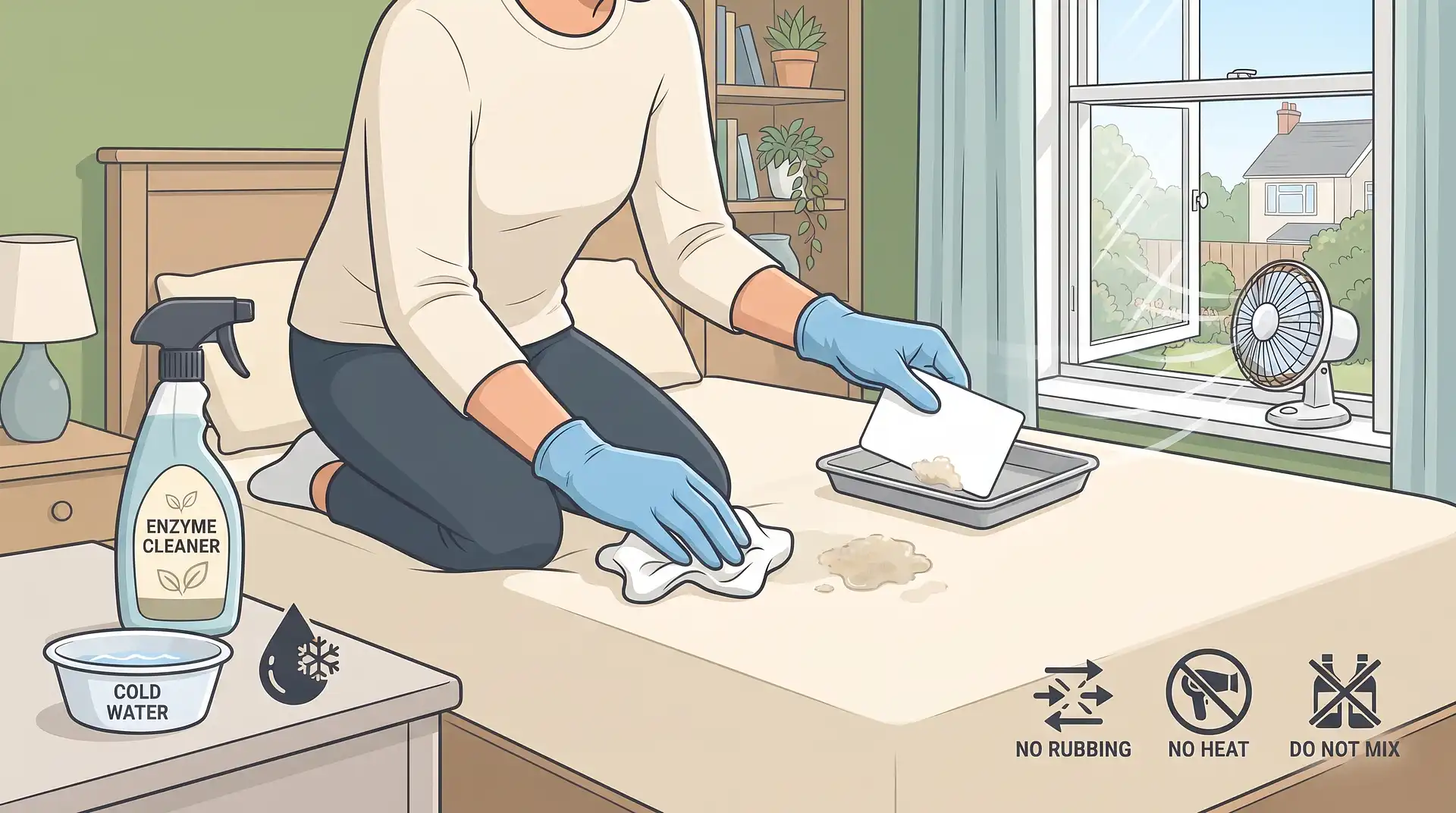
Quick answer: Put on disposable gloves, remove the bedding and lift away any solid vomit with a spoon, scraper or stiff card. Blot the wet area with white towels without rubbing. Use a white cloth lightly dampened with cold water, then apply a mattress-safe enzyme cleaner according to its label. Give it the full contact time, blot away any residue as directed and dry the mattress completely with open windows and a fan. Do not use hot water, steam or a hairdryer because heat can set protein stains. If the vomit came from someone with a stomach bug, treat hygiene and stain removal as separate jobs.
Vomit contains moisture, partially digested food, protein and acid. The visible mark may lift before the smell disappears, while liquid that reaches the mattress filling can remain trapped long after the cover feels dry. Acting quickly gives you the best chance of removing both problems without soaking the mattress.
What you will need
Disposable gloves
A spoon, blunt scraper or pieces of stiff card
Paper towels or clean white absorbent cloths
Cold water
A mattress-safe enzyme cleaner
Bicarbonate of soda for remaining moisture or odour
A vacuum with a clean upholstery attachment
A fan and good room ventilation
Waste bags for contaminated disposable materials
Check the mattress care label before applying anything. Products suitable for carpet are not automatically suitable for a mattress cover or foam. Test the enzyme cleaner on a hidden part of the side panel and let it dry before treating the visible area.
How to get fresh puke out of a mattress
1. Keep people and pets away
Open a window if possible and keep anyone who does not need to be in the room away from the mess. Put on gloves before touching the bedding or mattress. If the person may have an infectious stomach bug, avoid shaking dirty bedding because this can spread contamination around the room.
2. Remove the bedding carefully
Roll the sheets and protector inwards so the contaminated area is enclosed. Check their care labels and wash them separately using the permitted programme. Do not carry uncovered soiled laundry through the home or place it on the floor.
If a waterproof protector stopped the liquid reaching the mattress, clean the protector according to its label and inspect the mattress before doing anything else. There is no benefit in wet-cleaning an unaffected mattress.
3. Lift away the solids
Use a spoon, blunt scraper or two pieces of card to lift the material without pressing it into the cover. Work from the outside towards the centre. Put the waste and disposable tools directly into a bag.
Do not vacuum fresh vomit. It can contaminate the vacuum, spread small particles and push liquid further into the mattress surface.
4. Blot out the liquid
Press folded white towels firmly onto the wet area. Lift and move to a clean section, repeating until very little moisture transfers. Do not rub or scrub. Friction spreads the stain, damages the cover and can force liquid into the filling.
5. Use a small amount of cold water
Dampen a clean white cloth with cold water and wring it out well. Blot from the edge of the mark towards the centre, then press with a dry towel. Cold water helps lift residue without setting the protein in the stain.
Apply water to the cloth rather than pouring or spraying it directly onto the mattress. A thick mattress has poor airflow inside, so liquid that reaches the core can be difficult to remove.
6. Apply a suitable enzyme cleaner
Choose a product labelled for biological stains and confirmed as suitable for the mattress fabric. Follow its directions for application, quantity and contact time. Some products need to remain damp for a stated period, while others require blotting or a light rinse afterwards.
Use enough product to contact the affected surface without flooding the mattress. Do not mix it with vinegar, bleach, disinfectant, peroxide or another cleaner. Mixing products can create hazardous reactions or stop the enzymes working properly.
7. Remove residue as directed
If the label requires rinsing, blot with a separate white cloth lightly dampened with cold water. Follow with dry towels and firm pressure. If the product is designed to dry in place, do not add an unnecessary rinse.
8. Use bicarbonate of soda only after the main treatment
Once you have removed the cleaning residue and the surface is no longer wet, apply a light, even layer of bicarbonate of soda over the affected area. It can absorb remaining surface moisture and reduce lingering odour, but it does not replace the enzyme treatment and it is not a disinfectant.
Leave it until the mattress is completely dry, preferably for several hours, then vacuum it away thoroughly with a clean upholstery attachment. Keep children and pets away while the powder is present.
9. Dry the mattress completely
Open windows and direct a fan across the mattress. If the mattress maker permits it and you can move it safely, stand it on its side so air reaches both faces. Use another adult for a heavy mattress.
Do not use a steam cleaner, radiator or hairdryer. Heat can set the stain, affect foam and dry the cover while leaving moisture trapped below it. Do not remake the bed until the treated area, seams and filling feel completely dry. A cool feeling under firm hand pressure can indicate remaining moisture.
How to remove dried vomit from a mattress
First decide whether the contamination may still be infectious. Do not dry-brush or vacuum material linked to a recent stomach bug. Wear gloves, lift loose material carefully with stiff card and follow the hygiene guidance in the safety section.
For an old, non-infectious mark, such as dried pet vomit, hold a cold, damp white cloth against the residue briefly to soften it. Lift it with a blunt scraper rather than scrubbing. Blot with cold water, apply a suitable enzyme cleaner for the stated contact time and dry the mattress fully.
A dried stain may need more than one light treatment. Let the mattress dry between attempts so you can judge the real result and avoid building up moisture inside it.
Smell or stain soaked into the mattress?
How to get the vomit smell out
A sour smell means organic residue remains on or below the surface. Fragrance spray may cover it briefly but does not remove the source. An enzyme cleaner is usually more useful because it breaks down the organic material responsible for the odour.
If the smell returns in warm or humid conditions, residue may have travelled deeper than the treated area. Avoid repeatedly soaking the mattress in an attempt to reach it. A cleaner cannot be removed easily from the centre of dense foam, and trapped moisture can create a separate musty problem.
After one treatment has dried, smell the area close to the surface and compare it with an unaffected section. Repeat once if the product permits. A persistent strong odour after careful treatment and full drying is a reason to request a professional assessment.
Ask About Mattress Stain Treatment
Safety guide for vomit caused by illness
Cleaning the stain and controlling infection are different tasks. An enzyme cleaner can break down organic residue but should not be assumed to kill viruses. If norovirus or another stomach infection may be involved, take these precautions:
Wear disposable gloves and wash your hands thoroughly with soap and water after removing them.
Do not shake contaminated bedding or press it against your clothes.
Wash affected bedding separately at 60°C when its care label allows.
Clean nearby hard surfaces with a suitable product, following its label and the surface manufacturer’s instructions.
Do not apply household bleach to a mattress unless its manufacturer expressly permits it. Bleach can damage the cover and foam, and soaking the mattress creates another hazard.
Do not rely on alcohol hand gel alone for norovirus. Use soap and water.
Follow the current NHS norovirus guidance for laundry, handwashing, limiting contact and knowing when to seek medical advice.
If the mattress is heavily contaminated during an infectious illness and cannot be cleaned without saturating it, contact the manufacturer or an appropriate professional before using it again.
Methods that can make the problem worse
Hot water or steam: Heat can set proteins into the cover and drive more moisture into the mattress.
Hard scrubbing: This spreads the stain and damages surface fibres.
Flooding the area: A wet mattress core may develop a persistent musty smell and can be difficult to dry safely.
Mixing products: Combining bleach, vinegar, ammonia, peroxide or other cleaners can create dangerous fumes or unwanted reactions.
Masking fragrance: Air freshener changes the smell temporarily without removing the residue.
Sleeping on it while damp: Bedding traps moisture and body heat against the treated area.
Assuming a removable cover is washable: Unzipping does not mean the cover can be removed or machine washed. Follow the mattress instructions.
Does the mattress type change the method?
Memory foam
Memory foam readily holds liquid and dries slowly. Use very small amounts of solution, blot repeatedly and maximise airflow. Do not remove the cover unless the maker says it is designed for removal and washing.
Sprung and hybrid mattresses
The quilted top and comfort layers can still trap moisture even when the core contains springs. Keep treatment local and avoid assuming the mattress will dry quickly because it is not made entirely from foam.
Pillow-top mattresses
A thick pillow top can absorb liquid through several soft layers. Use minimal moisture and allow extra drying time. A smell that returns after the surface dries may indicate the contamination reached below the ticking.
Removable-cover mattresses
Read the complete label before removing the cover. Some covers contain fire barriers or are fitted tightly enough to shrink or distort in a normal wash. Clean the mattress core separately only as the manufacturer directs.
When professional cleaning may help
Ask for professional advice when the affected area is large, liquid has soaked into the filling, the stain has spread through a tuft or seam, the smell remains after treatment, or the mattress is delicate and its care instructions limit home cleaning.
Tell the cleaner whether the vomit came from a person or pet, whether illness was involved, how long it has been there and every product already used. Cleaning suitability and cost depend on the mattress material, contamination depth, condition and work required.
For the wider treatment of protein, drink, oil and dye marks, read our guide on how to get stains out of a mattress.
When a mattress may need replacing
Replacement may be the safer choice when vomit has saturated a large part of the core, contamination has passed through to the underside, a strong odour remains after suitable treatment and full drying, or the mattress develops a musty smell or visible mould.
Cleaning can treat accessible contamination. It cannot guarantee removal from the deepest layers of a heavily soaked mattress. Consider the age and structural condition as well as the stain before paying for repeated treatments.
How to reduce the risk next time
Use a washable waterproof mattress protector that fully covers the sleeping surface. Keep a spare protector and bedding set available for children, pets or anyone experiencing sickness. Check the protector regularly for cracks, worn waterproof backing and damaged seams.
A protector should be washed and dried according to its label after an accident. Do not put it back on the bed while damp, and confirm that the mattress below is dry before remaking it.
Frequently asked questions
Should I use warm or cold water on mattress vomit?
Use cold water. Vomit contains protein, and heat can make the stain harder to remove. Apply water to a cloth rather than pouring it onto the mattress.
Will bicarbonate of soda remove vomit from a mattress?
It can absorb some surface moisture and reduce remaining odour, but it does not remove solid residue, replace an enzyme cleaner or disinfect the mattress.
Can I use an enzyme cleaner on every mattress?
No. Check the mattress label and the cleaner instructions, then test a hidden area. Natural fibres, delicate ticking and specialist finishes may need another method.
Can I steam clean puke out of a mattress?
Steam is unsuitable because the heat can set protein residue and the added moisture can become trapped inside the mattress. Use controlled cold treatment and thorough air drying instead.
Why does the mattress still smell after cleaning?
The enzyme cleaner may not have reached all the residue, the required contact time may not have been completed, or liquid may have entered the filling. Let the first treatment dry fully before deciding whether another careful treatment or professional assessment is needed.
Can I sleep on the mattress the same night?
Only if every treated layer is completely dry. Drying time varies with the amount of liquid, mattress construction, room temperature and airflow. Arrange another sleeping place if there is any remaining dampness.
How do you get the smell of sick out of a mattress?
After removing the vomit, sprinkle a thick layer of bicarbonate of soda over the area, leave it for 8 hours or overnight, then vacuum. An enzyme cleaner breaks down any remaining smell. Air the room well.
How do you clean vomit off a mattress quickly?
Scoop up solids, blot the liquid with paper towels, then spray a mix of cool water and a little washing-up liquid and blot again. Use as little liquid as possible so it does not soak into the core.
Can you use vinegar on a mattress?
Yes, a 1:1 mix of white vinegar and water helps neutralise smells. Mist it on lightly, blot, then let it dry fully. The vinegar smell fades as it dries.
Arrange an individual mattress assessment
InstantDry can assess the mattress material, depth of contamination, stain and remaining odour before recommending a suitable treatment. Share the mattress type, size, photographs and products already used when requesting a quotation.
Request a Mattress Cleaning Quote
Related guides: how to get vomit out of carpet, how to get urine out of a mattress. For a professional finish, see our mattress cleaning service or carpet cleaning in Manchester.
Related guides
Need it cleaned properly?
Book our pet stain & odour removal service — from £25 (UK average £40), free in-home survey and pay on completion.