How to Get Pen Out of a Sofa
30 August 2026
Quick answer: Identify the ink type before reaching for anything. Ballpoint pen ink is oil-based — it doesn't dissolve in water and needs isopropyl alcohol (surgical spirit) on a cloth, dabbed rather than rubbed. Felt tip and marker inks are usually water-based and respond to cool water and mild detergent. Gel pens often need alcohol too. On fabric, check the cleaning code label first — an S-coded sofa needs solvent only, not water. On leather, use alcohol sparingly, dab rather than rub, and condition immediately afterwards. Fresh ink is always easier than dried ink.
Pen on a sofa looks like a disaster but is one of the more manageable stain types when you know what kind of pen caused it. The method that works perfectly for a felt tip fails entirely on a ballpoint, and the method for ballpoint on leather risks the sofa if used wrong. Starting with the right identification saves both the sofa and the frustration of trying a method that wasn't designed for what you're dealing with. For any stain that doesn't respond to careful home treatment, Instant Dry Carpet Cleaning provides professional upholstery cleaning across England and Wales with a free survey before any work begins.
Identify the ink type first
This is the step every competing guide either skips or handles in a sentence, and it matters more than any other factor.
Ballpoint pen (biro). Oil-based ink. The most common pen type in UK homes. Ballpoint ink does not dissolve in water — applying water to a ballpoint stain spreads it and embeds it further. The correct solvent is isopropyl alcohol (also sold as rubbing alcohol, surgical spirit or IPA). It dissolves the oil-based carrier and lifts the pigment.
Felt tip, marker and rollerball pens. Usually water-based ink. Responds to cool water and mild detergent on most fabric types. On leather, water-based treatment with a leather cleaner rather than a solvent.
Gel pens. A hybrid — gel-based ink that is typically alcohol-soluble. Treat as ballpoint (isopropyl alcohol) for best results.
Fountain pen ink. Water-based but often with strong dye pigments. Cool water and mild detergent as a first attempt. More colourfast than many ballpoint inks once dry.
Permanent marker. Alcohol-soluble. Requires isopropyl alcohol and will be harder to remove fully than ballpoint, since permanent marker is designed for dye penetration.
If you're not sure which pen caused the mark, try a tiny amount of isopropyl alcohol on a hidden test area first, then a water and detergent solution on a second test area, and see which produces better results on the fabric.
Check the sofa's cleaning code
On fabric sofas, the care label carries a cleaning code that determines what's safe.
W — water-based cleaning is safe. Water and detergent methods apply. S — solvent only. No water or water-based products. For an S-coded sofa, isopropyl alcohol is appropriate; water-based detergent solutions are not. WS — either method is safe. X — vacuum only. No liquid cleaning. A pen mark on an X-coded sofa needs professional treatment.
Test any solution on a completely hidden area first regardless of code — inside a seam or behind a back cushion. Check for colour change and dye lift before touching a visible area.
Getting pen out of a fabric sofa
For ballpoint and gel pen (oil-based/alcohol-soluble):
Don't blot with water first. This spreads the oil-based ink.
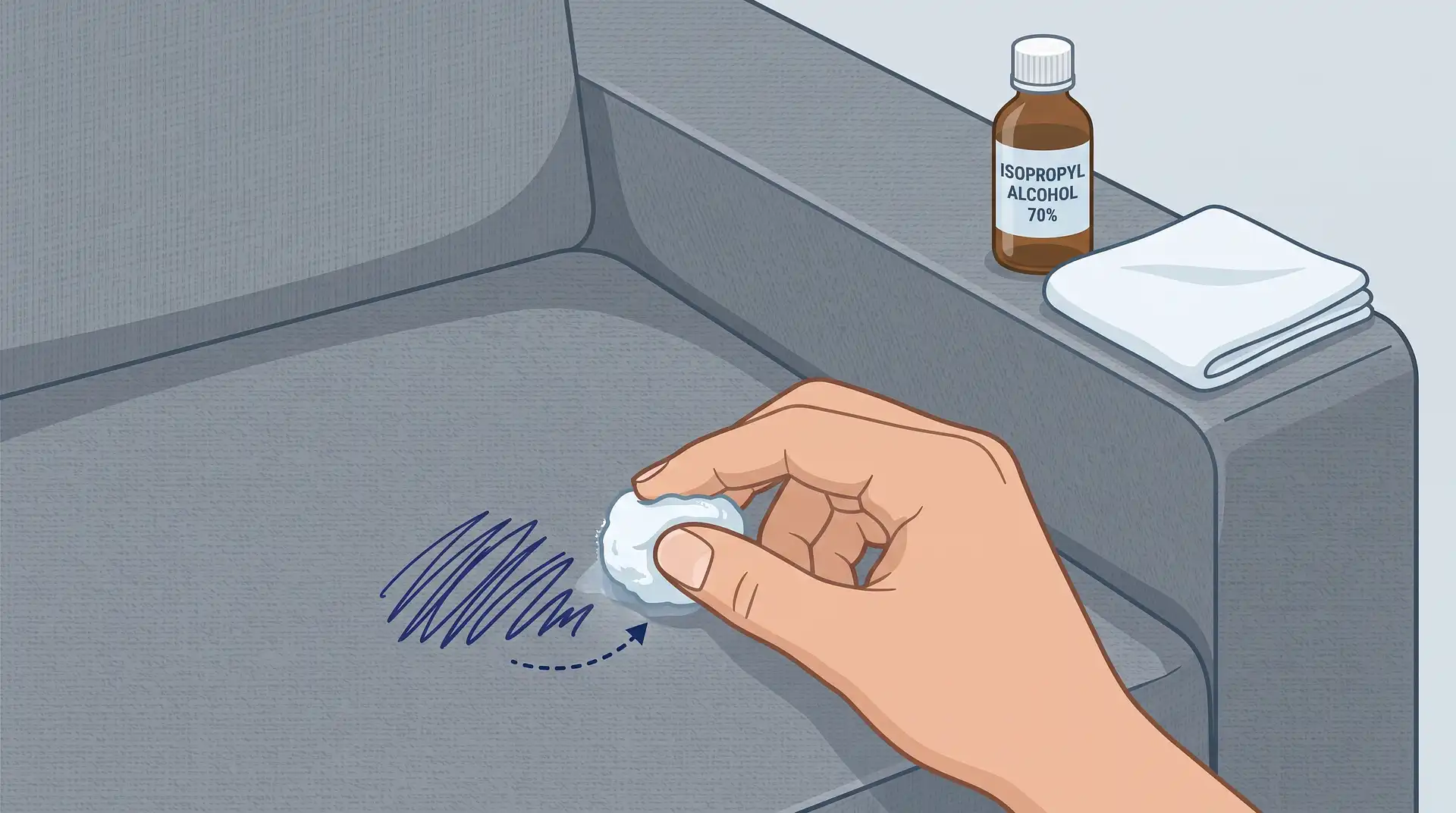
Apply a small amount of isopropyl alcohol to a white cloth — not directly to the fabric. Dab gently at the outer edge of the mark, working inward. Never rub, which spreads the stain and drives it into the foam below.
As ink lifts onto the cloth, move to a clean section constantly. Using a section already loaded with ink puts it back onto the sofa.
Work gradually. Multiple light passes lift more ink than one heavy application.
Once no more ink transfers, rinse the area with a barely damp cloth and plain water to remove alcohol residue.
Blot dry.
For a W or WS coded fabric where the alcohol treatment has addressed the main stain, a mild detergent solution on a cloth can follow up on any residue, then a plain water rinse cloth.
For felt tip and marker (water-based):
Blot fresh ink immediately with a dry white cloth.
Apply a small amount of cool water and mild detergent solution to a white cloth and dab at the mark.
Work from outside in, changing to a clean cloth section frequently.
Rinse with a plain cool water cloth.
Blot dry.
The cushion drying point applies here too. Any wet treatment risks moisture reaching the foam inside the cushion, where it can't escape easily. Use the minimum amount of liquid needed, blot thoroughly, and prop the cushion on its edge with ventilation to dry rather than replacing it flat on the sofa while still damp. The how to clean a fabric sofa guide on this site covers the enclosed foam drying principle in detail.
Getting pen off a leather sofa
Leather handles pen stains reasonably well when treated promptly, but the solvent required — isopropyl alcohol — has its own risks on leather that need managing.
For ballpoint and gel pen:
Blot any fresh ink gently with a dry white cloth. Don't spread it.
Apply a small amount of isopropyl alcohol to a cotton wool ball or soft white cloth. Dab at the stain — do not rub in circles, which spreads the ink and can lift leather colour.
Work at the stain in small, controlled dabs, replacing the cotton wool as it picks up ink.
Once no more ink transfers, wipe the area with a barely damp cloth to remove alcohol residue.
Dry immediately with a dry cloth.
Apply leather conditioner immediately after. This is not optional. Isopropyl alcohol strips the natural oils from leather and accelerates drying and cracking if conditioning doesn't follow promptly. The same conditioning guidance from the leather sofa guide on this site applies here.
Aniline and semi-aniline leather — the most delicate, natural-finish types — are particularly vulnerable to alcohol lifting the colour. If the sofa has a matte, natural appearance and the leather feels soft and uncoated, test in a completely inconspicuous spot before proceeding, and consider professional treatment for any mark larger than a small dot.
For felt tip on leather:
A leather cleaner applied to a soft cloth, dabbed at the mark and wiped off, is the appropriate first attempt for water-based felt tip. If the mark has penetrated the surface leather finish, alcohol is the next step, with conditioning to follow.
Getting pen off suede and velvet
Suede: isopropyl alcohol on a barely damp cloth, dabbed gently in the nap direction. Use the minimum amount possible. Dampen the whole surrounding panel lightly to prevent a watermark forming at the drying edge — the same principle from the suede sofa guide. No rubbing. Brush the nap back into place with a suede brush once dry.
Velvet: isopropyl alcohol on a white cloth, dabbed in the pile direction. Follow with a barely damp plain water cloth to remove alcohol residue, then dampen the whole panel lightly to prevent tide marks, dry with ventilation, and brush the pile back into alignment once fully dry.
Both materials are sensitive to over-wetting and to the drying boundary issue. Work quickly and keep moisture to an absolute minimum.
Old, dried ink: what's realistic
This is where honesty matters more than reassurance.
Fresh ink is mobile. The solvent can access the pigment, dissolve it and lift it. Dried ink has bonded with the fibre, and the older the mark, the more completely that bonding has occurred.
On fabric, dried ballpoint that's been on the sofa for days or weeks is considerably harder than a same-day mark. Isopropyl alcohol may lighten it significantly but not remove it entirely. Multiple treatment cycles over several sessions, each followed by complete drying, give the best chance of progressive improvement.
On leather, dried ink that has been worked into the surface finish may have partially stained the leather itself rather than just sitting on the surface. Professional leather colourist treatment — where a matched leather dye is applied to the repaired area — is sometimes the practical solution for a large or well-set ink stain on leather.
The honest position is: lighter marks, recent accidents and pale inks on most surfaces are highly treatable. Dark ink, permanent marker, large marks and stains that are weeks old are in the difficult category, and setting realistic expectations before beginning saves frustration.
What not to use
Baking soda paste on leather or suede. Mildly alkaline and mildly abrasive. It can scratch the surface of leather and suede and its alkalinity risks the same pH damage noted in the suede sofa article. Not a recommended approach for ink on any leather or suede surface.
Hairspray. Widely recommended in older guides. Hairspray used to contain high levels of alcohol, which is what made it occasionally effective. Modern hairsprays contain far less, and also contain sticky polymers and fragrances that leave residue in the fabric. Using isopropyl alcohol directly is more effective and cleaner.
Nail varnish remover on fabric sofas. Acetone dissolves latex backing and certain synthetic fibres. The nail varnish remover guide on this site covers the acetone risk in detail.
Rubbing in circular motions. Spreads the stain and damages the fibre or leather surface. Dab only.
Water on a ballpoint stain before solvent. Spreads the oil-based ink and makes subsequent treatment harder.
Excessive alcohol on unconditioned leather. Multiple applications without conditioning between them strips natural oils progressively. Apply conditioning after every alcohol treatment session, not just at the end of the whole process.
FAQ Section
How do you get pen out of a fabric sofa? Identify the ink type first. Ballpoint and gel pen are oil-based and need isopropyl alcohol (surgical spirit) on a white cloth, dabbed rather than rubbed. Felt tip and marker are usually water-based and respond to cool water and mild detergent. Check the cleaning code label before using any water-based product on the sofa.
How do you get biro off a leather sofa? Apply a small amount of isopropyl alcohol to a cotton wool ball and dab gently at the mark, working from the outside in and replacing the cotton wool as it picks up ink. Wipe off residue with a barely damp cloth, dry immediately, then apply leather conditioner. Conditioning after alcohol treatment is essential.
Does rubbing alcohol damage a sofa? On fabric it is generally safe at the concentrations used for stain treatment, provided the cleaning code permits solvents. On leather it strips natural oils and must be followed immediately by conditioning. On aniline or semi-aniline leather, test on a hidden area first as it can lift colour.
Why doesn't water remove ballpoint pen ink? Ballpoint pen ink is oil-based. Water doesn't dissolve oils. Applying water to a ballpoint stain spreads the oil-based ink across a wider area without lifting it. Isopropyl alcohol dissolves the oil-based carrier and lifts the pigment.
Can you remove old dried pen from a sofa? Dried ink is harder than fresh ink because the pigment has bonded more completely with the fibre or leather. Isopropyl alcohol may lighten it significantly over multiple treatment sessions. Very old or large marks on leather may require professional leather colourist treatment for a complete result.
Does hairspray remove pen from sofas? Modern hairsprays contain far less alcohol than older formulas and also leave sticky polymer residue. Using isopropyl alcohol directly is more effective and doesn't leave residue.
How do you remove felt tip from a sofa? Felt tip ink is usually water-based. Cool water and mild detergent on a white cloth, dabbed from the outside in, handles most felt tip marks on W or WS coded fabric. On leather, a leather cleaner applied to a cloth is the appropriate first attempt.
How do you get permanent marker off a sofa? Isopropyl alcohol, applied carefully with a cotton ball or white cloth, dabbed rather than rubbed. Permanent marker is designed for dye penetration and is harder to remove fully than ballpoint. Test on a hidden area first, work gradually, and accept that significant lightening rather than complete removal may be the realistic outcome on fabric.
Service Section
Stain not shifting, or on a delicate leather or suede?
A pen mark that's been on the sofa for a while, a large ink spill, or a mark on aniline leather or suede where the wrong product risks making it worse — these are the cases where professional upholstery treatment is the right answer rather than escalating DIY. Instant Dry Carpet Cleaning provides professional upholstery cleaning across England and Wales, with a free assessment and fixed price before any work begins.
Get your fixed quote in 60 seconds
Or call 07555 856988.