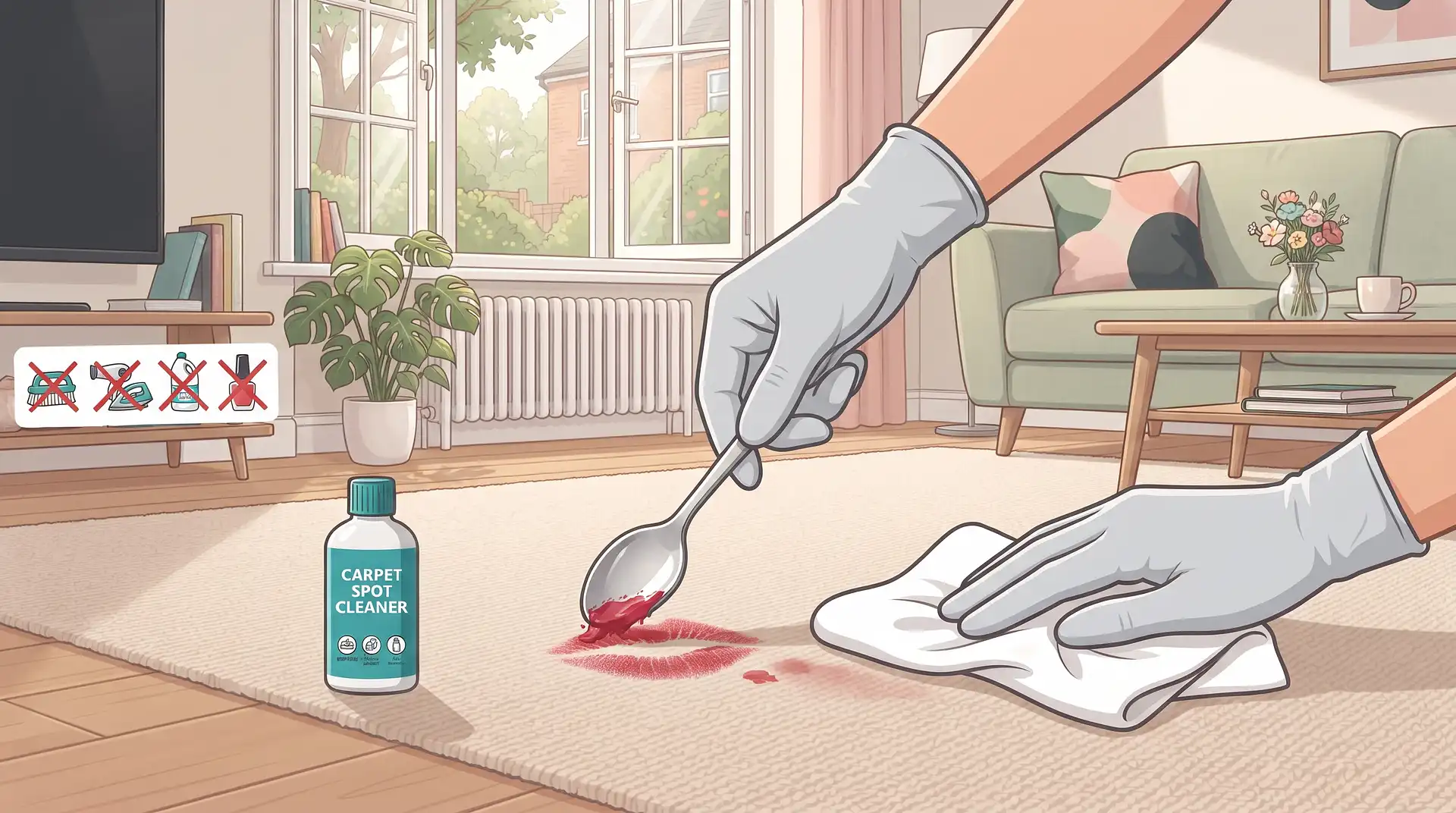
How to Get Lipstick Out of Carpet Safely
4 October 2026
Would rather leave it to a professional? See our carpet cleaning in Manchester.
Quick answer: Lift any solid lipstick with a spoon or stiff card, working from the outside towards the centre. Do not rub. Lipstick contains wax, oil and strong pigment, so water alone usually spreads it. Check the carpet fibre, then test a carpet spot solvent approved for oily cosmetic stains in a hidden area. Apply the product to a white cloth, not directly to the carpet, and blot with fresh sections as the colour transfers. Treat any remaining oily mark with a suitable mild carpet detergent, rinse as directed and blot dry.
Lipstick is more complicated than an ordinary drink spill because it leaves three things behind. Wax holds the product together, oil helps it glide and pigment gives it colour. Removing only the surface wax can leave a greasy red or pink shadow, while scrubbing the pigment can spread it through more of the pile.
What you will need
A spoon, blunt plastic scraper or stiff white card
Plain white paper towels or absorbent cloths
A carpet spot solvent approved for oily cosmetic stains
A fibre-safe, pH-appropriate carpet detergent if needed
Clean water for rinsing when the product instructions require it
Several clean white cloths
A dry towel and good ventilation
Gloves when required by the product label
If the lipstick is very soft, a sealed bag of ice or clean cold pack can help firm the surface before you lift it. Keep melting water out of the pile and do not use heat.
Why ordinary water is not enough
Lipstick is designed to resist moisture and remain on skin. Its oily and waxy base does not dissolve readily in plain water. Adding water first can move loose pigment to the edge of the wet patch and leave a wider ring.
A suitable solvent loosens the oily binder so the colour can transfer into a cloth. A mild detergent may then remove the thin oily residue that remains. These are separate stages, and each should be completed with controlled amounts of product.
Do not assume that every solvent is carpet-safe. A product that removes makeup from skin or nail polish from nails may affect carpet dye, fibre, adhesive or backing.
Check the carpet and lipstick first
Find the carpet label or manufacturer’s care information and identify the fibre if possible. Wool needs a gentler product than many synthetic carpets. Natural plant fibres may not tolerate normal wet finishing, while some synthetic fibres and backings are damaged by strong solvent.
Look at the lipstick as well. A traditional stick usually leaves a waxy solid plus pigment. Cream lipstick and tinted balm may contain more oil. Long-wear liquid lipstick can leave a thin, strongly bonded colour film. The same order still applies: remove excess material, lift the oily binder with an approved product, then judge the remaining colour after drying.
Type of mark | First action | Main risk |
|---|---|---|
A broken piece sitting on the pile | Firm it with a sealed cold pack and lift it | Pressing it deeper while soft |
A fresh smear | Lift excess and blot straight upwards | Wiping pigment across more fibres |
A dried mark | Remove dry excess before patch-tested solvent treatment | Aggressive scraping or excess solvent |
A coloured shadow after cleaning | Let it dry and assess the remaining pigment | Bleaching the carpet while chasing the last colour |
How to get fresh lipstick out of carpet
1. Keep people away from the mark
Do not kneel on the lipstick or let anyone walk over it. Pressure spreads the wax and pigment through a wider area. Keep children and pets away while products and stained cloths are in use.
2. Lift the excess lipstick
Use the edge of a spoon, plastic scraper or stiff card. Start outside the mark and lift towards the centre. Wipe the tool after every movement so removed lipstick does not return to the carpet.
If a soft lump bends or smears, hold a sealed cold pack against it briefly until it firms. Avoid loose ice, which adds water before the oily material has been removed.
3. Blot without rubbing
Press a clean white cloth straight down onto the mark and lift it directly upwards. Move to a clean section every time colour transfers. Do not wipe backwards and forwards because this distributes pigment through clean pile.
4. Choose a suitable carpet spot product
Use a product whose label approves the carpet fibre and names grease, oil, cosmetics or lipstick. For wool, choose a product approved by the carpet maker or carrying suitable WoolSafe approval. If the fibre is unknown, stop after removing the excess and ask for professional advice.
5. Patch-test and let the test dry
Test the exact product inside a cupboard, behind furniture or on a retained offcut. Apply it in the same way you intend to treat the stain. Check for carpet colour on the cloth, fading, texture change or backing damage after the area has dried completely.
A wet patch naturally appears darker, so judging the test before it dries can hide a problem.
6. Apply the solvent to a white cloth
Dampen a clean white cloth with the approved product. Do not pour or spray it directly onto the carpet. Blot the outer edge of the lipstick mark and work gradually towards the centre.
Turn the cloth frequently. When red, pink or brown colour transfers, use a fresh section rather than pressing it back into the carpet. Several light passes are safer than one heavily soaked treatment.
7. Stop when colour stops transferring
Do not keep adding solvent without checking progress. Stop if carpet dye appears on the cloth, the pile becomes sticky, the backing feels wet or the treated area grows. Let the spot dry before deciding whether another pass is justified.
8. Treat the remaining oily residue
Once the waxy colour has stopped transferring, inspect the fibres for a clear or darker greasy patch. If the care instructions allow water-based spot cleaning, use a small amount of suitable carpet detergent at its stated dilution.
Apply the solution to another white cloth and blot the affected fibres. Do not use neat washing-up liquid. Concentrated detergent is difficult to rinse from carpet and can leave a sticky patch that attracts dirt.
Ask About Lipstick Stain Removal
9. Rinse as directed
If the product instructions call for rinsing and the carpet permits it, blot with a clean cloth lightly dampened with plain water. Repeat with fresh cloth sections, then press a dry towel firmly onto the area.
Do not flood the pile. Liquid and solvent reaching the backing may affect adhesive, cause browning in natural backing materials or leave a ring as the carpet dries.
10. Dry and inspect the result
Ventilate the room and keep people off the treated area until it is completely dry. Do not use a hairdryer, radiator, iron or steam cleaner. Once dry, view the carpet in natural light and gently reset the pile if the manufacturer allows brushing.
A faint coloured shadow may be remaining lipstick pigment, carpet dye loss or pile distortion. Those problems need different responses, so do not automatically repeat the strongest product.
Makeup stain that will not lift?
Book professional carpet cleaning
How to remove dried lipstick
Dried lipstick usually needs more time rather than more force. Lift any hardened surface material with a blunt plastic edge. A sealed cold pack may help firm a waxy deposit before lifting, but do not scrape aggressively into the pile.
Patch-test a carpet-approved cosmetic or grease spotter. Apply it to a white cloth and work on a small section from the outside in. Let each treatment lift into the cloth before adding more product.
Long-wear lipstick may leave a bonded pigment film after the oils have been removed. Stop if progress becomes very slow. Repeated solvent treatment can damage the carpet before the final pigment disappears.
How to treat liquid lipstick and lip gloss
Use stiff card or the edge of a spoon to collect any pooled product without spreading it. Blot the remaining mark with a white cloth. Lip gloss may leave a larger oily area with less pigment, while liquid lipstick may spread a thin but intense colour.
Follow the same tested solvent-first process. Do not add water until the oily cosmetic has stopped transferring. After that, use a compatible detergent only when needed for residual oil, then rinse according to the label.
Adjust the method for the carpet fibre
Wool and wool-rich carpet
Wool is sensitive to high alkalinity, aggressive rubbing and unsuitable solvent. Use minimal product, a WoolSafe-approved treatment where appropriate and gentle blotting. A bright pigment stain on valuable wool is a sensible reason to seek professional help early.
Polypropylene carpet
Polypropylene is generally colourfast but attracts oily soiling and is sensitive to heat. The lipstick’s oily base may cling even after much of the colour lifts. Use an approved spotter and avoid steam, irons and oily home remedies.
Nylon carpet
Nylon is durable, but some strong pigments can bind to its dye sites. Test solvent carefully and stop if carpet colour transfers. Removing the oily binder does not always remove every trace of pigment.
Polyester carpet
Polyester can hold oily residue. Use controlled solvent treatment followed by an approved detergent stage if needed. Complete rinsing and drying help prevent a dark soil-attracting patch.
Loop pile and deep pile
Blot in the direction of the pile and avoid catching loops with a scraper. In deep pile, lipstick can sit below the visible surface. Do not pour product down to reach it, because this can carry pigment towards the backing.
Jute, sisal and other plant fibres
These carpets may stain or distort with water. Follow the maker’s dry-treatment instructions and do not improvise with water, detergent or household solvent. Remaining pigment is best assessed by a specialist.
Safety guide for carpet stain removers
Read the complete product label and follow its ventilation, dilution, contact-time and disposal instructions.
Wear gloves or eye protection when the label requires them.
Apply solvent to a cloth rather than pouring it onto the carpet.
Keep children and pets out of the area until the carpet is rinsed where required and fully dry.
Never mix a spot solvent with bleach, peroxide, vinegar, ammonia, detergent or another stain remover.
Keep flammable products away from flames, cigarettes, heaters, sparks and other ignition sources.
Follow the Health and Safety Executive guidance on working with solvents, including ventilation, skin contact, storage and flammability precautions.
Methods that may make a lipstick stain worse
Makeup remover and cleansing oil
A product made for skin may contain oil, moisturiser, fragrance or colour that remains in carpet. It can loosen lipstick while creating a second residue that attracts soil.
Makeup wipes and baby wipes
Wipes encourage rubbing and may contain lotion or surfactant that is difficult to rinse. They also give little control over which ingredient reaches the carpet.
Hairspray
Older advice relies on the alcohol in some hairsprays. Modern formulas vary and may leave resin, fragrance or conditioning ingredients behind. Use a labelled carpet product instead.
Nail-varnish remover or acetone
Acetone can affect carpet dye, some synthetic fibres, adhesive and backing. Do not use it unless the carpet manufacturer specifically approves it, which is uncommon.
Steam, an iron or a hairdryer
Heat softens wax and oil, allowing pigment to spread deeper or farther. It can also glaze or melt synthetic carpet fibres.
Bleach or strong peroxide
These may remove carpet colour along with the lipstick pigment, leaving a permanent pale patch. A colour-loss mark cannot be cleaned back to its original shade.
Scrubbing with a brush
Scrubbing spreads pigment, frays fibres and changes how the pile reflects light. Blotting transfers the stain into the cloth instead of distributing it.
When professional cleaning is sensible
Arrange professional assessment when lipstick covers a large area, has been walked into the pile, remains after careful patch-tested treatment, or sits on valuable wool, natural fibre, pale carpet or an unknown material.
Stop immediately if carpet dye transfers, pile texture changes, backing becomes wet or a previous home treatment has created an oily ring. Tell the cleaner the lipstick type and every product already applied. Treatment suitability and cost depend on the carpet fibre, construction, affected area and previous attempts.
If a separate greasy patch remains after the colour has lifted, our guide on how to get oil out of carpet explains why oily residue needs a different finishing stage.
Frequently asked questions
Can washing-up liquid remove lipstick from carpet?
A correctly diluted, carpet-compatible detergent may help with the oily residue after the wax and pigment have been lifted. It is usually not the best first step because water-based detergent may spread intact lipstick.
Does rubbing alcohol remove lipstick?
Alcohol can dissolve some lipstick ingredients, but it is not safe for every carpet, dye or backing. Use a carpet-approved spot solvent and follow the maker’s instructions rather than assuming household alcohol is suitable.
How do you remove red lipstick from a light carpet?
Lift the solid material, then use a patch-tested solvent approved for the fibre and blot with clean white cloth sections. Do not use bleach to chase the final red shadow. Professional treatment is safer when strong pigment remains.
Can I steam clean lipstick out of carpet?
Do not use steam as the first treatment. Heat can soften the wax and oil and carry pigment farther through the pile. Remove the lipstick with controlled spot treatment before considering any wider carpet cleaning.
Why does the stain look darker after it dries?
Oily or detergent residue may remain and attract soil, or pigment may have travelled back to the surface during drying. Stop adding products until you know whether the remaining mark is oil, colour or pile change.
Will lipstick come out completely?
Many fresh marks improve greatly or come out, but no method can guarantee complete removal. Result depends on pigment strength, fibre, heat exposure, time and any products already used.
How do you get lipstick out of carpet?
Scrape off excess with a blunt knife. Dab a little rubbing alcohol or micellar water on a white cloth and blot, moving to a clean part of the cloth each time. Finish with a few drops of washing-up liquid in cool water and rinse.
Can you use hairspray on lipstick stains?
It is not reliable on modern formulas and can leave a sticky patch. Rubbing alcohol or micellar water dissolves the oils and pigment more cleanly.
How do you get long-lasting or matte lipstick out of carpet?
Long-wear formulas need an oil-based makeup remover first to break the film, then washing-up liquid solution to lift the oil. Test on a hidden area and rinse well.
Get help with a lipstick stain
InstantDry can assess the carpet fibre, lipstick residue, pigment depth and previous treatments before recommending a suitable cleaning method. Send a clear photograph of the stain and carpet label when requesting advice.
Request a Carpet Cleaning Quote
Related guides: how to get makeup out of carpet, how to get foundation out of carpet, how to get nail varnish out of carpet. For a professional finish, see our carpet cleaning service or carpet cleaning in Manchester.
Related guides
Need it cleaned properly?
Book our carpet cleaning service — from £29 (UK average £45), free in-home survey and pay on completion.