How Long Do Mattresses Last
23 August 2026
Quick answer: Most mattresses last between seven and ten years, depending on type, build quality and how they're used and maintained. Pocket sprung and open coil mattresses typically sit toward the lower end of that range. Memory foam and hybrid mattresses generally last a little longer. Natural latex is the most durable type. The single most useful question before replacing a mattress is whether the problem is structural, sagging, uneven support, broken springs, or hygiene-based, staining, odour, discolouration. The first is a replacement problem. The second is often a cleaning problem, and a professional clean at a fraction of replacement cost is worth considering first.
Around seven million mattresses are discarded in the UK every year, and a significant proportion of them are replaced not because they've lost their structural support but because they look or smell worn. That's worth knowing before you decide, because a mattress that no longer feels comfortable and a mattress that no longer looks or smells clean are different problems with different solutions.
Lifespan by mattress type
Different construction types degrade at different rates. The ranges below reflect the general industry consensus across multiple sources, though actual lifespan depends substantially on build quality, weight and usage, so treat them as a guide rather than a guarantee.
Mattress type | Typical lifespan | Key failure mode |
|---|---|---|
Open coil (Bonnell spring) | 5 to 7 years | Springs lose tension, surface begins to sag |
Pocket sprung | 7 to 10 years | Individual spring fatigue in high-pressure areas, usually the centre |
Memory foam | 8 to 10 years | Foam loses the ability to fully recover its shape, developing a permanent body impression |
Hybrid (foam and springs) | 7 to 10 years | Depends on the quality of both components |
Natural latex | 10 to 15 years, sometimes longer | Highly durable, resistant to body impression, slow to degrade |
Synthetic latex | 6 to 10 years | Degrades faster than natural latex, often develops impression sooner |
A note on these figures. Almost every source giving mattress lifespan data is either a mattress manufacturer, a retailer, or a review site with commercial relationships to both. The ranges above are consistent across independent sources, but be aware that the industry has an interest in shorter replacement cycles. A quality mattress that's well maintained and still providing genuine support at ten years is not necessarily ready for replacement.
The clean-or-replace test
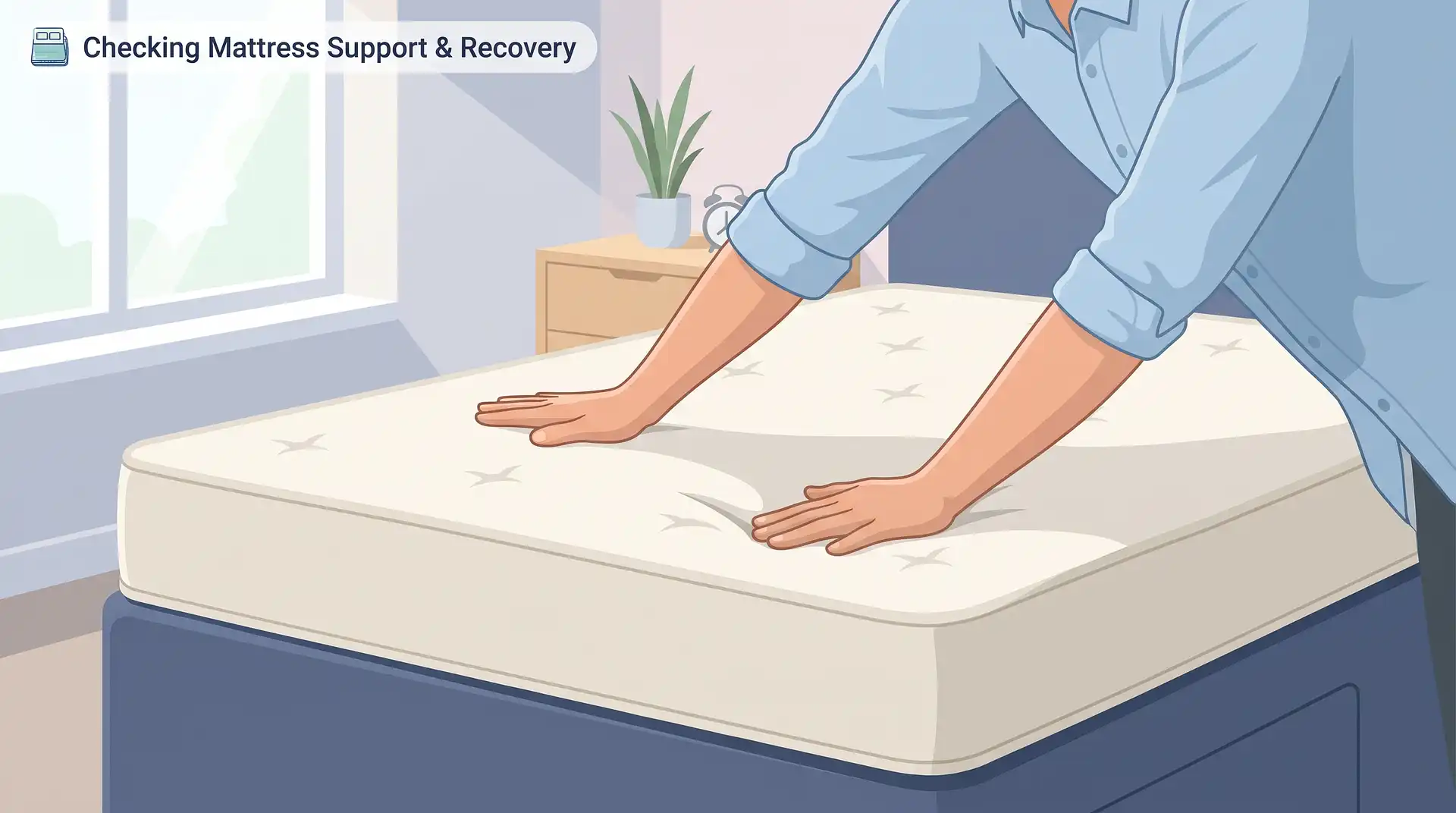
Before deciding either way, a simple physical test is the most reliable indicator.
Press firmly across the mattress surface in several places, distributing your body weight. Work systematically from one end to the other.
If the support feels even and the mattress springs back, the mattress is structurally sound. Any problems with how it looks or smells are cleaning problems, not structural ones.
If there are areas that feel softer than others, sink noticeably further, or don't recover when you lift your hand, those areas have lost support. If this is at the main sleeping position, the mattress is past its useful structural life.
If you can feel springs through the surface, or if there's a visible dip at the sleeping position when you stand at the foot of the bed, the mattress is finished.
Structural failure means replacing. Staining, yellowing, odour and general hygiene issues mean cleaning, often a great deal of which is recoverable before you conclude the mattress is beyond saving.
Signs your mattress genuinely needs replacing
Visible sagging or body impression. A permanent dip of 3 to 5 centimetres or more at the sleeping position, visible when you stand at the foot of the bed, indicates the support structure is compromised.
Uneven support across the surface. If you roll toward one side, or if one side of a shared bed has noticeably more give than the other, the springs or foam have degraded unevenly.
Springs you can feel through the surface. On a pocket or open coil mattress, individual spring failure can create pressure points and localized discomfort that doesn't improve and isn't a cleaning issue.
Morning pain that resolves during the day. Waking with back, shoulder or hip pain that eases within thirty minutes of getting up is often associated with inadequate spinal support during sleep. Not every case of morning stiffness is mattress-related, but if it correlates with the age of the mattress and other signs are present, it's worth taking seriously.
Age beyond twelve years. Even a structurally sound mattress accumulates biological material, dust mite allergens and degraded foam over time. Beyond a decade, replacement is reasonable regardless of appearance.
Signs it needs cleaning, not replacing
Yellow or brown staining. Sweat, body oils and oxidation cause yellowing that looks significant but is often a surface and hygiene issue rather than a structural one. Professional hot water extraction can substantially improve yellowing, though complete removal of long-established staining is not always achievable.
Persistent odour. A musty smell, urine smell, or general staleness is almost always a hygiene issue rather than a structural one. Odour in the mattress surface and upper foam layers responds to proper cleaning, particularly enzyme treatment for biological sources. Odour that persists after thorough cleaning and drying may indicate moisture has reached the core, at which point professional extraction is the appropriate tool.
Surface staining from spills. Coffee, wine, blood, urine and food staining on a structurally sound mattress is a cleaning problem. The methods are covered in detail across our mattress cleaning guides.
A mattress that looks worn but feels fine. Visual deterioration and structural deterioration are not the same thing. A mattress that still supports you evenly and springs back consistently may simply need a professional clean to look and feel significantly better.
What shortens a mattress lifespan
No mattress protector. Every night of use deposits perspiration, skin cells and body oils into the mattress. A protector intercepts the majority of this before it reaches the mattress itself, and a washable protector is far easier to maintain than a mattress. The absence of a protector is the single biggest factor in premature mattress degradation.
Eating and drinking in bed. Spills and crumbs create moisture pockets and biological contamination that break down materials and attract dust mites. Around a fifth of UK adults eat in bed regularly, and this is one of the leading causes of premature mattress deterioration.
Allowing pets to sleep on the mattress. Pet dander, hair and moisture accelerate biological contamination and can void manufacturer warranties.
Never rotating or flipping. Continuous sleeping in the same position compresses the same areas repeatedly. Rotating the mattress head to foot every three months distributes wear more evenly. Some mattresses are also designed to be flipped, though most modern one-sided mattresses are not.
Bending or folding during moves. Mattresses should always be moved flat or on their side, never bent. Bending damages the internal support structure, particularly on pocket sprung and foam mattresses, often permanently.
Using an inappropriate base. A mattress designed for a slatted bed frame on a solid platform, or vice versa, can degrade faster because the ventilation and support the base provides affects how the mattress performs and how moisture dissipates from beneath it.
What extends it
A good quality mattress protector, washed regularly. The most effective single measure. Move the problem from something you can't wash to something you can.
Rotating every three months. Even on a one-sided mattress, rotating head to foot distributes wear across the surface rather than concentrating it at the main sleeping position.
Keeping it dry. Moisture is the enemy of every mattress type. Ventilate the bedroom daily, avoid making the bed immediately on waking, which seals overnight moisture in, and address any spills promptly with the minimum moisture needed.
Professional cleaning periodically. Accumulated soil, body oils, biological matter and moisture all contribute to material degradation over time. A professional clean every year or two removes what routine vacuuming and a protector can't reach, which is particularly relevant for foam mattresses where biological contamination in the surface layers accelerates breakdown.
A suitable base. The right base for the mattress type, as specified by the manufacturer, ensures adequate ventilation and support underneath.
7. FAQ Section
How long do mattresses last in the UK? Most mattresses last between seven and ten years. Open coil and basic foam mattresses tend toward the shorter end of that range. Pocket sprung and hybrid mattresses typically last seven to ten years. Memory foam generally holds up for eight to ten years. Natural latex is the most durable type and can last considerably longer with proper care.
How do I know if my mattress needs replacing? Press firmly across the surface in several places. If support feels even and the mattress springs back, it is structurally sound. If there is visible sagging, uneven support, or springs you can feel through the surface, the mattress has lost structural integrity and needs replacing. Staining, odour and discolouration without structural failure are cleaning problems rather than replacement problems.
Is a ten year old mattress too old? Not necessarily. A ten year old mattress that still provides even support and springs back consistently may have useful life remaining, particularly if it's a quality pocket sprung or memory foam type. A ten year old mattress showing sagging, broken springs, or significant body impression has reached the end of its useful life regardless of age.
Does a mattress protector really extend mattress life? Yes, significantly. A protector intercepts the perspiration, skin cells and body oils that would otherwise accumulate in the mattress directly. This slows biological degradation, reduces dust mite populations, and makes the mattress easier to keep clean. It is the most effective single measure for extending mattress lifespan.
How often should you rotate a mattress? Every three months is the general recommendation. Rotating head to foot distributes wear across the surface rather than concentrating it at the main sleeping position. Check the manufacturer's guidance on whether your mattress should also be flipped, since most modern one-sided mattresses should not be.
Can professional cleaning extend a mattress lifespan? Yes, particularly for mattresses showing hygiene deterioration rather than structural failure. Professional hot water extraction removes accumulated body oils, biological matter and moisture from the surface layers that routine vacuuming doesn't reach, which slows material degradation and improves both appearance and hygiene.
What is the most durable type of mattress? Natural latex is widely regarded as the most durable mattress type, with a lifespan significantly longer than foam or spring types when properly maintained. It is also resistant to dust mites and mould, which makes it a good choice for allergy sufferers. It is typically the most expensive option.
What is the most common reason people replace mattresses before they need to? Hygiene deterioration rather than structural failure. Staining, odour and yellowing cause many people to replace a mattress that is structurally sound and could be significantly improved by a professional clean at a fraction of the replacement cost.
Professional mattress cleaning removes the accumulated body oils, biological matter and moisture that cause most hygiene deterioration. It won't restore a structurally failed mattress, but it can substantially improve the appearance and hygiene of a sound one, and it costs a fraction of replacement.
InstantDry provides professional mattress cleaning across England and Wales using controlled hot water extraction, with a free survey and fixed price before any work begins. If we don't think cleaning will achieve what you're looking for, we'll tell you rather than take the booking.
Get your fixed quote in 60 seconds
Or call 07555 856988.