How to Polish a Leather Sofa
8 September 2026
Quick answer: Most leather sofas should be conditioned rather than polished in the traditional sense. A leather conditioner restores the oils that daily use and central heating strip out, keeping the leather supple and preventing cracking. For a finish with some sheen, a dedicated leather polish from a specialist leather care brand — not shoe polish, not furniture polish, not olive oil — can be applied over a clean, conditioned surface on pigmented leather. On full-grain aniline leather, conditioning alone is the correct approach; traditional polishing products damage the natural surface. Clean the sofa first, always.
Searching for how to polish a leather sofa puts you in the middle of a genuine contradiction in the market. Several specialist leather care brands sell products labelled as leather polish and recommend them enthusiastically. At least one premium leather furniture manufacturer says you should not polish a leather sofa at all. Both positions are defensible, and the difference comes down to leather type and what you mean by polish. Instant Dry Carpet Cleaning cleans leather upholstery across England and Wales and the conditioning step is part of the professional service — understanding why helps you maintain what professional cleaning achieves.
Polish or condition: what's the difference?
These two words are used interchangeably in most guides and they shouldn't be.
Conditioning restores moisture and oil to leather fibres that have been depleted by use, sunlight and central heating. A conditioner is absorbed into the leather and keeps it supple, preventing the drying and cracking that shortens leather life. It may leave a very slight sheen as a byproduct, but its purpose is protective rather than cosmetic.
Polishing, in the traditional sense, applies a surface product that creates a shine by filling in minor surface irregularities and reflecting light. Shoe polish and beeswax polishes work this way. On finished pigmented leather with a surface coating, a dedicated leather polish from a specialist leather care brand works similarly — it sits on the surface coating and adds sheen. On full-grain or aniline leather with a natural, uncoated surface, a surface-sitting polish product damages the porous leather beneath it.
The practical position for most UK households: condition regularly with a proper leather conditioner, and if you want a sheen on a pigmented leather sofa, use a specialist leather polish from a leather care brand rather than a general household product.
Identify your leather type first
The correct approach depends on which type of leather your sofa has.
Pigmented leather. The most common in UK homes, used by most major sofa retailers. Has a surface coating of pigment and protective finish that gives it its colour uniformity and reasonable stain resistance. Slightly cooler to the touch than natural leather. Accepts both conditioning and specialist leather polish.
Semi-aniline leather. A light coating over a natural-dyed leather, with more natural feel than pigmented but more protection than full aniline. Accepts conditioning. Use specialist leather products only — test on a hidden area before applying anything.
Aniline and full-grain leather. No surface coating, natural appearance, warm to the touch, shows the natural grain and marks of the hide. The most luxurious and most sensitive type. Conditioning is appropriate and necessary. Traditional polishing is not — surface products clog the natural pores of the leather and damage the surface over time.
Faux leather and PU. Not real leather. A plastic or polyurethane surface on a fabric backing. Conditioning and polishing products designed for real leather are not appropriate — they don't absorb and can leave a greasy residue. A damp cloth and mild cleaner is the correct maintenance.
If you're not sure which type you have, check the manufacturer's label, the original purchase documentation or the retailer's product description.
Clean before you condition — always
This is the step that most guides either skip or handle in one line, and it's the step that determines whether conditioning helps or harms.
Conditioning a leather sofa without cleaning it first traps body oils, dust, skin cells and surface debris under the conditioning product. The conditioner seals this material against the leather surface, which accelerates the breakdown of the surface coating and creates a tacky surface that attracts further soil. The sofa feels temporarily better and looks somewhat better, but the underlying contamination has been sealed in rather than removed.
Clean first with a pH-neutral leather cleaner on a microfibre cloth. Work panel by panel across the full sofa, applying the cleaner to the cloth rather than directly to the leather. Wipe gently in the direction of the leather grain. Dry each panel immediately with a second dry cloth.
Allow to dry fully before applying any conditioner or polish. Conditioning into a slightly damp surface dilutes the product and affects how it absorbs.
The leather sofa guide on this site covers the full cleaning method including leather type identification and what to avoid.
How to condition and polish a leather sofa, step by step
Step 1: Vacuum first
Remove loose debris from seams, creases and under cushions with a soft brush attachment before applying any liquid product.
Step 2: Clean with a pH-neutral leather cleaner
As described above. Work across the full sofa, not just visible marks. Allow to dry.
Step 3: Apply leather conditioner
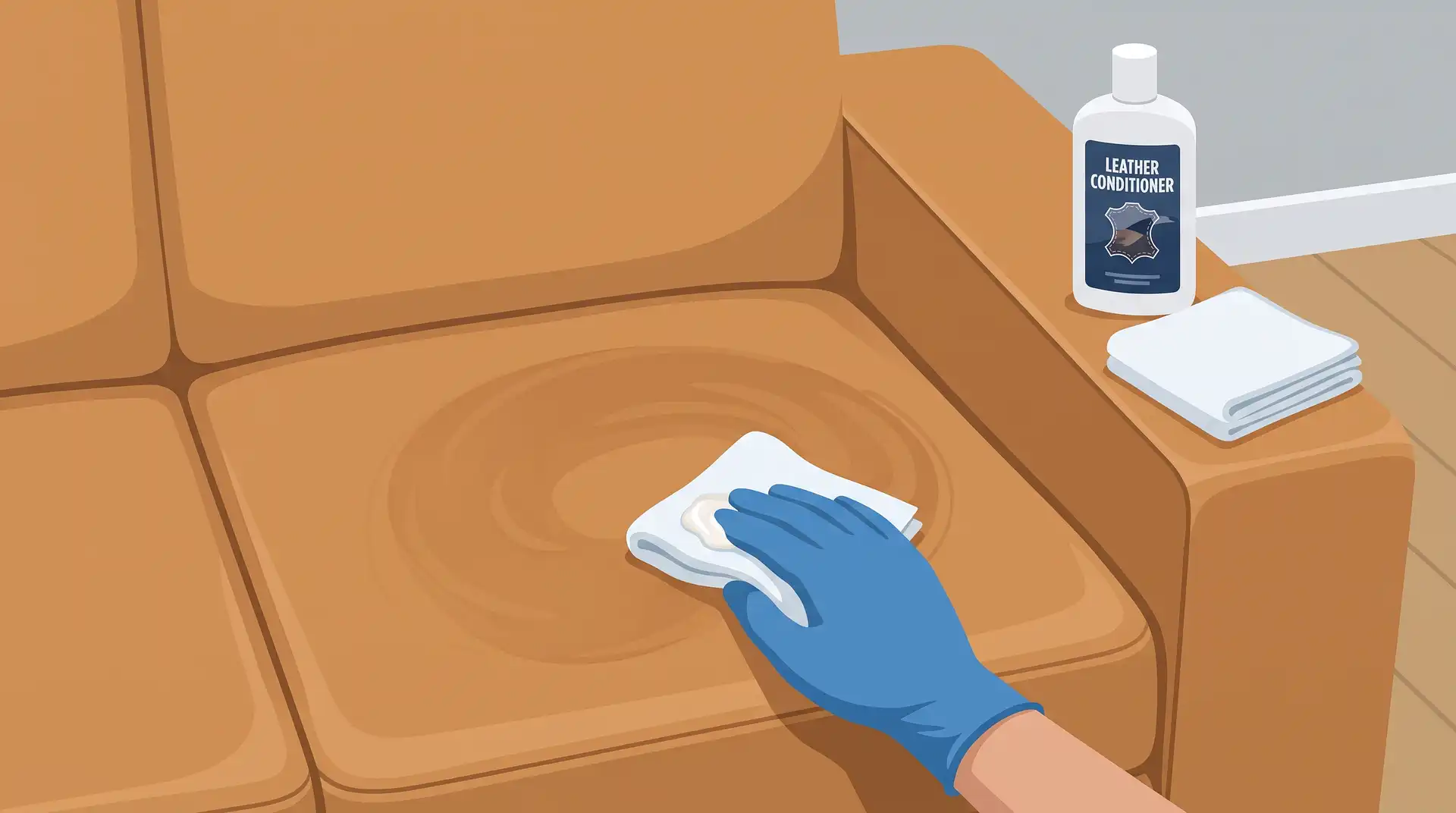
Use a dedicated leather conditioner — not olive oil, coconut oil, shoe polish or furniture polish. Apply a small amount to a clean, dry microfibre cloth. Work in gentle circular motions across each panel, covering the full surface including backs, sides and undersides of arms.
The conditioner should be absorbed rather than sitting visibly wet on the surface. If it sits in pools, you have applied too much. A thin, even coat is more effective than a heavy application.
Step 4: Allow to absorb
Leave the conditioner to absorb for ten to fifteen minutes. For a heavily dried sofa, a second thin coat applied after the first has fully absorbed gives better results than one heavy application.
Step 5: Buff lightly
With a clean, dry microfibre cloth, buff the surface with light circular motions. This removes any surface residue, blends the conditioner evenly and brings up whatever natural sheen the leather finish offers.
Step 6: Apply leather polish (pigmented leather only, optional)
If you want a more polished finish on a pigmented leather sofa, a dedicated leather polish from a specialist leather care brand can be applied over the conditioned surface. Apply sparingly to a cloth, work across the surface in circular motions, leave for the time specified on the product and buff to a shine with a clean dry cloth.
Specialist leather polish is not shoe polish. It is an emulsion product formulated specifically for leather furniture, typically containing conditioning agents alongside the sheen-producing element. Furniture Clinic UK and similar leather care specialists produce dedicated sofa polishes that are safe on pigmented leather.
Step 7: Do not apply to aniline or full-grain leather
On aniline leather, stop after Step 5. Conditioning and buffing is the correct endpoint. No polish product should be applied to full-grain natural-finish leather.
How often does leather need conditioning?
The honest answer depends on three variables: leather type, usage intensity and the home environment.
Every three to six months for most UK households with a pigmented leather sofa in regular use. This is the range given by most leather sofa manufacturers including DFS.
More frequently in centrally heated homes. UK homes with central heating running through autumn and winter have considerably lower indoor relative humidity than the guidance written in more temperate climates assumes. A leather sofa in a centrally heated living room dries out faster than the same sofa in a naturally ventilated space. If the sofa is near a radiator or in a room where the heating runs continuously through winter, conditioning every two to three months is more appropriate than every six.
Less frequently in naturally ventilated homes or for sofas that see lighter use.
Signs the sofa needs conditioning regardless of the schedule: the leather feels slightly stiff or less supple than it should; the surface appears dull even after cleaning; the leather is starting to show fine surface cracks or creases that weren't there before.
What not to use on a leather sofa
Shoe polish. Contains dyes that transfer onto clothing and can alter the leather's colour. Not formulated for furniture leather.
Furniture polish (Mr Sheen and similar). Contains silicones that sit on the leather surface, build up over time and create a cloudy or tacky finish that is difficult to remove.
Olive oil and coconut oil. Both go rancid when absorbed into leather over time, causing an unpleasant smell and a texture that attracts soil. Neither is a substitute for a conditioning product formulated for leather.
Beeswax products not formulated for upholstery leather. Saddle soap and traditional boot polish beeswax products are formulated for hides that will be subject to water and abrasion — not for furniture leather where you want consistent colour and a surface that doesn't transfer onto clothing.
Baby wipes. Contain alcohol, fragrance and other compounds that dry out leather over time. The DFS leather care guide specifically recommends avoiding them.
Vinegar. Acidic and damages the surface finish of pigmented leather with repeated use. Consistent with the established position across this site's leather articles.
Any product not specifically formulated for leather upholstery. The rule applies across every leather article on this site: leather is a sensitive material and the wrong product causes damage that is difficult or impossible to reverse.
Restoring a dull or dry leather sofa
A leather sofa that has lost its colour depth, looks faded or flat, and feels slightly stiff rather than supple has usually been conditioned infrequently if at all, or has been exposed to sustained UV or heat.
Clean thoroughly first. Years of body oil and surface contamination on an unconditioned sofa takes more than one cleaning pass. Two cleaning cycles with a leather cleaner, with drying between each, addresses what one pass can't.
Condition twice. Apply a conditioner, allow full absorption, then apply a second thin coat. On severely dried leather, the first coat is largely absorbed by the depleted fibres and the second coat begins the actual restoration.
UV damage is not reversible by conditioning. Fading from sustained sunlight exposure is a change to the dye in the leather and cannot be reversed by cleaning or conditioning. Instant Dry Carpet Cleaning provides professional leather upholstery cleaning and conditioning across England and Wales — for leather that has significant UV fading or surface cracking, a specialist leather colourist is the appropriate next step after professional cleaning, as they can re-dye faded areas.
Frequently Asked Questions
Should you polish a leather sofa? It depends on the leather type. On pigmented leather (the most common in UK homes), a dedicated leather polish from a specialist leather care brand can add a sheen after conditioning. On full-grain or aniline leather, conditioning alone is correct — traditional polishing products damage the natural surface. On all types, clean before applying anything.
What is the best way to make a leather sofa shine? Clean first with a pH-neutral leather cleaner. Condition with a dedicated leather conditioner and buff lightly with a dry microfibre cloth. For more sheen on a pigmented leather sofa, apply a specialist leather polish (not shoe polish or furniture polish) over the conditioned surface and buff.
How often should you condition a leather sofa? Every three to six months for most UK households. More frequently — every two to three months — for sofas near radiators or in centrally heated rooms where the leather dries faster.
Can you use furniture polish on a leather sofa? No. Furniture polish contains silicones that build up on leather over time and create a cloudy or tacky surface finish. Use a dedicated leather care product instead.
Can you use olive oil on a leather sofa? No. Olive oil goes rancid in leather, creating an unpleasant smell and a texture that attracts soil. It is not a substitute for a conditioning product formulated for leather upholstery.
What is the difference between leather polish and leather conditioner? A conditioner absorbs into the leather and restores moisture and suppleness — its purpose is protective. A leather polish sits more on the surface and adds a sheen — its purpose is cosmetic. The two serve different functions and both have their place on pigmented leather. For aniline and full-grain leather, conditioning only.
How do you restore a dull leather sofa? Clean thoroughly with a leather cleaner, condition twice with a dedicated conditioner allowing full absorption between coats, then buff lightly. If fading is from UV exposure rather than dryness, a specialist leather colourist is the appropriate treatment.
Why does my leather sofa feel sticky after conditioning? Either too much product was applied or it hasn't fully absorbed. Buff vigorously with a clean dry microfibre cloth. If stickiness persists, the product may not be appropriate for that leather type — clean the area with a leather cleaner to remove the excess and start again with a lighter application.
Service Section
Professional cleaning before conditioning gives the best results
A professional leather clean removes the body oils, surface contamination and residue that home cleaning often misses, giving the conditioner clean leather to work with rather than sealing contamination in. Instant Dry Carpet Cleaning provides professional leather upholstery cleaning across England and Wales, with a free survey and fixed price before any work begins.
Get your fixed quote in 60 seconds
Or call 07555 856988.