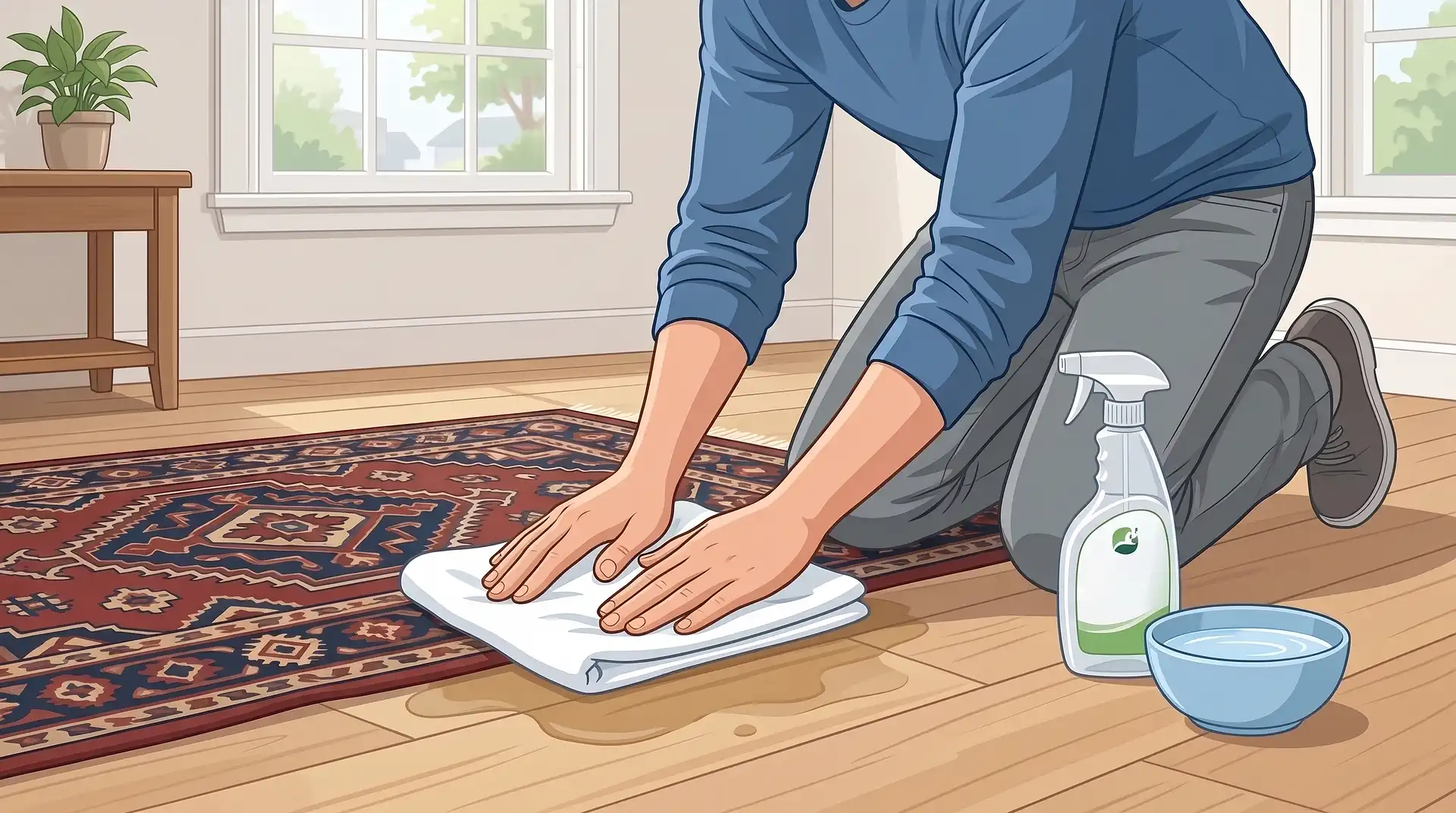
How To Clean A Rug Dog Urine
26 August 2026
Quick answer: Blot immediately with a dry white cloth, working from the outside in. Never rub, never use hot water and never put the rug in the tumble dryer. An enzyme cleaner is essential rather than optional — it's the only product that breaks down the uric acid crystals responsible for the smell returning days later. Vinegar and bicarbonate of soda handle surface odour but leave the uric acid intact. Dry the rug elevated so air reaches both sides. On wool, jute and natural fibre rugs, use the minimum moisture possible.
There's a moment every dog owner knows. You walk into the room, spot the guilty look, and find the damp patch on your favourite rug. What happens in the next ten minutes matters more than most people realise, because dog urine on a rug isn't just a stain. It's a compound problem, and dealing with only half of it is why the smell comes back, and why the dog comes back.
Instant Dry Carpet Cleaning treats dog urine contamination on rugs and carpets regularly across England and Wales, and the most common reason a rug still smells after a careful home clean is the same every time. The visible part was dealt with. The uric acid wasn't.
Why dog urine smells even after cleaning
Dog urine contains two chemically distinct substances, and they need different treatment.
The first is urea and associated salts, which dissolve in water. These are what create the visible wet patch and the initial sharp smell. Cold water and detergent lift them well. Once this fraction is removed, the area looks clean and smells significantly better.
The second is uric acid, which does something completely different as urine dries. It crystallises and bonds to the fibre at a molecular level. These crystals don't dissolve in water, detergent, or vinegar. They sit in the rug pile indefinitely.
Here's the part that explains why cleaned rugs smell again: uric acid crystals are hygroscopic. They absorb moisture from the air. On a warm day, when the central heating comes on, or when your dog settles near the spot and their body heat warms the floor, those crystals draw moisture in and release the odour compounds all over again. The rug smells. The dog investigates. The dog marks again. The cycle continues.
Enzyme cleaners are the correct tool because biological enzymes specifically digest uric acid at the molecular level, breaking the crystals down rather than washing around them. This is the same mechanism explained in detail in the urine mattress guide and it applies equally to rugs. No enzyme treatment, no lasting odour removal. Everything else is surface management.
Your rug type changes everything
The same amount of dog urine creates different problems depending on what it lands on. Getting the approach right for your specific rug prevents the kind of damage that's expensive or impossible to reverse.
Synthetic rugs (polypropylene, polyester): the most forgiving. The fibre doesn't absorb liquid deeply, colour stability is generally good, and cool water enzyme treatment works well. Most robust for this type of accident.
Wool and wool-blend rugs: protein fibre with natural lanolin, which gives some initial resistance to liquid penetrating deeply. Cold water is non-negotiable — hot water sets protein staining permanently, exactly as it does with blood. Enzyme cleaners safe for wool (look for WoolSafe certification) should be used rather than general formulations. No scrubbing, which damages the cuticle structure of the fibre.
Jute, sisal and seagrass: these natural plant-fibre rugs are the hardest case. They absorb water readily, stiffen permanently when thoroughly soaked, and the backing can mould or distort. The approach here is to use the absolute minimum moisture, work with barely damp cloths rather than any form of liquid treatment, and accept that a heavily soaked jute rug may need professional handling or replacement if the damage is significant.
Hand-knotted or antique rugs: any rug of significant value, age or quality should be assessed by a specialist before any DIY treatment attempt. Dye instability in older natural-dye rugs means that what looks like a cleaning solution can strip or shift colour permanently.
Fresh accident: what to do in the first few minutes
Speed is genuinely important here. Fresh urine hasn't yet crystallised and is still mobile in the pile.
Step 1: Blot, don't rub. Press a thick white cloth or wad of kitchen roll firmly onto the wet area and lift. Work from the outer edge toward the centre to prevent spreading. Keep replacing with dry sections. Get out as much liquid as possible before adding anything else. If you can access the back of the rug, press from beneath too.
Step 2: Rinse with cold water. A small amount of cool water applied via a cloth, not poured, dilutes what's left in the pile. Blot again thoroughly.
Step 3: Apply enzyme cleaner. This is where most guides underperform. The enzyme cleaner needs to reach as deep as the urine did, because that's where the uric acid will crystallise. Apply enough that it penetrates to a similar depth, following the product's instructions on quantity. Then leave it. Enzyme products need dwell time, typically fifteen to thirty minutes minimum, kept damp throughout. Blotting immediately after application removes the cleaner before it has done its job.
Step 4: Blot out and dry. After the dwell time, press dry towels into the area and lift out as much moisture as possible. Then dry the rug correctly — covered below.
Dried or old urine
Finding a dry patch you didn't notice happening is common, especially with dogs who sneak off to quieter corners. The crystals have formed, but they can still be broken down.
Rehydrate the area first with a small amount of cool water applied via a damp cloth. This brings the uric acid crystals back into a state where enzymes can reach them. Then apply the enzyme cleaner generously and extend the dwell time — thirty minutes to an hour is reasonable for an older mark, keeping the area damp with a cloth laid over the top to slow evaporation.
Expect several treatment cycles over separate drying sessions rather than a single clean outcome. Old urine in deep pile, particularly wool pile, can require two or three full treatments before the odour is genuinely gone.
The visible mark may lighten but not vanish entirely. On a wool rug, the uric acid can carry a small amount of dye with it, leaving a faint shadow. That cosmetic trace is less important than the odour, which is what draws the dog back and what affects the room.
Getting rid of the smell for good
Two things are required, in this order:
First, the enzyme treatment must reach the uric acid crystals fully. If the treatment was too light, too brief, or didn't penetrate to where the urine settled, the crystals remain. There are no shortcuts here.
Second, the rug must dry completely. Uric acid crystals don't release odour in a genuinely dry environment. It's the moisture cycle — humid air, warm dog nearby, central heating — that activates them. A rug that retains any dampness provides exactly the conditions for the smell to return within days.
For rugs with multiple accidents in the same area, or rugs used by an incontinent or elderly dog, professional extraction cleaning is the most reliable route. The equipment pulls liquid and dissolved crystals out from deep in the pile rather than relying on surface treatment alone, which is what makes the difference on a rug that's been treated multiple times at home without lasting success. For professional results, Instant Dry Carpet Cleaning collects rugs, treats them in a controlled environment and returns them clean and dried properly.
Why your dog keeps returning to the same spot
Dogs navigate largely by smell, and their olfactory sensitivity is far beyond ours. A patch that looks and smells clean to a human still carries the residual uric acid scent that tells a dog this is a toilet location.
This is why removing the visible stain is not the same as removing the behavioural trigger. Enzyme treatment that fully breaks down the uric acid removes the scent signal. Cleaning that leaves uric acid in place leaves the signal intact, regardless of how little you can detect it.
If a dog has been repeatedly marking the same rug area despite repeated cleaning, the most likely explanation is that previous cleaning removed surface odour without addressing the uric acid. Multiple enzyme treatment cycles with proper dwell time, or professional extraction cleaning, are what change this pattern. A useful companion piece is the guide on stopping cats scratching carpet, which covers the scent marking cycle from a different angle and how cleaning removes the trigger.
Drying the rug safely
This step is where most home cleaning attempts fail in a way that creates a new problem alongside the original one.
A rug laid flat on a hard floor or carpet after cleaning traps moisture between its back and the surface beneath. That moisture has nowhere to go. The result is mould on the rug backing, a musty smell that adds to the urine smell rather than replacing it, and permanent staining of the floor or carpet underneath from dye transfer through the wet backing.
Elevate the rug. Hang it over a washing line or railing, prop it against a wall at an angle, or drape it over garden furniture. Air must reach both the pile surface and the backing. Outdoors on a dry day is the fastest and most effective drying environment.
Indoors: prop it off the floor, open windows, use a fan. Check the backing by pressing your hand against it once the pile feels dry. Any coolness or dampness means more time is needed.
No tumble dryer, no direct heat, no leaving it flat.
What not to use
Hot or warm water. Sets protein staining permanently and can cause wool to felt or shrink. Cold water throughout.
Steam cleaner. The heat sets protein into fibres in the same way as hot water. Steam also risks distorting pile, particularly on wool or delicate rugs.
Vinegar as the main odour treatment. It helps neutralise some surface smell and is useful as a supporting step after enzyme treatment. It does not break down uric acid crystals. Using it as the primary treatment leaves the crystals in place and the smell will return.
Ammonia-based cleaners. Ammonia is a breakdown product of urine and smells like urine to a dog. Cleaning with an ammonia-based product can actively encourage re-marking of the same spot.
Scrubbing. Spreads the stain, drives it deeper into the pile, and permanently damages fibre structure on wool and natural fibre rugs.
Bleach. Destroys colour and fibre integrity on any rug material.
FAQ Section
How do you get dog pee out of a rug? Blot immediately with a dry white cloth from the outside in, then rinse lightly with cool water and blot again. Apply an enzyme cleaner and leave it for at least fifteen to thirty minutes, keeping the area damp. Blot out, then dry the rug elevated with air reaching both sides.
Why does my rug still smell of dog pee after cleaning? Because uric acid crystals remain in the fibres. These don't dissolve in water, detergent or vinegar. Only enzyme cleaners break them down. If the smell returns, the crystals weren't fully treated — repeat the enzyme treatment with a longer dwell time.
Why does my dog keep peeing on the same rug? The uric acid scent signal is still present, even if you can't detect it. Dogs return to spots that carry this scent because it signals a toilet location to them. Full enzyme treatment that breaks down the uric acid removes the signal and interrupts the pattern.
Can you use vinegar to remove dog pee smell from a rug? Partially. Vinegar neutralises some of the ammonia smell from the urea fraction but has no effect on uric acid crystals, which are the source of recurring odour. Use an enzyme cleaner as the primary treatment and vinegar, if at all, only as a supporting step afterward.
How do you clean dog pee from a wool rug? Cold water and a WoolSafe-certified enzyme cleaner. Never hot water, never scrubbing, never bleach. Wool is a protein fibre and heat sets staining permanently. Use the minimum moisture needed and dry the rug elevated with air on both sides.
How do you clean dog urine from a jute rug? Very carefully and with minimal moisture. Jute absorbs water and stiffens permanently when soaked. Blot as much as possible, then use a barely damp cloth with a very small amount of enzyme cleaner on the affected area only. No soaking, no pouring of liquid solutions. Heavily contaminated jute rugs may need professional assessment.
How long does dog urine smell last in a rug? Indefinitely, without enzyme treatment. With proper enzyme treatment and thorough drying, the smell should be eliminated within one to three treatment cycles. If it returns after drying, another treatment cycle is needed.
Can you put a urine-soaked rug in the washing machine? Only if the care label confirms it is washable and the rug is synthetic or robust cotton. Use a cold gentle cycle and enzyme-based detergent. Never machine wash wool, jute, hand-knotted or delicate rugs. Remove promptly and dry elevated, never in a tumble dryer.
Service Section
Smell still there after multiple home attempts?
When enzyme treatment at home hasn't fully resolved the odour, the uric acid is sitting deeper in the pile than a surface application reaches. Professional rug cleaning uses extraction equipment that pulls contamination out from the base of the pile rather than relying on it to migrate to the surface. Each rug is assessed individually before any treatment begins.
InstantDry collects rugs across England and Wales, treats them in a controlled environment and returns them properly dried and wrapped. Rugs from £89.
Get your fixed quote in 60 seconds
Or call 07555 856988.