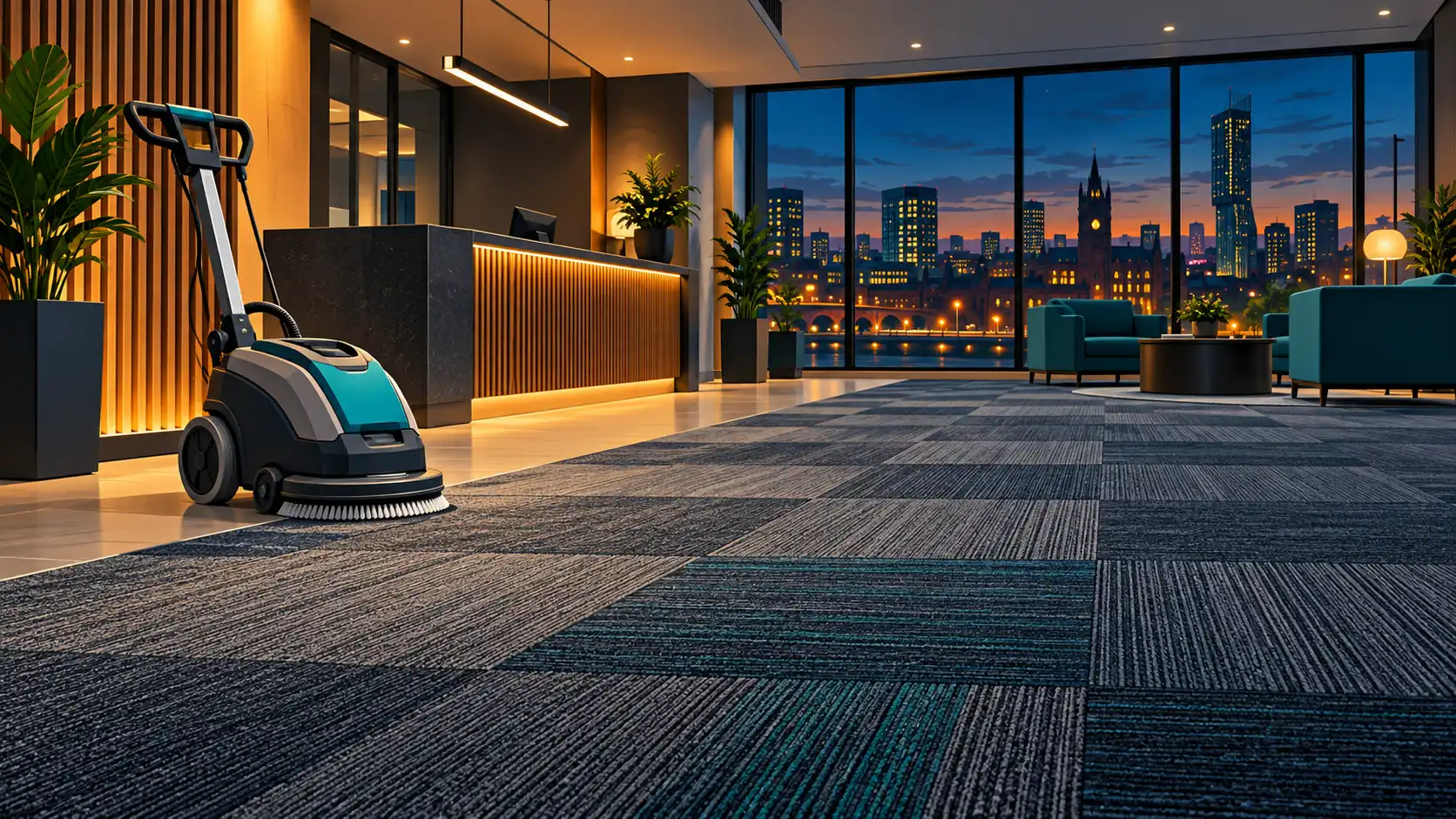
Office Carpet Cleaning Guide for Manchester
28 October 2026
Would rather leave it to a professional? See our end of tenancy carpet cleaning or check carpet cleaning prices in Manchester.
Quick answer: Commercial office carpet cleaning in Manchester can be arranged overnight or at weekends to reduce disruption. Low-moisture encapsulation often suits planned maintenance because treated areas may return to use sooner than after restorative extraction. The right method, drying window and cleaning frequency depend on the carpet, soil, footfall, ventilation and building access.
Do | Don't |
|---|---|
Arrange a site survey and map high-traffic zones | Accept one method for every carpet and stain |
Agree access, security and drying windows in writing | Assume “low moisture” means instantly dry |
Ask for RAMS, product information and service records | Judge a contract only by its headline price |
Plan cleaning around entrances, tea points and desk routes | Wait until every traffic lane is visibly grey |
Office carpet does not soil evenly. Grit collects inside entrances, coffee marks appear around tea points, chair movement affects desk areas, and lift lobbies carry far more traffic than quiet meeting rooms. Treating the whole floor as one identical area wastes time and may leave the busiest zones under-maintained.
A better plan divides the workplace into cleaning zones, selects a suitable method for each one and sets a realistic return-to-use time. That is particularly important in Manchester city-centre offices where loading access, concierge approval, lift bookings and security can be as important as the cleaning itself.
What is commercial office carpet cleaning?
Commercial carpet cleaning is the planned removal of dry soil, spots, residues and embedded contamination from workplace carpet. It may include routine low-moisture maintenance, targeted stain work and periodic restorative extraction. A professional service should match the method to the carpet manufacturer’s guidance, fibre, construction, backing and condition.
Office carpet cleaning in Manchester can cover traditional broadloom carpet, carpet tiles, entrance matting and textile flooring in reception areas, meeting rooms, corridors and open-plan workspaces. It is different from ordinary evening vacuuming. Vacuuming is essential, but it cannot remove every oily film, drink residue or compacted traffic-lane soil.
Why choose overnight or weekend carpet cleaning?
Out-of-hours work gives the cleaning team clearer access and gives treated carpet time to dry before employees return. It can also reduce noise, trailing-hose conflicts and movement around wet areas. The best time depends on the building rather than a standard rule.
Service window | Often suits | Points to arrange |
|---|---|---|
Weekday evening | Smaller offices and selected zones | Closing time, alarm setting, ventilation and morning handover |
Overnight | Larger floors with an early opening time | Security cover, lone working, lift access and key control |
Saturday | Restorative cleaning or several departments | Building access, parking, heating and contractor supervision |
Full weekend | Phased deep cleaning and longer drying windows | Sequence of areas, locked rooms and final inspection |
Occupied-hours zoning | 24-hour sites and buildings that never fully close | Barriers, alternative routes and small controlled sections |
“Overnight” should describe an agreed working window, not a promise that every carpet will be ready at a fixed hour. Ask the contractor to record the expected completion and return-to-use times after inspecting the site.
How does low-moisture carpet cleaning work?
Low-moisture cleaning uses less liquid than a full hot-water extraction process. A common office method is encapsulation. After dry-soil removal, a compatible solution is applied in a controlled amount and worked through the pile with suitable agitation. As it dries, the formulation surrounds loosened soil so residue can be removed during subsequent vacuuming.
This method can work well for routine appearance maintenance on compatible commercial carpet tiles and low-profile carpet. It usually needs less drying time, creates fewer hose-management problems and can be carried out in phases. It is not a shortcut for every condition.
Heavy oily soil, flooding, widespread drink residue, deeply contaminated backing or certain odour sources may need extraction or specialist treatment. A cleaner should explain why a method is being recommended rather than selling “low moisture” as the answer to every problem.
Request a Manchester Commercial Site Survey
Low moisture or hot-water extraction: which does your office need?
Method | Best considered for | Important limitation |
|---|---|---|
Encapsulation | Routine maintenance, traffic lanes and compatible low-profile commercial carpet | Does not replace restorative extraction in every building |
Hot-water extraction | Deep soil removal, residues and periodic restorative cleaning | Uses more moisture and needs a suitable drying window |
Dry compound | Moisture-sensitive settings and short access windows | May not address deep or greasy contamination |
Absorbent pad cleaning | Fast interim appearance work on a compatible surface | Can leave deeper soil untouched if used as the only method |
Targeted spot treatment | Coffee, tracked dirt and individual marks | Wrong chemistry can set a stain or affect colour |
Many offices benefit from a combined programme. High-traffic areas receive more frequent low-moisture maintenance, isolated spills receive prompt spot treatment, and restorative extraction is scheduled when inspection shows it is needed. This avoids repeatedly wet-cleaning low-use rooms while neglected entrances continue to deteriorate.
How quickly can office carpet return to use?
Low-moisture carpet may be ready sooner than heavily extracted carpet, but no responsible contractor should promise one drying time without seeing the site. Fibre, pile density, backing, application rate, indoor humidity, air movement, heating, existing residue and outdoor weather can all change the result.
Before work begins, agree how dryness will be assessed and who can reopen each zone. Carpet that feels dry at the pile tip may still hold moisture lower down. Furniture, cable covers and chair mats should not be replaced until the contractor confirms that it is appropriate.
A practical traffic-map plan for Manchester offices
A traffic map is a simple floor plan that grades carpet by use and risk. It produces a more useful contract than applying the same frequency to every square metre.
Zone | Typical soil | Planning priority |
|---|---|---|
Entrance and reception | Grit, rainwater, salt, street soil and oily particles | Frequent vacuuming, mat care and shorter inspection intervals |
Lift lobby and main corridor | Compacted traffic lanes and wheeled-soil transfer | Planned interim cleaning before lanes become obvious |
Tea point and breakout area | Coffee, tea, milk, food oils and sugar residue | Fast spill response and targeted treatment |
Open-plan desk area | Dust, tracked soil and chair-zone wear | Phased access, cable checks and movable-chair planning |
Meeting and board rooms | Lower general traffic with occasional drink marks | Condition-led cleaning around booking schedules |
Printer and storage areas | Toner, paper dust and narrow access routes | Equipment protection and controlled product use |
For wet Manchester days, entrance matting and frequent dry-soil removal matter as much as periodic wet cleaning. Fine grit cuts and dulls fibre under foot. Removing it early helps preserve appearance and may extend the usable life of the floor covering.
Need your office carpets cleaned?
Book commercial carpet cleaning
What should be included in a commercial carpet cleaning quotation?
A useful quotation should define the job clearly enough for a facilities manager to compare providers. “Clean office carpet” is not a complete scope.
Site address, floor level and measured or agreed carpeted area
Carpet type, condition and any manufacturer restrictions
Areas included, excluded and treated at a different frequency
Proposed cleaning method for each zone
Known stains, odours and contamination requiring separate assessment
Furniture movement and the party responsible for it
Working hours, access contact, alarm procedure and key control
Parking, loading bay, lift and water or power arrangements
Expected drying or return-to-use window, with stated conditions
Service records, photographs and completion sign-off
For a more accurate quote, send a floor plan, approximate square metres, current photographs and a list of problem areas. Mention carpet tiles, raised access floors, floor boxes, loose cables, fixed desks and restricted rooms. The InstantDry services page provides an overview of related cleaning options, while the carpet cleaning service page explains the core cleaning process.
How much does commercial carpet cleaning in Manchester cost?
Commercial pricing varies, so a fixed figure without a defined scope can be misleading. The area is only one factor. Carpet construction, soil level, stain work, furniture density, access, parking, out-of-hours staffing, required equipment and contract frequency all affect the quotation.
Compare like with like. One quote may cover basic maintenance in open areas, while another includes edge work, spot treatment, furniture movement, completion records and a weekend access team. Ask whether VAT, parking, minimum attendance and repeat visits are included.
Contract work may be priced per visit, by measured area or as an agreed maintenance programme. Whichever model is used, the scope should state what changes the price and how additional work is authorised. There should be no surprise treatment added without approval.
What should contract carpet cleaners in Manchester provide?
Contract carpet cleaners in Manchester should offer more than a recurring diary date. Facilities teams need a service that is measurable, safe and easy to audit.
A named contact and clear escalation route
Site-specific risk assessment and method statement where required
COSHH information or safety data for products used
Evidence of suitable insurance and technician competence
An asset or area schedule showing service frequency
Attendance, completion and exception records
A process for urgent spills and stain callouts
Written limits for permanent stains, wear and damage
Review meetings for scope, results and changing occupancy
Useful service measures can include attendance within the agreed window, completion of every scheduled zone, reporting of inaccessible areas, documented spot-treatment outcomes and delivery of the service report. Avoid targets based only on “looks clean”, because lighting, pile direction and permanent wear can change appearance.
How often should an office carpet be professionally cleaned?
There is no single calendar interval for every workplace. Frequency should follow inspection, manufacturer guidance, footfall, soil exposure and business needs. A quiet first-floor meeting room may not need the same schedule as a ground-floor reception beside a rainy entrance.
Condition | Suggested management approach | Trigger for action |
|---|---|---|
Very high traffic | Frequent inspection, strong vacuuming plan and planned interim cleaning | Soil building before a visible dark lane forms |
Food and drink zone | Immediate spill response plus scheduled maintenance | Sticky residue, recurring spots or odour |
Normal desk area | Routine vacuuming and condition-led professional cleaning | Dull pile, visible soil or accumulated spots |
Low-use room | Inspect and clean when condition justifies it | Dust, local stains or a planned whole-floor visit |
Restorative need | Survey for extraction or specialist work | Embedded soil, residue or failed interim maintenance |
Cleaning too late allows abrasive grit and stains to become harder to manage. Cleaning too often with an unsuitable method can create residue or unnecessary moisture. Review the programme after occupancy changes, office refits, seasonal weather and changes to entrance matting.
How should an office prepare for out-of-hours cleaning?
Confirm the exact zones. Mark restricted rooms, emergency routes and areas that must reopen first.
Clear small items. Remove paperwork, bags, bins and loose objects from the floor.
Manage cables. Secure loose leads and tell the contractor about floor boxes and raised access flooring.
Agree furniture movement. Decide which chairs, pedestal units and light tables may be moved.
Share building procedures. Provide loading, lift, alarm, security and lone-working instructions.
Plan ventilation. Confirm whether heating, air handling or secure window ventilation will operate.
Nominate sign-off contacts. Give both the cleaning team and morning facilities staff a responsible contact.
Photograph sensitive equipment and existing carpet damage before the visit. If a department cannot clear its floor, move it to a later phase instead of asking technicians to work around confidential papers or unstable cable arrangements.
Commercial carpet-cleaning safety guide
Every job should protect employees, visitors, cleaners and the building. The Health and Safety Executive guidance on cleaning and slip risks advises planning cleaning so wet areas are controlled and people are kept away until the floor is dry.
Use barriers or signs at every approach, not only beside the machine. Keep hoses and electrical leads out of emergency routes, protect sockets from moisture and maintain safe access to fire exits. Products should never be mixed, decanted into unlabelled containers or used outside their instructions. Ventilation, protective equipment and spill arrangements should follow the product and site assessment.
For 24-hour offices, clean small sections and provide an alternative route. A warning sign is not enough if people must still walk across a damp carpet or step over hoses.
What can cleaning improve, and what may remain?
Issue | Possible cleaning result | Likely limitation |
|---|---|---|
Tracked soil | Often strong improvement after suitable pre-treatment and cleaning | Permanent fibre wear may still look dull |
Coffee and tea | Fresh marks often respond well to correct treatment | Old dye or previous chemical damage may remain |
Chair-zone darkening | Soil and oily residue may be reduced | Crushed pile or abrasion cannot be cleaned away |
Odour | Improves when the source can be identified and reached | Contamination beneath tiles or in the subfloor needs separate work |
Bleach or colour loss | Surrounding soil can be removed | Missing colour needs repair or replacement, not cleaning |
Loose or damaged tile | Adjacent carpet can be cleaned carefully | Adhesive or tile failure needs flooring repair |
A pre-clean inspection should record these limits. If the carpet has burns, pulled seams, ripples, failing adhesive or widespread colour loss, ask for repair advice before authorising repeated stain treatment.
Manchester office types and access considerations
Commercial office carpet cleaning in Manchester can involve very different properties. A staffed city-centre tower may require loading-bay reservations, concierge approval and booked service lifts. A converted mill office may have older floors, limited access and sensitive original finishes. A business park may offer easier parking but lock gates at a fixed time.
Buildings around the city centre, Spinningfields, Deansgate, Ancoats, Salford Quays and Trafford Park should each be surveyed on their actual access conditions. Location alone does not determine the method or price. The Manchester carpet cleaning page gives further information about local service coverage.
Questions to ask before appointing a contractor
Which method are you proposing for each carpet type, and why?
What should be dry before staff return, and how will you confirm it?
What preparation must our team complete?
Which spots or damaged areas may not improve?
Will you provide RAMS, product information and insurance evidence?
How will you protect floor boxes, cables, furniture and adjacent hard floors?
What happens if security delays access or a room is unavailable?
What service record and photographs will we receive?
How are additional treatments approved and charged?
Can the maintenance frequency be changed after a condition review?
These questions make commercial quotes easier to compare and reduce uncertainty on the service night. For general preparation and fibre-care principles, see the guide to cleaning a carpet.
Frequently asked questions
Can office carpet cleaning be completed overnight?
Often, yes, but the contractor must first assess the area, method, access window and drying conditions. A phased low-moisture clean may suit a normal overnight closure. Heavy restorative work may need a longer weekend window.
Is low-moisture cleaning suitable for carpet tiles?
It is often useful for compatible commercial carpet tiles, especially for routine appearance maintenance. The technician should still check the tile, backing, adhesive condition, manufacturer guidance and existing contamination before selecting it.
Does low-moisture carpet cleaning remove every stain?
No. Results depend on the substance, fibre, age, previous treatments and whether colour or fibre has been permanently damaged. A stain may improve without disappearing completely.
Can staff walk on the carpet straight after cleaning?
Only when the contractor has confirmed that the zone is ready. Low moisture does not mean no moisture. Early traffic can transfer soil, flatten damp pile or create a slip risk at transitions.
Do contract carpet cleaners work at weekends?
Many commercial services offer weekend scheduling, subject to availability and building access. Confirm security, parking, lifts, heating, ventilation, keys and the authorised site contact before the booking.
Can commercial cleaning remove office coffee stains?
Many fresh coffee marks respond well to prompt, correct treatment. Milk, sugar, old residue, heat and previous products can make removal harder. Report the spill and anything already used on it.
Will desks and furniture be moved?
That depends on the agreed scope. Chairs and light items may be movable, while loaded cabinets, fixed desks, IT equipment and heavy furniture are normally left in place unless a separate safe plan is agreed.
What information is needed for a commercial carpet cleaning quote?
Provide the carpeted area or floor plan, photographs, carpet type if known, floor level, furniture density, stains, business hours, access rules, parking and the required return-to-use time. A site survey is best for complex offices.
How often should reception carpet be cleaned?
Use condition and traffic rather than a universal interval. Reception areas need frequent inspection, effective matting and strong vacuuming. Schedule professional maintenance before a visible traffic lane develops, following manufacturer guidance.
Can one contractor maintain several Manchester offices?
Yes, if the contract identifies every site, area, access rule, frequency, method, reporting requirement and escalation contact. Each location should still have its own survey and service record.
Get a Commercial Carpet Cleaning Quote
Written by: InstantDry Carpet Cleaning Editorial Team
Last updated: 28 October 2026
How often should office carpets be cleaned?
Vacuum daily or several times a week, with deep cleaning every 6 to 12 months. Busy entrances, kitchens and corridors may need cleaning every 3 months.
Can office carpets be cleaned outside working hours?
Yes. Most commercial carpet cleaning is booked early morning, evenings or weekends so the office is dry and usable for the next working day.
Which method is best for commercial carpet?
Low-moisture cleaning suits regular maintenance because it dries fast. Hot-water extraction is better for a periodic deep clean of heavily soiled carpet tiles and walkways.
Related guides: commercial carpet cleaning cost UK, how long carpet takes to dry, what is a good carpet stain remover. For a professional finish, see our commercial and end of tenancy cleaning service or carpet cleaning in Manchester.
Related guides
Need it cleaned properly?
Book our commercial & end of tenancy service — from £99 (UK average Free on-site survey), free in-home survey and pay on completion.