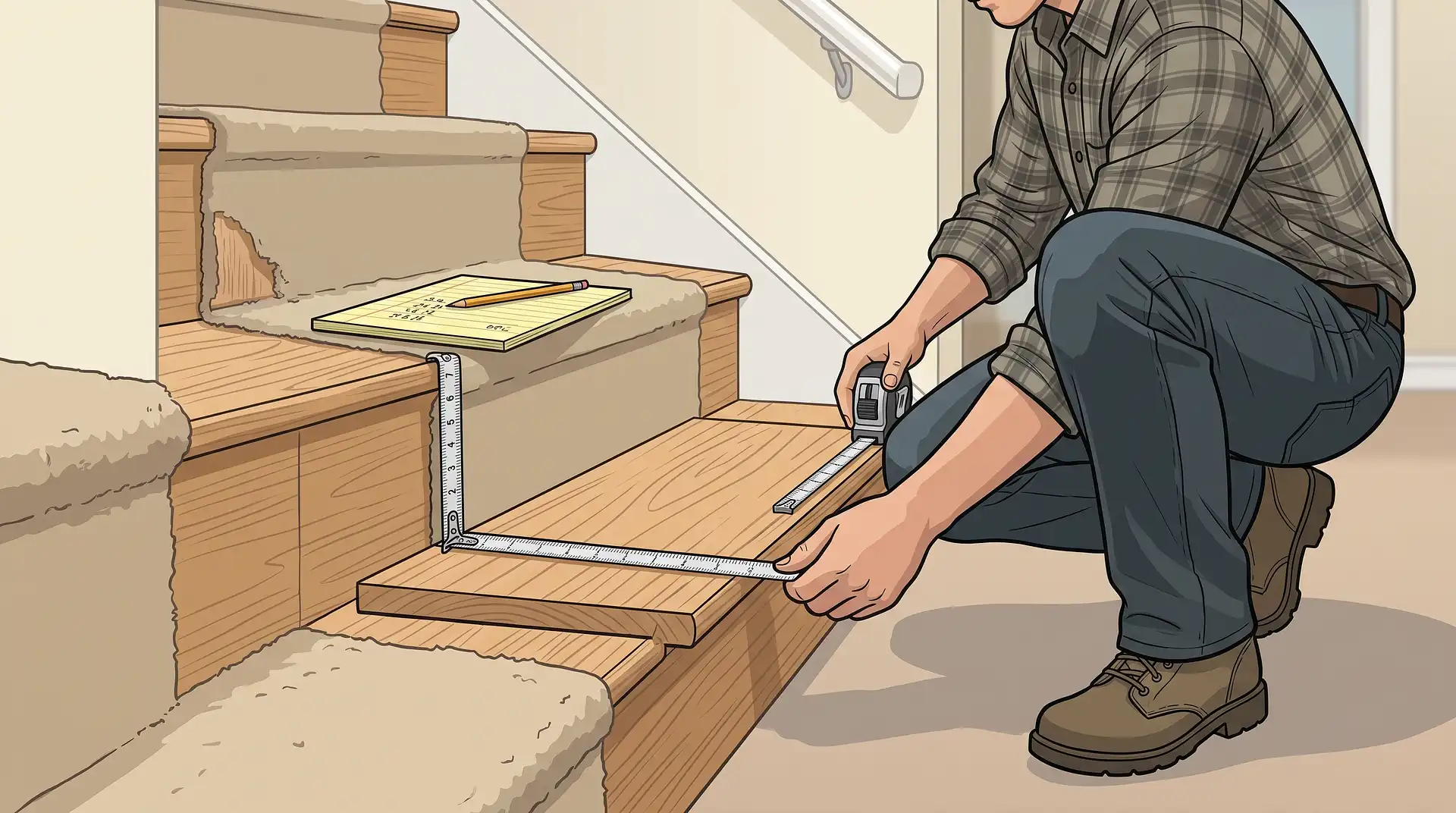
How to Measure Stairs for Carpet
23 August 2026
Quick answer: Measure the tread depth (front to back of the horizontal surface), the riser height (floor to floor vertically), and the width of each step. Add tread and riser together to get the carpet length per step, then multiply by the number of steps. Add at least 10% waste. Measure winder steps at their widest point, measure the landing separately, and always order with the pile running downward. Use the same dye lot for the whole job, since going back for more from a different batch risks a visible colour mismatch on a staircase.
Measuring stairs for carpet is one of those jobs that feels straightforward until you're standing at the bottom with a tape measure wondering why your number doesn't match what the fitter quoted. The reason is almost always the same: stairs use considerably more carpet than their footprint suggests, because the carpet wraps over the nosing and down the riser on every step rather than just lying flat.
Terms you need to know
Before measuring anything, being clear on the vocabulary prevents errors.
Term | What it means |
|---|---|
Tread | The horizontal surface of each step, where your foot lands |
Riser | The vertical face of each step, from the top of one tread to the underside of the next |
Nosing | The front edge of the tread, which overhangs the riser below. Some nosings are bullnosed (rounded), some are square |
Winder | A triangular or trapezoidal step used to change the direction of the staircase. Usually found at the bottom or at a turn |
Kite winder | A specifically shaped winder step, wider on one side, named for its kite-like shape |
Half landing | A flat platform where the staircase turns 180 degrees |
Quarter landing | A flat platform where the staircase turns 90 degrees |
Pile direction | The direction the carpet fibres lie. On stairs, pile should run downward |
Gripper rod | A narrow strip of spiked wood fixed to the stair, which holds the carpet in place |
What you need before you start
A steel tape measure, at least 5 metres
A pencil
A piece of paper for a rough sketch, with measurements noted as you go
A calculator
Draw a rough plan of the staircase before you start. It doesn't need to be accurate or to scale. What matters is having a reference that lets you note which measurement belongs to which area, since by the time you've measured a staircase with a landing, a turn and a hallway, the numbers become difficult to track without a drawing.
Count the steps first. Walk up and count every riser, including the top step that leads onto the landing. Write the number down.
Why stairs use more carpet than you expect
On a flat room, the carpet area equals the floor area. On stairs, it doesn't.
Each step needs carpet to cover the tread, wrap over the nosing and extend down the riser. So the carpet length for each step is the tread depth plus the riser height, not just the tread depth.
On a typical UK staircase with a tread depth of around 25cm and a riser height of around 18cm, each step needs roughly 43cm of carpet length. A staircase of 13 steps needs around 5.6 metres of carpet length before waste is added, even though the footprint of those stairs might only be around 3 metres from bottom to top.
This gap between footprint and carpet required is where most DIY measurement errors happen, and it's why a fitter's quote almost always comes to more material than an inexperienced estimate.
Step by step: measuring straight stairs
Step 1: Measure the tread depth
Place the tape measure at the back of the tread, where it meets the riser, and measure to the front edge of the nosing. This is the tread depth. On most UK stairs this is between 22cm and 28cm.
Step 2: Measure the riser height
Measure from the top of one tread down to the top of the tread below, which is the face of the riser. On most UK stairs this is between 17cm and 22cm.
Most staircases have consistent tread and riser dimensions throughout, but check a few steps rather than assuming. If they vary, use the largest dimensions.
Step 3: Add tread and riser together
This gives you the carpet length required per step.
Example: tread 25cm + riser 19cm = 44cm per step.
Step 4: Multiply by the number of steps
Example: 44cm x 13 steps = 572cm, or 5.72 metres.
Step 5: Measure the stair width
Measure from wall to wall, or from skirting to skirting, across the full width of the stair. Most UK staircases are between 80cm and 100cm wide.
For a carpet runner rather than full width, measure the runner width you want instead, typically between 60cm and 70cm, and note that you'll need to account for the exposed floor on either side.
Step 6: Note the roll width
Carpet is sold in rolls with standard widths, most commonly 4 metres and 5 metres in the UK. If your stair width is 90cm and the roll is 4 metres wide, you can cut multiple strips from one roll width and waste is manageable. If your stair is unusually wide or you have an unusual layout, discuss roll width with the retailer before ordering.
Measuring the landing
The landing is measured as a separate rectangular area. Measure the longest length and the widest width, and treat it like a small room.
Include the top step in the landing measurement. The carpet should flow from the landing over the nosing of the top step and down the riser, with no seam at the top. This means the landing measurement should include the top step's tread depth and riser height.
Measure from the back wall of the landing, across the landing floor, over the nosing of the top step and down the riser to where the stair carpet begins. This is your total landing length for this edge.
Also measure the hallway at the bottom of the stairs if it's being carpeted at the same time, as a separate rectangular area. Getting all three areas from the same dye lot is important.
Measuring winder and turn stairs
Winder steps are the most common source of measurement error, and they cannot be measured the same way as straight steps.
A winder step is wider on one side than the other. If you measure only the narrow side, you won't have enough carpet. Measure each winder at its widest point, from the outer wall to the inner corner of the step.
For a standard bottom winder where the stairs turn 90 degrees, you typically have two or three winder steps. Measure each one individually and record them separately on your plan.
Kite winders follow the same principle: measure at the widest point, and treat each one as a distinct step with its own dimensions.
Quarter and half landings are measured as rectangular areas, including the top step of each flight that leads off them.
If the staircase has multiple turns or complex winding steps, having a fitter take measurements rather than ordering yourself is genuinely worth considering. The cost of a professional measure-up is considerably less than the cost of ordering too little from the wrong dye lot.
Full width carpet versus a stair runner
Full width carpet covers the entire stair from wall to wall and is fitted with gripper rods and tacks. It gives a neat, complete look and is easier to keep clean since there are no exposed edges gathering debris.
A stair runner covers the central portion of the stair, leaving a border of exposed wood, tile or stone on either side. Runners are held in place with a combination of gripper rods, stair rods through decorative brackets, or carpet tape on hard floors.
For measuring a runner: measure the tread depth and riser height in the same way, but use the runner width rather than the stair width for your calculation. Add at least 5cm extra on each side for the runner to tuck neatly under the stair rod brackets.
Pile direction: why it matters and what goes wrong
All carpet has a pile direction, the way the fibres naturally lie. Hold your hand flat on the carpet and move it in both directions — one way will feel smooth, the other will ruffle the pile.
On stairs, the pile should run downward from top to bottom of the staircase. This is the convention in UK fitting and there are two practical reasons for it. The carpet wears more evenly when people walk down with the pile rather than constantly lifting it against the nap. And the carpet looks consistent in colour and texture from every angle, since pile that runs against foot traffic catches light differently and can look patchy.
When cutting strips from a roll, each strip must be cut with the pile running the same way. Getting this wrong produces a staircase where alternate steps look different colours in certain lighting. It's a common mistake when fitting is done by someone unfamiliar with the convention, and it's not fixable without re-laying.
Underlay on stairs
Underlay makes the carpet feel better underfoot, softens impact noise, extends the carpet's life by absorbing the stress of foot traffic, and provides a safer, more cushioned surface.
On stairs, underlay is fitted on the tread only, not on the riser, since riser underlay causes problems with fitting and looks poor at the nosing edge. Cut and fit underlay pieces to cover each tread, butted up to the back of the nosing.
When calculating how much underlay you need, use the tread depth only, not tread plus riser. So on a 13-step staircase with a 25cm tread, you need 13 x 25cm = 3.25 metres of underlay at the stair width.
Stair underlay is typically sold by the linear metre at a standard width, or cut from a sheet. Check which format your supplier uses before calculating.
Ordering: waste allowance and the dye lot risk
Add at least 10% to your total calculated carpet length before ordering. 15% is safer on a complex staircase with winders. This covers cutting waste, any fitting adjustments, and the possibility that a measurement is slightly off.
The dye lot is the most important ordering consideration. Carpet is manufactured in batches, and even the same colour from the same range can have a slight variation between different production runs. On a flat room, a small variation can be invisible, since it's covered in one piece. On a staircase, where carpet is laid in strips, a dye lot mismatch is visible as a step-by-step colour change in certain lighting.
Always order all the carpet for your staircase, landing and adjacent hallway from the same roll if possible, or from the same dye lot at minimum. If you need to order more later because the original order fell short, there is a real risk the replacement batch won't match.
This is why measuring generously and ordering with proper waste allowance is worth the extra cost upfront. A roll of leftover carpet is a much smaller problem than a mismatched staircase.
Why professional fitting pays for itself on stairs
Measuring and ordering is something most people can do themselves with patience and a good plan. The fitting itself is a different skill set.
Stair carpet fitting requires correctly tensioning the carpet over the gripper rods, neat folding at the nosings, invisible seaming at turns and landings, and straight, even cutting at both edges. Fitting done well lasts many years. Fitting done poorly looks poor immediately and wears badly.
If the staircase has winders, a landing with multiple edges, or a runner with decorative stair rods, professional fitting is consistently worth the cost. The fitting itself is also a safety consideration: a stair carpet that's not properly tensioned or that has lifted at a nosing is a trip hazard, and stair falls are among the most common causes of serious injury in UK homes.
7. FAQ Section
How do I calculate how much carpet I need for stairs? Measure the tread depth and riser height of one step, add them together, and multiply by the number of steps. Add at least 10% for waste. Measure the stair width separately. Measure the landing and hallway as separate rectangular areas.
What is the formula for measuring stair carpet? Carpet length per step equals tread depth plus riser height. Total carpet length equals that figure multiplied by the number of steps, plus waste allowance. Total carpet area equals total length multiplied by stair width.
What is a typical tread and riser measurement for UK stairs? On most UK staircases, tread depth is between 22cm and 28cm and riser height is between 17cm and 22cm. Check a few of your own steps rather than assuming they match typical dimensions.
How do I measure winder stairs for carpet? Measure each winder step individually at its widest point, from the outer wall to the inner corner. Never use the narrow dimension of a winder step, since it won't give enough carpet coverage. Record each winder's dimensions separately on your plan.
Should the carpet pile run up or down the stairs? Downward. The pile should run from the top of the staircase toward the bottom. This produces even wear and a consistent colour appearance from all angles.
Do I need underlay on stairs? Yes, on the tread only. Underlay on the riser causes fitting problems. Cut underlay pieces to cover each tread and fit them up to the nosing edge. Calculate underlay using tread depth only, not tread plus riser.
How much extra carpet should I order for waste? At least 10% on a straight staircase. 15% on a staircase with winders, a landing or a turn. Order all the carpet from the same dye lot to avoid a colour mismatch between strips.
What is a dye lot and why does it matter for stair carpet? A dye lot is the specific production batch the carpet was made in. Carpet from different dye lots can have a slight colour variation even in the same range. On a staircase where carpet is laid in strips, a dye lot mismatch shows as a step-by-step colour change in certain lighting. Always order the whole job from the same dye lot.
What is the difference between a stair runner and full width stair carpet? Full width carpet covers the whole stair from wall to wall. A runner covers the central portion and leaves a border of exposed floor on either side. Runners are typically held in place with stair rods through decorative brackets. Measure a runner at its chosen width rather than the full stair width.
Should I fit stair carpet myself or use a professional? Measuring is manageable DIY. Fitting is a skilled job, particularly on stairs with winders, landings or decorative stair rods. Poorly fitted stair carpet is a trip hazard as well as an aesthetic problem, and professional fitting on stairs pays for itself in longevity and safety.
InstantDry carries out hot water extraction cleaning for carpets, rugs, upholstery and mattresses across England and Wales. Every visit starts with a free survey and a fixed price before any work begins.
Single rooms from £49. Whole home, including stairs and landing, from £179.
Get your fixed quote in 60 seconds
Or call 07555 856988.